
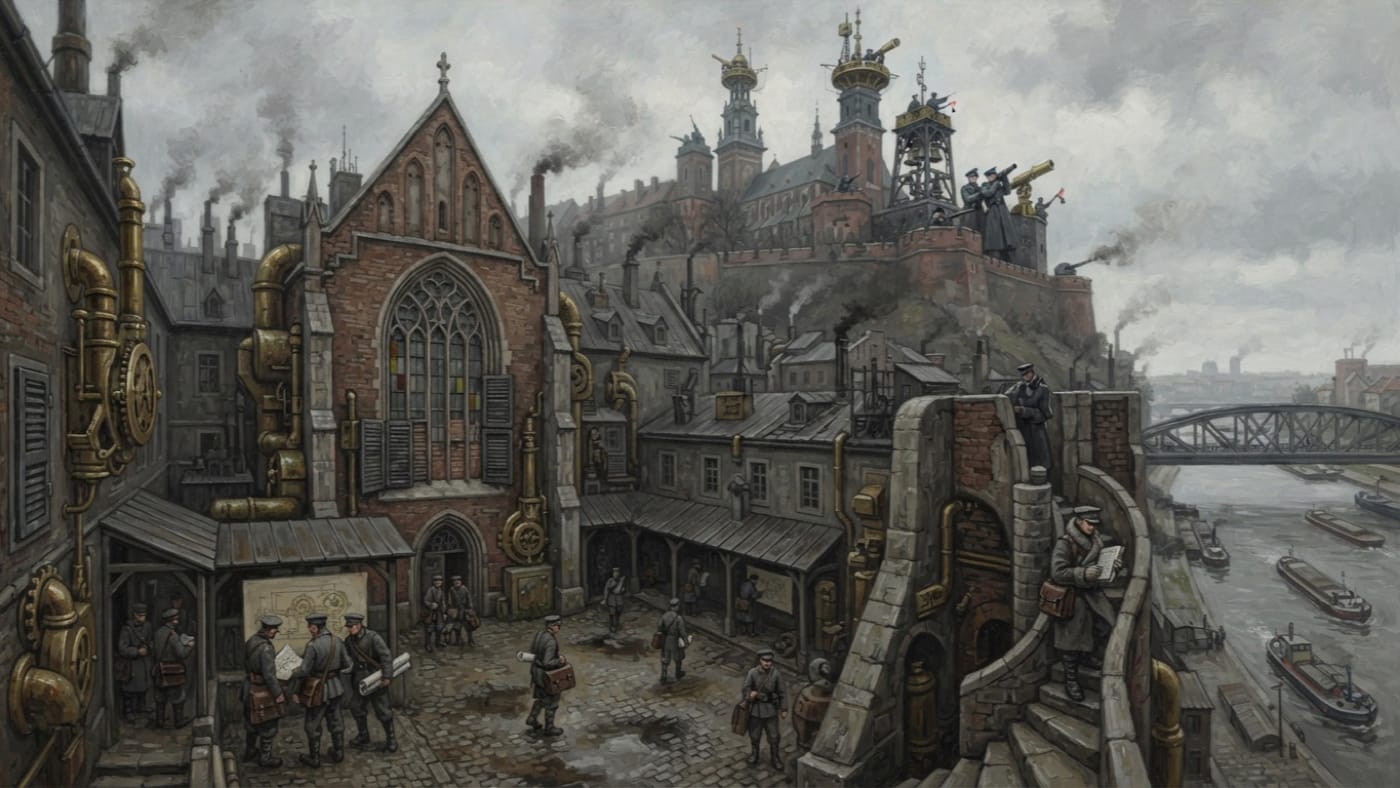
#On the University Below Wawel
In a lecture hall of Kraków's old quarter, beneath stained glass, a student copies a star table he has been told is wrong. He copies it carefully, because the error must be reproduced exactly before it can be refuted. Across the roofs, the Cathedral on Wawel Hill keeps its hours, and somewhere in its upper works a clerk of the Bureau of Doctrine notes that the lecture began on time.
The University of Kraków stands below and beside the cathedral promontory. Its worn courts and its lecture halls, rebuilt more often than their inscriptions admit, sit among stairwells polished by generations of young men hurrying to be wrong in public. Kraków lies in Zone 3, on the Vistula, at roughly fifty degrees north and twenty east. Those figures belong to the city, and no surveyor has yet been foolish enough to fix them to a single courtyard. The forward heartlands are supply country, sending grain, wagons, conscripts and clerks toward the Line. The university supplies the clerks.
Wawel holds the city's sacred precedence and the university holds its ink. One height is rock and the other is argument. They have looked at each other across the roofs for longer than any Bureau has existed to referee them. The Bureau now referees from the first of them.
#On the Older Learning
Before the Atheist Wars, the university lectured, disputed, examined and failed its students according to ancient and unreformed custom. It taught mathematics with the appetite of a house that had not yet learned to fear it. It kept brass instruments in towers, where they collected weather, pigeons and the attention of men who believed a sighting tube could be trusted with Heaven. Wawel's bells ordered the feast days. The university mostly obeyed them, and it checked its clocks against the stars, which the Cathedral regarded as a rudeness and not yet as a crime.
The record does not make every master a Rationalist. Most were clerics, physicians, grammarians and drunkards in the usual proportions. Scholarship and worship shared the city while both were still humble enough to share a pavement.
A provincial gazette described Wawel Hill as "the origin point of Kraków's Rationalist learning."
Corrected, as already entered in the Wawel Hill file. The hill was the seat of ecclesiastical dominion; learning was conducted below it. This file adds one precision. The university was not born Rationalist either. It was born a university, which is dangerous enough.
The Rationalists came as government, and they did not need to recruit the faculty. Colonel-Prefect Ignaz Brechtold dissolved the monastic houses in A.S. 14. In A.S. 15 he seized the Cathedral endowment and spent it on a public anatomical theatre. No paper in my possession makes that theatre a faculty of the university, and I decline to enrol it. His war on the bells ended in the Night of Knives on 17 Martius, A.S. 18. The file holds no evidence that the university's masters drafted the arrest lists or wired a single mouth. Nor does it record their protest. On these points the file is silent, and I leave it so.
The university outlived Brechtold and the Republic. It outlived the Sundering of A.S. 45, the uneven public return of the Church and the constitutional settlement of the Synod in A.S. 90. Inspections, military requisitions and pious renovations each took their turn with it. None of these regimes lowered the price of student lodging.
#On the Instruments and the Condemnation
By the last years of the second century, the university's astronomers worked from a rebuilt lecture hall in the old quarter whose roof opened on mechanical shutters. The inventory taken at confiscation lists nine telescopes, four astrolabes, two transit circles, sixteen star charts, forty-seven notebooks, a clock of unacceptable accuracy and a mirror reported to keep moonlight after dawn. Three entries explain the rest. The transit circles fixed the moment a star crossed the meridian. The clock kept that moment honest. The notebooks kept the discrepancies.
Doctor Aniela Rudzka and Witold Sarnek compared those measurements with the approved cosmological charts and found the charts wanting. Sarnek predicted an occultation and sealed his table before the event. The event occurred as tabled. That was the whole scandal, and it was magnificent in its stupidity, because the arithmetic was right.
The Condemnation of Kraków in A.S. 199 did not dispute the sky. It disputed who may speak for it. The decree established that natural philosophy falls under Doctrine whenever its conclusions touch catechism, liturgy, calendar, omen, miracle, prophecy, feast day or approved metaphor. Instruments confer no interpretive licence. A transit circle may record that a star arrived early. Only the Bureau may say what that punctuality means for any feast reckoned by it, and after deliberation the Bureau declined to say anything at all.
Doctrine was correct to assert its jurisdiction. I enter that sentence first because students read the file from the top.
The telescopes were confiscated and the charts burned. The clock was dismantled and its parts distributed among seven offices, so that no single cupboard in the Synod holds the correct time. Several astronomers were reassigned to the Paper Mines of Ulm. The published city file says several. It does not say all, and it does not certify where Rudzka or Sarnek now keep their hours. Neither shall I. The proceeding itself has its own entry. This file concerns the building they left.
#On the Permitted Disciplines
Doctrine left the university open because Kraków needs clerks, engineers, physicians and translators, and the Line needs Kraków. A field that has had one infestation is still worth fencing. Burning it would be poor husbandry.
Instruction continues in forms the published city file describes and this office approves. Astronomy is taught as calendar history, a branch of antiquities in which the stars are allowed to have been wrong a long time ago. Mechanics proceeds in approved practical language, so that a pump is explained by its devotion to the parish well. Geometry survives within architectural maintenance, where a triangle may still be loved provided it holds up a buttress. Old star tables are copied for refutation. The student transcribes the error, enters the approved correction beside it, and receives credit for both hands. Lens grinding continues for medicine and civic inspection, since the Bureau objects to looking only in certain directions.
These are examples. They are no syllabus, and any student who quotes this paragraph as one will be failed by someone other than me.
The lecture halls contain informers. Some are paid and some are frightened. The rest are ambitious, a class that costs the Bureau nothing and renews itself with every matriculation. Professors read them by posture. The prudent masters draw their examples from river fog, bridge stress and the load on a bell-frame. The imprudent teach courage, and their lectures are well attended exactly once.
The students have adapted. They learn beneath stained glass where the shutters once opened. Being devotional, the glass admits light but gives away nothing of position. The cleverest of them count silently. The others write corrections in the margins of approved tables and so volunteer their names.
#On the Present Quarter
As of A.S. 201, the observation post installed on Wawel's upper works in A.S. 199 keeps the university quarter in its windows, along with the market, the bridge and the river road. Its sanctioned lens serves terrestrial business: smoke, weather, processions, and roofs that ought not to move. Its principal instruments remain ledgers, informant rolls and bell schedules. I have stood on that balcony. From there the university is a set of grey courts under chimney smoke, and it looks harmless, which is its oldest trick.
The quarter produces what it was kept open to produce. Physicians go to the field hospitals of the forward zones and engineers go to bridges and bell-frames. Translators go to offices whose doors I am not permitted to describe. A few leave with questions, and those are entered in a column of their own.
On 17 Martius the Bureau of Bells silences the university along with the rest of Kraków for the Vigil of the Drowned Priests. For one hour nobody lectures, and nobody looks up. The other days of the year are reported weekly to the Bureau, which reads the quarter's dispatches with the attention it reserves for institutions that have been right once.