
#On the City That Learned Silence Twice
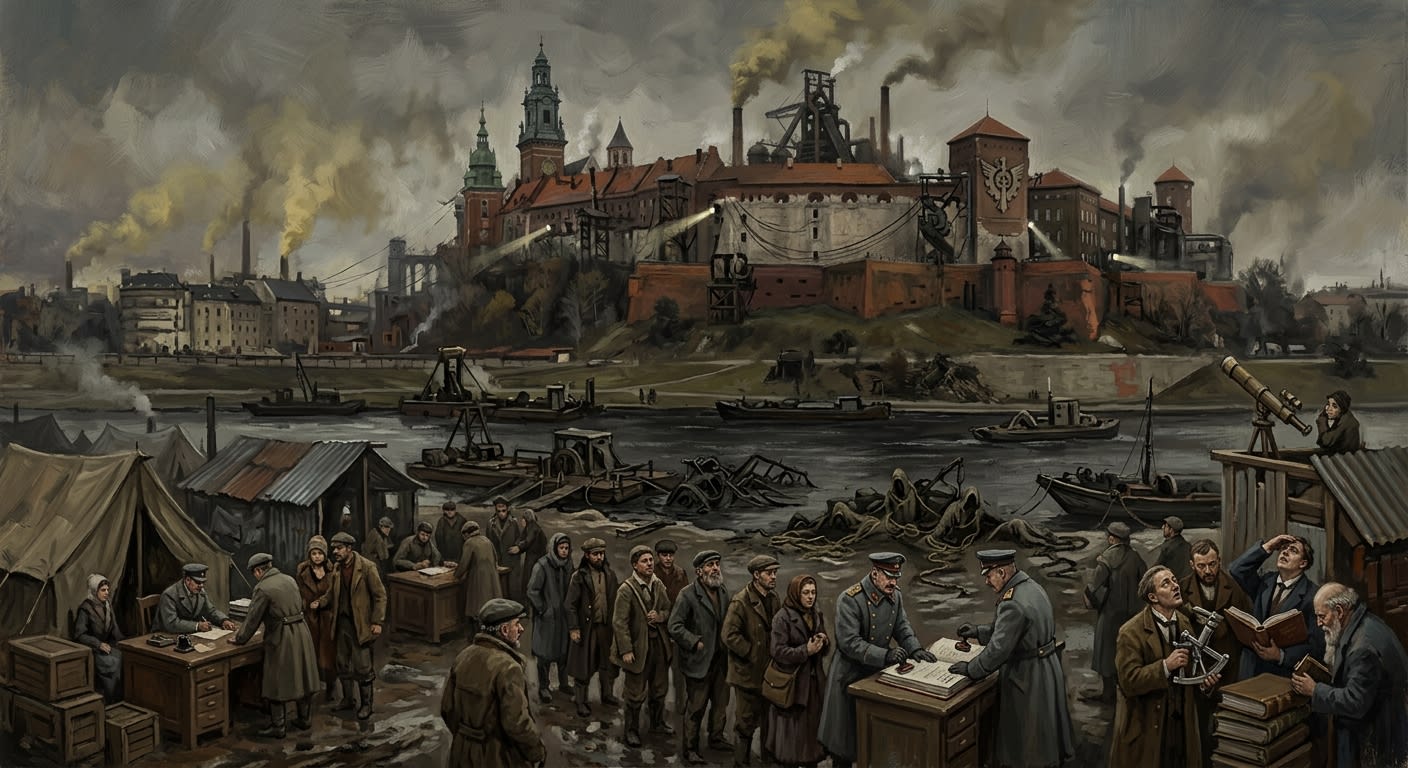
Kraków sits in Zone 3 on the Vistula, west of the worst mouths of Hell and east of any comfort worth trusting. The maps call it a major city. The pilgrim offices call it a Martius station. The Bureau of Doctrine calls it a useful wound. I call it a city with too many roofs trained upward and too many memories trained downward, which is the arrangement most likely to produce sermons, prosecutions, and unpleasantly accurate astronomers. A magnificent nuisance, naturally, and administratively mine.
Its coordinates are tame enough for surveyors: fifty degrees north, nineteen degrees east, a bend of river, a hill, a market, bridges, university courts, restored spires, garrison depots, pilgrim hostels, and a civic population that has survived so many official interpretations of its own history that it now answers questions with the stillness of a man expecting the second blow. Strasbourg likes cities that can be made exemplary. Kraków is exemplary to the point of injury.
Before the Atheist Wars, Kraków enjoyed the old privileges of piety, scholarship, trade, and local vanity. Its churches kept the hours. Its university measured the heavens. Its merchants measured everybody else. Wawel Hill held the cathedral above the river with the calm of stone accustomed to obedience. Below it, students argued in lecture rooms, priests argued in sacristies, guild men argued over weights, and widows argued with the Creator in language too exact for theologians to improve. It was, in short, a city.
The Rationalists found this intolerable. They always did. Their genius lay in encountering any living arrangement and asking how it might be corrected by decree, committee, blade, or anatomical theatre. In Kraków they received the opportunity for all four.
Kraków is not a front-line bastion. This is sometimes mistaken for safety by persons whose education has been conducted indoors. Zone 3 is staging ground, road-junction, supply artery, administrative shoulder, and moral reservoir. The Line eats from such places. The Bureaus recruit from them. Pilgrims pass through them. Heresies hide in their schools because schools contain desks, and desks attract clever boys, and clever boys eventually invent an instrument.
The city’s importance has never rested on walls alone. Kraków’s power is vertical: hill above river, cathedral above market, observatory above lecture hall, Doctrine post above observatory, and above all of them the Ledger, which improves every view by deciding what may be seen.
Its streets keep older names under newer paint. A rationalist plaque may be hammered off, but the nail holes remain; a parish door may receive a Bureau schedule, but old women still call the side entrance by the name of a priest dead before their grandmothers were born. The market guilds pretend indifference to theology until theology touches weights, bridge dues, feast closures, student rents, or candle supply. After that, they become theologians of astonishing speed. Commerce is faith with better shoes.
#On Wawel and the Old Heights
Wawel is the city’s crown, conscience, and excellent inconvenience. It rises over the Vistula as if the river had once tried to escape and the hill had been placed there to supervise its conduct. The Cathedral on the Hill held Kraków’s sacred precedence long before the Synod learned to make precedence into a form, duplicate the form, stamp the duplicate, and charge the parish for both.
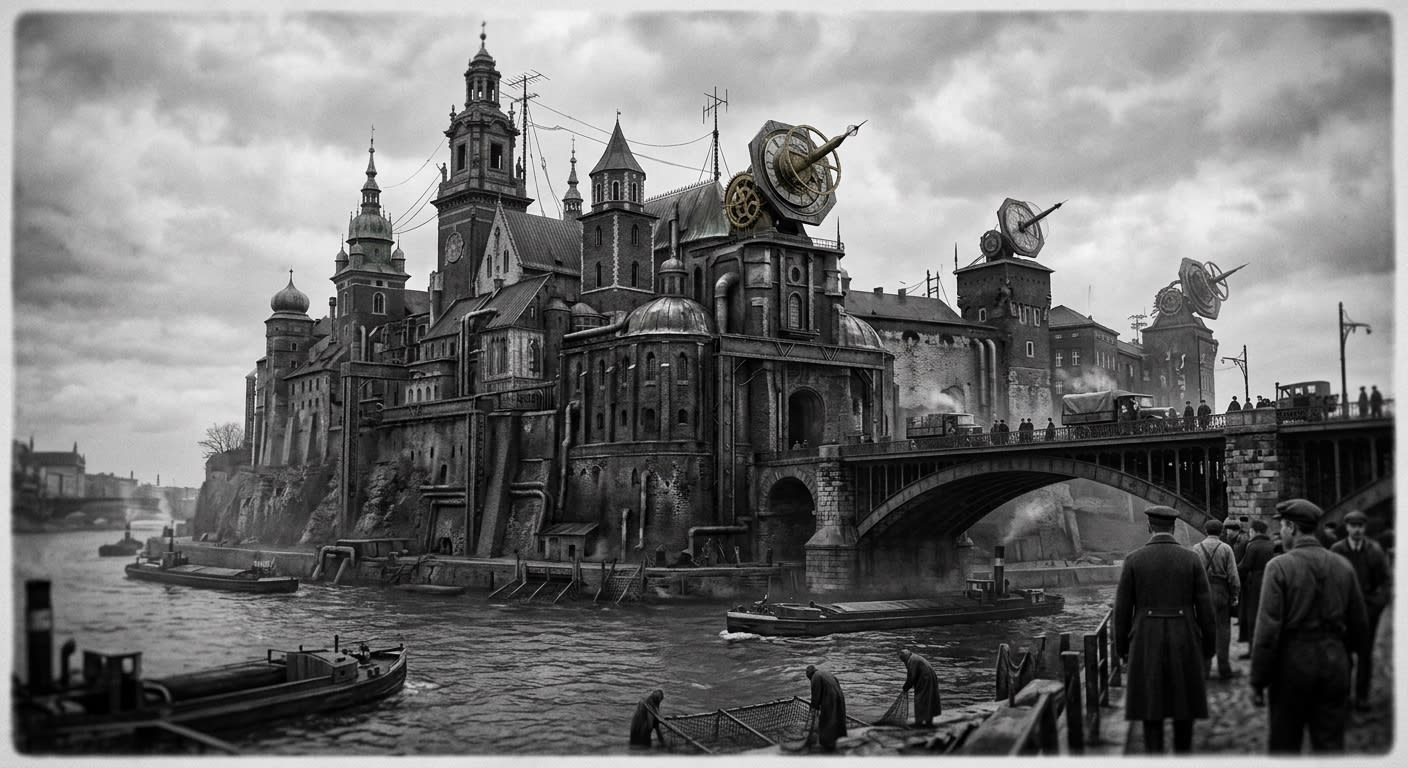
Before the wars, Wawel’s bells ordered feast days, burials, weddings, fasts, and that broad civic category known as behaving oneself. Dynastic graves slept in the chapels. Processions descended toward the market square with banners, relics, and the slow certainty of institutions that had not yet met modern philosophy at close range. The university below did not oppose Wawel at first. It looked upward from another angle. Scholarship and worship can share a city while both remain humble. Humility, alas, suffers poor retention among men with instruments.
The university gave Kraków its second height: intellectual, prickly, polished, eager to offend in the name of accuracy. Its astronomers kept lenses, tables, shutters, clocks, and the charming delusion that sight produces authority. In ordinary times this might have remained a local nuisance. The Atheist Wars converted every nuisance into a doctrine with armed followers.
Colonel-Prefect Ignaz Brechtold understood Wawel’s symbolic power as soon as he entered office. He was Rationalist Prefect from A.S. 14 to A.S. 18, a short reign measured in years and a long reign measured in wire. In A.S. 14 he dissolved monastic houses. In A.S. 15 he seized the Cathedral endowment and redirected it to a public anatomical theatre. He banned daytime bells, then confiscated clappers when the faithful answered at three in the morning. A tyrant who fears bells has already written half his confession.
Certain secular summaries name the Wawel endowment seizure a “redistribution of dormant ecclesiastical assets.”
Corrected. Dormant assets do not ring, feed, teach, bury, shelter, or keep old women from freezing beside a chapel stove. Brechtold stole the Cathedral’s purse and called the wound educational.
Wawel did not answer with armies. It answered with persistence: cellar Masses, attic liturgies, butcher-shop incense disguised by blood smell, old priests saying words over bread while young informers listened at cracks. The hill remained above the river. The Prefect mistook silence for surrender because Rationalists were always confusing interruption with victory.
#On the Night of Knives
The Night of Knives on 17 Martius, A.S. 18 is the city’s black hinge. Every account of Kraków before it sounds unripe. Every account after it hears water.
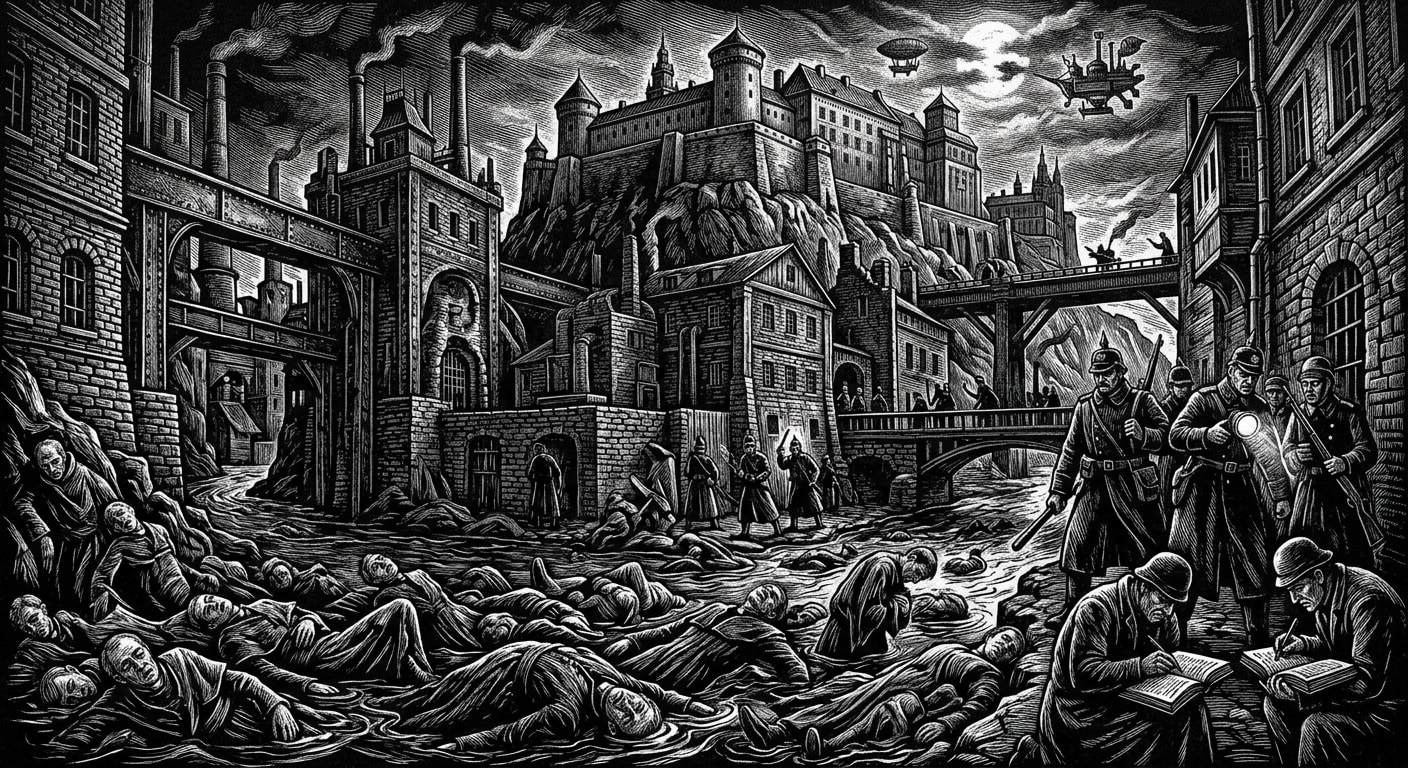
Between the second and third hours after midnight, Brechtold deployed sixty-three Kraków Secular Guard and fourteen Rationalist Philosophical Police against eleven targets. The targets were priests, friars, brothers, and the stubborn remnant of religious life the Prefect had failed to extinguish by decree. The arrest lists were good. This must be admitted because evil with poor paperwork gives the reader false comfort. Brechtold’s papers were exact: names, addresses, known associates, weak doors, parish ties, stair counts, and four-man details.
Each detail carried iron wire cut to arm’s length. The wire had been requisitioned from the municipal farrier three days earlier. Brechtold signed the requisition personally.
Forty-seven clergymen were seized. The youngest, Brother Paweł Nowak, was nineteen and four days ordained. The eldest, Father Janusz Sobecki, was seventy-one, parish priest of Saint Anne’s for thirty-eight years, unable to walk since the previous autumn. Reason, when it puts on boots, does not grow embarrassed by old legs.
They were dragged into the streets. Vestments tore. Crosses broke. Mouths were stitched shut with iron wire so that no prayer could escape. They were marched to the Dębnicki Bridge and cast into the Vistula while the river still carried ice.
SISTER AGATA WIŚNIEWSKA — TESTIMONY, SEALED APPENDIX “They pulled Father Janusz by the ankles when the road bent toward the bridge. His head struck once. I heard the sound because the boots stopped for breath. The wire was put on him while he moved. The man doing it whistled. It was the apple song from market days.” Handling note: retain under devotional restriction; whistling detail approved for advanced instruction only.
The bodies were recovered downstream at Sandomierz over nine days, mouths wired, palms torn where fingers had clawed at iron. The Rationalist tribunal ruled ritual suicide. This conclusion remains one of Reason’s finest achievements in clerical obscenity: forty-seven men, many elderly, one unable to walk, all independently inspired to stitch shut their own mouths and leap into freezing water at the same hour under armed escort. The proposition insults arithmetic before it reaches theology.
The Night did not destroy Kraków. Cities are hard to kill and easy to teach bad posture. It taught Kraków the posture of guarded remembrance. It taught the faithful that silence could be imposed by force and later reclaimed by schedule. It gave the Synod, once born, a perfect instructional atrocity: wire, water, tribunal lie, recovered bodies, named witnesses, and a villain whose penmanship remains aggravatingly beautiful.
#On the Vigil and the Public Memory
For one hundred and thirty years the Night lived in testimony, bargemen’s songs, parish whispers, exile bundles, and the sympathetic negligence by which truth evades offices too busy to murder it properly. Sister Agata Wiśniewska’s account travelled to Avignon hidden in a psalter binding in A.S. 18. It reached the Fifteenth Doctrinal Congress in A.S. 148. The Congress ratified it within the hour, a briskness that would be comic if the dead had not waited so long for minutes.
The Congress established the Vigil of the Drowned Priests: 17 Martius, annual, perpetual. The Bureau of Bells enforces one hour of silence in Kraków. Forty-seven candles are carried from below Wawel, through the Cathedral observance, down by Grodzka Gate, and toward the Dębnicki Bridge. At the midpoint, pilgrims extinguish them one by one and drop the smoking wicks into the Vistula. The river carries them south toward Sandomierz. Fishermen collect them, as their forebears collected bodies.
The silence is the rite’s sharpest instrument. Brechtold wired mouths so no prayer could escape. The Synod silences bells so the wound can speak without competition. Rationalist silence was suppression. Synodic silence is custody. The distinction is doctrinally immense and acoustically identical, which is why weak minds complain and strong minds read the stamp.
Children learn the route early. They are taught to look first at Wawel, then at the river, and never at wire unless a licensed instructor holds the case. The order matters. Heaven, water, instrument. Mercy, memory, evidence. Reverse the sequence and you produce either superstition or scholarship, both of which require supervision.
The commemorative seal shows a river bisected by iron wire with forty-seven drops suspended above the waterline. It appears on Rationalist-sympathizer arrest warrants. This is not vengeance. Vengeance is private and therefore vulgar. This is administered memory.
The Vigil also made Kraków profitable. Pilgrims require beds, candles, licensed wicks, guide slips, chapel tokens, bridge marshals, warming broth, sermon copies, and approved grief. Tithes does not exploit the dead. It invoices the living for access to correct remembrance. The distinction has financed many clean offices.
#On the Year Without Dawn and the Grey Children
Kraków had scarcely finished being a city of knives when Europe entered the Year Without Dawn in A.S. 32. For forty days, by the public count, the sun failed to rise. Crops sickened. Livestock circled. Militias marched into grey and returned arranged in geometries that made even Bureau of War men speak softly. Children born during those days emerged grey-eyed, quiet, and warm to holy water’s touch: the Greyling Cohort.
Kraków produced its share. The parish ledgers are damaged, but not useless. Eleven births in the city proper bear later 32-A suspicion marks; four in the Wawel district; three near the university quarter; two along the river wards; two whose mothers gave no address and whose infants left no baptismal crying in the notes. Records prefers numbers that end cleanly. Kraków refuses the courtesy.
A.S. 94 public reassurance notices treated Kraków’s Greyling births as “ordinary children under extraordinary weather.”
Clarified for internal use. The weather was a continental portent. The children were a cohort. The word ordinary was retained for parish distribution because mothers dislike metaphysics near cradles.
The city did not persecute the Greyling children, which is to its credit or its exhaustion. After wire, after water, after false tribunals, Kraków had learned that the quiet body should not be trusted to explain itself under pressure. Many Greylings entered trades. Some entered church schools. One, according to a damaged Saint Anne’s parish scrap, sat through an entire dawn office with eyes open and no blink recorded by the assistant curate, who underlined the fact three times and then married a candle-maker’s daughter, which tells us nothing except that life continues even around portents.
The Bureau of Purity later classified the matter as Nativity Sub-Category 32-A. The public version says the Cohort aged out of history. The private version has more teeth. Kraków’s records are still flagged. Burial clerks examine eyes before shrouding. Bellwardens note still listeners. Doctrine observers compare old family lines against modern silences. A city that has been made to remember becomes useful for watching what refuses to end.
Thus Kraków’s second silence entered the file: the silence of infants who did not cry beneath a sky that had mislaid the sun. The first silence was manufactured with wire. The second arrived swaddled. Both remain in the city’s throat.
#On the University and the Condemnation
Kraków’s university survived the wars, the Sundering, restorations, inspections, pious renovations, military requisitions, and its own habit of producing men and women who looked upward with tools. This last offence culminated in the Condemnation of Kraków in A.S. 199, when the Bureau of Doctrine prosecuted the city’s astronomers for measuring heaven with impious instruments. Correctly, of course. Magnificently, inevitably, profitably. Amen, clerk, proceed, stamp, invoice, smile, survive.
Their observatory stood in the old university quarter: rebuilt lecture hall, roof shutters, brass fittings, forbidden tables, nine telescopes, four astrolabes, two transit circles, sixteen star charts, forty-seven notebooks, a clock of unacceptable accuracy, and one mirror that retained moonlight after dawn. It was the kind of inventory that makes a Purity assessor sweat and a Doctrine officer reach for elegant language.
The accused claimed they had discovered errors in approved cosmological charts. They were correct in their arithmetic. This increased their guilt. A man wrong in his figures can be dismissed. A man right without permission must be corrected.
Doctor Aniela Rudzka and Witold Sarnek became the case’s brightest irritants. Sarnek predicted an occultation and smiled. The event occurred. The sealed table matched. The Bureau did not change doctrine. Doctrine changed jurisdiction. The decree established the principle that natural philosophy falls under Doctrine whenever its conclusions touch catechism, liturgy, calendar, omen, miracle, prophecy, feast day, or approved metaphor. This left natural philosophy free to concern itself with stones, unless the stones behaved suggestively.
The telescopes were confiscated. Charts burned. The accurate clock dismantled and distributed among seven offices so that no single mechanism could remain impertinently faithful to time. Several astronomers were reassigned to the Paper Mines of Ulm, where eyes once squandered on stars now count pulp for the printing of approved truth. Symmetry is one of the Bureau’s cheaper mercies.
Afterward the Wawel upper works received a Doctrine observation post. Its windows face the university quarter, market square, Dębnicki Bridge, and river road. Its sanctioned lens may be used for weather, smoke, processions, riot formation, roof mechanisms, and other terrestrial inconveniences. Its real instruments are ledgers, informants, bell schedules, and the human talent for noticing when another human has stared too long at Heaven.
Kraków’s university remains open as of A.S. 201. This is not tolerance. It is husbandry. A city with a university produces useful clerks, engineers, physicians, translators, and occasional heretics with clean handwriting. The Bureau does not burn such a field after one infestation. It fences it, salts the suspicious furrows, and stations a man with a notebook at the gate.
The students have adapted, which is the polite verb for cowardice when cowardice has passed examinations. Astronomy is now discussed as calendar history. Mechanics appears as pump devotion. Geometry survives inside architectural maintenance, where triangles may still breed under respectable supervision. Star tables are copied as “legacy errors” for refutation practice. Lens grinding continues for medical use, smoke assessment, and bridge inspection; every lens above permitted diameter receives a number, a prayer, and the attention of three suspicious men with different uniforms.
There are informers in every lecture hall. Some are paid. Some are frightened. Some are merely ambitious, the cheapest and most renewable category. Professors know them by posture: too still during dangerous phrases, too eager near office shelves, too clean in winter. The best professors teach around them, speaking in examples drawn from river fog, bridge stress, and approved saints with unusual astronomical feast days. The worst professors try courage. Courage produces wonderful last lectures and poor pensions.
#On Trade, Pilgrimage, and the Present Streets
The present city is restored, supervised, busy, and sourly alive. The market square sells ordinary things at extraordinary prices during Martius: candle wax, warm bread, river amulets, stamped bridge maps, Sandomierz wick copies, wooden throat-bells for children too young to know better, and little coils of harmless black cord advertised as devotional wire until Purity raids the stall and buys three for evidence.
The Vistula wards serve bargemen, pilgrims, cordage merchants, fishwives, garrison buyers, and those civic organisms known as licensed touts, whose function is to separate the pious from coin before Tithes does so with less charm. The bridge approaches are watched during Vigil week by city guards, Bell clerks, Doctrine observers, Pilgrimage marshals, and men from Shadows who do not exist and therefore cannot be blamed for the missing broadsheet sellers.
Wawel’s Cathedral holds authorized liturgy. Its treasury holds wire fragments, petitions, relic inventories, and several empty spaces left by Brechtold’s theft, preserved because an absence under glass can accuse more loudly than a replacement. Saint Anne’s keeps memory of Father Sobecki’s chair, classified as devotional furniture pending further assessment, a phrase that has lasted long enough to become furniture itself.
The university quarter pretends humility. Its students now learn approved celestial devotion under stained glass where shutters once opened. The brightest still count. The cleverest count silently. The stupidest write corrections in margins. Doctrine thanks them for identifying themselves.
The garrison presence is lighter than frontier standards and constant by civic ones: patrols on the river road, inspection at bridge warehouses, courier detachments for Zone 4 traffic, and route clerks forwarding men and supplies toward the Line. Kraków does not face a Sin-General at its gate. It feeds places that do. That distinction comforts only people who have never watched a ration column depart with half a parish’s sons walking beside it.
The city magistrates retain local dignity in the ceremonial sense. They sign, receive, process, petition, object, and are overruled with admirable frequency. The real powers are distributed through Bureau offices: Doctrine above, Bells during Martius, Pilgrimage along the route, Records in every cellar that smells of damp vellum, Tithes wherever grief produces commerce, Purity whenever memory grows decorative in the wrong hands.
Kraków’s brokers have perfected pious logistics. A candle consignment arrives as wax, becomes devotion under licence, becomes smoke over the Vistula, becomes wick in Sandomierz, becomes relic-adjacent inventory, becomes sermon copy, becomes tourist token, becomes audit. The circle is not holy in origin. It is holy by repeated stamping, the way many things are improved past recognition.
A local merchant petition claimed that Martius pilgrimage commerce is “private devotional exchange beyond tithe assessment.”
Rejected. Any exchange involving licensed candles, bridge access, commemorative cord, guided grief, or officially tolerated broth falls within assessable circulation. The Bureau of Tithes thanks the petitioner for identifying an under-collected category.
The poor understand this better than the rich. The rich purchase memory in boxes. The poor rent it by the hour: a place in procession, a half-candle shared by cousins, a warm cup after silence, a printed name held close because the family cannot afford the chapel version. They are not purer. Poverty is not sacrament. It simply gives fewer hiding places to hypocrisy.
#On the Current Use of Kraków
As of A.S. 201, Kraków serves the Synod in five principal ways. It is a pilgrimage wound. It is a Zone 3 logistical node. It is a university under watch. It is a river city whose bridges remember murder. It is a test case in the conversion of local trauma into durable administration.
This last function is the greatest. Any crude regime can terrorize a city. Any sentimental church can mourn one. The Synod perfects the higher art: mourning with schedules, terror with receipts, restoration with observation windows, pilgrimage with tariffs, silence with enforcement, and memory with seals thick enough to survive weather.
Kraków’s citizens know this. They step carefully around the official version without denying it. They keep the Vigil. They sell the candles. They hush children on the bridge. They mutter about Tithes over soup. They send students to lecture and warn them not to be brilliant near windows. They marry, bury, trade, cheat, pray, and look away when the Doctrine post turns its glass across the roofs.
The city has been called obstinate. That is too simple. Obstinacy is refusal. Kraków’s art is continuance under interpretation. Brechtold interpreted its piety as infrastructure and tried to cut it out with wire. The Year Without Dawn interpreted its cradles as witness. Doctrine interpreted its university as danger and corrected the sky’s local readership. The city remains: spire, hill, market, bridge, river, ledger, candle, silence.
Its danger lies in that continuance. A ruined city obeys easily. A triumphant city preens and can be flattered into stupidity. Kraków neither ruins cleanly nor triumphs safely. It absorbs each decree, each atrocity, each correction, and returns to work with one more private name for the same street. Such cities must be watched. They teach survival without permission.
At dawn outside Vigil week, Kraków rings again. Bells descend from Wawel, cross the market, strike the university roofs, and travel down to the river where water accepts every sound and keeps none of them clean. Students wake. Pilgrims cough. Clerks open ledgers. Fishermen check their nets. Somewhere an old woman corrects a child’s candle grip with more authority than a bishop.
The Vistula moves south. It has carried bodies, wicks, ash, rumours, ice, petitions, and the reflected faces of men who believed themselves modern. It will carry more. Kraków watches from the bank, restored and unhealed, while the Bureau records the difference only when useful.