
#On the Productive Depths
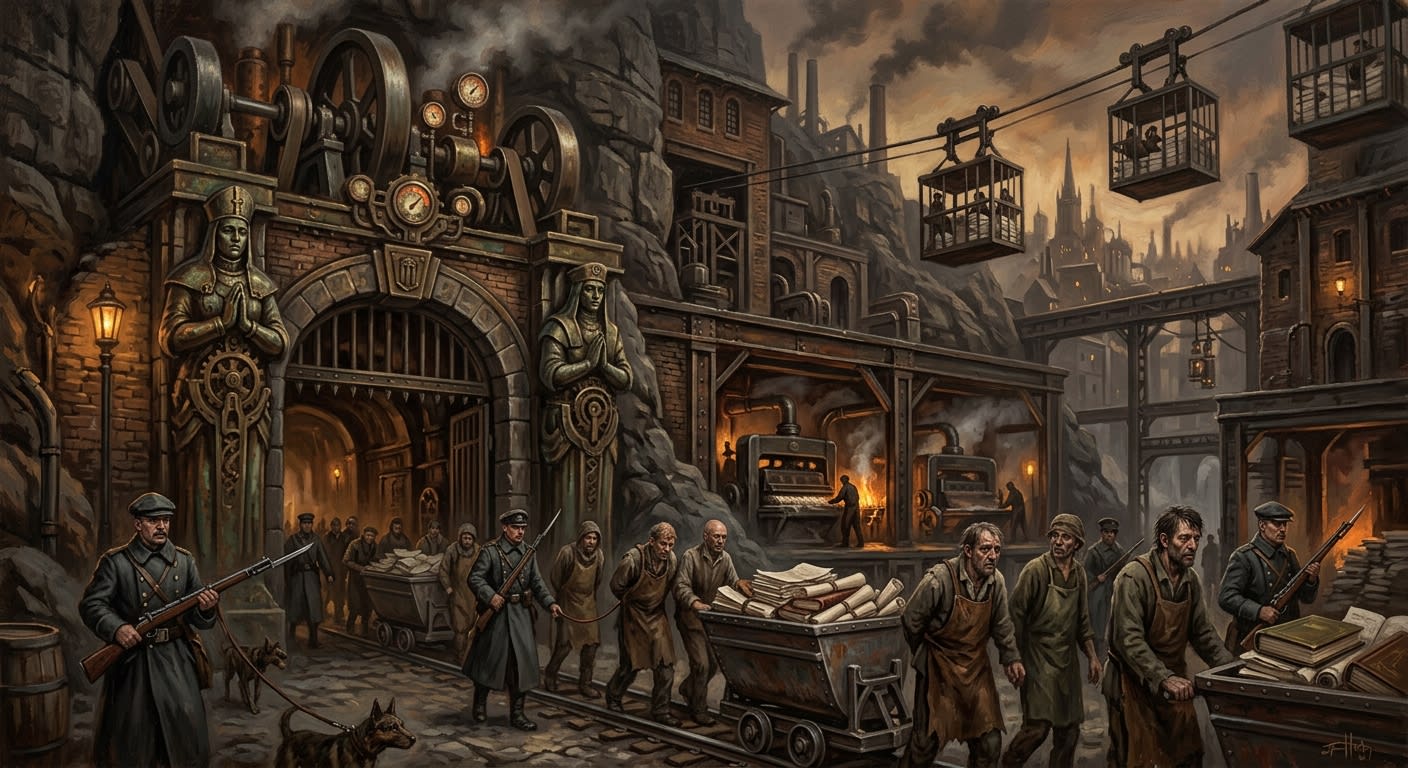
The Paper Mines of Ulm lie outside Ulm proper, beyond the corrected university halls, beyond the printing yards, beyond the point at which respectable citizens stop calling the road a road and begin calling it that way. The Bureau of Doctrine calls the place a punitive industry. The Bureau of Silence calls it a secured cellulose complex. The condemned call it nothing. Names are removed at intake, along with belts, rings, letters, family prayers, and any remaining belief that language belongs to the speaker.
The name is not figurative. I have written this before; I write it again because fools persist in assuming the Bureau enjoys cruelty as decoration. The Mines are cut stone galleries, pulping yards, rag-boiling sheds, guarded drying halls, and press frames sunk into the hill like a second cathedral devoted to blankness. The Bureau has provided production figures, requisition schedules, guard rotations, and mortality abstracts. It has not provided the mechanism by which paper is mined from stone.
#On the Sentence That Becomes a Sheet
A condemned scholar enters under a number. His surname is suspended. His given name is sealed. His prior titles are converted into weight: professor, copyist, astronomer, midwife, clerk, lecturer, witness, assistant, wife, son, daughter, debtor, nuisance. The intake clerk records only category, labour fitness, doctrinal contamination class, and whether the subject can still read. Literacy increases quota.
Families work there as well, because the Synod understands inheritance when punishment is available. A professor's son who ate bread purchased with heretical salary has consumed derivative error. A wife who mended the coat in which a forbidden lecture was delivered has materially supported the lecture. A daughter who learned letters from condemned books has received contraband literacy. The family enters together when the file requires symmetry. The file often requires symmetry.
A charitable digest of A.S. 142 claimed the Paper Mines housed only “the principal authors of Rationalist corruption.”
Corrected. The Mines accept authors, binders, heirs, household members, clerks, questioners, failed Redactors, inconvenient witnesses, and persons whose chief offence was proximity to paper at the wrong hour. Authorship is admired. Guilt is broader.
The labour is counted under Anonymous Productive Penance. This phrase is hideous enough to be official and efficient enough to endure. A miner sorts rag, cuts fibre, stirs vats, trims sheets, feeds presses, hauls pulp, counts reams, and breathes dust until the dust begins counting back. The day's output leaves in sealed carts for doctrinal colleges, Records vaults, Silence offices, Purity tribunals, and the little parish desks where a priest condemns independent thought on paper made by independent thinkers.
#On What the Paper Does
Paper from Ulm is obedient in public and badly behaved in private. Ordinary sheets take ink well, dry quickly, resist damp, accept the Triune Alphabet with the smooth blankness every censor mistakes for virtue. Redaction-grade vellum from Ulm drinks black wax until the forbidden line beneath becomes less than absence. Emergency writ sheets travel folded in courier tubes and remain legible after rain, blood, coal smoke, and moderate screaming.
Some batches are warm. Some reject names. Some show, when held over a candle, a watermark not authorised by any plate-master: an initial, a hand, a face pressed thin by pressure and policy. Clerks test suspect sheets by writing a dead man's name in the lower left corner. If the name remains, the sheet is cleared. If the name disappears, Records receives it. If the sheet answers, Mercy receives the clerk.
PAPER MINES OF ULM — INTERNAL PROCESS REPORT, A.S. 187 Stage I: sorting of intake by fibre suitability and intellectual residue Stage II: pulping, confession-noise suppression, lime wash Stage III: ███████████████████████████████████████████ Output defects: heat, whispering pulp, name rejection, unsorted teeth, premature text Recommended correction: increase ash ratio; reduce night shift singing
The Bureau of Silence prizes Ulm paper because it erases cleanly. The Bureau of Records prizes it because it lasts. The Bureau of Doctrine prizes it because it completes the sermon before the preacher opens his mouth: forbidden mind converted into approved surface. The Ashen Circle hates the Mines with an intimacy close to devotion. Forty-seven captured operatives sent there between A.S. 195 and A.S. 200 now produce pulp for the documents suppressing the knowledge they preserved.
#On the Famous Condemned
The Mines are full of people whose names the Bureau has removed and whose usefulness official documentation keeps rediscovering. Gerda Weil, source-person for Protocol 7-C, died there in A.S. 114 of the fever she had taught garrisons to reduce. Aldric Venn, whose withdrawn memorandum on Pale Chanter echoes raised questions too precise for Records' comfort, was transferred there under speech restriction. Astronomers from Kraków, failed theorists from Engineering, calligraphers with suggestive serifs, Purity assessors who noticed too much, and clerks whose conclusions arrived with insufficient obedience all descend the same road.
The road does not care whether the condemned were right. Rightness sends more people to Ulm than error. Error can be mocked, corrected, filed, and forgotten. Accuracy with consequences requires production custody.
Aldebrand's miracle complicates the account, as miracles are rude enough to do. In A.S. 156, in Gallery Three, a shift of nameless labourers struck blind by white paper-dust recovered sight after passing near an unlabelled wrapped relic. Records filed the episode as occupational recovery. The miners called it a miracle. One recovered name later appeared faintly in the watermark of penitential forms for two years. Records blamed fibre contamination. Fibre has become a hardworking theologian in modern reports.
The Gallery Three event has been described in two minor catechisms as a public healing performed for the edification of Ulm's citizens.
Corrected. It occurred below ground, among nameless labourers, under sealed custody. The citizens were not edified. The citizens were not told.
#On the City Above
Ulm above the Mines remains loyal. Loyalty is easier when disloyalty can be heard below the hill, chopped, boiled, pressed, dried, bundled, stamped, and sold back to the offices that ordered it. The cathedral spire watches the carts leave. The university courts teach corrected history. The presses print the Index Damnatus on paper whose ancestry would get the printer arrested if ancestry still belonged to the sheet.
Convoys arrive twice weekly. Students are made to watch them during penitential observances on the old Concordats' date. They process barefoot from faculty court to cathedral and kiss a blank page. The page is Ulm stock. Sometimes it warms under the mouth. No one remarks on this unless already eager for the road.
The Mine Road is lined with hostels for relatives awaiting derivative disposition. Their windows face inward. Curtains are forbidden. The theory is that hidden cloth encourages private thought. The practice is that grief becomes easier to count when it has nowhere to look.
#On the Present Production
As of A.S. 201, the Paper Mines are productive. That is the official word, and productive is the Bureau's favourite absolution. The output feeds catechisms, writs, denunciation forms, tribunal notices, sealed memoranda, redaction sheets, and the blank forms by which a human person becomes a labour category. Ulm paper passes through every office in Strasbourg. It carries Doctrine's voice, Records' corrections, Silence's black wax, Purity's warrants, Medicine's stolen protocols, and the occasional name trying to crawl back through the fibres.
The Bureau has considered dispersing production to reduce anomaly concentration. The recommendation failed. No other city offers Ulm's combination of skilled presses, corrected universities, secure galleries, symbolic punishment, and civic fear aged to a useful consistency. The Mines will remain where they are. Punishment is cheaper when the architecture already knows the hymn.
The carts leave at dawn. The sheets dry in white ranks. Below the hill, numbers answer roll call. Above the hill, students learn obedience from printed pages. Somewhere between vat and press, a condemned hand becomes a margin wide enough for the Bureau to write over.