
#On the Circle Beneath the Roof
The Astronomers of Kraków were never a society. They kept no charter. They swore no oath before a Witnesser, registered no emblem with Heraldry, and paid no guild dues that Tithes could find. This was their first offence, and the Bureau noticed it last. They were a habit of the university: a roof, a ring of keys, a rota of night watches, and a conviction passed from doctor to student that the sky ought to be written down correctly. A chartered faction can be dissolved with one stamp. A habit has to be confiscated one piece at a time.
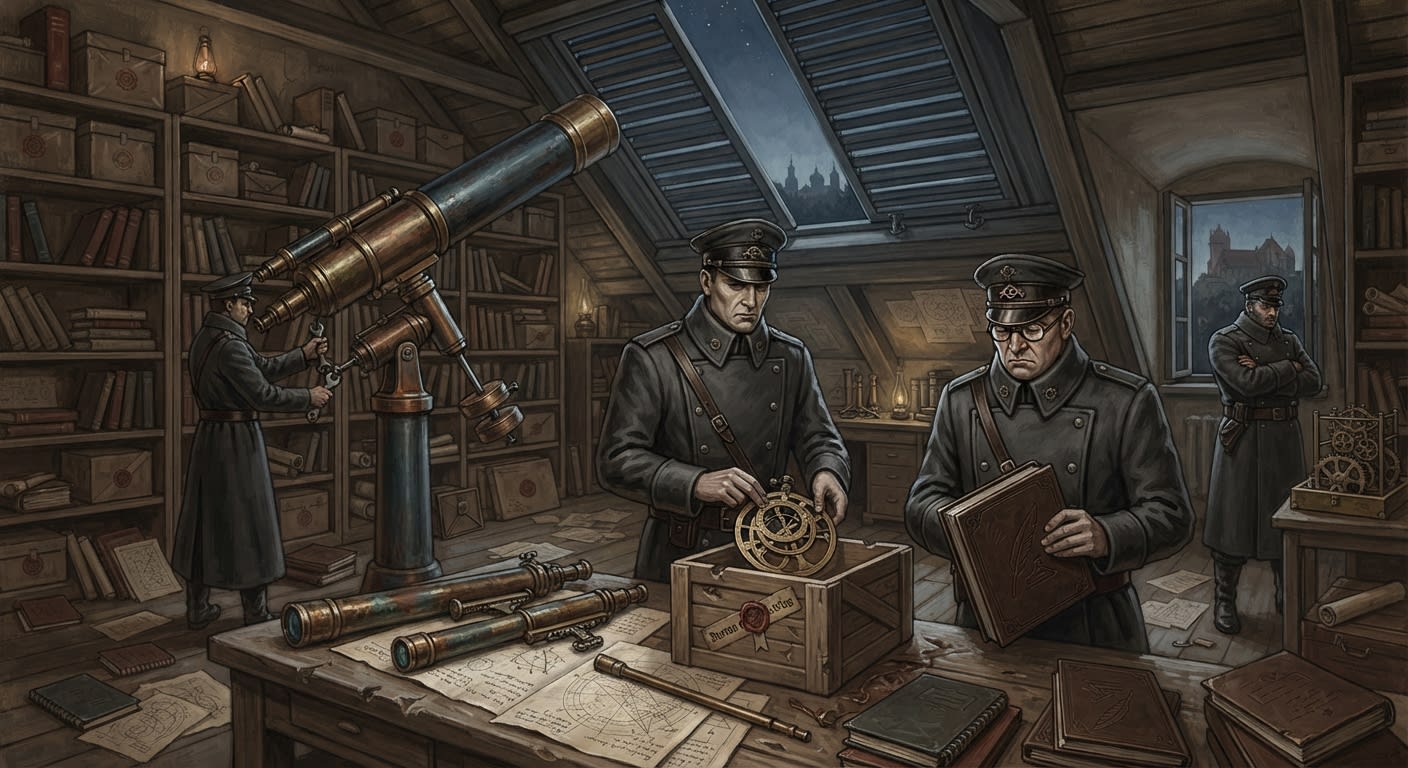
They worked in the old university quarter of Kraków, Zone 3, on the Vistula, in a rebuilt lecture hall whose roof opened on mechanical shutters. I have written about that roof elsewhere and will not repeat myself, except to note that it was greased. Someone climbed up each season with a pot of tallow so the hinges would open without complaint. Heresy, it turns out, keeps a maintenance schedule.
The habit is older than anyone now living. Kraków's university kept astronomers before the Night of Knives of 17 Martius A.S. 18. In those years the Rationalists still had use for the telescopes, though none for the souls behind them. The roof outlasted Brechtold's wire, the Sundering, the restorations and a century of inspectors who found the astronomers punctual, adequately devout and tiresome. Nobody thought to condemn them, because nobody had yet laid their tables beside a chart bearing the seal of the Bureau of Doctrine. That comparison was made in A.S. 199, and the Bureau did not go back to sleep afterwards.
#On Their Instruments
The inventory runs as follows: nine telescopes, four brass astrolabes, two transit circles, sixteen star charts, forty-seven notebooks, a clock of unacceptable accuracy, and one polished mirror that held moonlight for three hours after dawn. The Bureau of Records copied every title before the burning. Records would copy the label off a plague cart if the cart stood still long enough.
Lenses frighten nobody. Men have ground glass for spectacles since before the Church came into the open, and the Bureau has never burned a pair of reading-glasses on principle. The trouble with the Kraków instruments lay in what they did together. The telescopes took positions. The transit circles fixed times. The clock kept those times honest. The notebooks gathered it all, the charts reproduced it, and anyone with a pencil could lay the charts over the approved cosmology and count the difference. An instrument is a witness that cannot be catechized. Put nine of them in a room and you have a tribunal no Bureau convened.
One telescope bore a maker's mark from Amsterdam, where Rationalist vanity was first polished. Another carried a sliding scale cut in fractions so fine that a Purity assessor developed a headache and accused the brass of whispering. The charts showed divergences from approved cosmology: minutes of arc, slippages of date, a Jupiter that wandered. Three students went further and wrote their corrections into the margins of a catechetical chart. Mars does not behave as printed. The table is wrong by seven minutes. A provincial catechist found the chart. The rest was procedure.
The clock was dismantled and its gears divided among seven offices, so that no single mechanism could go on keeping faithful time on its own authority. The mirror went to the Bureau of Relics, which returned the crate with No written across the lid. I file that among Relics' more lucid opinions. What the mirror does with moonlight has not been explained and will not be explained here. It is catalogued, and that is what the Bureau owes it.
Earlier Codex entries record that the Bureau declared the offending celestial bodies "in error and shall be corrected in due course."
The operative wording of the decree is provisionally in error, pending corrected language from Doctrine. The Bureau does not promise the heavens a date.
#On Rudzka, Sarnek, and the Other Nineteen
The condemnation file names six principal astronomers, twelve assistants, two lens-grinders and one clerk. That makes twenty-one defendants. This entry names two. The others are recorded in the file, and the file stays in its cabinet. Readers who would like names for the remaining four principals may write to Records and wait.
Doctor Aniela Rudzka was the senior accused. The Ledger has no publishable birth entry, family, age or Rationalist membership for her, and I will not invent any. She showed the Bureau the patient form of danger. She was correct, she was quiet, and she waited for the Bureau to explain why that was a crime. Such patience is harder to answer than insolence, and the Bureau was put to the trouble of answering it all the same.
Witold Sarnek was younger and louder. He showed the other form: he enjoyed being correct. He owned or used the Amsterdam tube, laughed at the Purity assessor's headache, and at the hearing produced a table predicting an occultation three nights ahead. He smiled as he explained what it would mean for the printed cosmology. When I ordered the table sealed unread, he said the sky itself would read it aloud. Delight is aggravating evidence. A man who takes pleasure in contradicting a seal has confessed to ambition before anyone asks.
The remaining nineteen made up the circle's body. The assistants kept the logs and turned the shutters. The lens-grinders shaped the glass, and one of them tried to sell me spectacle frames at his own arraignment. The clerk's only crime was beautiful handwriting in a forbidden notebook. He protested that he had copied what he was paid to copy. I admired the defence. It failed, as it was always going to, because the Bureau cannot let copying become a trade with no theology.
#On the Strasbourg Hearing
The twenty-one travelled to Strasbourg under guard. The Condemnation was sealed at my desk in the Gallery of the Tower of the Quill, in the autumn rain. The hearing lasted two days. The astronomers presented calculations on the first. The Bureau presented jurisdiction on the second.
The occultation came at the hour Sarnek had predicted. The observation party on the Tower roof consisted of myself, two Bell clerks, a Doctrine assessor and one presence whose name the Codex does not carry. We opened the table after the event, and it matched. The Bell clerks asked whether to record the silence that followed. I told them no silence had occurred, and they recorded none. By morning the decree was drafted.
It laid down three principles. Natural philosophy falls under Doctrine whenever its conclusions touch catechism, liturgy, calendar, sacrament, omen, miracle, prophecy, bell schedule, agricultural fast, navigational procession, feast day or approved metaphor. Instruments confer no interpretive licence. Celestial bodies that contradict approved charts stand provisionally in error until Doctrine supplies better words for their obedience.
Provincial summaries state that the Astronomers of Kraków were condemned by the Bureau of Records.
Records archived the instruments. The condemnation belongs to the Bureau of Doctrine, as it has always done.
#On the Punishment of Accuracy
The astronomers went to the Paper Mines of Ulm, outside Ulm in Zone 2. Intake procedure is settled. Names are suspended, prior titles become a labour category, and literacy raises the quota. A circle that had signed its tables with twenty-one hands entered Ulm as a single category, and the most educated of them pull the heaviest share. Rudzka's condition after transport is unreported. The Codex certifies neither her death nor her survival as of A.S. 201, and it will treat speculation on either as unauthorized interpretation.
In Kraków the observatory was sealed for ninety days and reopened as the Institute for Approved Celestial Devotion. The shutters came off. The opening was glazed with stained glass showing the Seven Seals of Faith, so a student who looks up now sees Doctrine before any star. The Bureau of War garrisoned the university quarter for a year to guard against unrest that never came. The garrison was a complete success, which is more than most garrisons can say.
The Bureau of Doctrine has since kept a post in the upper works of Wawel Hill, watching the university quarter, the Dębnicki Bridge, the market square and the river road. The university remains open under supervision, with rules the circle made necessary. There is no observation after Compline and no lens above three inches. There are no independent tables. Nobody may say according to the evidence unless the evidence has been filed, stamped, witnessed and made doctrinally safe. The Index Claritatis restricted orbit, parallax, retrograde and eccentricity in lay speech. Eccentricity was later restored for personnel reviews, where the Bureau could not do without it.
The Index Damnatus swallowed the observations. The Sealed Archive of Doctrine keeps the confiscated diagrams. Cabinet Astrum-3 in the Tower holds Sarnek's table, Rudzka's final deposition and one brass gear from the dismantled clock. The gear turns once a year with no axle and no spring. Records has asked for it to be transferred to Relics. Doctrine declines. Of all the Holy Bureaus, only Doctrine has read the deposition, and Doctrine sees no reason to hand a turning gear to an office that writes No on crates.
The circle is gone. Its habit survives in a guarded form. Kraków's students still count, quietly, under coloured glass, and the post on Wawel counts the students. The sky goes on keeping the times Sarnek's table gave it, down to the minute. No one has licensed it to do so.