
The Condemnation of Kraków — Prose Draft
#On the Crime of Looking Up
The Condemnation of Kraków was sealed from the Gallery of the Tower of the Quill, at my desk, in the autumn rain, with three bells sounding beneath my elbow and the city of Strasbourg properly quiet below. I remember the hour because the ink dried badly. I remember the case because the defendants had the insolence to be correct in their mathematics and wrong in their theology, which is the most tiresome species of heresy. It forces the Bureau to work.
The accused called themselves astronomers. The Bureau called them, with greater precision, persons engaged in unauthorized celestial interpretation. They operated from the old university quarter of Kraków, a city already known to the Ledger for the Night of Knives, for drowned priests, wired mouths, Rationalist arrogance, and a Vistula that has carried more doctrine downstream than any river should be asked to bear. Their observatory stood in a rebuilt lecture hall whose roof opened by mechanical shutters. This detail offended me immediately. A roof is a theological statement. It declares that Heaven may look down and man may not presume to peer back through hinges.
The formal charge was concise: measuring heaven with impious instruments. Lesser prosecutors wished to add clauses concerning mathematical sedition, nocturnal assembly, lens-polishing without permit, and possession of unlicensed ephemerides. I struck them. A great condemnation should enter the record like a blade, not like a laundry list.
The matter reached the Bureau of Doctrine after a provincial catechist discovered that three Kraków students had annotated the approved cosmology chart with marginal corrections. One note read: Mars does not behave as printed. Another read: The table is wrong by seven minutes. The third, which I preserve here for the instruction of the faithful, read: If the heavens obey the Creator, why do our charts require alteration? There speaks the heretic: not denying Heaven, merely asking why the Bureau's diagram of Heaven lagged behind the thing itself.
#On the Instruments
The confiscated inventory survives in Records Annex K-17: nine telescopes, four brass astrolabes, two transit circles, sixteen star charts, forty-seven notebooks, a clock of unacceptable accuracy, and one polished mirror whose surface retained moonlight for three hours after dawn. The mirror was sent to the Bureau of Relics for assessment. Relics returned it with the word No written on the crate, which I take as one of that Bureau's clearer opinions.
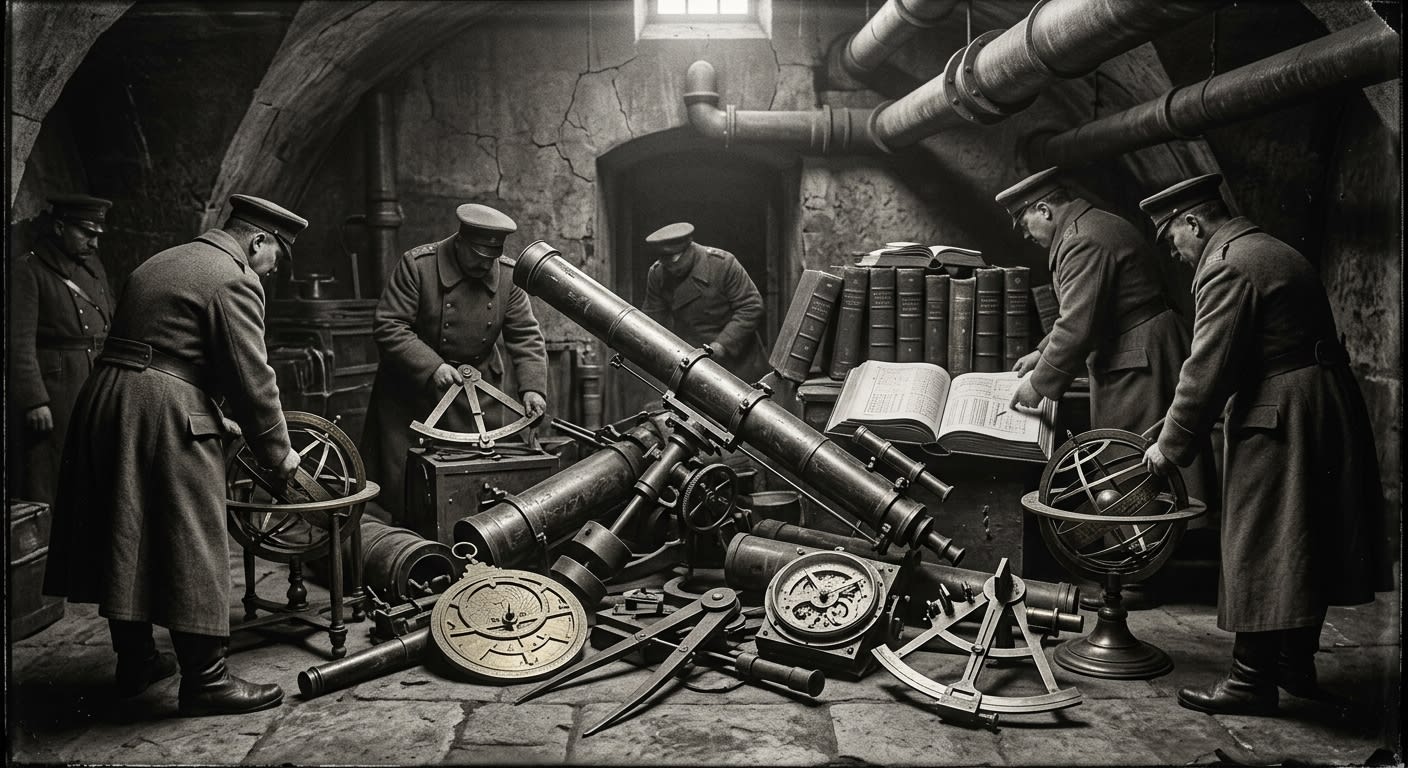
The telescopes were the worst of it. Each had been ground by hand, fitted in brass, and calibrated against the tower-clock of Saint Stanisław's, whose bell had not been certified for scientific use. One bore a maker's mark from Amsterdam, that old privy of Rationalist self-admiration, and another had a sliding scale etched with fractions so fine that a Purity assessor developed a headache and accused the instrument of whispering. The assessor was laughed at by an astronomer named Witold Sarnek. Sarnek later apologized. Apologies delivered after seizure are devotional garnish.
The charts troubled Doctrine more than the lenses. Lenses can be smashed. Charts reproduce. A lens is a sin in brass; a chart is a sin with clerical ambition. The Kraków charts showed planetary positions diverging from the published cosmology approved under the Seventh Catechetical Supplement. The divergences were small: minutes of arc, slippages of date, a wandering of Jupiter that some timid souls in the Cloister described as interesting. I had the word removed from the minutes. The permitted term is disobedient.
The defendants claimed the heavens moved according to law. Their law. Their tables. Their sleepless, ink-stained, the Creator-bothering arithmetic. They insisted they had discovered no attack upon doctrine, only an error in the Bureau's printed diagram. This was, naturally, the attack. A printed diagram bearing the Bureau seal cannot be wrong in the manner of ordinary wrongness. It may be superseded, recontextualized, ceremonially narrowed, or declared allegorical by authorized hand. It may not be corrected in a university margin by a boy whose beard has not yet earned its own ration card.
Provincial accounts state that the Astronomers of Kraków were condemned for discovering that the Earth moves.
This is vulgar simplification. The Bureau does not condemn motion. The Bureau condemns unauthorized explanatory authority. The celestial bodies may perform whatever revolutions Providence permits; interpretation of those revolutions belongs to Doctrine. The difference is the width of civilization.
#On the Hearing in Strasbourg
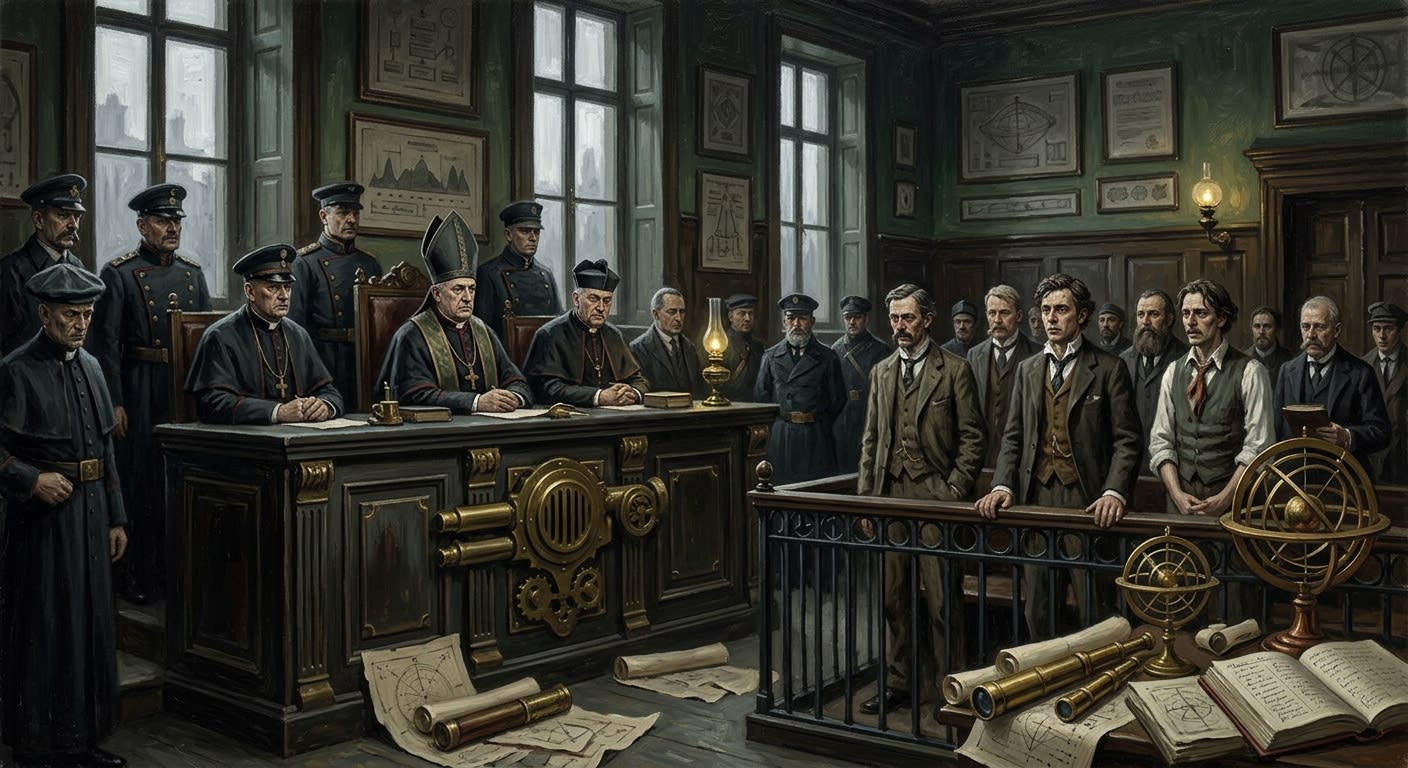
Six principal astronomers were transported to Strasbourg under guard, together with twelve assistants, two lens-grinders, and a clerk whose crime consisted of beautiful handwriting in a forbidden notebook. The clerk protested that he had merely copied what he was paid to copy. I admired the defense. It failed.
The hearing lasted two days. On the first day the astronomers presented calculations. On the second day the Bureau presented jurisdiction. Jurisdiction won, as it always does, because arithmetic can demonstrate movement but cannot appoint a tribunal.
Doctor Aniela Rudzka, senior among the accused, spoke with admirable composure. She said that a telescope does not invent what it sees. I replied that a gallows does not invent a hanging either, yet the Bureau still regulates who may build one. She said that truth cannot be harmed by observation. I replied that truth cannot be harmed by confiscation. She asked whether the Bureau feared the stars. I told her the Bureau fears nothing in Heaven, nothing in Hell, and very little in Kraków.
The turning point came when young Sarnek, headache-mocker and owner of the Amsterdam tube, produced a table predicting an occultation three nights hence. If the table proved correct, he said, the Bureau would have evidence that the printed cosmology required revision. He smiled when he said it. The smile cost him dearly. A man may challenge a doctrine and survive if he appears miserable enough. Delight is aggravating evidence.
I ordered the table sealed unread. Sarnek objected that the sky itself would read it aloud. That phrase entered the record. It entered several other records too.
The occultation occurred at the hour Sarnek predicted. The observation party assembled on the Tower roof consisted of ████████████, two Bell clerks, one Doctrine assessor, and myself. The sealed table was opened after the event. It matched. The assessor vomited into a rain gutter. The Bell clerks asked whether they should record the bell-silence that followed. I instructed them that no silence had occurred. They recorded no silence. ████████████████████████████████████
By morning, the decree was drafted.
#The Decree of Correction
The Condemnation declared three principles, each obvious, necessary, and hated by every young scholar who has ever mistaken cleverness for authority.
First: natural philosophy falls under the jurisdiction of the Bureau of Doctrine whenever its conclusions touch matters named in catechism, liturgy, calendar, sacrament, omen, miracle, prophecy, bell schedule, agricultural fast, navigational procession, feast day, or approved metaphor. This left natural philosophy free to concern itself with stones, unless the stones behaved suggestively.
Second: instruments do not confer interpretive licence. A telescope may magnify an object. It may not magnify the standing of the fool looking through it. Lenses are tools, not ordinations; brass is not a stole; calibration is not sacrament.
Third: celestial bodies observed to move in contradiction of approved charts are to be considered provisionally in error until such time as the Bureau issues corrected language describing their obedience. The stars do not disprove doctrine. They await better phrasing.
The telescopes were confiscated. The charts were burned in the Cloister furnace under supervision of Doctrine and Purity, though Records insisted on copying the titles first, because Records would copy the label on a plague cart while coughing blood. The clock was dismantled. Its gears were distributed among seven Bureau offices so no single mechanism could remain impertinently accurate. The mirror was locked in a cedar case and sent to a room whose number I decline to provide.
The astronomers were reassigned to the Paper Mines of Ulm. This phrase has become so common in Codex entries that readers may forget its generosity. Ulm is not execution. Ulm is correction through production. Men and women who wasted their sight measuring stars now spend that sight counting pulp, trimming rag-bond, sorting fibres, and manufacturing the very paper upon which approved truth is printed. There is a symmetry there so beautiful it nearly excuses the damp.
#On Kraków Afterward
The university observatory was sealed for ninety days, then reopened as the Institute for Approved Celestial Devotion, a name that reassured parents and ruined enrolment. Its roof shutters were removed. The opening in the roof was glazed with stained glass depicting the Seven Seals of Faith, so that any student gazing upward now sees Doctrine before heaven. This is pedagogy in architectural form. I recommend it.
Kraków received a garrison detachment from the Bureau of War for one year, officially to protect the university from public unrest. The public had shown no unrest. The garrison protected Kraków from becoming interesting. It succeeded. Lectures resumed under new rules: no observation after Compline; no lens above three inches; no independent tables; no use of the phrase according to the evidence unless the evidence had been pre-filed, stamped, witnessed, and made doctrinally safe by a man with warmer rooms than yours.
A draft of the decree ordered the stars named in the Kraków tables to be corrected physically.
The language was amended before publication. The Bureau of Doctrine does not command the stars by artillery. We command them by interpretation, which is cheaper, safer, and less likely to embarrass the Bureau of War.
The case entered every catechist's manual within five years. Children now learn the approved lesson: The Creator made the heavens; the Bureau defines the permitted descriptions; the faithful may admire what they are not licensed to measure. In village schools, the story is told with little wooden stars hung from a wire. At the end, the teacher covers the wire with a strip of grey cloth stamped with the Bureau seal. The children clap. The brightest ones stop asking questions.
The Condemnation also strengthened the Index Claritatis. After Kraków, the words orbit, parallax, retrograde, and eccentricity acquired restricted status in lay speech. Eccentricity was later restored for use in personnel reviews, where the Bureau finds it indispensable. Language, like Heaven, obeys better when watched.
#On What Was Learned
The astronomers learned that accuracy is no defense against authority. Kraków learned that its old wound had not made it immune to new correction. Doctrine learned, with some irritation, that the sky possesses habits the Bureau had not yet named.
I learned that men who look upward too long begin to forget who stands above them administratively.
This, more than any chart, was the crime. The Kraków astronomers did not merely see lights moving through darkness; they imagined that seeing entitled them to speech. They forgot the proper order: Creation, Revelation, Doctrine, licensed commentary, silence. Observation belongs somewhere below silence, pending approval.
The sealed file remains in the Tower of the Quill, Cabinet Astrum-3, between the Doctrine of the Virtue-Generals and a rejected sermon on whether comets are divine punctuation. Sarnek's table is inside. Rudzka's last deposition is inside. One brass gear from the dismantled clock is inside, turning once per year without axle or spring. Records has asked whether it should be transferred to Relics. Doctrine has declined.