
#On the Towers and the Wick
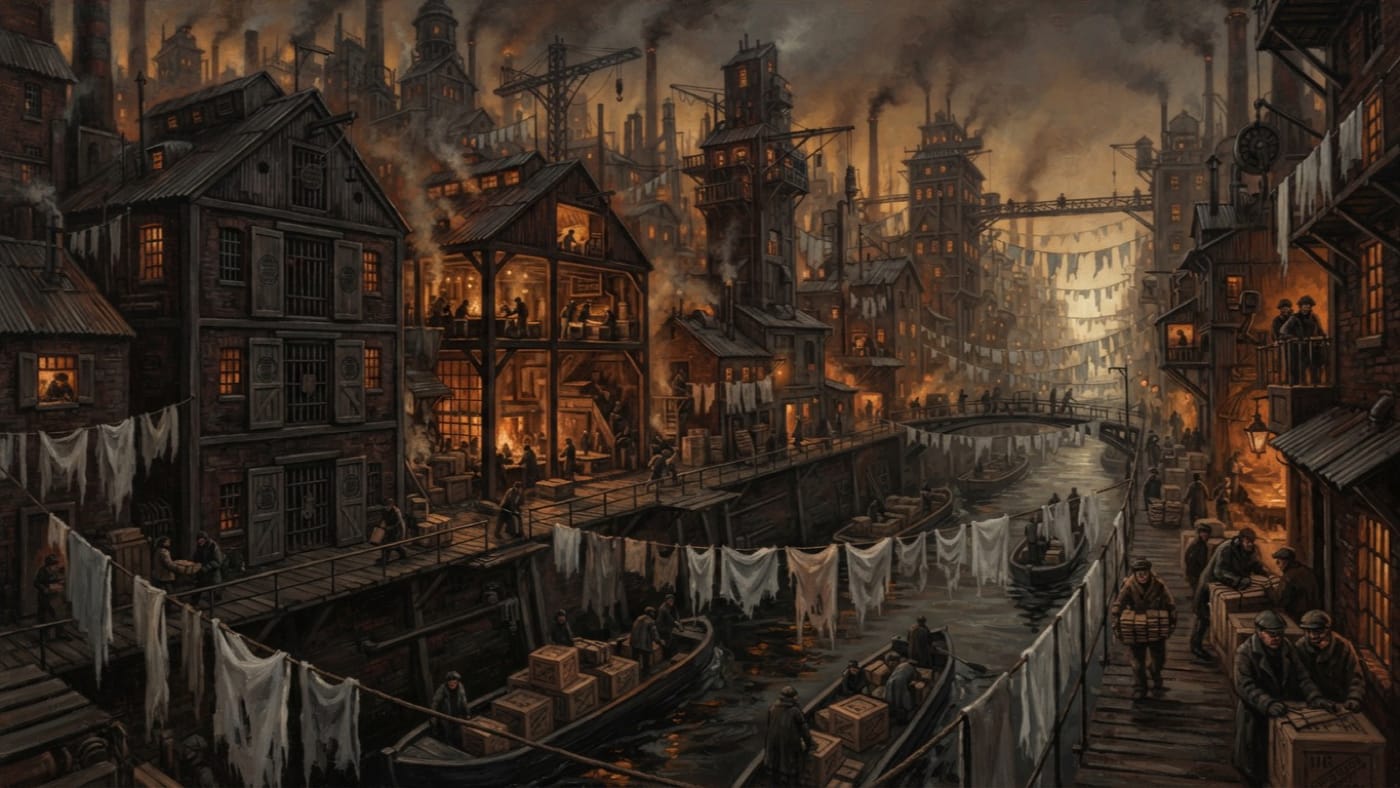
The Lantern Mile is the part of the Candlewick Palatinate that stands up. The rest of the city lies low and wet on its marsh terraces, pressed between canals like a document between blotters. Here the chandlery towers and wick-spinning halls climb above the rooftops. A boatman on the water below sees them first as smoke, then as cloth, and only last as buildings.
Everything burned in the Palatinate after dark was made here. The household candle lets a mother mend after curfew. The workshop taper lets a die-cutter finish his quota. The inspection lamp lets a Provost examine that mother's papers and that die-cutter's seals. All three left the Mile in a crate stamped by House Wickwarden. All three were counted when they left and counted again when they arrived, and the two counts agreed exactly as often as the House found convenient.
The district smells of oil and singed fibre. Its people smell the same. The chandlers, the wick spinners, the apprentices with blistered fingertips and the distribution crews carrying wax down stairwells a fire inspector would weep to see are the Mile in the sense that a quill is a decree: necessary, replaceable and rarely consulted.
#On the Work Above the Water
The wick halls spin, and that is their entire liturgy. Fibre is twisted, braided, waxed, cut and bundled from first bell to curfew. The halls are long rooms where lint hangs in the air and the floors are swept every hour, because lint is fuel, and in Candlewick fuel may never pile up except under licence. The chandlery towers dip, pour and cool. Wax goes up by lift and stair, and finished stock comes down by crew. Between the buildings run the roof-walks of plank, rope and iron hook. They are strung with drying cloth that flaps over the canals like the laundry of some enormous and slovenly saint.
The cloth dries up there because there is nowhere else to dry it. The roof-walks exist because there is nowhere else to walk. Over the decades a district that makes fire for an entire city has given itself the lungs of a bellows. Oil smoke rises from every vent and singed fibre settles on every sill, with wet roofs below and combustible stock within. The Palatinate's own structural survey lists its fire risk as elevated and permanent. The Mile is where the word permanent earns its salary.
Apprentices learn the trade under contracts that the guild calls instruction and that a fair reader would call servitude with a pleasanter vocabulary. The House sets the quotas, and debts are owed to the House. A spinner who falls behind on the first soon falls into the second. A spinner who defaults loses guild protection and becomes unlicensed labour, without a mask ration, a movement token or the infirmary. Candlewick calls this soft severance. It is soft the way tallow is soft, and it still takes the shape of the mould.
All this labour produces legal light. A candle in Candlewick is a candle, and it is also a permit and an alibi. Activity after dark is lawful when it is lit in the proper colour, by the proper lamp, from the proper stock. Darkness ends a person's legal existence for the night. The Mile manufactures the exception.
#On the House That Issues Light
"Which House owns the flame?" — Candlewick shibboleth, put to visitors who have not yet learned.
House Wickwarden owns the flame. It holds territory both in the Lantern Mile and on Wickcourt Heights, and the division tells you everything: the Heights is where the House sits, and the Mile is where it works. The wax stores, candle towers and distribution crews all answer to Wickwarden. Lady Maris Wick, the House's current head, answers to the Guild Compact in roughly the way the tide answers to the harbour-master.
The arrangement dates from the Great Fire of circa A.S. 98. The fire taught the city to build firebreaks and canal cordons. It also destroyed so much stock that strict wax quotas followed, and that winter Wickwarden took over the distribution of candles. The House has not given it back. Quotas, once established, are levers, and levers, once held, acquire heirs.
The Chromatic Registry defines which colours are lawful. Wickwarden supplies the wax and light on which every lawful colour depends. The Registry can declare that a lantern must burn a certain shade at a certain hour on a certain canal, but it cannot make the lantern. The Bureau of Records has studied this imbalance with a creditor's sober attention. It concluded, as it usually does, that renting a monopoly is cheaper than understanding one.
The House's leverage lies in curfew, inspection and permission. A late convoy means a dark district, and a dark district permits no lawful activity. Without light an audit cannot proceed, a shift cannot finish, and a Provost cannot examine anything at all. Wickwarden never needs to refuse the Bureau. It need only be slow.
#On the Windows Over the Canal
Height has consequences. On a clear night a person on the roof-walks can look across the canal rooftops to the windows where the smugglers of the Black Canal hang their lights, and can read them.
Candlewick runs two systems of lamp-colour, and the Mile overlooks both. The first is lawful. The Registry fixes the lantern colours, and each lamp burns the proper shade for curfew, patrol and permission. The second belongs to the canal trade. It uses the same glass, the same flame and often the same wax to say things the Registry has never licensed. The Black Canal Syndicate deals in outlaw shades, counterfeit papers and purchased identities. It moves them partly by false lantern codes, signals that look lawful and mean something else entirely to those who know.
Everyone knows. That is the scandal of the Lantern Mile. The code is understood on the roof-walks, in the wick halls and in the taverns along the cordon. The Seal Provosts understand it too. They have read it for years and maintain, at considerable personal profit, that they cannot. Their ignorance is not cheap, and it is renewed on a schedule, like any other licence.
For the record, I distinguish between seeing and acknowledging. A wick spinner who glances up from a roof-walk and reads a window has committed no offence, since the Bureau does not yet prosecute eyesight. A Provost who reads the same window and acts on it has made an administrative decision with consequences for his income. Most Provosts are excellent administrators.
None of this makes the Mile a smugglers' parish. Chandlers sell candles, and some of those candles end up in windows that lie. A foundry that casts a blade is not a murderer for having cast it, though the Bureau reserves the right to discuss the matter.
#On the Two Closed Halls
The Fading Winter began in A.S. 199, when documents across the River-belt started losing their text while their seals stayed perfectly intact. The Registry called it heresy. House Vatmarsh called it a failure of the mordant-salt supply. The Syndicate called it a market. The cause is still disputed. Older suspicion falls on Hungry Ink, the Palatinate's resident scribal anomaly, though the Bureau has not been permitted to settle its connection to the season.
The Registry's remedy was chromatic reconciliation. New purity standards suspended every unverified shade, and every suspended document became void pending review. Every household and workshop was summoned for shade revalidation. A wick hall runs on paper like any other workshop: apprentice contracts, quota ledgers, wax receipts, mask-ration books, and the licence that makes the hall a hall. Once that paper was suspended, the hall became a room full of people spinning fibre without permission.
The Lantern Mile lost two wick halls.
I record the figure with care, because care is required. Across all of Candlewick, reconciliation closed eighteen workshops and reclassified forty-seven workers as unlicensed. The Mile's two halls are counted within those eighteen, not in addition to them. Bottle Quay lost more. Vatmarsh Row lost nothing, a fact I set down without comment because comment would be redundant. The published reckoning does not say how many of the forty-seven worked in the Mile's two halls, and I will not improve upon it.
The halls' names are not entered here. Neither is any account of their reopening, because none has been filed. What is known is the general pattern. A hall's papers were suspended and its licence voided, pending a review set for no particular hour. Its spinners could wait or work without protection. Waiting meant missing quota, and missing quota meant debt. In Candlewick, debt means a person goes down the stairs one morning a guildsman and climbs them the next as unlicensed labour, without mask, token or care.
The rest of the Mile kept spinning, because it had to. The city still needed light. The Registry had just closed two of the halls that made that light, and it needed more of it than ever, because revalidation queues do not run in the dark.
Earlier assessments described the Fading Winter as "a contained incident."
The Fading Winter is ongoing as of A.S. 201. Readers who took "contained" to cover the Lantern Mile are referred to the two halls above and to the Amber status below.
#On the Present Allocation
In A.S. 201 the Palatinate remains at Operational Amber, and the Fading Winter has not ended. The Mile works. The towers pour, the halls spin, and the cloth dries above water that carries the finished light away in crates.
Over the past eighteen months House Wickwarden has arranged three "accidental shortages" of candle wax. Each one fell with remarkable punctuality on a Records audit, and each was resolved by concessions the Records Annex denies having made. The file does not say which towers ran short, which warehouse mislaid its keys, or which crew lost its way between the Mile and the Heights. The House has always kept tidy paperwork about its accidents. Across the city the documents keep fading, but the candles the clerks read them by never do.