
#On the Trade in Permission
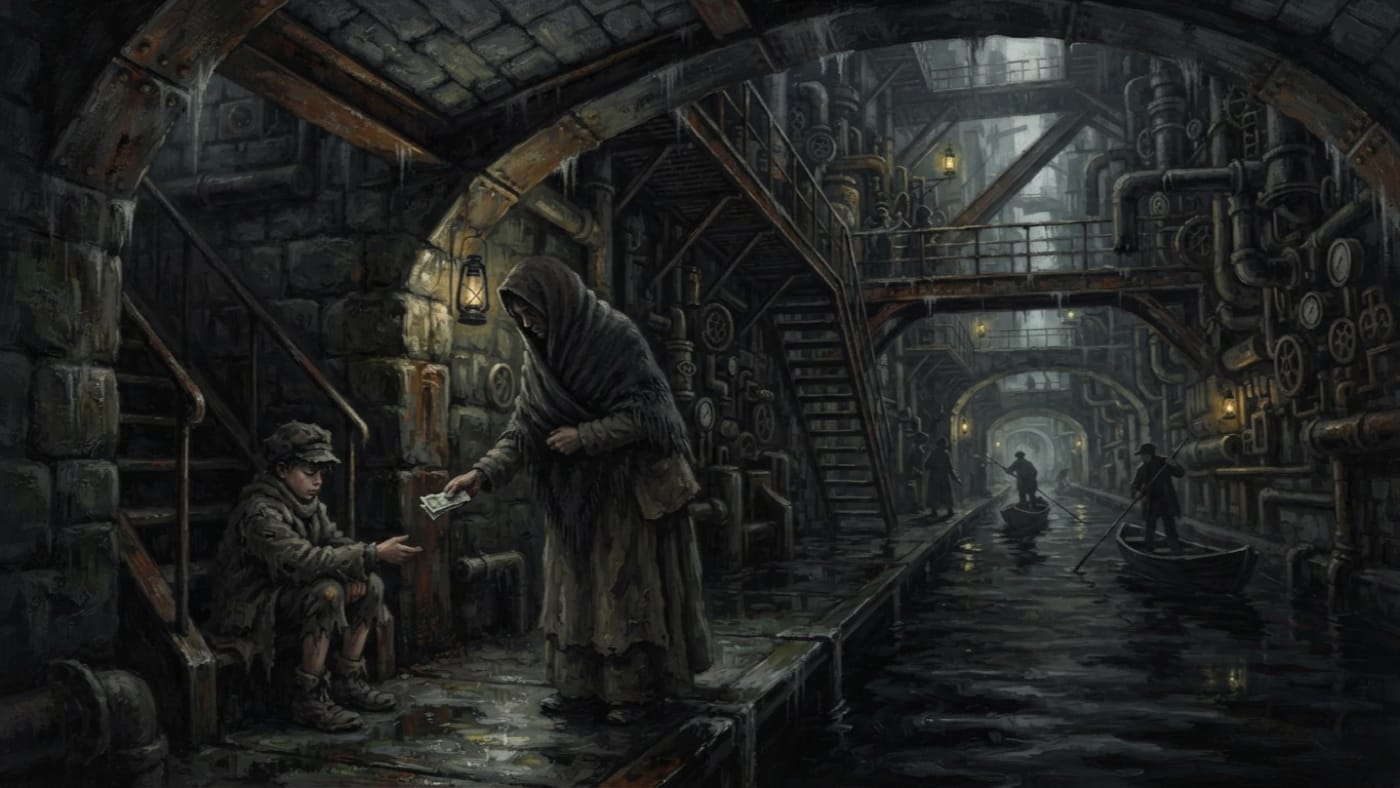
The transaction is small and wet. A woman whose ration token has been suspended goes down a service stair below the Lantern Mile and hands a folded sum to a boy who never looks at her face. In return she gets a grey token that will pass one inspection queue, two if the auditor has a cold. She has bought a week of bread. The seller has written her name into his ledger. He keeps it in no book, and he forgets nothing in it.
Reduced to its coinage, that is the whole of the Black Canal Syndicate. Candlewick makes permission: the seals, the sanctioned shades and the watermarked paper without which a person exists nowhere the Bureau of Records can see. Wherever permission is made under monopoly, someone will make it more cheaply under the stair.
The Black Canal is the water. The Syndicate is the people who sell what floats on it. The difference matters to the Seal Provosts, who can chain a sluice and have never found a way to chain a habit.
#On the Cartel and Its Recorded Names
The Syndicate has no charter day. Doctrine has looked for one with the hunger of an office that wants an anniversary to condemn. Contraband moved beneath Candlewick long before anyone called the people carrying it a cartel. The organization built up through the long middle years, as colour-law hardened and every quarter-gradation of shade variance became a danger to a household. Men who live under perfect law learn to want imperfect exits. Someone began selling those exits on a schedule.
What exists now has no public face, no seal of its own, and no roster that has ever survived a raid. Its parts can be named by trade: skiff pilots who read lock bells through the pole, outlaw dyers in hidden vat-cellars, die-cutters with ruined eyes, signalers on the roof-slits, runners with ink under their nails, lockhouse cousins, and Registry clerks whose cuffs are always damp. Trade, access, fear and bribery hold them together. Whether anyone stands above them all, the Bureau cannot say. It has hanged several men on the theory that someone does.
Two names keep appearing in provost testimony and incident files. Lantern-Jack is reported with teeth lacquered in a colour code. Witnesses say pilots and clerks read meanings in his smile, but no file has decoded it. Some reports suggest more than one man has worn the name and the teeth. Nema the Smudge is known by fingerprints on paper in offices where she had no business being. Whether either of them commands anything, or is simply the face a story needs, nobody has established. Their legal names are unknown and their ages unrecorded. This Codex will not certify a hierarchy because the Seal Provosts would like one.
#On Shades, Seals, and Purchased Names
The stock is unremarkable on its face. There are outlaw pigments for workshops squeezed by House quotas, and false lanterns for workers crossing districts after curfew. There are counterfeit shade tokens, unregistered seal dies, and colourless paper waiting for whoever can afford to fill it. From Bottle Quay come micro-vials of bureau-grade ink, made or diverted outside lawful custody. The Syndicate moves them in wick crates and eel baskets. It also moves them inside corpse candles, which are searched less often than they should be, since the Provosts dislike opening the dead's luggage.
Behind every counterfeit sits a forger doing skilled, poisonous work. One bad die does more than ruin a customer. It brings a raid down on his street, his neighbours' tokens, and the dye-house that sold him wax. When the Syndicate's craft fails, the whole lane pays the fine.
The best-paid product is the new name package: paper, token, wax mark, supporting witnesses, and enough Registry echo to survive an ordinary inspection. Its purpose is administrative resurrection. A buyer who has been reclassified, struck off for debt, or chromatically reconciled out of existence gets back passage through the Seal Locks, ration standing, employment, and a debt colour he can live with. Not every package works. Discovery ends the buyer.
The Syndicate keeps the old name. That is the collateral. Blackmail is one of the cartel's recorded methods, and arson is another. When payment fails, Candlewick reports quiet disappearances and blames the Syndicate. A desperate customer can find it useful the way a moneylender is useful, and he should expect no more kindness than that.
#On Bargains with the Law
The Seal Provosts raid the under-dikes on a schedule worthy of a cathedral calendar. They seize vials, burn palettes, plant samples where the quota needs them, and take their cut where it doesn't. The lantern signals in the alcoves are read by everyone, provosts included, and acted on selectively. A scrape under the west coping of the Seal Locks tells bribe boats which watch has been paid. The Provosts have ordered it scrubbed off many times. The scrubbing is always given to the watch that was paid.
The Chromatic Registry defines lawful colour under Records oversight, and the Syndicate studies it the way a heretic studies the catechism, with more attention than the faithful pay. High Registrar Sable Vorn and Shade Auditor Pell run the tests the cartel spends its money learning to pass. No evidence makes either of them a member, and this Codex does not suggest it. Their tests do, however, set the cartel's prices.
The Houses deal with it the way merchants deal with the weather. Wax stolen from House Wickwarden comes back through intermediaries' warehouses and is booked as recovered stock. Factors for House Vatmarsh buy suspect canal samples to find out what their rivals are mixing. These are trades. None of them makes an alliance.
Every purification campaign burns two workshops and an apprentice, and leaves the Syndicate useful to the same offices that condemned it.
#On the Fading Winter's Market
The Fading Winter began in A.S. 199 (1909 CE). Text came off documents across the River-belt, while the seals, signatures and fee stamps stayed in place. The Registry answered with chromatic reconciliation. It voided documents in bulk, closed eighteen workshops, and reclassified forty-seven workers as unlicensed. Those are citywide enforcement figures. They count the state's own work, and the Syndicate suffered none of it. Each closure did, however, send the cartel a new customer by evening.
The market adjusted faster than the Registry. Black Canal brokers sold licenses with blank backs, whose genuine seals could carry whatever text was written in later. Pre-winter ink became something to hoard. Fade-proof ink sold for three times its ordinary price.
All fade-proof ink sold beneath Candlewick is fraud, poison, or both.
All fade-proof ink sold beneath Candlewick is fraud, poison, or both.
The author struck this sentence before sealing. The canal trade sells three grades. The false grade is lampblack and confidence. The dangerous grade holds its own words by attacking the text around them, which is useful in a contract where only one clause matters. A small number of effective samples appear in restricted reports. Nobody knows why they work, and no reliable cure follows from them.
Hungry Ink passes through the same hands. It is a Category Two Localized Scribal Anomaly that eats or rewrites text while the genuine seal stays genuine. Its link to atmospheric ash was first noted in A.S. 143, and the Bureau of Doctrine has since asked everyone to forget it. The Syndicate sells vials that are active, inert, or fraudulent, and buyers rarely learn which until the page answers. The cartel profits from the anomaly. No evidence shows that it caused the winter or controls what the ink eats. It sells into a famine it did not cause, which in Candlewick counts as a recognized profession.
Then comes the counterfeit bureau shade, now moving into the lower districts. Three separate auditors certified it genuine before they were told where it came from. The Registry's own instruments, its noses and its phials accepted the criminal article as lawful colour. The auditors are still employed. No one can say whether that is mercy or evidence.
#On the Present Account
In A.S. 201 (1911 CE), the Syndicate is active and richer in chances than it has ever been. Raids still reach it. They thin its pilots, burn its cellars, and put the occasional die-cutter on a scaffold whose rope was made on contract by a lawful House. The winter goes on. Reconciliation goes on producing the unlicensed. The Registry keeps tightening rules that the cartel then sells exemptions from.
Its position is that of a parasite with a theological problem. The Syndicate lives on the value of Candlewick's monopoly. If its counterfeit shade passes into general circulation across the Heartlands, and transit passes and ration permits carry forged colour that no auditor can separate from the lawful kind, the monopoly fails. The cartel's prices fail with it. That outcome remains a threat and has not happened. Every party in the Palatinate is counting on someone else to stop it in time.