
#On the Lodge That Owns Night
The Lanternline Chandlers' Lodge is the licensed guild-corporation that controls harbour light at Saffron Bastion, which means it controls work, curfew, lure pressure, quarantine movement, night wages, insurance exposure, and the small mercy by which a dockhand sees the board beneath his boot before the sea asks his name. It sells oil. This is its public innocence. It sells darkness by the hour. That is its office.
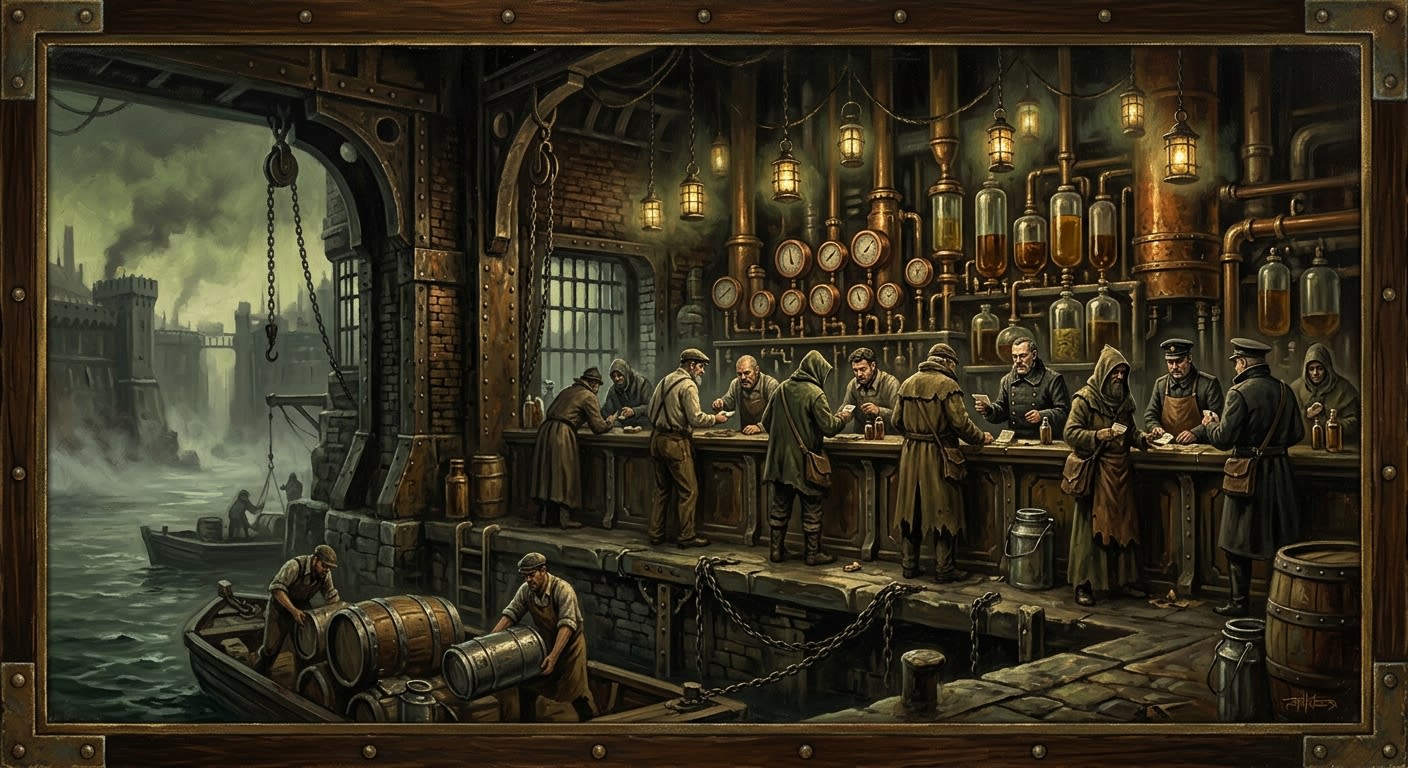
The Lodge sits along the Lanternline catwalks above the waterline piers, amid whale-oil vats, wick sheds, saffron-glass stores, shutter frames, pattern chains, ladder cradles, and the blackened little offices where pattern clerks copy tonight's lawful sequence onto oilskin slates. Its members are chandlers, riggers, oil factors, glass setters, shutter counters, night-walkers, and the failed apprentices who learn too early that light has grammar and grammar can drown a man.
The Lodge emerged from the first Demon-Lure trials after the A.S. 68 work-lamp disappearances (Unregistered) and became indispensable by the A.S. 72 fortification designation (Unregistered). Some lights called. Some lights calmed. Some lights brought waterline things close enough for Battery Twelve to practice a persuasive theology. The men who knew the difference became rich, licensed, feared, bribed, and spiritually filthy. The usual ladder of civic usefulness.
#On Oil, Wick, and Pattern
A common chandler sells flame. A Lanternline chandler sells permission for flame to mean one thing rather than another. A pier lamp on an inland street lights a puddle and inconveniences thieves. The same lamp under Saffron's boards, shuttered in a wrong interval, may wake a voice in the black water that knows a widow's maiden name, a dead sailor's registry number, and the sound a child made before fever took him. Oil is not oil where the sea has learned syntax.
The Lodge's pattern books are sealed in oilskin and wax, stored in a saltproof room whose lock requires three keys: one held by the Master Chander (Unregistered), one by the Harbor Marshal's night office, and one by a Quarantine deputy who has never once arrived on time except when bribed. The books prescribe lantern heights, shutter counts, glass colour, wick thickness, salt-line distance, bell-shard accompaniment, crew speech, and the small permitted pauses between exposures. A pause is the most expensive part. It is where the water decides whether to answer.
The standard night issue begins before chain-drop. Wick-cutters trim every third lamp lower than the eye expects. Glass setters face saffron panes outward and milk panes inland, allowing citizens to see reassurance while the water receives invitation or refusal. Shutter boys test hinges with cloth-wrapped thumbs. Riggers check catwalk lashings, salt damp, and whether any lamp has begun to lean seaward without wind. A leaning lamp is reported first to the Lodge, then to the Harbor Marshal, then to anyone still alive enough to care.
Unauthorized patterns are capital offences because Saffron has learned prudence through corpses. A smuggler may darken a pier to move goods. A Brine Choir sympathizer may open a gap for counter-song. An Insurance Court agent may arrange a plausible marine incident under a storm-exception writ dated tomorrow. A Low Nets mother may set a calming sequence over a culvert where her son hears his father calling. The law condemns all four acts with equal ink, since law hates motive when motive complicates fees.
A Harbor Marshal broadside once described Lanternline pattern work as “simple illumination maintenance.”
Corrected. Simple illumination does not require closed pattern books, registry-number silence, salt posts, armed provosts, and death sentences for shutter deviation. The Lodge maintains a coastal countermeasure whose chief component happens to burn.
#On the Lodge and the Lures
The Lodge claims that it does not bait the water. It manages luminous exposure under Harbor Marshal command. This distinction is suitable for tribunal men, cowards, and certain species of mollusc. In practice the Lodge decides which pier glows, which pier sleeps, which pier presents a false registry sequence, which pier is left dark long enough for Low Nets to understand that darkness has policy behind it.
Demon-Lure procedure assigns light as the first movement in the hook: light calls, salt directs, number deceives, tone fixes, gun corrects. Chandlers own the first movement and invoice the rest. They do not command Battery Twelve. They do not write quarantine holds. They do not sign storm exceptions. Yet a late lamp can make a gun useless, a cracked pane can draw the wrong name from the water, and one missing wick can move the bite from an empty kill-lane to a pier where men are unloading grain.
The Lodge enjoys the oldest form of power: everyone can blame it, nobody can dispense with it. Harbor Marshal Command threatens audit. Quarantine threatens hold. The Bureau of Bells threatens jurisdictional review. The Insurance Courts threaten delayed payment. The Lodge responds by raising oil prices, reporting glass shortages, and allowing two nights of lawful gloom to educate the harbour.
#On Apprentices, Night-Walkers, and Oil-Cuffs
A Lanternline apprentice begins with wick, not flame. The first year is cutting, twisting, drying, soaking, counting, and reciting the approved excuses for waste. The second year permits oil carry under supervision. The third permits glass handling after the apprentice demonstrates that he can distinguish saffron harbour glass from amber quarantine glass under fog, fever, and shouting. The fourth year introduces shutter arithmetic. Many fail there. A failed Lanternline apprentice makes excellent Brine Choir material, being full of half-knowledge, resentment, and acoustical sin.
Night-walkers occupy the higher terror. They cross the catwalks after chain-drop, carrying trimming hooks, shutter rods, replacement wicks, waxed earplugs, salt knives, and a little slate listing the registry number they must answer to until dawn. They wear oil-cuffs: dark leather bands rubbed with lampblack and stamped with the Lodge's three-flame mark. The cuffs keep oil from sleeves, identify lawful hands, and provide something for the recovered body to wear if the face has become a negotiation.
LANTERNLINE APPRENTICE REVIEW — A.S. 199, SOUTH PIER AFTERMATH Apprentice: ███████, third-year glass handler Failure: opened milk pane seaward after hearing maternal voice beneath Pier Six Result: two-lamp gutter; false registry call compromised; Battery Twelve depression failure Disposition: listed as quarantine transfer Lodge private notation: “Do not teach grief before shutter count.”
The Lodge trains speech as carefully as hand. No full names on open piers after chain-drop. No family terms near black water. No answering if called twice. No humming with the shutter rhythm unless licensed by Orison, which never licenses it. If a lamp speaks with a human voice, the night-walker must mark the frame with salt and withdraw without correcting the flame. This last rule produces argument among brave idiots. The brave idiots are dead.
#On the Brine Choir and Other Thieves of Pattern
The Brine Choir is the Lodge's most intimate enemy because it steals without touching stores. A dock thief steals oil and can be hanged with pleasing simplicity. The Choir steals interval. It sings into the gaps between shutters, replaces bell-shards with human throats, and uses cupped hands where the Lodge uses glass. Worse, it sometimes works.
The Lodge calls Choir counter-patterns sabotage. The Choir calls Lodge patterns mutilated tide-speech sold by dry men. The Harbor Marshal calls both parties to closed rooms and leaves with new procedures nobody admits were borrowed. This is Saffron's natural liturgy: accusation, denial, appropriation, invoice.
During the A.S. 199 South-Pier Incident (Unregistered), two lamps guttered and the false registry number was answered by the dead man who once owned it. The sanctioned lureline failed. The Choir sang three tide phrases under the gutting racks. The water lowered. Six men survived. The official report credited corrected lantern pressure, which allowed the Lodge to avoid humiliation, the Harbor Marshal to avoid testimony, and the Choir to avoid being useful in public. Four singers were arrested anyway. Gratitude, like light, must remain licensed.
Lanternline testimony originally denied any Brine Choir contribution during the A.S. 199 South-Pier Incident.
Withdrawn under sealed A.S. 200 addendum (Unregistered). The contribution occurred. It remains illegal, inadmissible, and operationally studied by Lodge pattern clerks under the phrase “hostile interval pressure.” The Bureau admires a euphemism that can wear gloves while stealing.
#On Corruption, Insurance, and Chosen Darkness
The Lodge's corruption is rarely vulgar. A vulgar chandler waters oil, steals wick, sells cracked glass, or hides a barrel from Tithes. Lanternline corruption has better posture. It moves a lawful pattern one pier east. It schedules trimming during a patrol gap. It reports a shortage where darkness would benefit a storm-exception writ. It sells safe-lantern advice to Low Nets families and then sells the list of buyers to Quarantine as evidence of lure anxiety.
The Insurance Courts understand this beautifully. Prewritten disaster needs theatre, and theatre needs light. A storm exception signed before the storm looks suspicious if no storm arrives; a lureline failure under bad lantern pressure supplies fog, bodies, damage, salvage, quarantine holds, compensation claims, and that excellent moral mist in which every party says necessity until the coins dry. The Lodge insists it serves harbour safety. It does. Safety, in Saffron, is the safest mask worn by profit.
Canon-Inquisitor Silex Marrow has authority to interrogate the pattern books. The audit file already cross-links Harbor Marshal Command, the Quarantine Prefecture, Battery Twelve, Low Nets, the Ropehand Compact (Unregistered), Writ-Lector Odrin Vale (Unregistered), and the A.S. 199 South-Pier Incident. Such cross-linking is the Bureau's substitute for courage: if the room catches fire, every culprit is already tied to the same chair.
The Lodge fears this more than Purity, more than Bells, more than the Choir singing at noon. Purity looks for sin. Bells looks for stolen jurisdiction. Marrow will look for sequence: which lamp changed, which claim paid, which hold opened, which family vanished, which chandler's cousin bought dry housing two days before the water spoke. Sequence is the one light no chandler can shutter.
#On the Present Flame
As of A.S. 201, the Lanternline Chandlers' Lodge remains necessary to every lie Saffron tells itself about control. Seventeen active lurelines require its wicks. Nine dormant lanes require its darkness. Four sealed pattern books require its clerks. Low Nets curses it, bribes it, steals from it, and prays its apprentices remain competent. The Harbor Marshal threatens it with inspection while borrowing its best night-walker for private actions. Quarantine brands unauthorized oil and then buys quiet lamps through intermediaries whose gloves smell of iodine. The Brine Choir listens under the boards.
The Lodge's public motto is Light Keeps Harbour. The catwalk version is older: Which pattern is safe tonight? Ask it incorrectly and the chandlers laugh. Ask it correctly and they name a price. Refuse the price and the sea may name you for free.