
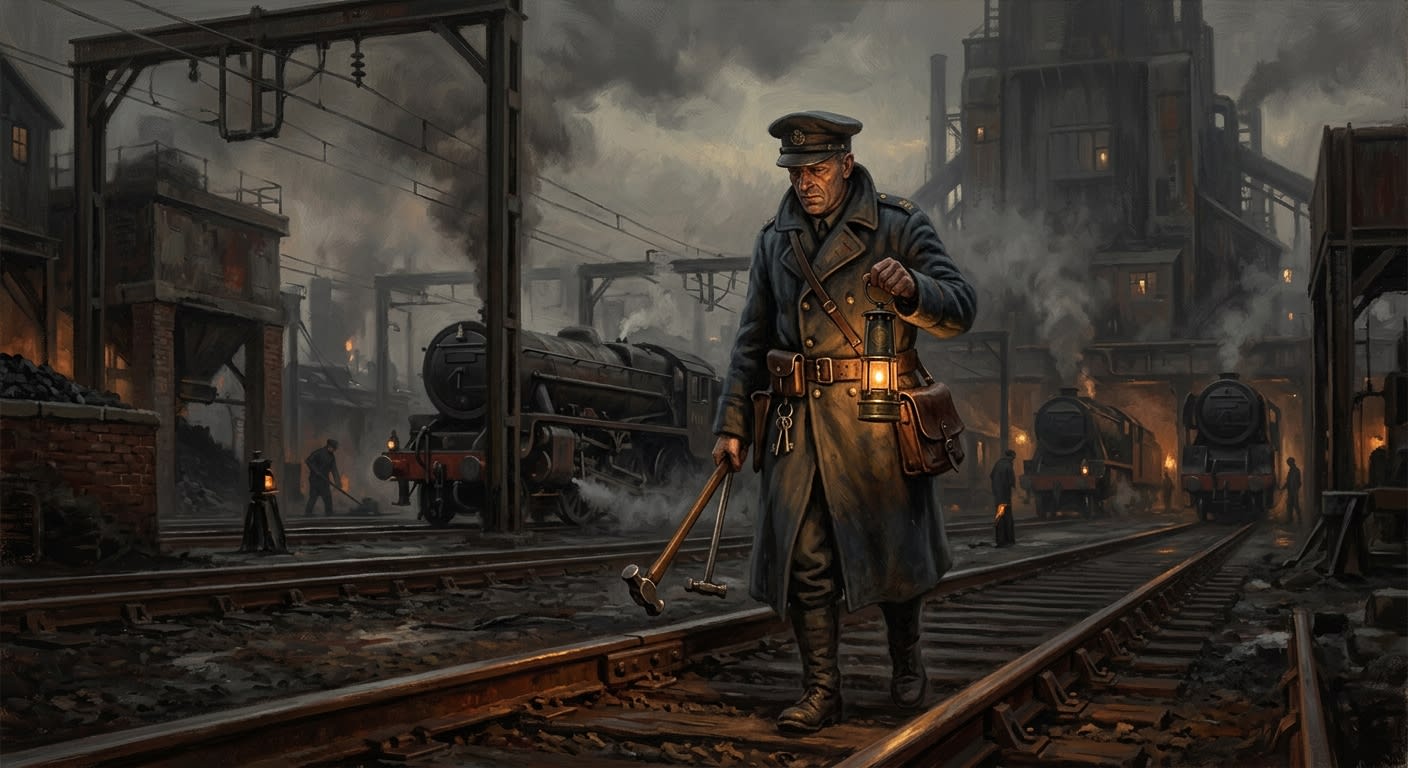
#On the Men Who Walk After the Last Bell
Lantern low. Hammer quiet. Chalk warm. — Guild night instruction, transmitted orally because paper has enemies
The Night Walkers are the dusk-to-dawn patrolmen of the Guild of Rails, drawn from senior Railway Track Engineers and assigned to walk the rails when honest workers have retreated indoors and the track begins to speak in the tones it saves for darkness. Every section has them. Every Stationmaster pretends the assignment is ordinary inspection. Every crew knows better.
They walk between dusk and dawn, lantern in one hand, hammer in the other, listening.
The Guild says stress fractures are more audible at night, when traffic falls and cold tightens the steel. The Bureau of Engineering says thermal contraction after sunset makes night inspection a prudent technical schedule. The Bureau of Doctrine says demon-sign chalk is a maintenance marker with no theological standing.
The Night Walker says nothing. He walks.
#On Tools and Procedure
A Night Walker carries humble implements: lantern, hammer, gauge rod, oil rag, spare wick, a narrow notebook, and chalk in the breast pocket. The chalk mark, when used, is a circle with a vertical line through it, white on the rail-head, plain enough to pass for maintenance notation and old enough that no one admits inventing it. To the uninitiated it means frost crack, tie rot, or ordinary defect. To the Guild it means: do not walk here alone after dark.
The inspection begins at the section house after evening meal. The Walker checks his lantern, taps the hammer head against the stove iron, pockets the chalk, and receives no blessing unless the crew has grown sentimental through exhaustion. A pious man may mutter to Saint Vandrail. A practical man checks the wick twice. The wisest do both and do not brag.
He walks slowly. A day crew measures by interval. A Night Walker measures by answer. Clear ring: live steel. Dead sound: fracture, void, or patience under the sleeper. Wrong heat: stop. Honey-ozone: mark and withdraw. Lamp-flame bending toward the ballast: do not kneel.
ORAL INSTRUCTION FRAGMENT — RECORDED BY DOCTRINE AUDITOR, A.S. 197 If the rail rings clear and the chalk darkens, █████████████████████. If the signal bell answers before struck, do not look toward the hut. If footsteps behind match your own one beat late, leave the hammer on the rail and walk without turning until first light.
#On the Male Requirement
Night Walkers are men. Always men, according to Guild custom; emphatically men, according to Stationmaster practice; inexplicably men, according to every Bureau inquiry whose author wished to remain employed. The Guild has never explained the requirement and declines to discuss it. Declining to discuss things is the Guild’s second language, after delay.
The obvious theories have all been filed and made useless. Purity suspects contamination protocol. Engineering suspects inherited labour custom. War suspects discipline. Records suspects the Guild has a reason and hates not owning it. Doctrine suspects the truth is embarrassing, which covers most truths and several lunches.
A Bureau of Records personnel note described the male-only Night Walker requirement as “traditional preference without operational consequence.”
Corrected. Nothing in the Guild survives as tradition unless it has once kept men alive or kept ledgers clean. The Bureau has not determined which applies here.
Some wives of Track Engineers know more than the Guild admits. They sew extra lamp-wicks into coat hems. They leave salt in pockets. They do not ask why husbands return at dawn with chalk under fingernails and no memory of the third mile. The Synod, being wise in its own fat way, has not attempted to subpoena them.
#On Disappearances
The official disappearance figure is small. An earlier edition claimed Night Walker disappearances averaged two per annum across the network. The Bureau of Records corrected the figure to fewer than one per annum, attributable to weather, terrain hazard, and personal misadventure. This phrase has killed more curiosity than several rifles.
The Guild keeps another number.
The Guild has declined to share it. The Bureau has declined to request it. This mutual restraint is one of the Dominion’s least celebrated peace treaties.
A vanished Night Walker leaves traces according to the manners of the thing that took him. Lantern found lit with no oil. Hammer balanced upright on the rail-head. Chalk line extending fifteen paces beyond the last sleeper. Bootprints approaching a switch and continuing on the far side without crossing the points. Notebook dry in rain. Coat folded on ballast as if laid out for inspection by a valet with claws.
#On the Devil's Joint and the Old Half-Mile
After the Devil's Joint Incident of A.S. 147, Night Walker practice hardened. The Metz junction taught the Guild what paper could not bear: certain rail-throats accumulate appetite, and appetite can be delayed by ritual disguised as maintenance. Silver spike requisitions increased under tool headings. Salt appeared in caches where ice charts did not justify it. Chalk marks became consistent across section houses.
No Night Walker taps the sealed points of the Devil's Joint twice. No Walker crosses it bareheaded. No Walker whistles inside the old half-mile. The rails there ring clear now, which reassures visitors and insults professionals.
Section Foreman Grosz once told me, in his usual festival of excess language, “Clear can lie.” This is a theology fit for iron.
Engineering guidance states that a clear ring denotes sound rail.
Clarified for Night Walker use. A clear ring denotes sound rail under ordinary conditions. The word ordinary is doing work here large enough to deserve hazard pay.
#On Recruitment and Punishment
Stationmasters choose Night Walkers from men with good ears, steady nerves, poor sleep, and enough iron-blood to feel wrongness before tools confirm it. Some accept the duty as honour. Some receive it as punishment. Some are men the section house needs kept useful but separate: gamblers with debts, old foremen with too many dead in memory, troublemakers who asked why chalk warmed before sunrise.
The Military Track Corps sometimes inherits these men when War requisitions crews. This is efficient cruelty. A troublesome Night Walker can be sent south to repair tactical rail, certify shrine-locomotive spurs, and test whether his private terrors survive artillery. The Sepulcher Locomotive leaves dedicated spurs that Night Walkers dislike: rails holding heat too long, chalk darkening at the edges, signal bells answering late.
#On Present Practice
As of A.S. 201, Night Walkers remain active across the Guild’s corridors, from the northern frost routes to the southern shrine spurs, in mountain cuts, yard throats, bridge approaches, tunnel mouths, and those small stretches of track that appear on no public map because maps are optimistic by profession. Their work enters ledgers as nocturnal inspection. Their true authority remains oral, practical, and warm in the pocket.
Do not stop a Night Walker for conversation. Do not ask what he marked. Do not touch a fresh chalk sign, even if rain fails to wet it. If he tells you to step away from the rail, step away. If he says nothing, step away faster.