
#On the Northern Application
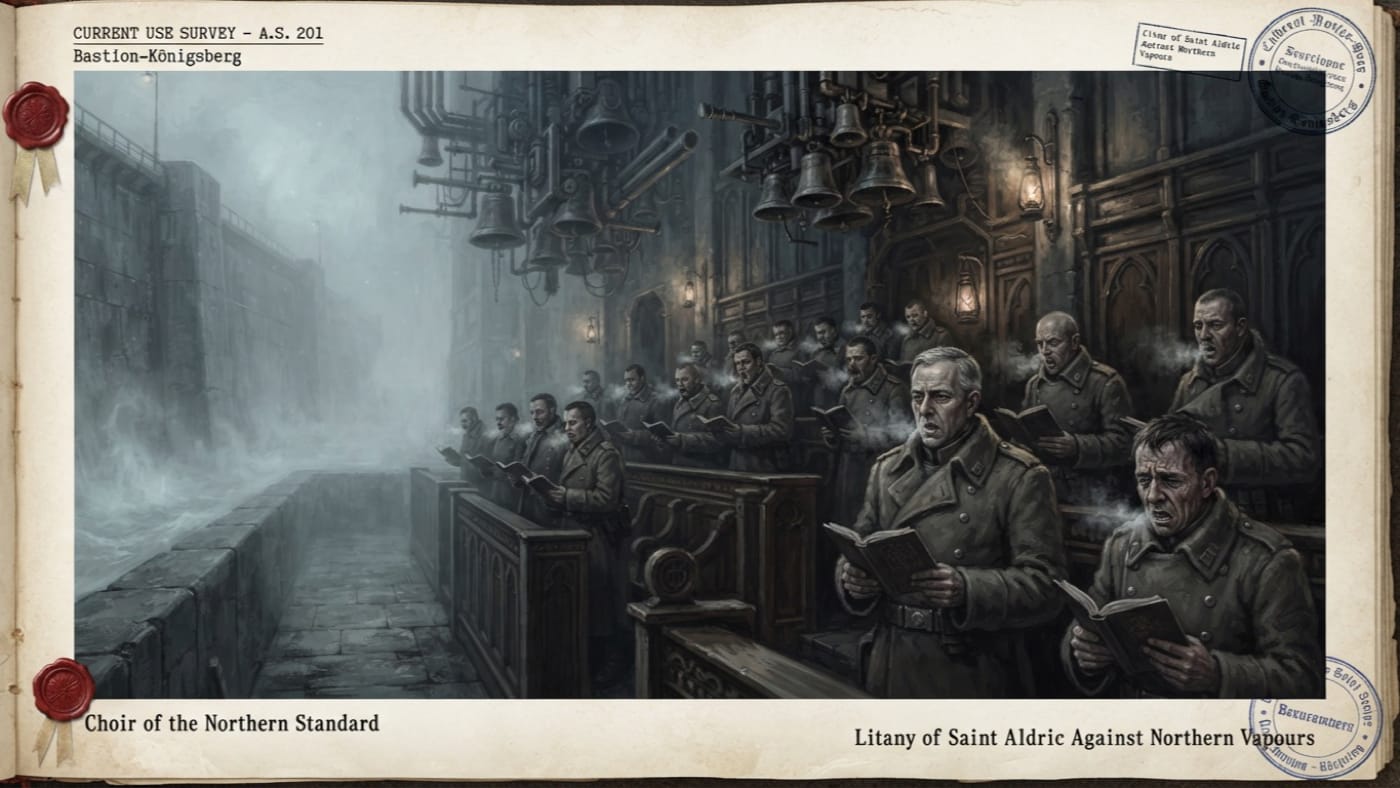
The Litany of Saint Aldric Against Northern Vapours is sung at Bastion-Königsberg, in the Cathedral Close, by the Choir of the Northern Standard, under the rectorate of Wendelin Grau. That sentence holds nearly everything the Codex can certify about the work. The rest of this tract concerns what the sentence costs.
The record is narrow. It holds a title, a choir, a place, a final antiphon, and one evening in A.S. 201 when the fog beyond the Sea Wall gave that antiphon back before the singers had finished giving it. It holds no text. No score has been lodged with this survey. It records no mode, tempo, count of verses or rubric of gestures, and it does not say which bells of the Northern Carillon sound beside the singing. Those things exist somewhere, because a choir cannot sing a title. They exist in the stalls and service books of the Close, and the Codex has not been given them. I will not compose them. A clerk who fills a gap in the record with a plausible verse has committed forgery with good intentions, which is the worst kind, because it gets promoted.
#On the Authorized Voice
The Choir was established in A.S. 188, two years into Grau's rectorate. By the evening in question it had sung for thirteen years. Twenty voices serve it in continuous rotation, twelve hours on and twelve off. Clerks in warm offices read "twenty voices" and picture twenty mouths open at once, all night, a wall of sound against the Baltic. They picture wrongly. The rota is a ledger of relief. Some men stand in the stalls while others eat, confess, or lie in their bunks listening to the fog and pretending to sleep. The Choir's endurance lives in the handover, when one throat yields to the next without the line breaking.
Its hymn cycles are calibrated by the Bureau of Bells, approved by the Bureau of Doctrine, inspected annually and corrected quarterly. This survey does not know whether the Litany of Saint Aldric has passed through any particular correction, in which quarter, or under whose seal. I state the Choir's general practice. I do not invent a private file for the litany.
Grau's discipline is also general, and everything else depends on it. He teaches his singers to hold the authorized pitch, mark the clapper delay, ignore the second voice, and finish the verse. A seminarian could memorize those four instructions before Lauds. The difficulty is that each one must be obeyed at the moment the body most wants to disobey it. The singer holds pitch while his ear hears his own note coming back off the water. He marks the delay while bronze and fog disagree about time. He ignores a second voice that sounds exactly like his own. He finishes the verse after his throat has already been answered.
#On the Returned Antiphon
I came to the Close after evening rotation in A.S. 201. The Choir had just completed the Litany. Grau told me, and my record of that night repeats, that the fog beyond the Sea Wall had returned the final antiphon before the last human breath of it was finished. The singers did not stop.
Exactness matters here, because the Bureau will soon be offered a looser version and will prefer it. What is attested is an overlap at the close. The human antiphon was still in the singers' chests when the answer came. For a moment the end of the litany sounded twice, once from the stalls and once from beyond the wall that was built to keep such things outside. The Choir's general experience of the Grey is that its returns are faithful in note, word and timbre, close enough that men lose their place inside their own throats. This survey does not separately certify the fidelity of this one return. It certifies the return and its timing.
Nothing larger is attested. Nobody reports that the fog began the litany before the Choir did, or that its words were unwritten. Nobody places this evening among the two documented occasions when a melody returned before the Choir had sung it, which the Bureau filed as anticipatory acoustic resonance, mechanism undetermined. Those occasions belong to Grau's dossier. I will not lend them to this litany to make the evening more frightening. It is frightening enough. The answer arrived early inside the final antiphon, a breath early or less. On the Far Nail a breath is a long interval.
When I asked what the singing was for, Grau said the Choir sings for the Creator, and whatever sings back is singing for something else. I asked what. He said he did not know. That same evening, and under seal, he said more about the Grey and hymns not yet written. That testimony belongs to him and to its classification. It does not become a finding about the Litany of Saint Aldric because it was spoken over the same bad spirits.
#On the Protection Claimed
The title says Against. Clerks south of the Sagittal Line read that preposition as a receipt. They imagine the litany pushing the fog off the Sea Wall like a sexton sweeping the nave. In their next circular they will ask why Königsberg still needs a garrison if the litany works.
The title proves intention. At some point the record does not supply, someone set these words against the northern weather and put a saint's name over the effort. Whether the fog obeys is another matter. The record of A.S. 201 shows no dispersal of vapours and no withdrawal of the Grey. It shows no man spared who would otherwise have fallen, and nothing the Bureau of Doctrine could stamp as a miracle without perjury. The fog answered. The fog remained. The Choir finished.
That last sentence is the whole claim, and it is enough. A litany against vapours, sung into vapours that sing back, has done one demonstrable thing: it has been completed. That is the protection the Bureau actually demands and the protection Grau actually provides. The cycles are calibrated, approved and scheduled so that the authorized voice continues. Doctrine asks only that the service not stop. It is a modest demand and a merciless one.
The Grey is the Host Without Name. Its nature, number and purpose remain unresolved, and the registry holds that it does not speak. Returned hymnody does not overturn the registry. An echo that keeps perfect time with a choir is not thereby a correspondent. It has proposed no terms, and nobody in the Close has been fool enough to reply. Clerks who confuse it with Brest's Nameless Tide because neither gives a name should be posted to each coast for a winter and asked to report the difference.
#On the Singers
The Litany is sung by men, and men are the part of the apparatus that wears out.
Grau keeps a list of singers removed from rotation for echo-sickness. The list covers the Choir's whole service, and no clerk has broken it out by hymn. This survey attributes no removal to the Litany of Saint Aldric. Grau visits the men on the list who remain inside the bastion after transfer. To those who do not, he writes once. If no answer returns, he enters a black tick beside the name and says the Office for Those Whose Voices Are Missing.
I mention the black ticks because the Bureau of Bells calls Grau's administration exemplary, and the word reads more honestly when the reader knows what it is made of. Exemplary means the rota holds. The rota holds because men are relieved before they break and remembered after they are gone. When the fog returned the final antiphon in A.S. 201, the men in the stalls had been taught to finish, and they stood in places other men had left.
An earlier working note credited the Choir of the Northern Standard with thirty years of service.
Corrected. The Choir was established in A.S. 188 and had served thirteen years by A.S. 201. Thirty years is the figure a clerk produces when he estimates suffering by the look of the stalls.
#On Present Use
As of A.S. 201, the Litany of Saint Aldric Against Northern Vapours is in use in the Cathedral Close of Bastion-Königsberg. The Choir of the Northern Standard sings it under Rector-Chaplain Grau, among cycles calibrated by Bells and approved by Doctrine. The Northern Carillon's forty-one bells hang above the Close. The fog lies beyond the Sea Wall. Halvorsen's logs receive what the fog returns.
The survey makes no finding on the litany's authorship, its date of composition, its effect on the weather, or the identity of its saint. It finds that the litany is sung, that on one recorded evening it was answered before it was finished, and that it was finished.