
#On the Wall Where the Land Gives Up
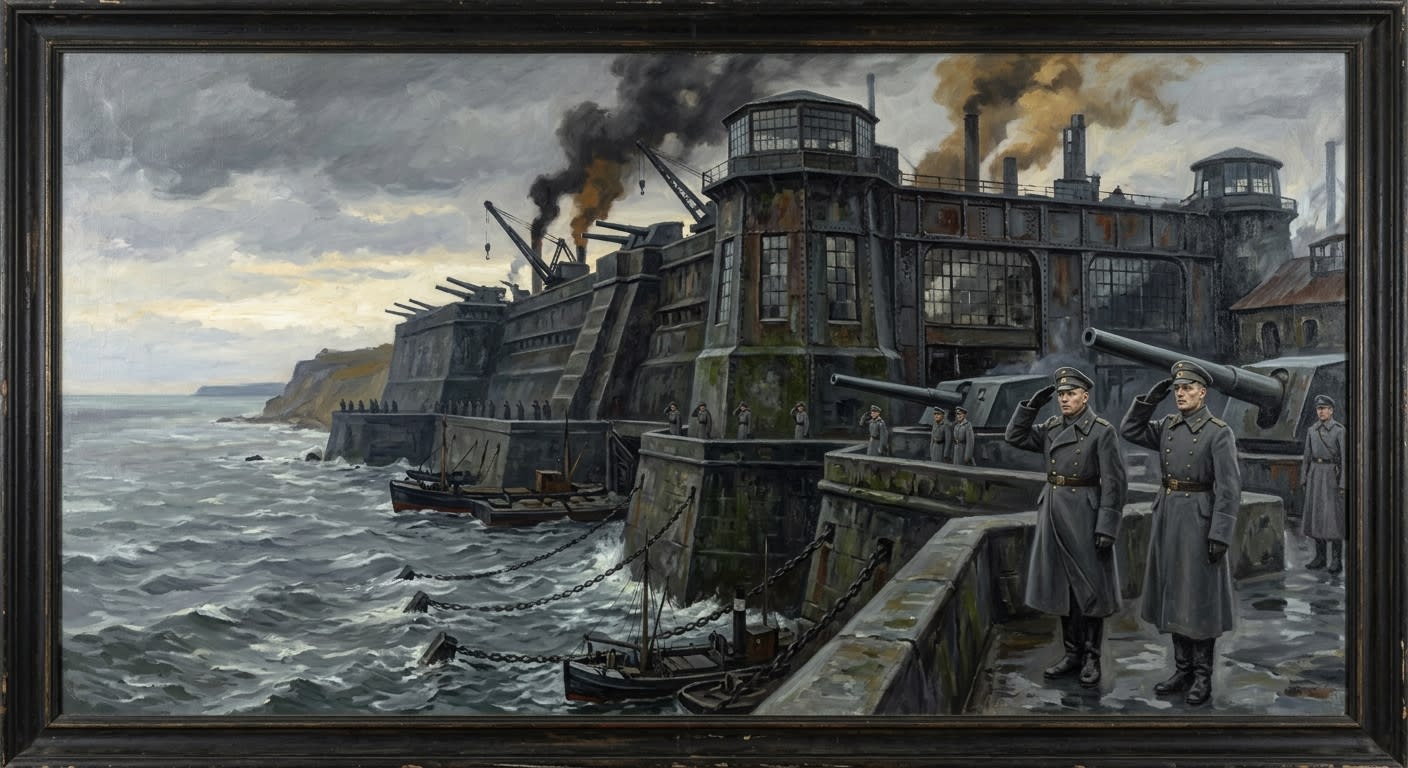
The Sea Wall of Bastion-Königsberg is the northern lip of the Sagittal Line, the place where two thousand miles of trench, rail, wire, bell, prayer, ration ledger, and official confidence run into Baltic water and stop. South of it, the bastion has districts, officers, kitchens, warrens, bell-stairs, punishment rooms, and clerks enough to make cowardice look busy. North of it lies the sea, which has never submitted an opinion and has governed more honestly than most offices.
The Wall faces northeast across the grey approaches. Its guns cover harbour ice, surf wire, shoal channels, and the visible nothing from which the Grey arrives. This phrasing is procedural, not poetic. The approach charts show water, patrol lanes, wrecks, disputed Scandinavian routes, seasonal ice, gull roosts, and navigational warnings. They show no citadel, no wound, no gate, no throne. The Grey comes from that absence, and the Sea Wall has become the Synod's most heavily supervised conversation with a blank part of the map.
The Wall is not high by southern vanity. It does not rear itself like Constantinople above the Bosphorus or coil like Irongate through stone and thunder. It is broad, low, iron-faced, salt-bitten, and ugly in the Northern Theater fashion, which is to say that it works more often than it flatters. Wave-breakers jut below it like black teeth. Surf stakes carry wire into the water until the wire vanishes under chop. Gun galleries sit behind slit shutters plated with old Prussian iron. Above them runs the sentry walk where men learn that fog can have posture.
#On Its Making and Salt
The first sea face was a harbour defence, not a metaphysical instrument. Königsberg was requisitioned into the northern Line around A.S. 67, when retreat hardened into refusal and the Synod learned, with the optimism of men drawing lines far from weather, that the Baltic could serve as an anchor. The old merchant quays and Teutonic stone gave engineers material. The Pregel (Unregistered) mouth gave access. The Masurian Lakes gave an eastern maze. The sea gave a boundary. A boundary is a theological comfort until something crosses it without crossing.
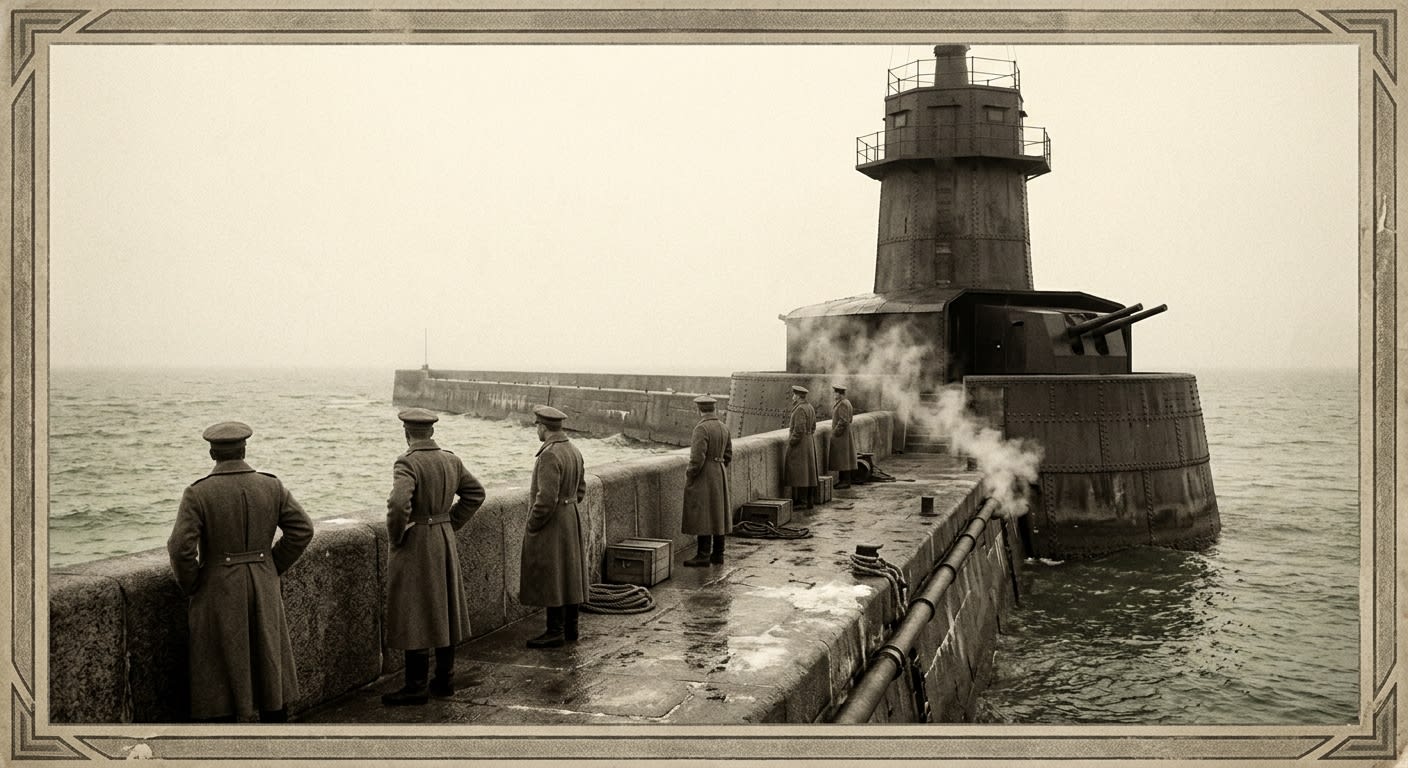
The Sea Wall's present form belongs to the Concordat-era rebuilding of A.S. 92–110, when the old quay defences were thickened, iron-backed, wired, armed, and tied into the Ordensburg (Unregistered) command chain. The Bureau of Engineering designed for ships, ice, artillery, landing boats, smugglers, and Scandinavian embarrassment. It did not design for a fog that returns hymns before they are sung. Engineers rarely do. Their manuals become charmingly thin at the edge of Revelation.
Every decade added plates. A.S. 118 gave the lower wave apron. A.S. 137 added the black iron shutter rails after winter ice tore three gun-mouths open. A.S. 166 brought the surf-wire drums, whose first installation strangled twelve harbour seals and one unfortunate sapper before the drums were declared successful. A.S. 190, the year of formal Grey classification, brought observation cages along the northeast angle and the first rule that no sentry was to stand alone after fourth bell. The rule is observed except when it is not, which is how all rules survive a wall.
The sea has eaten every improvement. Salt enters hinge, rivet, shutter, boot seam, prayer book, lung, and sacramental wine. Bronze sweats. Iron furs red. Stone flakes under freeze. The Wall is repaired constantly by crews whose hands look twice their age and whose curses would enrich the Bureau of Orison if licensed. The Synod says the Sea Wall holds. The crews say the Sea Wall is held. The difference is a wage, a cough, and a missing fingernail.
A Bureau of Engineering survey described the Sea Wall as “substantially complete after the A.S. 110 works.”
Corrected. No sea wall is complete while the sea remains at liberty. The A.S. 110 works established the current defensive line; every year since has been maintenance, argument, corrosion, and the replacement of whatever confidence the previous winter drowned.
#On the Walk and Its Eyes
The sentry walk is divided into numbered slabs from Harbour Crook (Unregistered) to the Northeast Horn (Unregistered). Every slab has a drain, a rifle notch, a bell-pull, a frost spike, and a small brass plate naming the crew that last repaired it. Some plates bear three names. Some bear none. The unnamed plates are never polished. Soldiers notice such things because soldiers notice everything that might later kill them.
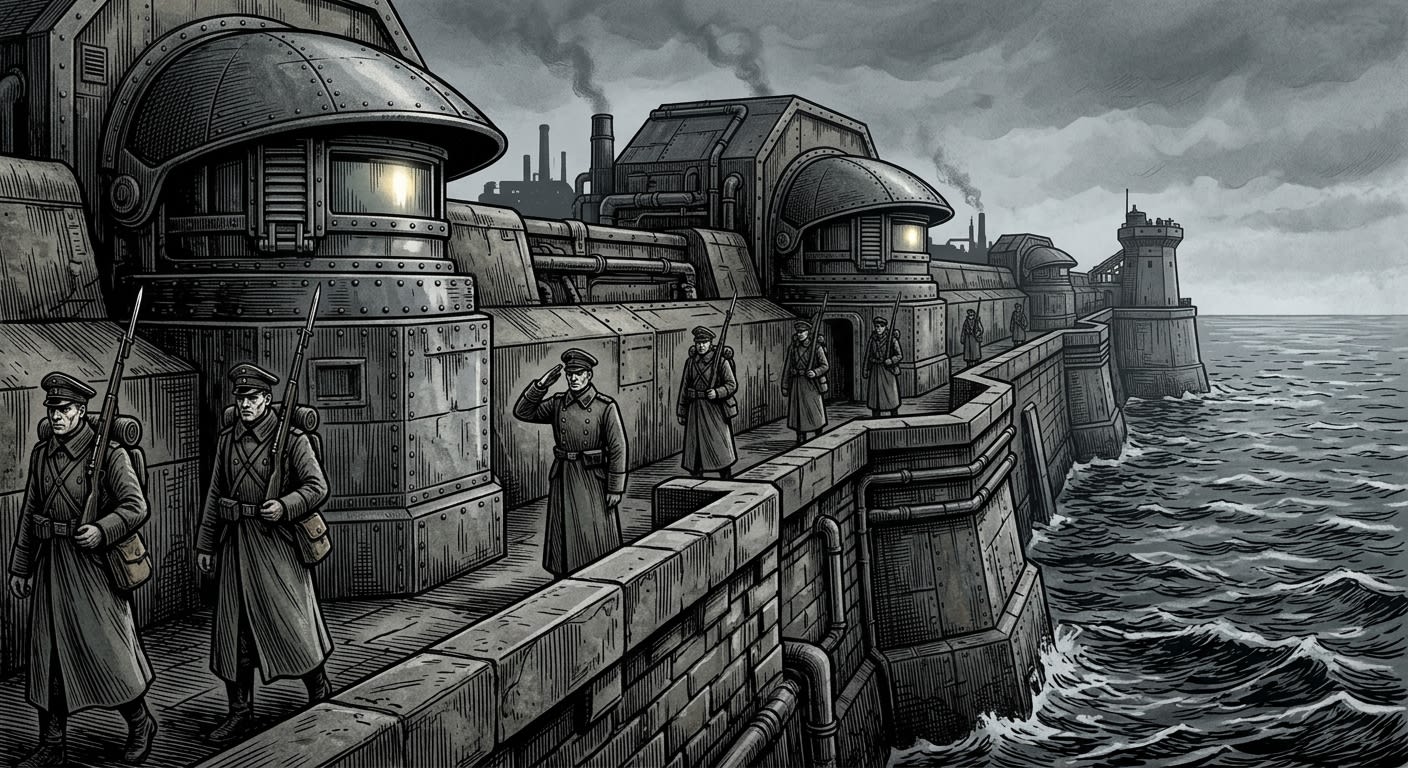
Sea Wall rotation lasts six weeks. Standard Line rotation runs longer. Königsberg does not. Castellan-Warden Ingrid Halvorsen shortened the turn before approval arrived and then supplied the Bureau of War with casualty tables until approval discovered it had always been forthcoming. Six weeks is the official balance between vigilance and strain. The enlisted explanation is shorter: six weeks is how long a man may stare into the Baltic before the Baltic begins returning the attention with interest.
The watches are paired. A senior man stands with a fresh man, then a fresh man becomes senior if he does not salute the fog, hear a relative in the surf, lose time between bell pulls, or begin describing shapes in the water with more grammar than command prefers. Fog reports are spoken into slate hoods and carried by runner to the Ordensburg. Bell irregularities go to Rector-Chaplain Wendelin Grau before they go to Bells if Halvorsen is awake, and Halvorsen is nearly always awake when the sea has ideas.
The Purity exit interview follows every rotation. “Did you see faces?” “Did you recognise rank?” “Did your hand move without command?” “Did the fog smell of anything?” “Did you hear singing before the Carillon?” The questions are written to elicit denial. The men answer badly because survival has made them honest in narrow, damaging ways. A soldier who says nothing happened is watched. A soldier who reports exactly what happened is watched differently. The Bureau of Purity calls this screening. The Wall calls it the second watch.
#On the Fog and the Salute
The Grey does not assault the Sea Wall. Assault would flatter the Wall. The Grey arrives. It crosses visible water without respect for wind, distance, tide, or the garrison's need for sequence. Men have watched it form two miles out and reach the wire before the second breath. Men have watched it appear already inside the near surf, clinging to breaker stones as though it had been waiting there since before the watch began. Men have watched clear water become occupied by attention.
Fourteen documented sentry cases between A.S. 192 and A.S. 201 record the saluting reflex. The hand rises. The chin comes level. The spine straightens. The soldier reports conviction that something of rank has passed before him, though no officer, banner, figure, or lawful superior appeared. Purity calls this involuntary motor response to atmospheric anomaly. The phrase has the chill beauty of a coffin label. It explains nothing and stacks neatly.
A salute is not fear. Fear bends, ducks, runs, curses, prays, pisses, or fires. A salute recognises. That is why the reflex has spread dread through the Wall faster than any casualty. The men know fear. They were trained for fear. Recognition is harder. Recognition implies there is something in the fog with a claim upon the body older than orders and faster than thought.
SEA WALL WATCH ABSTRACT — CASE 9, A.S. 198 Post: Northeast Horn, second night bell Sentry: name sealed; cleared by Purity Observed: fog bank; no figure confirmed Action: full military salute, duration ██ seconds Statement after recovery: “It outranked the wall.” Follow-up disposition: ███████████████████████
Halvorsen forbids punishment for first reflex. Second reflex removes a man from the Sea Wall. Third sends him to Grau, then Medicine, then a posting where walls face mud rather than water. Bureau of War objected to the leniency until Halvorsen supplied figures showing punished men concealed later incidents and concealed incidents produced worse watch failures. Mercy occasionally enters command through arithmetic. Do not tell Mercy; it would form a committee.
#On the Bells Behind the Stone
The Sea Wall does not stand alone. Behind it, in the Cathedral Close, the Northern Carillon rings forty-one bells cast from Prussian gun-bronze and tuned to Northern Standard Resonance. The Choir of the Northern Standard sings in continuous rotation under Grau. Their sound crosses the city, climbs the Wall, and passes over the water like a legal notice thrown into a grave.
The Grey sings back.
On the Wall, the echo arrives differently than in the Close. In the bell chamber it is acoustic terror: voice matching voice, pitch answering pitch, future bars returning early enough to make a singer doubt his own throat. On the Sea Wall it comes thinned by wind and salt, sometimes beneath the surf, sometimes from behind the sentry, sometimes from the fog itself with no visible movement. Men do not always hear the words. They know the cadence. A hymn known by bones becomes worse when the air knows it too.
Grau teaches the Wall men three disciplines. Finish the assigned response. Do not turn toward the second voice. Do not harmonise. The third rule is hated for its necessity. A tired soldier, hearing his own liturgy returned perfectly, will sometimes match it by instinct. The mouth seeks completion. The Wall punishes completion. In A.S. 197, two men on Slab Nineteen joined the echo during the Litany of Saint Aldric Against Northern Vapours. Both lost the next eleven minutes. One returned with frost on his tongue. The other asked why the sea had a choir-stall.
A Bureau of Bells advisory stated that Sea Wall echo exposure could be managed through improved pitch confidence.
Clarified after Königsberg objection. Pitch confidence is useful against bad singers, frightened choirs, and provincial hymnody. It is less useful when the Baltic returns an authorised antiphon in your own voice before your lungs have earned it.
#On the Men Who Leave the Wall
A man leaving Sea Wall rotation is not the man who began it. This is true of all military posts and doubly true here, where the enemy's courtesy consists of letting the body survive while altering the room around obedience. The return procession from the Wall passes through the lower salt arch (Unregistered), across the inspection court (Unregistered), and into the grey benches outside Purity's interview rooms. The benches are warmed. This is not kindness. Warmth makes hands shake visibly.
Grau's assistants sit near the benches with tea, ash wafers, and the small slates used for immediate witness capture. They ask for nouns first. Fog. Face. Bell. Hand. Name. Water. Rank. Mother. Nothing. The order matters less than the speed. A man who tells a story too early becomes owner of the story and will defend its ornaments. A man who gives nouns may yet be saved from interpretation.
The Wall has its own after-sickness. Men dream of standing at attention under water. Men wake with arms raised. Men stop using mirrors if the fog showed them a face almost known. Men count gulls compulsively because gull absence often precedes Grey approach. Men flinch at perfect singing. Men refuse promotions that would return them to the Wall as squad leaders. Men request transfer to Przemyśl, which tells the informed reader everything. A soldier asking for the Wire Orchard to avoid the sea has made his theology plain.
The Fractured North murmurs behind half the charms sold under the salt arch. The Warrens (Unregistered) make them for Wall men: knotted grey thread, fishbone tabs, counterfeit Saint Olaf (Unregistered) medals, clipped bell-rope fibres, stamped paper triangles bearing unauthorised Scandinavian marks. Purity seizes these objects in sweeps, burns them, fines the sellers, and buys replacements through informants for study. The trade continues. The Bureau hates superstition until superstition supplies usable data.
#On the Northeast Horn
The Northeast Horn is the Wall's foulest point. It curves beyond the main harbour angle and faces the open Baltic without the comforting clutter of masts, cranes, sheds, and human commerce. The surf there strikes lower, harder, and with a rhythm the Bell staff deny resembles a counter-peal. Wire vanishes into the water. Ice builds in ribs along the lower plates. Fog appears there first often enough that men call the post First Witness and then deny having coined a nickname.
Halvorsen keeps her best watchers there and shortens their hours during winter dark. She also visits the Horn herself, a habit that annoys War and steadies the men. Command presence is a sacrament when sincere and theatre when scheduled. Halvorsen arrives unscheduled, hood down, hair punished by sleet, asking for fog height and bell delay while clerks in Strasbourg would still be composing the memorandum announcing weather.
The Horn contains a brass orientation gauge installed after Halder's Frost Yards reports began aligning dead men toward the same quarter. Officially the gauge measures wind-bearing and visibility. Unofficially every watch captain notes whether fog, gull absence, echo, salute, and body orientation share the same degree. The answer is often enough yes that the unofficial log has grown thicker than the official one. Facts, like contraband fuel, prefer useful pipes.
The Grey has never crossed the Horn. This sentence has comforted fools. The Grey has never needed to cross it. It has produced salutes, echoed hymns, lost time, face recognition, corpse orientation, and command anxiety while remaining beyond the surf. A knife is not less dangerous because it has not yet touched the throat. It may be measuring.
#On Present Condition
As of A.S. 201, the Sea Wall remains held, watched, repaired, salted, and lied about with acceptable consistency. Its shutters function. Its surf-wire drums are cranky but serviceable. Its guns traverse when ice crews do their work and when Engineering replacement teeth arrive before the old ones fail. Its men complete six-week rotations under Halvorsen's orders. Grau's hymn discipline holds. Purity interviews remain detestable. The Grey continues to arrive without attacking.
The Bureau's public position is confidence. The private position is inquiry. The real position is waiting. The Wall knows this because stone knows pressure before clerks know language. Every rivet, plate, bell-pull, watch slate, salt arch, and frost-spiked step exists in the long interval between an enemy that has not struck and a command structure that cannot decide whether restraint is mercy, threat, study, or contempt.
The Sea Wall faces water. The water faces back.