
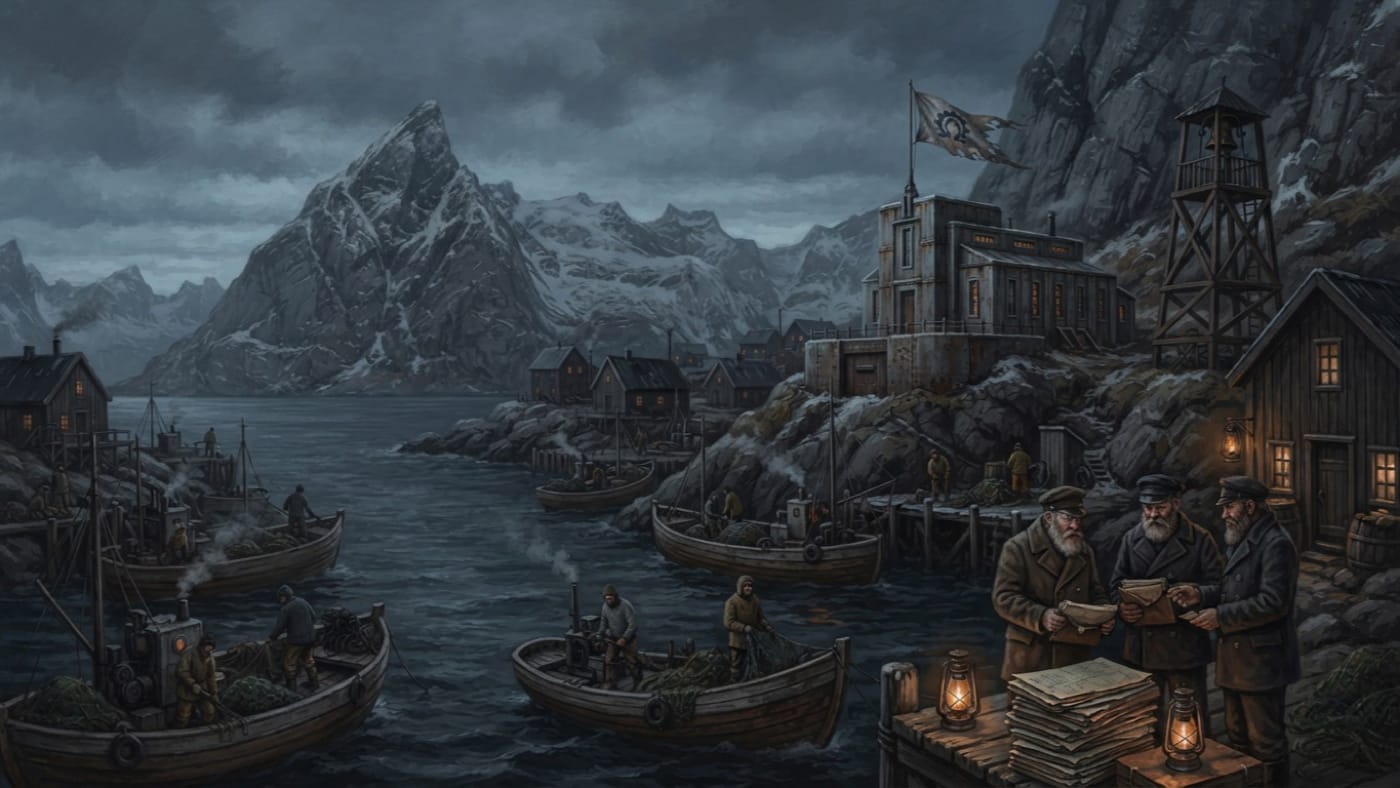
#On the Islands and the Southern Claim
"Prior-districts, Northern Theater: eleven (11). Extent: Bergen to the Lofoten Islands. Boundaries: as locally understood." — Bureau of Records, Northern Registry, district schedule
The Lofoten Islands are a chain of mountains that the sea never finished drowning. They lie off the Norwegian coast, inside the region that the Fractured North occupies and the Synod administers on paper. In the Bureau's northern correspondence they turn up mainly as a terminus. Strasbourg keeps eleven Priors in the North, and the standard formula places them "from Bergen to the Lofoten Islands." So the islands have earned an odd distinction in the southern chancery: they are better known as the far end of a sentence than as a place where anyone lives.
People do live there. The Bureau holds reports of their faith and records of their nominal supervision. It holds no record of them made by a Bureau officer who stood on the islands and counted. The reader will expect an inspection, and I will not make one up. The Hieromnemon has seen Hrafnvik. He has not seen Lofoten. What follows comes from the registry, the regional reports, and the letters of men who got nearer the place than the Ledger ever has.
The southern claim is simple, as claims made from a desk tend to be. Lofoten lies in Zone 8. It lies within the territory sealed to the Concordat and within the reach of a Prior-district. Beyond that, the islands are arranged the way the whole North is arranged: the Creator above, the elders beside, and the Prior somewhere in the margin, filing.
#On Passage and Provision
On a chain of islands every errand starts at the waterline. A visit to a neighbour, a burial or a quarrel all need a boat or a hull, and a crew who can read water the way a canon lawyer reads a codicil, looking first for the clause that drowns you. The Lore Book's account of the North covers the whole region in a few lines, and it fits Lofoten as well as anywhere. The seas that once carried raiders now serve as barriers, and they shut the North away from commerce and corruption alike.
Commerce gets through anyway, because commerce is less devout than corruption and more persistent. Across the Fractured North the diet is fish and seal-flesh. The Lore Book calls it meagre, and I have eaten it and would call it something else. The regional fleets take cod, herring and halibut. What they cannot eat goes south and comes back as grain, iron and paper. The North grows no grain worth the name, works its own iron only in the Swedish hills, and has no paper mills at all. The Bureau of Records insists on paper. As a result the most remote parishes in the Church depend, for their place in the Ledger, on a substance they have to buy from the people who keep the Ledger.
I have no shipping schedule for Lofoten, and I will not draw one. No registry gives the islands' catch, their share of the southern trade, or the number of hulls their harbours hold. The registry does give the arrangement they live inside: the boat goes out and the boat comes back, and the community lasts exactly as long as both halves of that sentence keep coming true.
Strasbourg calls this subsistence. The northerners call it Tuesday.
#On the Prior and the Clans
"The Priors do not govern." — The Fractured North, Codex entry, section on governance
The arrangement is the same in every Prior-district, and the Bureau has stopped pretending otherwise. The Prior is appointed from Strasbourg. He maintains a chapel, conducts services, and files compliance reports with the Bureau of Doctrine's Northern Office at Bastion-Königsberg. His appointment gives him jurisdiction. The weather gives him a tidy demonstration of how far jurisdiction carries over open water.
The North is governed by its clan elders and local councils. Some sit by bloodline and some by reputation. All of them sit because they know when the fish run and when the passes close. I cannot tell the reader who sits on the Lofoten councils, how they are chosen, or where they meet. Those records are kept in the heads of the people concerned, and those heads have not been deposited with the Bureau of Records.
What the Prior holds is correspondence. He reports. He keeps the sacraments, and as a rule the elders let him keep them, because the Creator's sacraments are welcome in the North even when Strasbourg's preferred forms of them are not. He does not decide who fishes where, who marries whom, or what happens to a man who steals from a smokehouse. Those questions are settled before the Prior hears of them. When he does hear, it is so he can write them down.
I have read enough of these quarterly reports from across the region to know their shape. They are dutiful and orthodox, and they are somewhat damp. They come to Königsberg slowly, go into a cellar, and are answered more slowly still, if they are answered at all. The Bureau classifies this as supervision. I classify it as a pen pal.
#On Fish, Oil and Obligation
"In Strasbourg, wealth is ink. In the North, wealth is warmth." — Prior Malthus of Hrafnvik, letter to the Bureau of Doctrine
The North trades in three currencies: fish, oil and obligation. Lofoten is named where the second one reaches its limit. The regional account says rendered seal-fat fuels the lamps of every settlement from Stavanger to the Lofoten chain. Of all the claims Strasbourg makes about these islands, this one says the most. When the Bureau wants to say how far the North's oil goes, it says Lofoten.
North of the Arctic line a lamp is a matter of policy. Winter darkness stretches across most of the day, and the work does not stop for it. Nets still have to be mended, fish gutted, psalters read and children counted. Oil turns a winter into hours a person can work. Fish feeds the household, oil lets it see, and obligation decides who owes whom a share of both when the season goes badly. The ledger behind these arrangements is held by memory and kinship. It has proved harder for the Synod to audit than any account in Strasbourg.
The regional reports also record that the North's seal-oil has gained a reputation in the south for long burning and steadiness in wind, and that Königsberg buys it through intermediaries. The Bureau of Tithes, according to the same reports, has tried six times to tax that trade, and six times the oil has stopped until the tax was withdrawn. I report these facts for the region. Nobody has told me how many of those barrels, if any, were rendered on Lofoten, and I will not assign the islands a share of a quarrel they may never have joined.
#On the Northern Observance
The northerners are faithful. Since the Bureau files its northern papers under a classification invented for people who are inconvenient without being heretical, I will say it plainly. They worship the Creator. They name the Great Deceiver as the Enemy. They keep the Covenant with a severity that would embarrass a southern tribunal. The Lore Book records that Wardens are few in the North and that each family enforces the Covenant itself. In the south that work is done by men with warrants. Here it is done by grandmothers.
Whole villages rise before dawn to chant the Creed on the cliffs. Ritual fasts run into famine, and the northerners say the privation proves their purity. The Bureau would prefer a firm line between a voluntary fast and an empty larder. The northern winter has never drawn that line for them. Their festival calendar follows Strasbourg's by season more than by date, because the sun keeps its own hours that far north.
Then there are the bells. Across the region, coastal Watches keep towers and schedules that predate the Bell Codex and do not answer to it. The Bureau of Bells has asked for copies of the old tunings three times and been refused three times. Witnesses at Hrafnvik and elsewhere describe what the bells are rung against, and I leave those descriptions in the parent entry, under the names of the people who gave them. The registry lists no Lofoten tower, no Lofoten Watch Captain and no Lofoten encounter. Its silence is a gap in the file. It is not a finding of peace.
ERRATUM — BUREAU OF RECORDS, GEOGRAPHIC SECTION.
A regional atlas entry recorded the spiritual character of the North as "Heretical, pagan, dangerous."
The classification is withdrawn as applied to the faith of the North. The Lore Book and the Bureau of Doctrine's own filings record northern communities that worship the Creator and enforce the Covenant within the family. The word "dangerous" stays under review. It was never established whom it referred to.
#On the Present Condition
The islands stay where the registry put them, at the far end of the Bergen formula. Their governance belongs to the councils, their light comes from rendered seal-fat, and their prayers rise from cliffs that no Bureau surveyor has climbed on the Ledger's behalf. The Fractured North as a whole is thinning. The Bureau's revised count of about 1.9 million souls covers the entire region, and the regional reports blame the losses on emigration south to Königsberg, to the shipyards and to the Line. No one has measured what that drain has cost Lofoten. I record the regional pressure, and I do not invent a local census to illustrate it.
A hundred and eleven years after the Concordat, Strasbourg's claim on these islands is still exactly what it was when it was sealed. It is valid in law and modest in practice, and it is kept alive in correspondence by a Prior whose name the Northern Office would have to look up. The islanders keep their own faith in the Creator and their own accounts with the sea. Given the choice, they would plainly rather the Synod kept its paper dry.