
#On the Nature of the Place
Where the oil burns, the Synod extends. Where it does not, the Synod invents.
I have been to Hrafnvik once. The Bureau of Doctrine dispatched me in A.S. 197, aboard a mail-packet out of Hamburg that smelled of bilge and institutional disappointment, to assess the theological compliance of the Fractured North's seal-oil settlements. The assessment required fourteen days. I completed it in nine, because on the tenth day I would have had to eat fish again, and there are limits even to devotion.
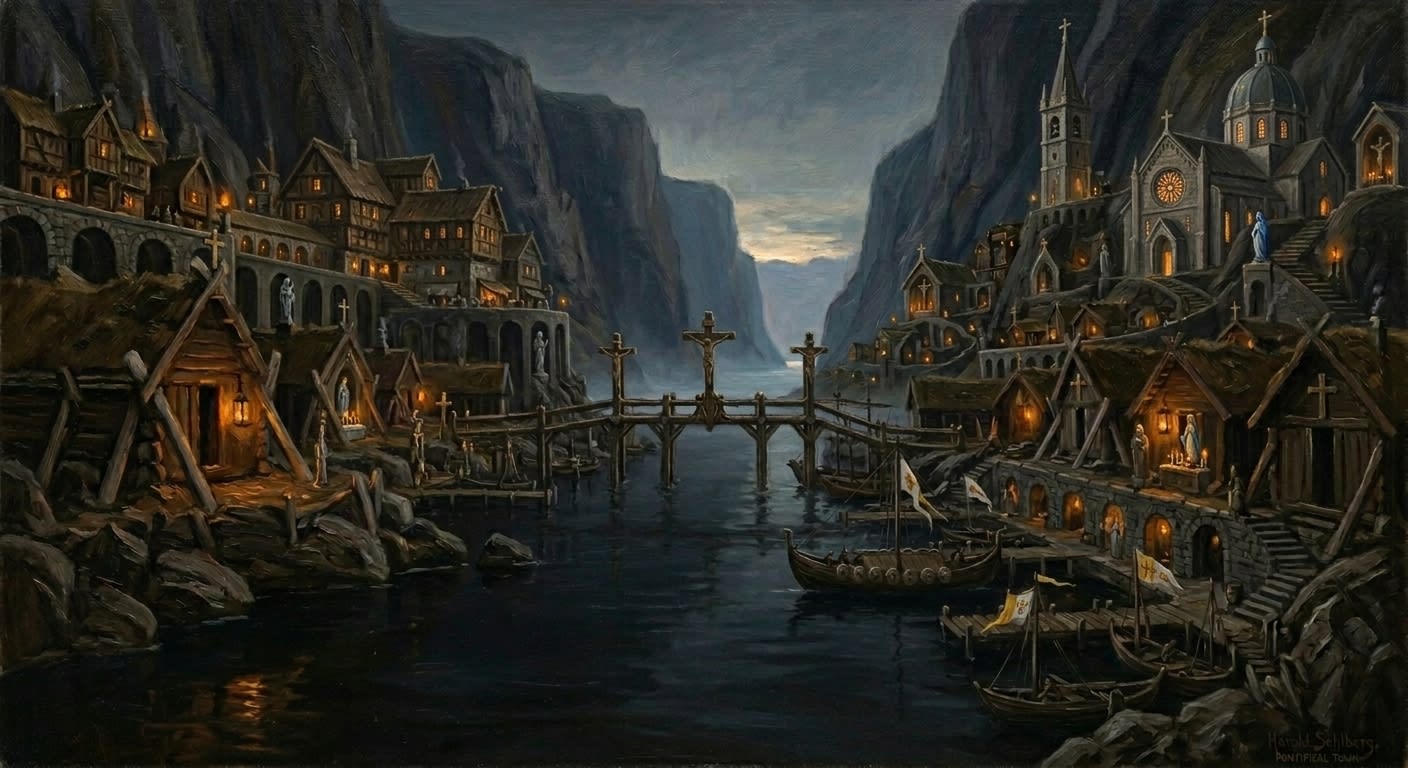
Hrafnvik is a string of wind-flayed hamlets knotted along a black fjord on the Norwegian coast, where the sea gives seal and the shrines demand accounting. It is not a city. It is not a town. It is a theological proposition expressed in rendered fat and bone-braced longhouses: that warmth is a moral category, that light can be taxed, and that the Synod's authority extends to the edge of the known world provided it arrives by skiff and does not ask too many questions about the bell-schedule.
The air tastes of brine and animal heat. Lanterns burn with a steady, oily warmth that makes southerners uneasy — the light is too alive, too organic, as though one were standing inside the lung of something still breathing. Seven thousand four hundred souls are counted in the Shrine Chapter's ledger, though the Chapter's ledger and the clan moot's ledger have never agreed on a figure, and the discrepancy — which fluctuates between three hundred and eight hundred depending on the season, the seal harvest, and the Prior's mood — is itself a kind of local currency. To be uncounted in Hrafnvik is to be free. To be free in Hrafnvik is to be cold.
#On the Geography and Its Cruelties
The fjord is a throat. Hrafnvik sits in the gullet.
The settlement — if one may dignify it with the singular — occupies both banks of a fjord whose name the locals pronounce in a way that suggests consonants have wronged them personally. Black water, cliff walls rising six hundred feet on either side, shingle beaches where the tide leaves things that are not always driftwood. The narrows at the fjord's mouth can be chained shut with a single pull; the Clan Moot maintains this chain, oils it twice yearly, and has used it four times in living memory — twice against southern tax-boats, once against a vessel flying no flag whose crew spoke a language the Watch Captain could not identify, and once, according to Rauk One-Eye, against "the tide itself, which was coming in wrong."
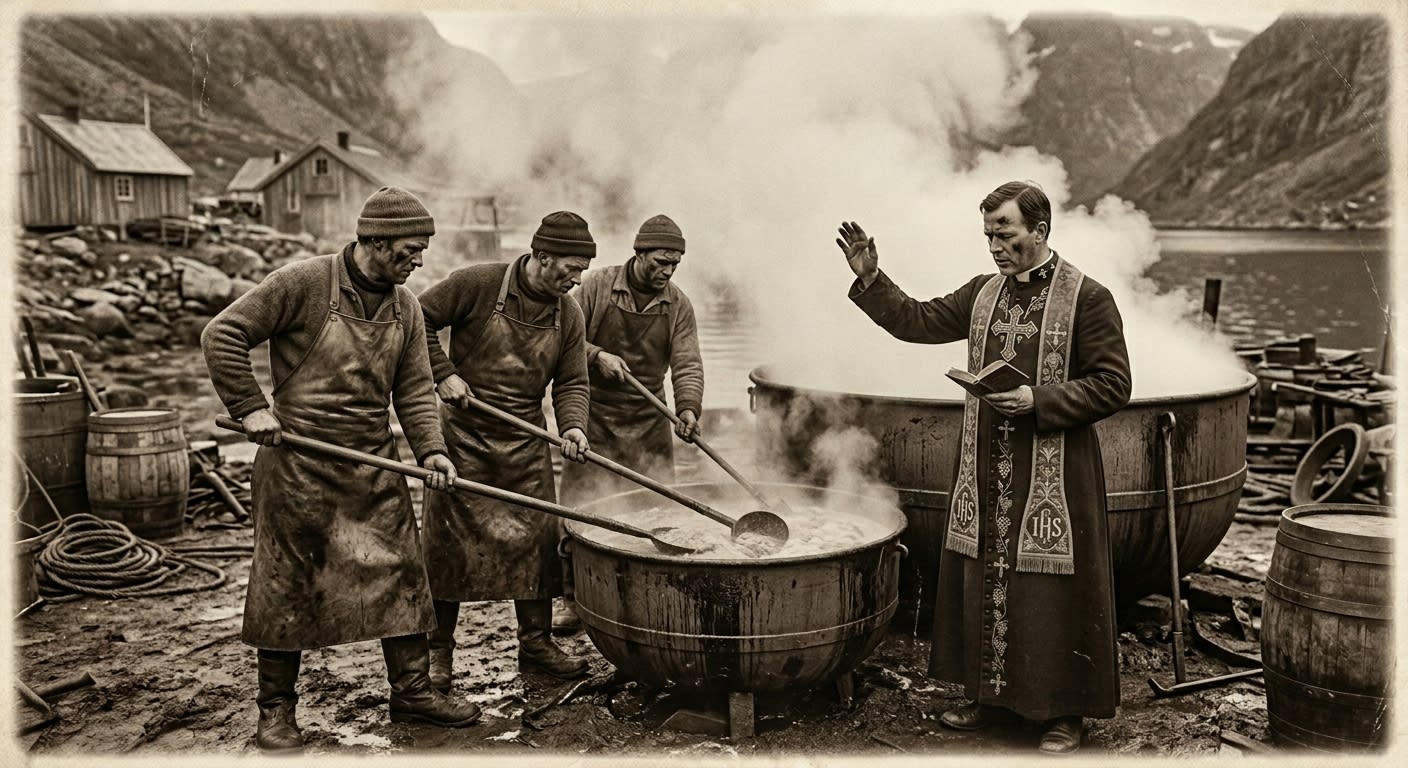
The hamlets are strung along the fjord like knots on a fraying rope. Render Yards at the south end, where the seal carcasses are boiled into oil in vats the size of baptismal fonts — an analogy I offer without irony, as the Shrine Chapter blesses each batch before rendering. Shrine Rings on the eastern cliff, where oil-lamps burn in circular arrangements around vow-stones that predate the Synod by centuries and predate Christianity by more centuries than the Bureau of Doctrine cares to acknowledge. Longhouse Rows along the western bank — clan housing, smoke-filled, dense with the smell of wet wool and perpetual stew. The Slipways at the narrows, where skiffs are hauled and the tar is always fresh. The Paper Hut — a single timber structure maintained by southern brokers, reeking of ink and the particular species of fear that attends men who have travelled a very long way to commit a very specific kind of fraud. Frost Pits cut into the cliff face for storage — stone-cold, blood-cold, the kind of cold that has ambitions. And the Watch Cairns along the ridgeline above, signal fires that can be seen from three passes and one sea-lane, tended by men who listen to the fog the way a physician listens to a chest.
The climate is an act of sustained aggression. Knife-wind changes direction mid-gust, as though the air itself cannot decide whom it hates most. Whiteouts descend without warning. The aurora distorts distance on clear nights — a cairn that appears a hundred yards away may be a mile, or may be directly above you, which is worse. Smoke-poisoning in sealed longhouses kills more reliably than any demon south of Königsberg.
#On the Economy of Fat
The Synod has reduced all of Europe to paper. Hrafnvik has reduced all of Hrafnvik to oil.
Seal-oil is the currency, the commodity, the sacrament, and the weapon. It is light when the winter dark runs twenty hours. It is heat when coal convoys from Hamburg freeze in the strait. It is medicine, lubricant, and — when the Shrine Chapter blesses it with the proper formulae — a low-grade relic-substance that the Bureau of Alchemical Standards has been trying to classify since A.S. 178 without reaching a conclusion that satisfies anyone.
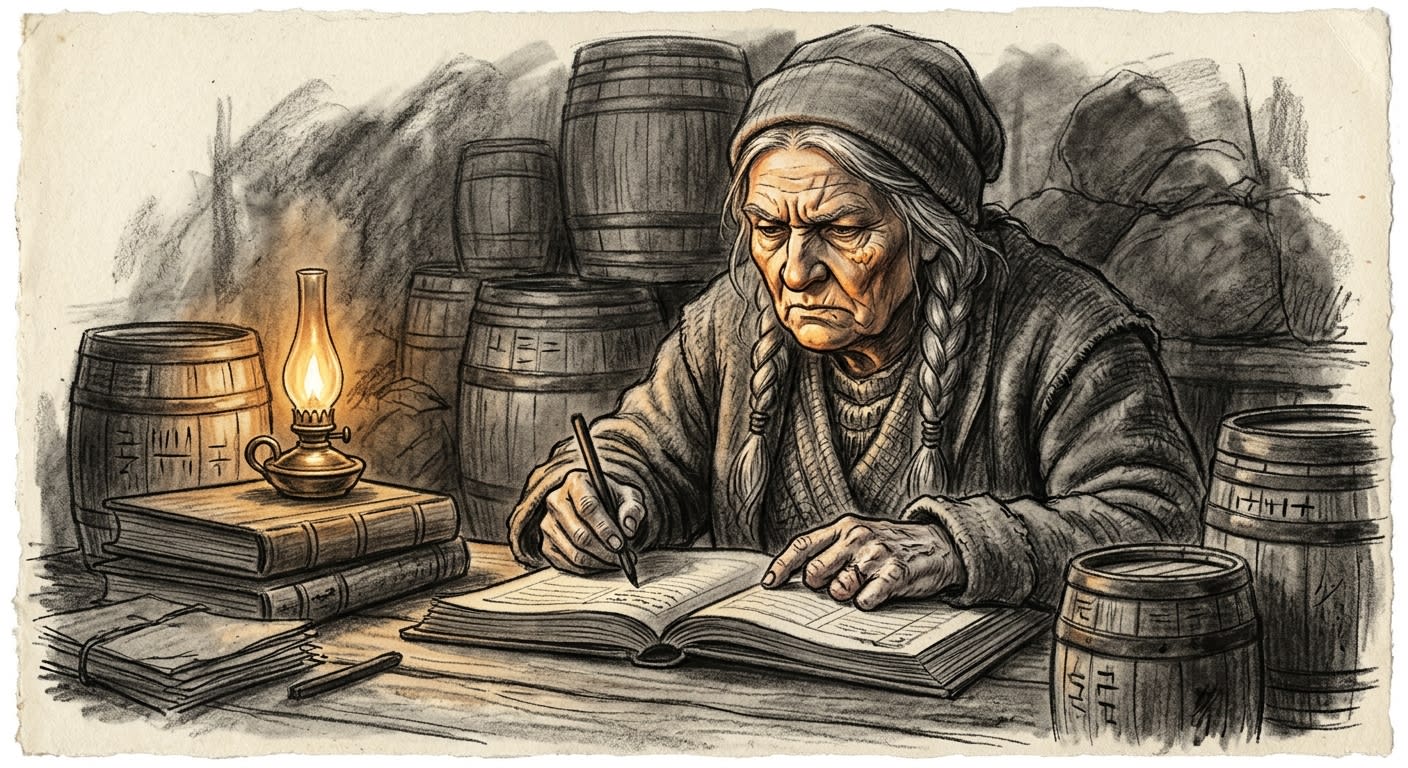
The economy is simple in structure and savage in practice. Seal hunts supply the Render Yards. The Render Yards produce oil. Oil is tithed to the Shrine Chapter in barrels — each barrel carved with notch-codes that serve as ledger entries, because paper rots in the damp and ink runs in the rain, and the North has solved the problem of bureaucracy by carving it into wood. Oil-chits circulate as money. Bone tokens serve for smaller transactions. Lamp-time — hours of light from a communal lamp — is taxed, traded, and confiscated as punishment. A household that falls behind on its oil-tithes or violates a fast decree is designated a dark-house: cut off from communal lamp aid, which in winter is a death sentence delivered by arithmetic.
The imports tell the story the exports conceal. Hrafnvik sends south oil, wicks, and cured hides. From the south it receives grain, iron tools, medicines, and what the locals call warm papers — identity documents, passage permits, exemption writs, ration stamps. The paper is more valuable than the grain. A stamped exemption from a fast decree can save a family. A forged passage permit can move a deserter from the front lines to a fishing village where no one asks questions. The exchange rate between oil and paper fluctuates with the temperature, the seal harvest, and the degree to which Prior Malthus has had a satisfying breakfast.
The Warm Paper Brokers operate out of the Paper Hut at the slipways — southern men, mostly, with clean hands and an instinct for leverage. They trade forged exemptions for oil barrels, counterfeit passage writs for lamp-time, and occasionally, when the desperation is acute enough, they will accept a child's lamp-pin as payment, which is the one transaction that can start a blood feud. The clans tolerate the brokers because the brokers bring paper that keeps people alive. The brokers tolerate the clans because the clans control the only commodity the south cannot produce for itself. The Bureau tolerates both because the Bureau has never successfully sent an auditor to Hrafnvik who returned with complete records. I returned with complete records. The Bureau has not yet asked to see them.
ERRATUM — BUREAU OF RECORDS, NORTHERN PERIPHERAL OFFICE Previous census (A.S. 195) listed Hrafnvik population as 6,200. Revised figure (A.S. 197): 7,400. The discrepancy of 1,200 persons is attributed to "seasonal population flux" and not to the previous census-taker's refusal to count dark-houses. The previous census-taker has been reassigned. His successor is invited to count everyone, including those the clan moot prefers uncounted.
Stamped: Bureau of Records — Northern Desk — A.S. 199
#On the Shrine Chapter and the Clan Compact
The Creator and the Moot disagree on the matter of governance. The oil, as always, abstains.
The formal structure of authority in Hrafnvik is a three-legged stool, each leg convinced it is the table. The Clan Moot — a compact of elders representing the longhouse families — controls the render schedules, the narrows chain, and the ancestral right to decide who freezes. The Shrine Chapter of the Blessed Wick — a Synod-appointed Prior and his three shrine-clerks — controls the paper, the exemptions, the fast calendars, and the thin theological fiction that Hrafnvik is a compliant Synod settlement. The Winter Watch — a militia under Captain Rauk One-Eye — controls the ice roads, the cliff paths, and the practical question of who gets rescued when the whiteout comes.
Elder Sigrun Half-Wick leads the Moot. She earned her name by cutting the wicks of her household's lamps in half during the Seal-Death Winter of A.S. 188, stretching three weeks of oil into seven, losing two fingers to frostbite in the process, and keeping every member of her longhouse alive. She counts barrels the way a Strasbourg prelate counts souls — with absolute authority and no interest in dissent. The render schedules are hers. She sets them at dawn, adjusts them at noon, and enforces them by the simple mechanism of withholding communal lamp-aid from any household that fails to deliver its quota. She has no title the Bureau recognizes. She has no title she requires.
Prior Malthus of the South is the Synod's representative — a polite man from somewhere near Munich whose hands are always warm, whose smile never reaches his eyes, and whose primary talent is the conversion of spiritual authority into practical leverage. He controls the stamp, the exemption papers, and the confession ledger, which in Hrafnvik means he controls the only mechanism by which a person can escape a fast decree, dodge a watch conscription, or obtain passage south when the ice opens. He arrived in A.S. 192, sent by the Bureau of Doctrine's Northern Office to replace a predecessor who had gone native — a phrase that, in the context of the Fractured North, means the man had begun eating seal meat without complaint and had stopped filing his quarterly compliance reports. Malthus files his reports on time. His oil-lamp burns imported wax, not rendered fat. He is feared, and he is useful, and these are the same quality expressed in different registers.
Watch Captain Rauk One-Eye commands the Winter Watch — thirty-odd men in fur cloaks with lamp-pins on their collars and the settled conviction that the weather is trying to kill them personally. He lost his left eye to a fishhook at age fourteen; the socket was packed with rendered fat and sealed with a prayer by the shrine-clerk, which constitutes field surgery in the Fractured North. He listens to the fog. He says the fog speaks. The Bureau of Doctrine classifies this as "localized superstitious affect." Rauk classifies it as information. His patrols have a lower casualty rate than any other Watch post in the northern periphery, which suggests that either the Bureau or the fog is wrong, and the Bureau does not have a perfect record.
The true governance of Hrafnvik operates beneath these three pillars, in the gap where their jurisdictions fail to overlap. The Clan Moot sets the render schedules; the Shrine Chapter sets the fast calendars; the Watch sets the patrol routes. When the schedules, the calendars, and the routes align — which is to say, when all three authorities agree on how much suffering is necessary and who should bear it — Hrafnvik functions. When they do not align, the settlement fractures along its oldest fault line: warmth versus paper, clan versus Synod, the people who produce the oil versus the people who stamp the permits that allow the oil to move.
#On the Doctrine of the Lamp
In Strasbourg, faith is measured in ink. In Hrafnvik, faith is measured in hours of light.
The Shrine Chapter of the Blessed Wick maintains a doctrine that the Bureau of Doctrine in Strasbourg has never formally ratified and has never formally condemned — a theological limbo that suits both parties, since ratification would require the Bureau to understand it and condemnation would require the Bureau to replace it with something that works in a fjord.
The doctrine is this: light is grace, and its distribution is a sacrament. A lamp lit in a shrine is a prayer made visible. A lamp extinguished in spite is a heresy. A household's lamp-time — the hours of light allocated from communal oil stores — is a measure of its standing before the Creator, the Moot, and the Shrine Chapter, in an order that varies depending on who is speaking. Lamp-debt — hours owed, withheld, or confiscated — is both an economic instrument and a spiritual judgement. To be in lamp-debt is to be in sin. To be a dark-house is to be damned.
The fast calendars are where doctrine becomes cruelty — or discipline, depending on one's altitude above sea level. The Shrine Chapter mandates fasting days tied to the liturgical calendar, extended by local observance, and enforced by clan honour rather than Bureau writ. Breaking a fast makes a person un-counted — removed from the communal tally, denied lamp-aid, denied passage priority, denied the small mercies that keep a body alive through the long dark. The propaganda line from the Shrine Chapter reads: "Fasting purifies the North." The counter-narrative from the dark-houses, whispered through the frost pits and unlit coves, reads: "Fasting makes the weak disappear."
Both statements are true. The Bureau prefers the first.
The bell-schedule is the deeper schism. Strasbourg mandates a standardized bell-rhythm for all Synod territories — the Bell Codex of A.S. 115, ratified, sealed, and non-negotiable. Hrafnvik's shrine-bells ring something older. The deployed garrison at Bastion-Königsberg, which sits at the uncomfortable hinge between Strasbourg's bureaucratic apparatus and the Fractured North's clan-faith, has documented the dissonance that results when the Northern Carillon rings the Strasbourg standard and the fjord-bells ring their ancient pattern simultaneously. The Bureau of Bells classifies this as "acoustically non-canonical." The garrison chaplains classify it as "deeply unpleasant." The Fractured North has its own name for it: they call it the argument, and they have been having it since before the Synod existed.
ERRATUM — BUREAU OF BELLS, NORTHERN OFFICE Previous notation (A.S. 195) described the Hrafnvik bell-schedule as "non-compliant but harmless." This assessment is revised. The bell-schedule is non-compliant. Whether it is harmless depends on one's definition of harm, one's tolerance for dissonance, and one's willingness to entertain the possibility that the fjord-bells were tuned against something the Bell Codex has not catalogued.
Stamped: Bureau of Bells — A.S. 199
#On the Fjord and What It Answers
The fog speaks. The Bureau has opinions on this. The fog has opinions on the Bureau.
The anomaly is classified as Category Two Localized Acoustic Distortion, Subcategory: Responsive. In practical terms, it means the fog talks back.
On certain nights — windless nights, when the fjord surface goes flat as poured lead and the air thickens to a substance closer to cloth than atmosphere — voices emerge from the fog. They repeat prayers. They repeat confessions. They repeat names. The repetitions are never exact. A prayer returns with the wrong saint invoked. A confession returns with a sin the speaker did not commit. A name returns pronounced in a cadence that belongs to someone dead.
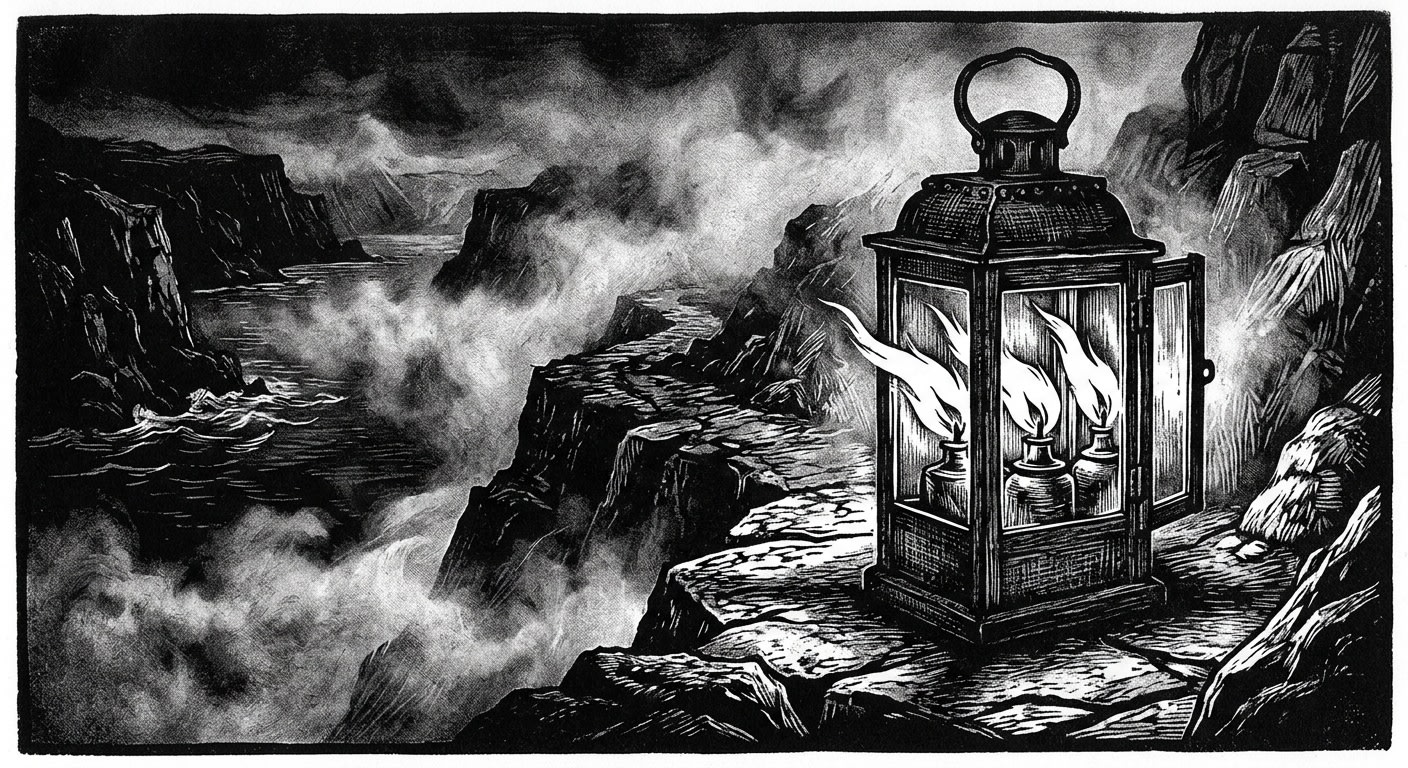
The countermeasures are local and pre-Synodal. Triple-wick lanterns burn on the paths where the fog is thickest — the locals say three flames confuse whatever is listening. Salt circles mark the boundaries of safe ground, refreshed after every tide. Silence rules govern certain routes: speak on the cliff path to Watch Cairn Nine, and the fog will learn your name. Walk silent, and it cannot find you. Or so the Watch insists. The Bureau of Rites sent a survey team in A.S. 199. The team spent four days at Hrafnvik. Their report was three sentences long. The first sentence described the acoustic phenomenon. The second sentence recommended further study. The third sentence requested reassignment.
The locals have a saying: "If the flame leans seaward, don't follow your own thoughts." I inquired after the meaning. Elder Sigrun told me the flame leans seaward when the fog is listening. Watch Captain Rauk told me the flame leans seaward when the thing under the water is hungry. Prior Malthus told me the flame leans seaward because of barometric pressure differentials in the fjord microclimate.
All three were lying, but only one of them knew it.
#On the Dark-Houses and the Hidden Lamp
The Synod counts its faithful. The faithful count their oil. The uncounted count their breaths.
Beneath the formal structure of Moot, Chapter, and Watch, there exists a fourth faction — unregistered, uncounted, and sustained by the kind of desperate mutual aid that bureaucracies are designed to prevent. They call themselves the Dark-House Circle, and they exist because the system that keeps Hrafnvik alive also produces a surplus of the dying.
A dark-house is a household stripped of communal lamp-aid. The reasons are various: failed fast, unpaid oil-tithe, a confession that displeased the Shrine Chapter, a quota shortfall attributed to theft rather than scarcity. The punishment is administrative — a line drawn through a name in the Chapter's ledger — and the consequence is material. No lamp-aid means no light. No light means no warmth. No warmth, in a Norwegian winter, means a countdown measured in days.
The Dark-House Circle steals wicks from shrine lamps. It hides oil in the frost pits under false inventory tags. It maintains unlit routes through the settlement — paths in the dark, navigable by touch, connecting the dark-houses to caches of fuel that do not appear in any ledger. The circle has no leadership the Bureau can identify, no hierarchy the Moot acknowledges, and no theology the Shrine Chapter can prosecute. It operates on a single principle: no child freezes because a clerk drew a line.
The thing that sustains Hrafnvik — that keeps the lamps burning with their uncanny steadiness, that makes the oil last longer than rendered animal fat has any physical right to last — is not addressed in the Shrine Chapter's theology, is not recorded in the Bureau's classification, and is not spoken of by anyone except Watch Captain Rauk, who speaks of it by looking at the water and saying nothing.
Something lives in the fjord. The oil burns because the fjord feeds it. The prayers are repeated because the fjord listens. The lamps burn steady because the devotion — the fasting, the tithing, the pain of the cold and the cost of the light — is consumed by whatever rests beneath the black water, and in consuming it, the thing gives back a fraction of what it takes. The shrines were built here because the lamps stayed lit. The lamps stayed lit because the shrines were built here. The circle closes. The oil burns. The fjord feeds.
The Bureau knows this. Not officially — officially, the fjord is a body of saltwater subject to tidal patterns and barometric variation, and the oil's anomalous caloric persistence is pending classification. But the Bureau knows. It sends a Prior. It sends a census-taker. It sends, once in a decade, a Hieromnemon to assess compliance. It does not send a Legate with a purification order. It does not send the Bureau of Purity. It does not send the Lictors.
Because the oil burns. And the south needs the oil.
#On the Question of the North
The Fractured North does not kneel to Strasbourg. It kneels to the cold, which is older and less forgiving.
Hrafnvik is a model of nothing. It is not a success story — its people fast into famine and trade their identities for barrels of fat. It is not a failure — its lamps burn, its tithes arrive (mostly), and its bell-schedule, while non-canonical, has not yet produced a heresy the Bureau can prosecute. It is a settlement that exists because the geography permits it, the oil demands it, and the Synod — for all its stamps and seals and quarterly compliance reports — lacks the reach to govern it by any mechanism other than polite fiction.
The Fractured North is Synod territory in the way that a man's garden is his garden when the foxes are in it: he owns the fence, he owns the gate, he owns the deed filed at the Hall of Records, and the foxes eat what they please. Hrafnvik kneels to the Concordat. It prays to the Creator the Synod has trademarked. It sends its oil south, where it lights the lamps of garrisons and cathedrals and the Bureau offices where men in clean vestments file reports on settlements they have never visited and will never understand.
The answer, of course, is classified.
Nihil obstat.