
#On the Matter of the North
"The Fractured North is Synod territory. The Fractured North is not Synod territory. Both statements are filed." — Bureau of Doctrine, Northern Correspondence, Classification: Pending (A.S. 162–201)
I will say what the Bureau will not: we do not own Scandinavia. We claim it. We have claimed it since the Concordat, when the Scandinavian jarls — those who survived the Sundering — affixed their seals to a document they did not read, in a language most of them could not speak, in exchange for a guarantee of supply that the Synod has honoured precisely twice in one hundred and thirty years. We have sent missionaries. We have sent inspectors. We have sent, on four occasions that the Bureau of War will confirm and two that it will not, armed delegations carrying conversion mandates sealed in red wax and good intentions that did not survive first contact with a Norwegian winter.
The missionaries returned. Most of them. They reported that the Fractured North was faithful, which was true; that it was obedient, which was generous; and that it was integrated into the Synod's ecclesiastical apparatus, which was a lie so vast that the Bureau of Doctrine filed it without comment, because commenting would have required admitting that the Bureau's Northern Office had failed to achieve in a century what a handful of fjord-elders achieved in a single generation with nothing but fish, fear, and a bell-schedule older than the Basilica.
The Fractured North is not a nation. It is not a province. It is not a diocese, a march, a prefecture, or any other administrative unit the Bureau of Records has invented. It is a condition — a state of geographic isolation, theological stubbornness, and jurisdictional ambiguity that has persisted since before the Synod existed and will persist, I suspect, after the Synod's filing cabinets have rusted to dust.
What it is, in practical terms, is this: approximately two million souls scattered across the Norwegian coast, the Swedish interior, the Danish approaches, and the Baltic island chains, all of whom worship the same Creator as Strasbourg, all of whom acknowledge the same Enemy, and none of whom take orders from the Bureau of Doctrine without a thirty-year argument conducted in writing, by longboat, at a pace that makes the Queue Road look efficient.
#On the Geography and Its Defences
"The fjords are the walls. The ice is the moat. The Scandinavians are the garrison. The Synod's contribution is the paperwork." — Castellan-Warden Halvorsen, private correspondence (A.S. 198)
The Creator, in His infinite strategic wisdom, built Scandinavia as a fortress before the Great Deceiver gave Him reason. The Norwegian coast is a shattered labyrinth of fjords, each one a drowned valley between granite walls that rise six hundred feet from black water. The Swedish interior is pine forest and frozen lake, traversable in summer by those who know the paths and in winter by those who wish to die. The Danish approaches are flat, yes — but flat across water, across the Skagerrak and the Kattegat, across channels where the Baltic current runs cold enough to kill a man in four minutes and the fog rises thick enough to hide a fleet.
No army has entered Scandinavia from the east. The Baltic is the barrier — and what the Baltic contains, the Scandinavians call det grå vattnet, and the Synod calls "Unknown Forces, Extradoctrinal Classification Pending," and I call the reason the Bureau of War does not station a conventional garrison north of Königsberg.
The settlements cluster along the fjord-coasts and the sheltered inlets, where the fishing is possible and the wind merely cruel rather than actively homicidal. The interior is sparse. The mountain passes between Norway and Sweden are maintained by trail-clans whose loyalty to the Synod is theoretical and whose loyalty to their own valleys is the kind of devotion that produces blood-feuds lasting generations. The southern approaches — the Danish flatlands, the Jutland peninsula, the island chains between Copenhagen and the Swedish coast — are the only terrain where the Synod's conventional logistics function, and it is here, accordingly, that the Synod's authority is strongest, which is to say: acknowledged, occasionally obeyed, and never loved.
The population is distributed across approximately nine hundred settlements of varying size — from the great harbour-towns of Bergen and Trondheim, which boast populations approaching thirty thousand and something resembling a municipal government, to the shrinefjord hamlets of the Norwegian coast, which boast populations of four hundred and something resembling a grudge against the southern church that has outlasted the original offence by several centuries. Between these extremes lie the fishing villages, the timber camps, the iron-workings of the Swedish hill-country, and the seal-oil rendering stations that supply both the Northern settlements and, through a trade network the Bureau of Tithes has never successfully taxed, approximately one-third of the lamp-oil consumed by Bastion-Königsberg's Harbour Quarter.
#On the Governance, Such As It Is
"The Synod governs by writ. The Fractured North governs by saga. When the two systems collide, the saga wins, because a saga can be recited at a feast with ale, and a writ cannot." — Bureau of Records, Northern Administrative Assessment, A.S. 187
The Fractured North is governed by the Clan Moot — or rather, by a constellation of Clan Moots, each sovereign over its own valley or fjord or island chain, each bound to its neighbours by a web of marriage-alliances, trade-obligations, and ancestral grievances so dense that the Bureau of Records' attempt to map them in A.S. 174 produced a chart eleven feet wide that the Bureau's own archivists described as "technically correct and practically useless."
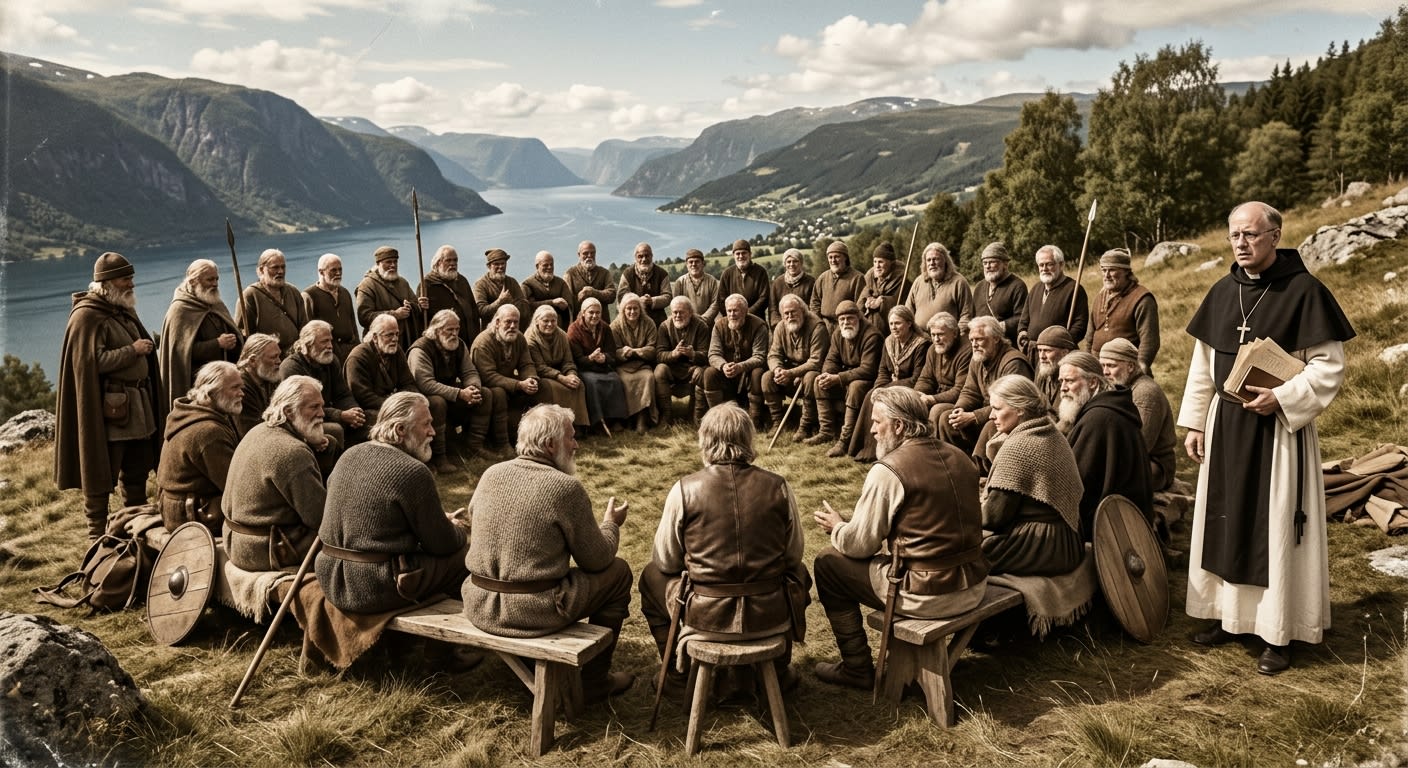
The Moots meet seasonally. The All-Moot — the grand assembly that settles disputes between clans and negotiates the Fractured North's collective relationship with the Synod — convenes at midsummer in a rotating location, traditionally a field near whichever harbour-town lost the argument about hosting. The All-Moot has met every year since the Concordat. The Synod has been invited to attend on four occasions: A.S. 92, A.S. 130, A.S. 174, and A.S. 193. On each occasion, the Synod's representative arrived to find that the portion of the agenda concerning Synod relations had been scheduled for the final day, and that the final day's proceedings were conducted in Old Norse, at speed, while the assembly consumed quantities of mead that the Bureau of Temperance would classify as a theological emergency.
The Synod's formal representative in the Fractured North is the Prior — a Strasbourg-appointed clergyman stationed in one of the larger settlements, tasked with maintaining doctrinal compliance and reporting to the Bureau of Doctrine's Northern Office. The role is, by universal acknowledgement, a punishment posting. The current generation of Priors — there are eleven, stationed from Bergen to the Lofoten Islands — are men of varying competence and uniform misery, dispatched to the North for reasons that range from bureaucratic disfavour to genuine missionary zeal, which in practice amounts to the same thing. They maintain chapels. They conduct services. They file quarterly compliance reports that the Northern Office receives, stamps, and stores in a cellar that floods every spring.
The Priors do not govern. Governance belongs to the elders — the clan-heads, the fjord-wardens, the council-women whose authority derives from bloodline, reputation, and the pragmatic calculation that a community of four hundred souls, cut off by ice for five months of the year, cannot afford to obey anyone who does not know where the fish run and when the passes close. The elders tolerate the Priors. Some of them like the Priors. Elder Sigrun Half-Wick of Hrafnvik once described her settlement's Prior as "a decent man, for a southerner, who has learned to gut a cod and has mostly stopped trying to correct our hymns," which is, by Scandinavian standards, high praise.
#On the Faith of the North
"They believe. God help us, they believe harder than Strasbourg. They simply believe differently, and the difference is the kind the Bureau cannot prosecute without losing the entire coast." — Bureau of Purity, Internal Assessment (A.S. 190), Classification: Amber
The Fractured North is faithful. This is the fact that torments the Bureau of Doctrine more than any heresy, because heresy can be burned and faith cannot. The Scandinavians worship the same Creator, revere the same saints — supplemented by a local calendar of Northern martyrs the Bureau has neither ratified nor had the courage to condemn — and observe the same liturgical year, adjusted for the realities of a latitude where midwinter darkness lasts twenty hours and midsummer daylight lasts the same, which means the festival calendar bears a relationship to Strasbourg's that is seasonal rather than identical.
They fast. They fast harder than Strasbourg mandates, in fact, because the Bureau's fasting regulations were written for a continent where grain is available and winter lasts four months, and the North's winters last seven and the grain does not grow at all, which means the Scandinavian definition of "fasting" overlaps considerably with the Scandinavian definition of "January." The Lore Book records that ritual fasts stretch into famine. This is true. It is also true that the Scandinavians do not distinguish between the two with the precision the Bureau of Doctrine would prefer, because the Bureau's theology of voluntary suffering presupposes that suffering is voluntary, and north of Bergen, suffering is the weather.
The bell-schedule is the crux. Every other doctrinal deviation — the local saints, the adjusted calendar, the supplementary hymn-cycles that incorporate pre-Concordat chant forms the Bureau of Orison has never approved — could be absorbed, reclassified, or ignored, as the Bureau has done with the minor heresies of the Iberian periphery and the liturgical eccentricities of the British Crown. The bell-schedule cannot be absorbed because the bell-schedule works.
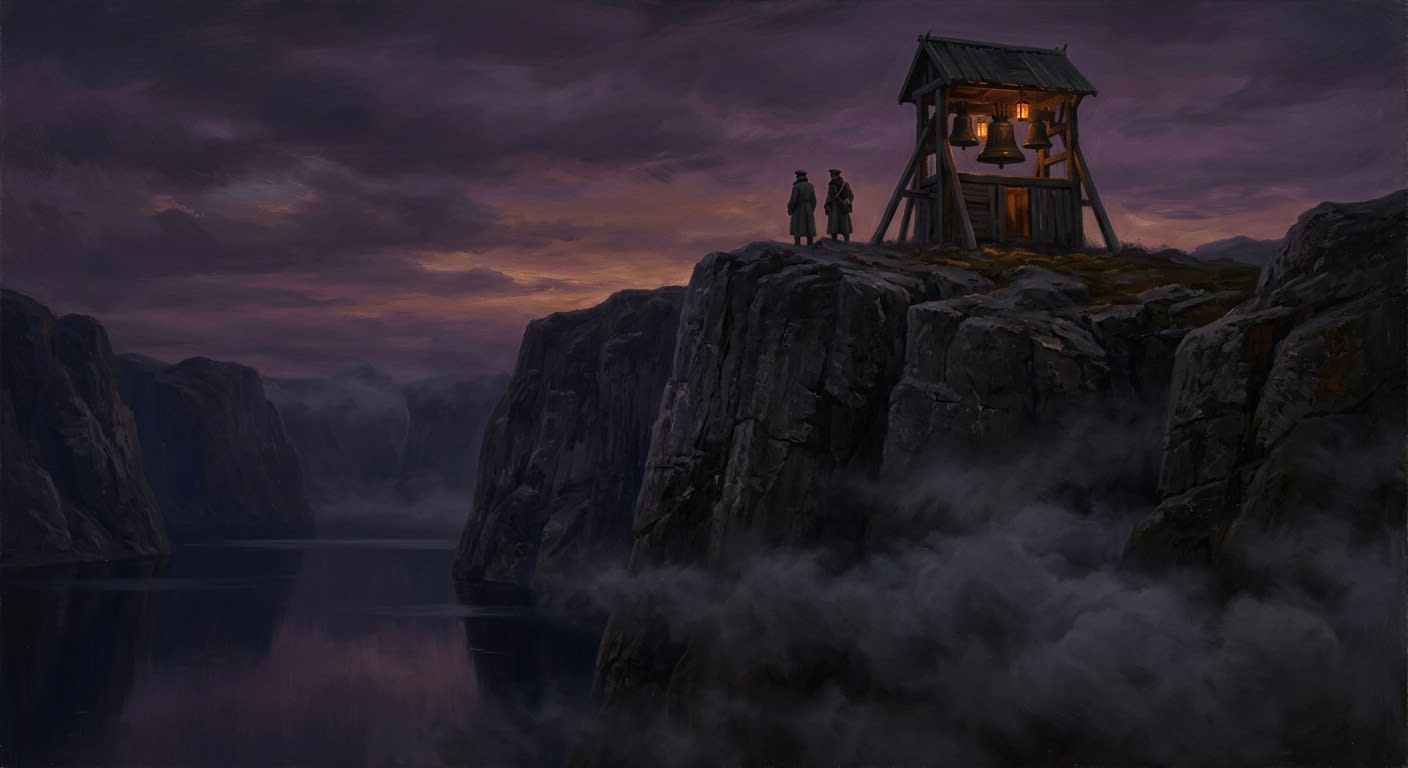
The fjord-bells of the Fractured North do not ring the Strasbourg standard. They ring something older — tunings that predate the Concordat, predate the Synod, predate, if the Scandinavians are to be believed, the Sundering itself. The Bureau of Bells has classified these tunings as "pre-Concordat folk tradition, unverified, and theologically naive." The Bureau of Bells has also requested copies of the old tunings three times, and been refused three times. The third refusal, as the Königsberg entry records, was accompanied by a demonstration at sea. What happened at sea is in a file the Bureau of Shadows holds. The Bureau of Doctrine does not discuss it. I am not permitted to describe it.
I will say this: the fjord-bells were tuned against det grå vattnet. The Grey. The thing in the Baltic that Königsberg's garrison faces every day and cannot name and cannot classify and cannot kill. The Scandinavians have been fighting it — or containing it, or negotiating with it, or performing whatever it is their bells do — for longer than the Synod has existed. They have not asked for help. They have not explained their methods. They have, on three occasions, demonstrated their methods at the Bureau's request, and the Bureau has, on three occasions, decided it would prefer not to understand.
ERRATUM — BUREAU OF BELLS, NORTHERN OFFICE. Previous filing (A.S. 186) classified all non-standard bell-tunings in the Fractured North as "deprecated liturgical variants requiring harmonization." This classification is suspended pending the outcome of Investigation 447-N, which has been pending since A.S. 186 and will continue to pend until the Bureau of Bells determines whether harmonization is possible without also harmonizing whatever the bells are tuned against.
Stamped: Bureau of Bells — A.S. 199
#On the Economy of Scarcity
"In Strasbourg, wealth is ink. In the North, wealth is warmth." — Prior Malthus of Hrafnvik, letter to Bureau of Doctrine (A.S. 198)
The Fractured North trades in three currencies: fish, oil, and obligation. The Synod's coinage circulates in the southern harbour-towns where trade with Hamburg and the Danish ports makes it necessary; north of Bergen, coins are ornamental at best and, at certain altitudes, less valuable than a good knife.
The seal-oil economy is the spine. Rendered seal-fat fuels the lamps of every settlement from Stavanger to the Lofoten chain, and the quality of Northern seal-oil — its uncanny burn-duration, its steadiness in wind, its refusal to gutter in conditions that extinguish every other fuel source on the continent — has made it an export of genuine strategic value. Königsberg purchases Northern seal-oil through intermediaries. The Bureau of Tithes has attempted to tax this trade on six occasions. On six occasions, the oil shipments have ceased until the tax was withdrawn, and the Bureau of Tithes has learned — slowly, expensively, and with the institutional reluctance of a bureaucracy that believes taxation is a sacrament — that the North's oil is available on the North's terms or not at all.
The fishing fleets are the other artery. The North Sea and the Norwegian Sea yield cod, herring, and halibut in quantities that feed the settlements and generate a surplus traded south for grain, iron, and the one commodity the North cannot produce: paper. The Bureau of Records insists on paper documentation. The Fractured North has no paper mills. This creates a dependency the Bureau has exploited and the Scandinavians have resented for a century, producing a thriving black market in forged warm-papers — the Bureau's term for the Northern transit documents that permit travel between settlements — and a corresponding Bureau of Purity investigation that has been "ongoing" since A.S. 174 and has produced no arrests, because arresting a Scandinavian elder for forging papers requires first reaching the elder's settlement, and reaching the settlement requires a warm-paper, and the warm-paper requires the elder's stamp.
#On the Watch and Its Silence
"We do not build walls. The water is the wall. We ring the bells. The water listens." — Elder Sigrun Half-Wick, to the author (A.S. 197)
Every coastal settlement maintains a Watch — a rotating guard of men and women who tend the cliff-fires, man the bell-towers, and observe the water. The Watch is not a military force in any sense the Bureau of War would recognise. There are no uniforms, no ranks beyond the Watch Captain, no standardised equipment, no drill schedules, no Bureau-certified training protocols. The Watchers carry axes, harpoons, and lanterns. They know the tides. They know the fog-patterns. They know when the water changes colour, when the current slows wrong, when the surface goes flat as poured lead and the air thickens in the way that means something is listening.
They do not discuss what they watch for. The Bureau of Doctrine's Northern Office has filed seventeen requests for a formal threat assessment from the Fractured North's Watch Captains. Seventeen requests have received the same answer, delivered in varying degrees of politeness: the Watch watches. What it watches for is the Watch's business. The Bureau may send an observer if it likes. The observer will be fed, housed, given a post on the cliff, and told nothing whatsoever about what they are observing.
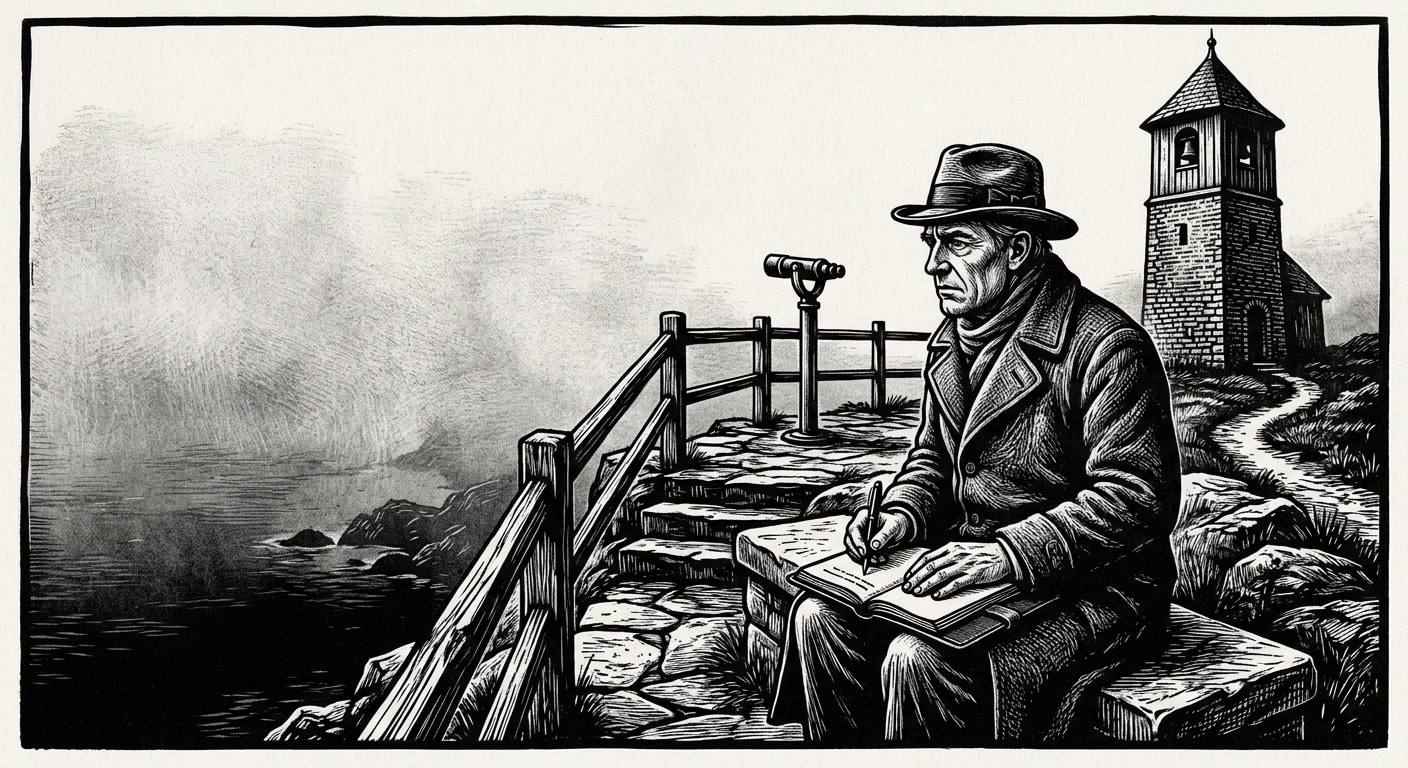
The Bureau sent an observer. Once. In A.S. 178. The observer was a Bureau of Rites classifier named Aldric Moen, dispatched to assess the theological status of the Watch's bell-ringing practices. Moen spent six weeks at a cliff-post near Bergen. His report, filed upon his return to Kanzleiburg, ran to three pages. The first two pages described the weather. The third page contained a single sentence: "The bells work. Do not change them." The Bureau of Rites classified the report as "inconclusive" and reassigned Moen to the Paper Mines of Ulm, which was unjust, and which I record here because injustice is the Bureau's preferred method of handling conclusions it did not want reached.
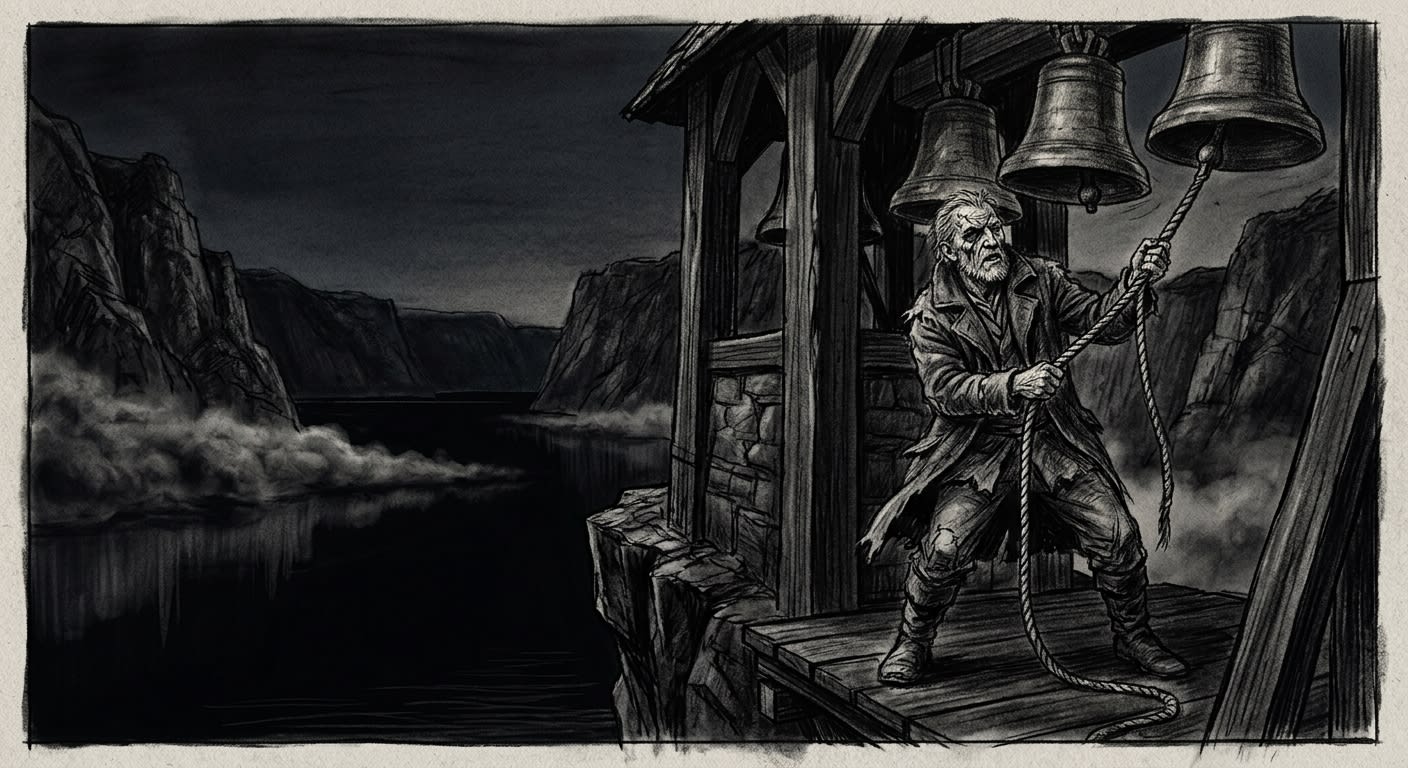
The Watch's bell-sequences are the North's true weapon. I will not describe them — not because they are classified, though they are, but because description would require a vocabulary the Bureau of Bells does not possess and I do not pretend to command. The sequences are not hymns. They are not the calibrated peals of the Bell Codex. They are older, stranger, tuned in intervals that the Bureau's standard pitch-gauges cannot measure and that produce, in the listener, a sensation the Watchers call klangro — "bell-peace" — and that I, standing on a cliff above a black fjord at three in the morning while the fog pressed against the waterline like something leaning on a door, can only describe as the sudden, absolute conviction that something very large had just decided not to come closer.
#On the Present Condition
The Fractured North endures. It has endured the Sundering, the Great Retreat, the Concordat, a century of bureaucratic neglect punctuated by bursts of bureaucratic interference, the loss of its eastern trade routes to the Grey, the slow encroachment of the Baltic fog, and the steady drain of its young men and women south to the Line, where they serve with a quiet competence that their commanding officers praise and their Bureau of Purity supervisors find unsettling.
The population declines. It has declined every decade since the Bureau of Records began counting, which was A.S. 130, and which the Scandinavians regard as an intrusion they have tolerated by the simple expedient of giving the census-takers numbers that are plausible, consistent, and wrong. The true count — the count the elders keep in their heads, in the oral ledgers that no Bureau has ever successfully committed to paper — is lower. How much lower, I cannot say. The elders will not tell me. They will not tell the Bureau. They consider their population a tactical matter, and they are correct: a people whose only defence is the distance between their settlements and the competence of their Watchers does not advertise its numbers to an empire that conscripts.
The young leave. They leave for Königsberg, where the garrison pays in coin and the food is warm. They leave for Hamburg, where the shipyards hire without papers. They leave for the Line, where a Scandinavian axe-psalter — a soldier who can fight and pray simultaneously, a novelty the Bureau of War has learned to value — is worth three southern conscripts. They do not come back. The fjords grow quieter. The bell-towers require fewer ringers because there are fewer settlements to ring for. The Watch grows thinner.
ERRATUM — BUREAU OF RECORDS, NORTHERN CENSUS OFFICE.
Population estimates for the Fractured North (A.S. 195) recorded approximately 2,400,000 souls across eleven Prior-districts.
Revised figure (A.S. 200): approximately 1,900,000, pending verification the Bureau acknowledges it will never receive. The decline is attributed to emigration, not attrition. The Bureau of War's recruitment records for the Northern Theater suggest the true emigration figure exceeds the Bureau of Records' estimate by a factor the Bureau of Records would prefer not to calculate.
The Grey presses. It presses in the Baltic, where the fog has expanded its range from the eastern approaches to the central channels over the past decade, and where fishing vessels now report encounters at latitudes that were clear water ten years ago. The Scandinavians do not discuss the Grey's expansion with the Bureau. They discuss it with their bells, in sequences the Bureau cannot hear and would not understand if it could.
And the bells still ring. In the fjords, on the cliffs, across the black water where the fog gathers and the thing beneath the surface listens — the bells still ring. They ring in tunings the Synod did not teach, against an enemy the Synod cannot name, with a faith the Synod did not create and cannot claim and should not, if the Bureau has any remaining capacity for wisdom, attempt to correct.
The Fractured North kneels. It has always knelt. It kneels to the cold, which is older than the Synod, and to the water, which is older than the cold, and to whatever it is that the bells hold back, which is older than all of us, and which has been patient, and which does not explain itself, and which the Scandinavians — alone among all the peoples of this continent — do not pretend to understand.
They simply ring the bells. And the bells work.