
#On the Tribunal's Charge
"Never argue with a stamp." — Proverb of the Orchard
When a manifest at Bastion-Przemyśl does not close, the difference is entered in red, carried to Taghouse Row and given a name. That is the whole charge of the Logistics-Penance Tribunal. The rest is procedure.
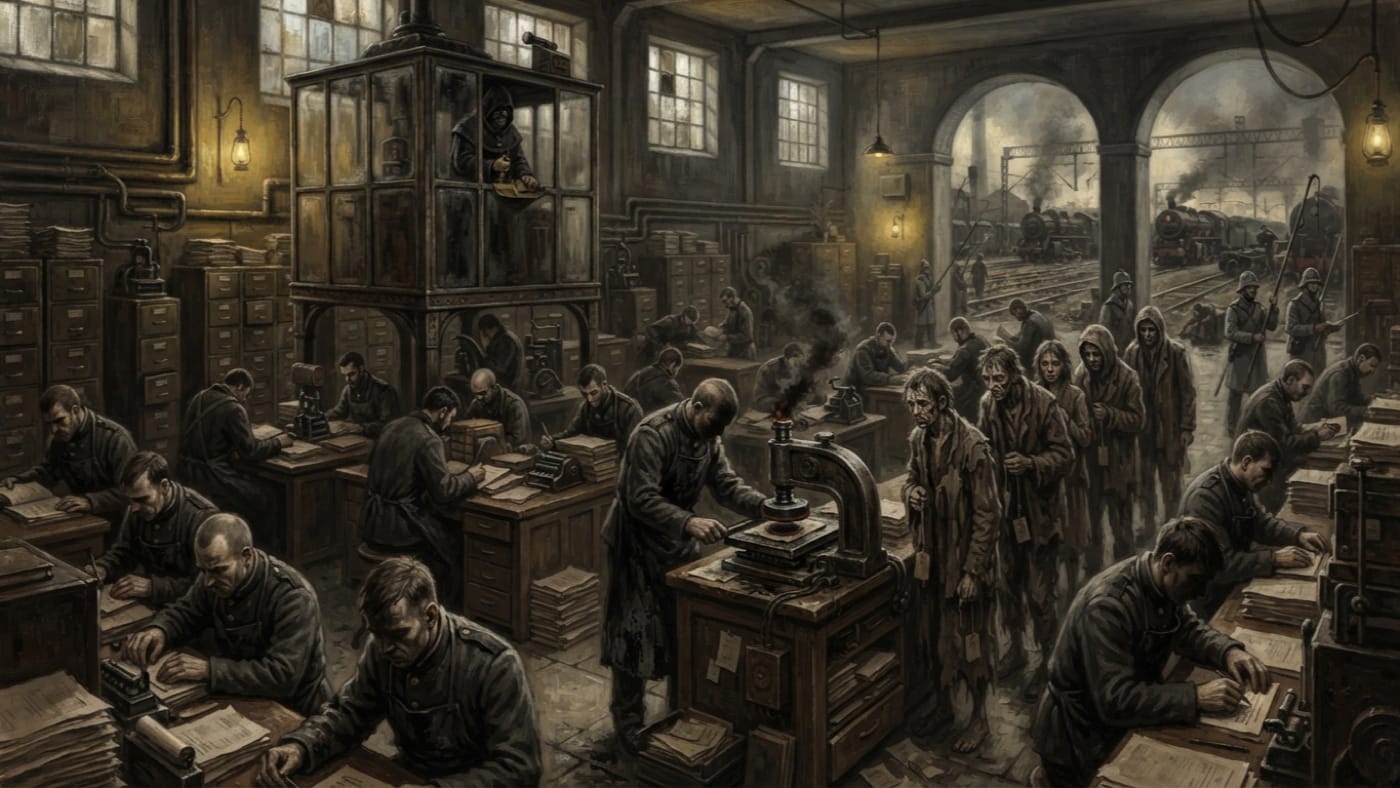
The Tribunal is a Synod office. It sits among the permit halls and stamp counters of the old fortress core, at the rail throat of the Sagittal Line. A manifest discrepancy sets it working: a rail car lighter than its waybill, a ration column fatter than the census, or a tag that came back when it ought to have stayed out. It has three methods, audit, confession and erasure. It uses them in that order when it has time and in any order when it does not. In public the Tribunal exists to keep the ration arithmetic fair. Its clerks describe the work more briefly in the lockhouse taverns after the curfew bell. They balance ledgers. When a ledger will not balance on paper, they balance it in persons.
Authority at Przemyśl stands on three legs. The Synod Chapterhouse issues decrees, the Tribunal audits and corrects, and the Provost-Marshal enforces with squads in ash-grey. Tribunal clerks keep the books. Inquisitor-visitors arrive to examine them, and provost squads collect whatever the books conclude. A man convicted of repeated paper crimes is fitted with an oath-collar. The collar is the only document in Przemyśl that never needs renewal.
#On Paper Validity
"A tag is warmer than a coat." — Proverb of the Orchard
Three objects must be kept apart. A ration tag is a small wax-sealed slip stamped with two dates, issuance and expiry. Between those dates its bearer may eat, sleep under a roof and appear in the ledger of the Bureau of Records. The interval is counted in life-days, and the locals count it as a priest counts beads. A seal blank is the unstamped wax disc from which every legitimate seal is pressed. It passes as currency, and the Candleworks pour it under the monopoly of the Sealwright Guild. A stamp die is the cut-steel instrument that gives a blank its authority. A tag is a life, a blank is the price of one, and a die is a mint for them.
Renewal happens at the Stamp Hall, the narrowest throat in the bastion. No stamp means no rail, and no rail means no food. Freight clearances and ration renewals pass the same counters under the thud of the same presses. A grain brick waiting on a manifest seal is in no better case than a laborer waiting on his. The queue smells of hot wax, wet paper and the cabbage boiled in the Rail-Throat Yards. A tag held too long against the skin goes damp. A damp tag smears, and a smeared date is a discrepancy.
The Tribunal need not kill a man whose tag has lapsed. It removes his record, and that record was the only thing holding his bread, his bunk and his name together. The street calls this paper-grave, erasure while alive. The Erased keep breathing for a while. The bastion arranges itself so that breathing becomes inconvenient.
#On Penance and Correction
"You can't eat truth." — Proverb of the Orchard
Przemyśl owes the Church four tithes: a share of each ration, a reckoning of labor-hours, duty on the wire and a quota of confessions. The last is the Tribunal's raw stock. Confessions are heard in the Chapel of Counting, copied onto slips, indexed and filed in the vaults beneath the chapel floor. There they wait until a column needs them. A slip admitting idleness can cut a ration assessment. A slip admitting a borrowed tag can open an audit. A slip admitting nothing in particular can be read, by a pious enough clerk, as an admission of everything.
The office's vocabulary is exact. I reproduce it because the Tribunal prefers its terms to its acts. Administrative correction means disappearance. Friendly severance is execution, with the paperwork filed afterwards. Confession reassignment is forced labor or exile, usually to whatever post the Ledger Bailiffs have found short of hands. A debtor may pay his day-debt in any of these coins, and the Tribunal does not insist on one. That is its mercy.
The bastion's chronicle lists a fire in the wire grid that stamped thousands invalid in a single night. Next it lists a reform: the Tribunal was installed, and confession became ration logic. The chronicle gives no year. It does not say whether the office was raised before or after the Concordat of Strasbourg gave the Synod its formal constitution. If before, the chronicle's word "Synod" is a later courtesy. I decline to supply the year on its behalf. The doctrine survives without a date: sin is a debit, bread is a credit, and the penitent is the column where they meet.
#On the Morning Balance
"Dawn is a knife with paperwork." — Proverb of the Orchard
Before the first bell, the Provost's harvest patrols go out into the Orchard Ring with hooked poles. They come back with tags on strings: ration tags, transit chits and identity tags, taken from whatever the wire held overnight. The division of labor is old and jealously kept. The Provost patrols and recovers. The Tribunal audits and corrects.
Recovered tags go into the morning ledger against the day's projected intake. When the count agrees, the ledger is read aloud at the public reading and the bastion goes to work. When incoming tags exceed the projection, the Tribunal adjusts. The adjustment follows no published formula, and the selection follows no published procedure. What is published are the harvest boards in Taghouse Row, lists of names posted at curfew. The lists standing at dawn do not always match them.
The street reads the boards its own way: they take whoever balances the week. It talks of staged captures, of tags planted on sleepers, and of a bounty paid by the string. It pays a dawn tax to keep the patrols walking past its door. It touches no one's tag string uninvited, since a tag in the wrong hand is a discrepancy waiting to happen.
"Only deserters are harvested." — Public assurance of the Orchard Ring, repeated at the harvest prayer.
Withdrawn from this entry. The Orchard Wardens are recorded as seeking harvest authority beyond deserters, and the morning ledger is balanced against projected intake rather than against desertion. The assurance remains in liturgical use. The Codex no longer repeats it as fact.
#On the Holders of Authority
"Names are heavier than bodies." — Proverb of the Orchard
No single holder owns the Tribunal. Three hold what it cannot work without.
Archivist-Prelate Odran Kelle keeps the confession vault beneath the Chapel of Counting. Kelle filed every slip the Tribunal reads before the Tribunal read it. The threat of erasure that hangs over Taghouse Row comes out of his drawers. Sealwright-Master Joryn Malk controls the wax blanks and the stamp dies. His guild's monopoly keeps the Tribunal's raw material scarce, so a correction can be delayed for want of wax as easily as a confession can hurry it. Provost-Marshal Vanna Rook commands the dawn harvest. Without that force, a Tribunal verdict is a sentence written on damp paper.
Below them, the bastion's appetite is ranked with liturgical clarity. Synod and Provost eat first. Guild sealwrights eat and fear audit. Laborers eat sometimes, prisoners and draftees freeze, and the Erased stand below the floor of the ledger itself. The Rail-Throat Consortium can choke a freight clearance at will. The Underwire Runners sell forged papers and escape routes in the galleries. The Gleaners shelter the uncounted and swap tags between the living and the recently dead, which the Church counts as sacrilege against the Great Ledger of Souls. In the Tribunal's arithmetic, each of them is a remainder.
At every muster the garrison recites the Doctrine of Equality Before the Divine: all are equal in the sight of the Creator. Then it walks to a counter where bread is issued by grade. Atheron, Sin-General of Pride, keeps his court across the eastern Carpathian highlands. He works through humiliation, denied advancement and a man's conviction of his own superiority. A clerk who classifies men for a living is fertile ground for that voice, and so is the man the clerk has classified.
#On the Present Discrepancy
"Sometimes the ledgers are wrong." — First clause of a saying of the Orchard. The remainder is not recorded here.
The parent survey reports a stamp die missing from Przemyśl in A.S. 200. A missing blank is a theft. A missing die is a heresy with a serial number. Whoever holds it can press seals no one can tell from the Synod's own. Every tag those seals validate is a life the ledger never authorized and must still feed.
The Bureau of Records' preliminary report adds that the die's serial appears in the records of two bastions at once. The report does not place the die at the second bastion, and it names no thief. The Tribunal's charge is the discrepancy. It has been handed the largest discrepancy in its history and no person to assign it to.
The consequences are already in the arithmetic. Forged tags dilute true ones. A ration economy stamped faster than it is fed inflates. An inflated ledger can be balanced by only two means, more bread or fewer names, and Przemyśl has never had more bread. The Bureau of War has modeled riot and mass erasure if the die stays lost, and has filed the model.
Provost-Marshal Rook has turned the emergency into an argument. The harvest, she maintains, is security rather than supply, and an office that cannot account for its own dies should answer to the command that already walks the wire. Her design is to absorb the Tribunal's authority under Provost command by way of an audit emergency. At this assessment it has not been accomplished. The Tribunal still sits on Taghouse Row, and its clerks still wear ink-black aprons. The presses still fall, and beyond the wall the wire still hisses.
Kelle watches from the vault, and Malk watches from the Candleworks. The die has not been recovered. The column stays open in red, and no name has yet been written against it.