
#On the Ring
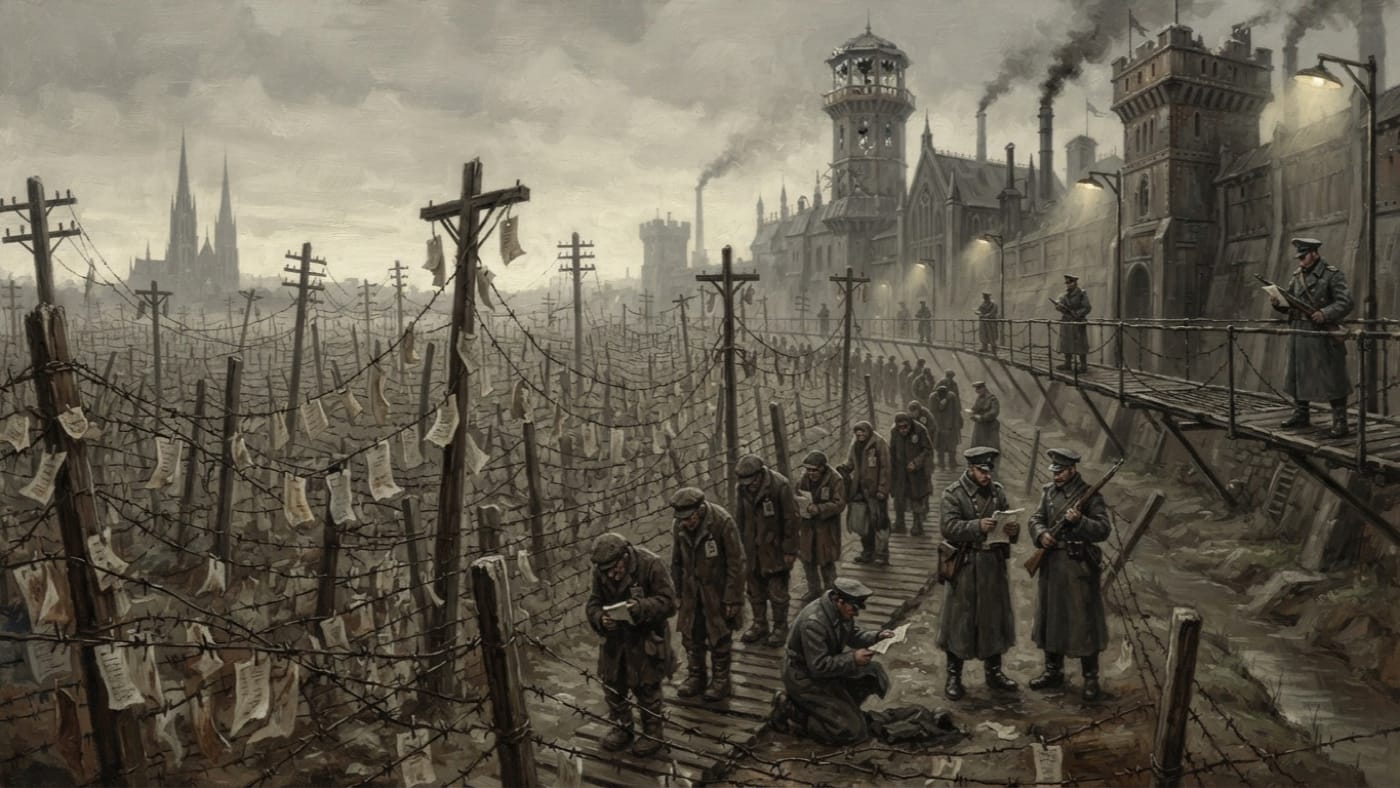
Of the seven districts of Bastion-Przemyśl, the Orchard Ring is the only one a man can be sentenced to stand in. It lies where the bastion's settled works give way to the Wire Orchard, the grid of barbed and electrified strand that the Synod has planted across the western Carpathian approaches with the patience other powers reserve for vineyards. The Orchard is the whole killing ground. The Ring is the inhabited district at its edge, where people queue, mend wire, carry papers and are hanged. Its register entry calls it wire groves and gallows posts. The entry is accurate and should not be read aloud to children.
Beyond the groves, Atheron presses the eastern highlands opposite this stretch of the Sagittal Line and crowns every ridge he holds with a spire taller than the last. The Ring looks back at those spires through a dead orchard of posts and salvaged pylons. From a distance the groves pass for trees. Up close they look like an invoice.
The district announces itself to the nose first: rust, blood-salt, wet rope. Then comes the ear, with the hiss of wind combing the strands, the bells, and the dry crackle of ozone where the live lines run. Then comes the paper. Ration tags, travel chits and confession receipts hang from the barbs in their thousands, swelling in the damp, curling at the corners like wafers left out in the rain. Visitors take them for decoration. Residents know them as evidence.
#On Tags and Passage
The bastion's motto is No tag, no dawn, and the Ring enforces it as liturgy. A provost checks the tag. A clerk checks the seal on the tag. The ration depends on the seal, the lane depends on the ration chit, and the man depends on all three, in that order of importance. Each is checked in turn, and nobody in the Ring has ever been allowed to see the whole of it.
Movement follows the wire. Catwalks run above the lanes, towers stand over the catwalks, and beyond them the bastion's triple cordon of wire, flood-ditch and patrol trench closes the frame. At curfew the bells lock the streets into patrol corridors and the lamps go out, except in the towers. A resident who knows the lanes moves through them carefully. A resident who doesn't learns them once.
The papers themselves are made elsewhere. Wax blanks and stamp dies belong to Sealwright-Master Joryn Malk. The ration arithmetic belongs to the Logistics-Penance Tribunal on Taghouse Row. The confession receipts trace back to the Chapel of Counting, where Archivist-Prelate Odran Kelle keeps the vault. None of these offices need to sit in the Ring to govern it. Their documents hang on its fences, which is presence enough.
Wire-maintenance duty counts as a tithe, and it is paid in skin. The strand bites the hands that mend it, the cuts fester, and the wire surgeons treat them with tar and prayer in proportions I am not qualified to audit. Cutting the grid in daylight is a red line in Przemyśl law. Cutting it with bare hands is a taboo. The Ring's labourers observe both, and their fingers keep the score.
#On the Dawn Harvest
The Orchard Wardens hold the Ring and its towers. They are militia, and their public charge is the security of the grid. Their methods are listed in the bastion register as patrol terror, "accidents" and wire-lane ambush, which tells you what security means once the bells have rung. A cut anywhere in the grid brings them out. They would like their authority to extend further than it does. Provost-Marshal Vanna Rook holds the dawn-harvest authority, and the Wardens are said to resent being its gardeners when they would rather own the orchard.
At dawn, as the ration lines form and the blessing is said, the harvest patrols come back out of the wire carrying bodies and tags. The tags are worth more to the bastion than the bodies. A tag can be read, reconciled and reclaimed in public. A body is filed in the ditch-pits unless someone holds paper for it. The blessing and the cart go on side by side, and the queue does not move for either.
Dawn harvest patrols in the Orchard Ring recover deserters only.
The statement is withdrawn. It was the provost's public assurance, and the bastion's own register now lists it as Przemyśl's famous lie. Street testimony consistently says otherwise, and the Wardens' declared ambition is to widen harvest authority beyond deserters. That ambition only makes sense if the current definition already chafes. The Bureau declines to state who else has been harvested. The tags may know.
Escape traffic runs under all of this through the Underwire's culverts and galleries, and it belongs in that district's file. The Ring sees it only as an absence: a tag string thinner by one, a lane walked one fewer time.
#On the Glass Rain
The Ring's best-documented incident took place in A.S. 194 (1904 CE). It deserves study because it struck a district that runs entirely on everyone accepting who outranks whom.
A burst from the Sun-Spear Legion hit Tower Nine, the Orchard Eye, the overwatch post the Nine-Eyes keep over Przemyśl's sniper lanes. What came down afterwards has entered the record as the Glass Rain. Over a reported radius of a quarter-mile, observation-glass fragments, spectacle lenses, cracked lamp chimneys and polished ration tins each showed a different rank to each man who looked down at them. The garrison then spent forty minutes fighting over promotions.
Corporal Jarek Muth declared himself Marshal of the Outer Wire and ordered a retreat. Private Elya Sorn declared that Muth was enlisted under her spiritual authority and countermanded him, in terms the published account records more bluntly than I will. Then Archivist-Prelate Kelle arrived with a bucket of ash and emptied it over both of them. His report contains no adjectives. I find this sinister in a clergyman.
In other districts such a fit would have been a spectacle. In the Ring it was a mechanical failure. Every transaction there assumes a fixed hierarchy: the provost outranks the tag, the clerk outranks the provost's reading of it, and the Warden outranks the man walking the lane. For forty minutes every person in the radius held a commission from his own reflection. A corporal can't order a retreat through electrified wire without someone more senior agreeing with him, and that morning everyone was more senior.
The surviving account is silent on several matters, and so am I. It does not explain how a lance-strike on a tower made the debris start handing out titles. It records no sighting of one of the Mirror-Lords that day, which makes the incident a reflective disorder of a familiar type without a confirmed author. It gives no casualties, no day of the month, and no later history for Muth or Sorn. It also does not claim that one bucket of ash quieted a quarter-mile. It claims that one bucket quieted two people, and Kelle, who distrusts adjectives, did not stretch it further.
#On the Present Discipline
The Glass Rain did not create the Ring's rules on reflection. It was the first serious test of them. Circular 192-M dates from A.S. 192 (1902 CE) and followed the Switchbox Nine affair. It requires unnecessary reflective surfaces in forward positions to be dulled and essential ones to be logged and watched. The Glass Rain showed what that adjective was worth. A ration tin is necessary because men eat. A lamp chimney is necessary because the towers are lit. Observation glass is the whole purpose of the Orchard Eye. The Circular had no answer for a district that needs its glass and has to pick it up off the ground afterwards.
A fuller answer came out of the eastern salient in A.S. 199 (1909 CE), when Przemyśl's field doctrine against Mirror contact was set down. Its instructions are crude and they work. Dull whatever can be dulled. Put the essential optics under named supervision. Let no one judge his own reflection without a witness who mildly dislikes him. Under pressure, recite the inventory aloud: boot, tag, cartridge, the man on your left, the order actually heard. Throw ash over anything that shines in the wrong way.
All of this is available to the Wardens, the Nine-Eyes and every provost who checks tags in the Ring. My office holds no certificate that the Ring as a whole complies, and I am not going to issue one from four hundred miles away on the strength of hope. Polished tins still go out through the ration lines. Lamps still burn in the towers. The groves are still hung with damp paper, and fragments of the Rain may still be lying among the posts, where nobody is permitted to go looking for them.