
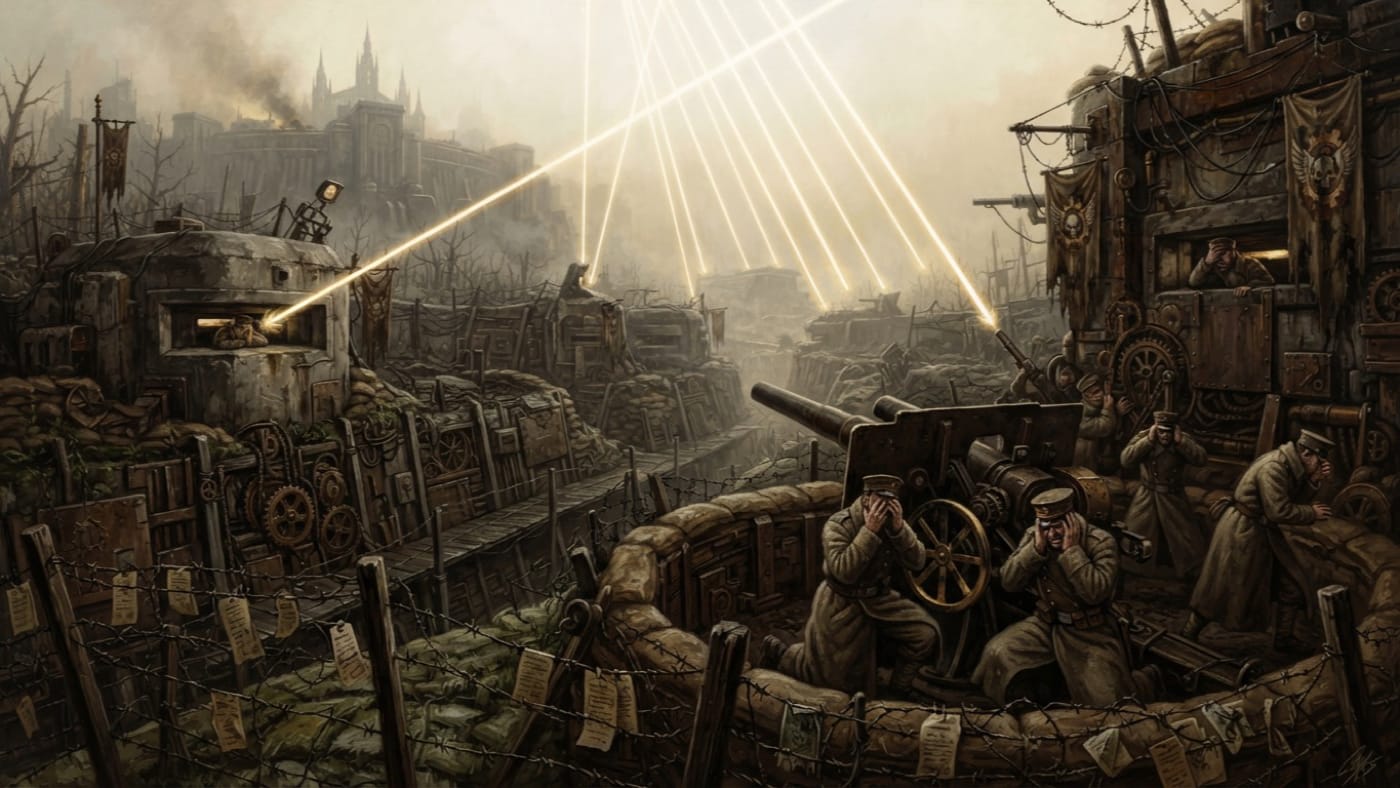
#On the Northern Position
Orchard Ring North enters the Ledger as the place where somebody saw something. The Sun Spear Legion file gives it one line. The Legion's first well-filed appearance at Bastion-Przemyśl came in A.S. 184 (1894 CE), and the sighting came from Orchard Ring North. My office holds nothing else on the place. It has no survey, boundary stone, garrison return, tower number or founding warrant. The name has outlasted its paperwork, which is common among saints and rare among trenches.
Its surroundings are better filed. Przemyśl holds the western Carpathian passes for the middle reach of the Sagittal Line, and Atheron's host of Pride holds the eastern highlands across the wire. The Orchard Ring is one of the bastion's seven districts. It sits at the working edge of the Wire Orchard, where the grid of barbed and electrified strand meets the people who mend it. "North" most likely names a northern stretch of that Ring. That is my reading of a word. No Engineering plan draws the line, and I will not draw one with a ruler and a hopeful heart.
What the record does establish is equipment. Whatever its extent, the position watched the enemy through observation slits and periscope mirrors. It took its share of the morning's injuries alongside a battery whose elevation wheel carried brass numerals. The works were built so their men could look out without being seen. Pride took the arrangement personally.
#On the Works and Their Uses
The Ring lives on passage. Ration tags, transit chits and confession receipts hang from the barbs by the thousand. They swell in the damp, curl at the corners and smell of wet paper over the rust, blood-salt and wet rope of the groves. Patrol lanes cut through the wire beneath catwalk and tower. The Orchard Wardens hold the Ring and its towers. Their charge is the security and upkeep of the grid, and they enforce it by patrol and by coercion, which the bastion register lists without blushing. Behind them stand the Provost's checks and the arithmetic of the Logistics-Penance Tribunal. A man walks a lane when three offices agree that he may. The live strand keeps the agreement, and ozone hangs where the current runs.
A position at the edge of such a grid controls passage by sight. A lane is worth nothing unless someone sees who walks it and what waits past its end, and sight under fire needs cover. Cover needs instruments: a slit cut narrow in a protected work, a periscope that carries the view down to a man whose skull stays below the parapet, mirrors set at their angles, glass wiped clean every watch. The guns need the same service. A crew turns a shouted order into an angle of fire by the elevation wheel, and those numerals must be read at speed, by lamp or by dawn.
Against bullets this is sound practice. A bullet travels in a straight line and cannot be flattered. The same instruments that keep a watchman's head out of a rifleman's sight carry the view in to him, polished and faithful and brighter than the trench around them. Against Pride a periscope becomes a confessional grille, and the enemy sits on the priest's side.
#On the Dawn of A.S. 184
The record sets the morning down in order. I keep its order.
At dawn a fog bank lay over the wire, and it turned gold. Twelve Sun Spear lances crossed three hundred yards of wire without disturbing the fog. The bank stayed level and gilded while twelve shafts of white-gold radiance went through it like a procession through a nave where the congregation had not been told to rise.
They struck observation slits. They struck periscope mirrors. They struck the brass numerals on the elevation wheel of Battery Saint Ulrich.
No soldier standing in the open was hit.
Forty-one men inside protected works lost partial sight.
Three things in those lines are numbers, and numbers attract liars. Twelve is the count of lances. The account does not say how many legionnaires threw them, so anyone who assumes one lance per legionnaire has made an assumption I decline to seal. Three hundred yards is the distance the lances are recorded crossing over the wire. It measures that crossing only. North's width and the Legion's reach stay unentered. Forty-one is the number for the whole incident. The file assigns none of it by emplacement, so I credit no share to Ulrich and none to any single slit. It records partial loss of sight. It does not record how many recovered, how many stayed dim for life, whether anyone died that morning, or whether the open ground was safe on any other day. On this dawn, the men on the parapet were spared, and the Ledger extends its finding no further.
The arithmetic remains obscene. The exposed men stood whole. The sheltered men bled into their hands. The bastion had been building cover for more than a century on the sensible doctrine that a protected man keeps his eyes. One dawn's work by the enemy reversed that doctrine without touching a single exposed head.
The morning was not the Legion's first. Atheron's ranged formations had been reported in broken language for decades. A.S. 184 is the first time a Przemyśl clerk filed the report properly, and the clerk has earned a modest candle for it.
#On the Three Bureau Conclusions
Three offices read the same file and returned three verdicts.
The Bureau of War concluded that the Legion preferred instruments to bodies. This is a targeting finding, and War makes those as other men breathe. Every recorded strike landed on glass or brass. The men in the open went untouched. War's meaning is plain enough for a field card. A sector with blinded watchmen and a battery with blinded layers are put out of action as surely as one full of corpses, and the enemy pays for no burials.
The Bureau of Doctrine concluded that Pride prefers mediation. My own house wrote it in the present tense, as it writes everything it intends to keep. On Doctrine's reading, Pride would rather reach a man through the thing he trusts to show him the world. I enter the conclusion as sealed and add no mechanism. The file contains none, and Doctrine has never needed one to be certain.
The Bureau of Engineering concluded that brass numerals should be blackened. That is one sentence and one pot of lampblack. A numeral exists to be read, reading means looking, and on that morning what shone was struck. Engineering did not ask why Pride wanted the shine. It asked what shone and sent for a brush. The Creator gave gunners eyes to read numbers with. Nobody required the numbers to be handsome.
#On the Discipline That Followed
Engineering's sentence became a line on a drill card in time. Everything else in present Przemyśl practice came later, out of other injuries at other posts, and none of it is recorded at North in A.S. 184.
The White Noon of A.S. 190 (1900 CE) produced the smoke doctrine. Clean smoke proved too thin. Smoke mixed with chapel-brazier ash and kitchen soot dulled the lances in flight. Circular 192-M of A.S. 192 (1902 CE) ordered unnecessary reflective surfaces in forward positions dulled and the necessary ones logged and watched. One Codex account files the Circular after the Glass Rain of A.S. 194. The Circular's own date is 192, and paper outranks memory. The Glass Rain itself fell from Tower Nine, the Orchard Eye, and it belongs to that file and that year. It did not fall on North in 184, whatever the tavern version claims.
The current Przemyśl alert card, revised in A.S. 201, reads like a penance list for vain men. Eyes down. Glass smoked. Brass blackened. Ash in the smoke. No clean banners. Shoot by table. Gunners lay by shouted range while looking at the mud lip of the parapet. Banners go forward stained. The lowered gaze, which the Church has preached for centuries to little effect, is now enforced by a sergeant, and the sergeant gets results the pulpit never did.
Troops are to observe the projectile path and report curvature.
Withdrawn. This was earlier Przemyśl guidance, and my office cannot fix its date. The Legion's file records that the men who watched the path were blinded by it, and curvature is no longer reported by eye. The order belonged to the bastion at large. I have found no copy issued to Orchard Ring North and I enter none.
The file does not say whether North's slits were narrowed afterward, whether its mirrors were smoked or replaced, or whether Ulrich's wheel was ever blackened, exchanged or melted down for cartridge brass. It gives no garrison for the position, no officer for that dawn and no later incident under its name. A sergeant on the Ring today may tell you he serves at North and point to a particular post. He may well be right. My office holds no paper that says so.