

#On the Designation
The Bureau of Purity numbers what it fears. When Purity identified the Rail Quarter society in A.S. 200 (1910 CE), it became RS-1, the Quiet Table. The society found in the Bureau of Mercy dispensary at Bastion-Shipka became RS-2, the Low Bench. The Codex dossier on Commandant Gaius Tarvor says RS-2 "followed" RS-1, and the Codex timeline files both under the same year's Purity digest. I accept that order. I will not add a month, a day or a bell to it. The record gives none, and a date invented by an archivist is still a forgery, even with a better seal on it.
The name is harder to leave alone. A bench is the plainest furniture in any ward, the place where a tired body sits without permission. Whether there was a bench, what it was made of, where it stood and who sat on it at which hour, the sources behind this survey do not say. Other pages of the Codex answer all of these questions confidently. I note their confidence and do not borrow it.
#On the Eleven
There were eleven members. The dossier lists their professions in one breath: nurses, orderlies, scribes, ward chaplains, and one visiting Mercy assessor. That is the whole roster this survey can stand behind. It gives no names, no leader and no count for each trade. A neighbouring Codex entry divides the eleven by profession and states how long the society operated. Those figures may be right, but they are not in the released source, so they stay out of this folio.
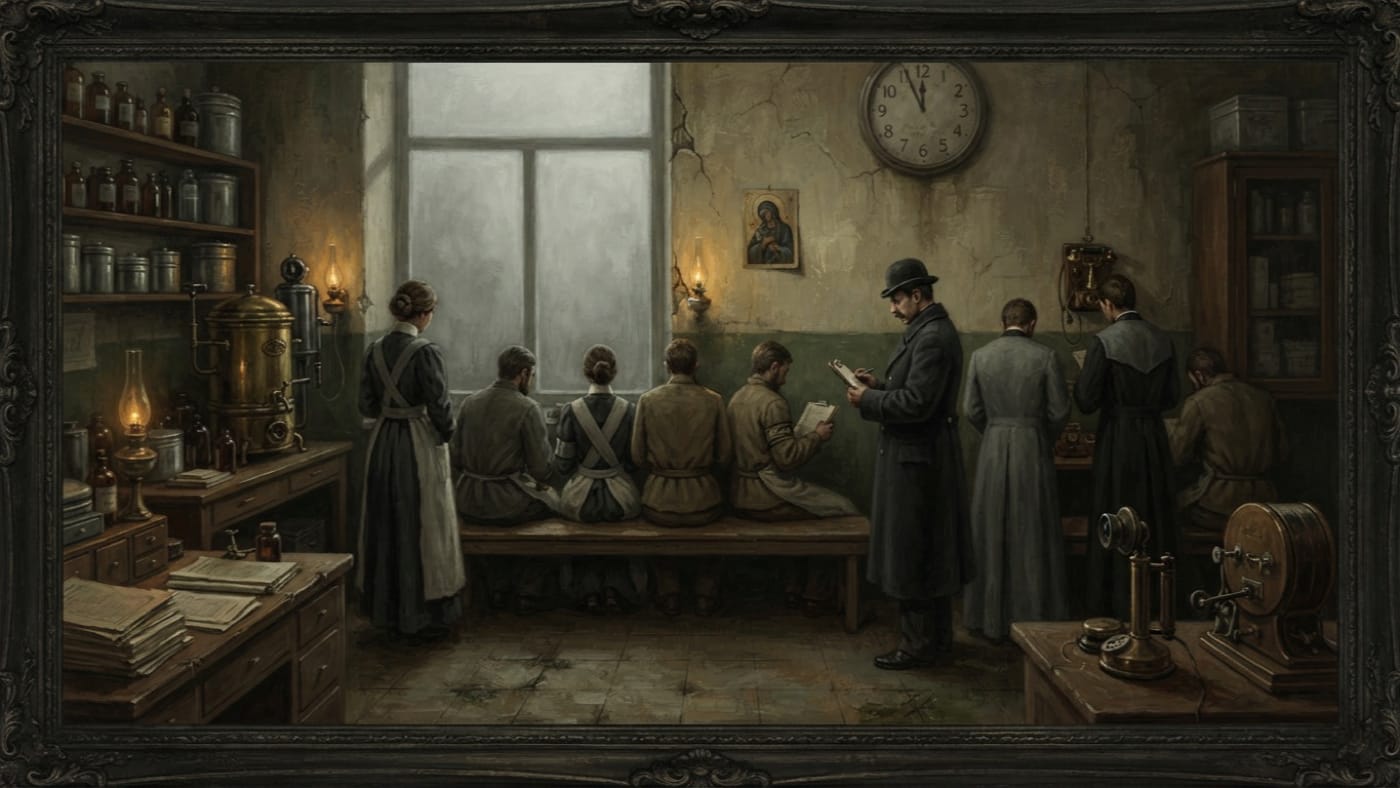
The list matters because of what a dispensary at Shipka is. The bastion faces Syrion across a marsh of time-fog. The garrison rotates every four months because men kept there longer lose the ability to count days. The wards take in whatever the fog sends back. Nurses and orderlies hold those wards through the night bells. Scribes keep the occupancy figures, which go up the tower to the Commandant every morning before chapel. Ward chaplains keep watch over the soul, which at Shipka mostly means keeping it awake. The assessor came from outside to count all of them.
So the eleven covered every part of the dispensary: hands, ledgers, altar and auditor. What they did together, beyond being arrested together, the released record does not say.
Shipka's general lore describes the Rest Societies as mutual-aid circles among clerks, nurses and rail hands. They begin by sharing shifts and pooling rations, and some go on to condemned teaching. That describes the type. It does not tell me how this particular society behaved. RS-1 began with shift coverage and pooled rations and moved into counter-litany. That history belongs to RS-1's file, with its sixteen members and its nine months undetected. I will not attach it to RS-2 just because the two folders sit in the same drawer.
The marsh is a different matter again. The Somnolent Communion Cells of the stilt-hamlets stand in rings at the water's edge and have their own condemnation under their own heading. The Low Bench is filed with the bastion's societies, among people who work indoors, by lamplight, with keys.
#On the Confiscated Report
The assessor is the society's scandal. An officer of Mercy visited the dispensary on business the dossier does not describe, and that officer's name appears on Purity's list of eleven. The assessor wrote a report. Purity confiscated it. As reported, the report treated the societies as a symptom to be studied rather than a disease to be burned.
I have not read it. The wording circulates through the Codex in quotation marks, and I have seen those marks without seeing the document behind them. Wherever the report now sits, it has not crossed my desk, and I record its position as reported. I do not certify it as a quotation, a clinical finding or a doctrinal ruling.
That leaves two readings of the same eleven people, and each has an owner. Purity classes the Rest Societies as Sloth-heresy. That is its jurisdiction, and the classification carries the force of that Bureau. The assessor, by the account of the confiscated report, called them a symptom: the result of a strain, and something to be examined before anyone sentenced it. This survey does not decide between them. It also enters no finding that Syrion reached into the dispensary by fog, dream or any other means. The sources available to me do not establish that. Doctrine does not record something as fact merely because it would make a satisfying sermon.
It should be noted, with the dryness the matter deserves, that Mercy sent a reader to Shipka and Purity confiscated what the reader wrote.
"A burned nurse cannot stand a night watch." — Codex dossier, Commandant Gaius Tarvor, as cited against Purity's correspondence
Corrected for the purposes of this survey. The line is rhetoric from the dossier, and good rhetoric. It records no burning. The sources available to this survey establish no execution of any member of RS-2, and none is entered here.
#On the Commandant's Arithmetic
The dossier gives the dispute in seven words: Purity saw Sloth-heresy; Tarvor saw missing staff.
The first sentence matters most and is the one readers most often skip. Tarvor concedes the jurisdiction before he says anything else. He is no friend of heresy. By the dossier's account he breaks circles, authorises bells, flares and sanctified noise for dispersal, and signs arrests when the evidence meets his standard. What he objects to is the hole the arrests leave in his staffing.
"Eleven trained medical personnel" is his phrase, and I leave it as his. The roster he is counting includes scribes, chaplains and an assessor who was visiting. Whether every one of the eleven was trained in medicine, or formally assigned to the dispensary at all, the note does not establish. It is a commandant's count, written to fill a watch bill, and a commandant can be forgiven for counting anyone who knows where the bandages are kept. It is still a claim, and the Codex records it as one.
The dossier gives a second figure: the dispensary's night shift remained three short. Three is the shortfall on the roster. It is not the number of arrests, and nothing in the record says how many of those three vacancies the arrests created, or whether they created any. A shortfall and an arrest list are separate entries, and only a careless clerk subtracts one from the other.
Purity, for its part, asked for more investigators to follow the suspected societies. Tarvor endorsed the request and added in the margin that he would prefer investigators who could also operate a telegraph. That is the whole of the exchange, and it is all the dispute the record supports. Tarvor wanted bodies, Purity wanted investigators, and nobody acknowledged the field note.
#On What the Survey Leaves Open
The Codex has been generous to the Low Bench in other places. It has printed meeting hours, a linen alcove, a chaplain's confession and a parish reassignment, along with an assessor's motives and a name struck from the logs. Those pages are published and remain where they are. They are not this survey's evidence. A Codex entry is not a source merely because it is printed in the Codex, and this folio does not cite its neighbours as proof of their own claims.
What the released record establishes is short:
The Bureau of War has acknowledged two of the Commandant's three support requests. The dispensary remains below complement. Its scribes still send the occupancy figures up the tower before chapel, and Tarvor still reads them first.
I kept every claim to what the released Tarvor source supports. Nothing from the other Codex pages was used as evidence. By my count the text is about 1,650 visible words, inside the 1,000–2,000 range.
- Dateline: A.S. 201 is labelled as the survey's date. It is not given as RS-2's founding or discovery year. The A.S. 200 link comes only through the timeline's digest entry.
- Details from neighbouring pages: two other published pages,
rest-societiesandbureau-of-mercys-shipka, add things the released source doesn't support. These include the 6/2/2/1 split by profession, the five-month estimate, the meeting place, the chaplain's confession, and the assessor's motives and gender. The article says these exist but does not use them. - The assessor: I used no pronoun, because the released source doesn't give one.
- The report: Drax says plainly that he hasn't read it, which matches what the rest-societies page says.
- The erratum: it corrects the parent dossier's "burned nurse" line, so the reader isn't left thinking an RS-2 member was executed.
- Links: the nine slugs I used (
commandant-gaius-tarvor,bureau-of-mercy,bastion-shipka,rest-societies,syrion,somnolent-communion-cells,bureau-of-war, and the two Purity-related pages already linked in context) all exist indeployed/codex/. That is below the brief's suggested 10–30; I didn't add more because the scope is narrow and every extra link would need its own source support.