
#On the Nature of the Rest Societies, and Why Fatigue Is the Great Deceiver's Favourite Door
"Heresy does not always arrive in vestments. Sometimes it arrives in a yawn." — Bureau of Purity, Shipka Tithe-District Assessment, revised A.S. 201
The Bureau of Purity would have the faithful believe that Sloth-heresy announces itself with spectacle: circles of marsh-folk standing glassy-eyed in black water, or whole villages folding into dream at the ring of a corroded bell. The Somnolent Communion Cells of the Shipka stilt-hamlets provide convenient theatre — foreign enough, rural enough, strange enough that a clerk in Strasbourg may read the report, shudder, and return to his ledger reassured that such corruption festers only among the superstitious poor.
The Rest Societies offer no such comfort. They form inside the bastion. Among its educated functionaries. In its corridors, its bunkhouses, its supply offices and dispensary wards. Their members are not wide-eyed marsh-folk holding hands in reeds. They are quartermasters, filing clerks, hospital orderlies, telegraph operators, night-shift nurses — men and women who keep the Line functioning and who have concluded, with the terrible clarity of exhaustion, that functioning is the problem.
#On the Origin, and How Mutual Aid Becomes Mutual Surrender
The Synod demands that Bastion-Shipka rotate its garrison every four months — the heaviest Bellwarden rotation on the entire Line, mandated because longer tours at the edge of Syrion's influence produce men who can no longer count days. The soldiers leave. The support staff do not.
A filing clerk at Shipka serves a two-year posting. A pump-room nurse serves until her contract expires or her hands shake too badly to measure morphine. A telegraph operator serves until the Bureau of the Hourglass decides his ears have grown unreliable. In the meantime, these men and women endure the same fog, the same muffled air, the same dreams that cling to the waking mind like damp wool — and they endure it without the soldier's consolation of eventual replacement.
Fatigue accumulates. The Bureau of Mercy's Shipka dispensary records a steady traffic in sleeplessness complaints, trembling hands, unexplained weeping during third-bell shifts. The approved treatment is prayer, supplemented by permitted stimulants: strong tea, candied ginger, a tincture of wormwood the dispensary calls "Doctrine's Kiss" and the staff call "the slap." The unapproved treatment is simpler. Someone says: let us share the burden.
The pattern is consistent across both confirmed societies and the three suspected cells Purity has since flagged. A small group — four, six, rarely more than a dozen at inception — forms around a practical grievance. Shifts are too long. Rations favour the garrison over the support cadre. Night duties go unrelieved because the Bureau of War does not count clerks when it counts heads. The group begins to solve these problems informally: covering one another's watches, sharing food, ensuring that each member sleeps at least once per cycle. Reasonable. Humane. The kind of arrangement that any sensible administration would formalise if it could bring itself to admit that its people are breaking.
The Synod is not a sensible administration. It is a theological one. And theology, as I have had occasion to observe, does not recognise exhaustion as a mitigating factor.
#On the Drift, and the Sermon That Writes Itself in Tired Mouths
The shift from mutual aid to heresy happens by degrees, and no degree announces itself.
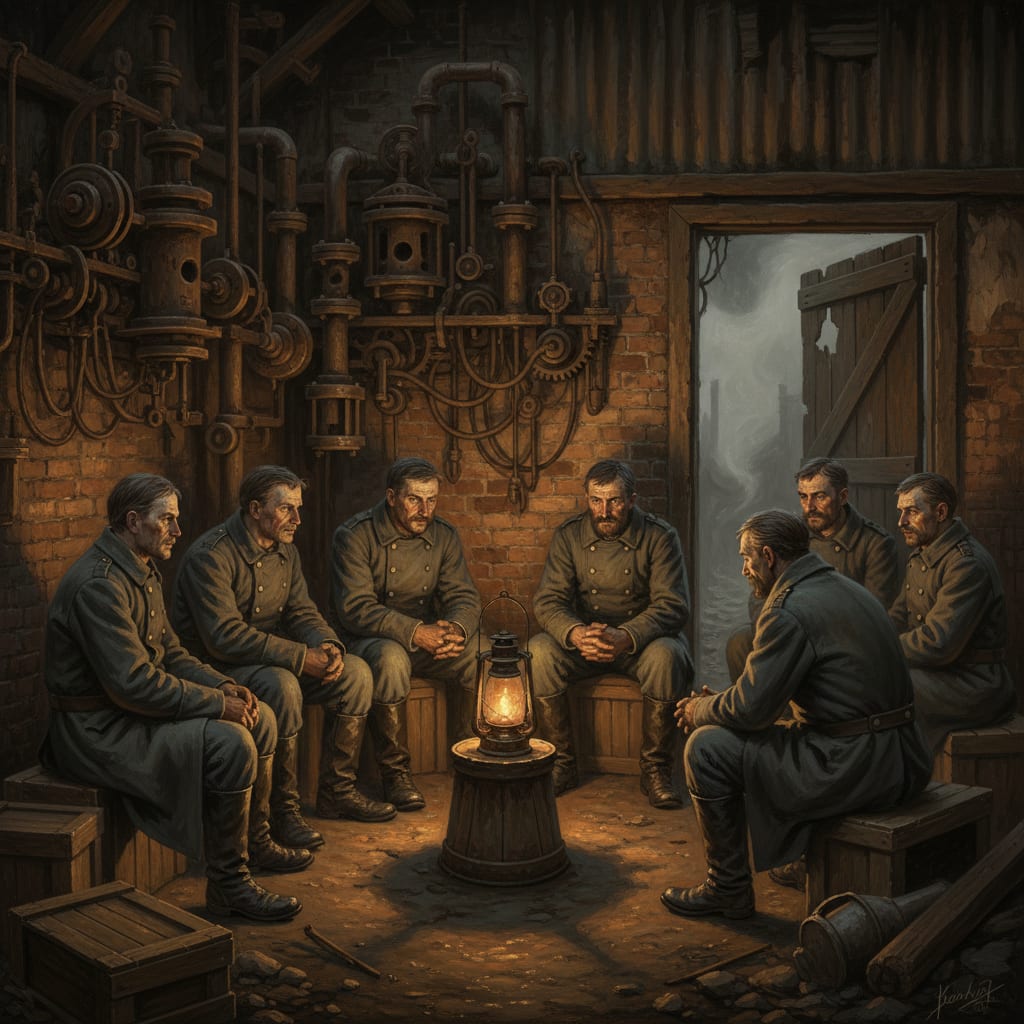
The group meets to share shifts. Meetings acquire a regularity — weekly, then twice-weekly, then whenever someone is too tired to stand their watch alone. A meeting needs a place; the place acquires a character. A disused pump-shed. A corner of the sump-chapel beneath the rail-bridge. A storage closet in the Bureau of Mercy dispensary where the morphine-ledgers are kept and no one enters after dark. The place acquires a name. The Quiet Table. The Resting Room. The Low Bench.
The meetings need a purpose beyond logistics, because logistics are solved within the first month. The purpose becomes conversation. The conversation, inevitably, turns to the question that every exhausted person in every fortress on the Line has asked and that Doctrine forbids anyone to answer: Why must it be this way?
From that question, the rest follows as water follows a channel.
Someone brings a copied pamphlet. The pamphlets are hand-written — no printing press would touch them, and no printer who wished to keep his licence would set the type. The slogans confiscated from Rest Society meetings include such treacherous half-truths as:
"The Synod demands endless waking; the Lord surely permits one honest sleep."
"If the Wall cannot stand without our exhaustion, perhaps the Wall is the heresy."
"They burn the man who rests. They promote the man who collapses. The difference is paperwork."
The pamphlets give vocabulary to grievance. Grievance, given vocabulary, becomes doctrine. The group begins to speak of rest as a right rather than a reward. They begin to frame the Synod's demand for perpetual wakefulness — the anti-Sloth vigilance that is Shipka's entire reason for existing — as itself a form of cruelty. The liturgy of the meeting shifts. Where once they recited psalms or mumbled the standard evening prayer, now they murmur a kind of counter-litany: Lie down, just lie down. Repeated in a slow rhythm. A breathing exercise, the members would say. A communal meditation.
The Bureau of the Hourglass would note the rhythm's resemblance to the temporal drag patterns measured at Station Two.
An earlier Purity assessment described the Rest Societies' chanting practice as "crude imitation of Somnolent Communion methods, lacking theological content."
The revised assessment acknowledges that the Rest Societies' counter-litany does not imitate the Communion Cells. It appears to have developed independently, from different source material, among a different social class — which, in the view of the Bureau's analyst, is considerably more alarming than imitation would have been. Parallel evolution of Sloth-heresy suggests a cause deeper than contagion.
#On the Two Confirmed Societies, and the Three That May Exist
Purity's records for the Shipka Tithe-District — corrected, revised, and grudgingly updated since the embarrassment of the "minimal heretical activity" assessment — identify two confirmed Rest Societies operating within Bastion-Shipka proper between A.S. 199 and the present.
RS-1, "The Quiet Table." Rail Quarter. Sixteen members at time of discovery, estimated nine months of operation. Composition: four logistics clerks, three telegraph operators, two dispensary assistants, two pump-room maintenance hands, three night-duty sentries (the only garrison soldiers involved), one rail-gang foreman, one catechist's scribe. The last is notable — a man employed to copy out anti-Sloth homilies by day who attended a Sloth-heretical assembly by night. When questioned, he said he did not see a contradiction: "The catechisms say rest is dangerous. I agree. I wanted rest anyway. A man can know the fire is hot and still be cold enough to reach for it."
The Society was discovered when a night-duty sentry, having failed to report for his watch, was found asleep in the pump-shed with six other members in a rough circle, a dulled lantern between them. The resemblance to the Communion Cells was immediate and damning. Purity sealed the shed and arrested all present. Under interrogation, members insisted the circle was coincidence — they had been sitting in a ring because the shed was small and the lantern was in the centre. The dulled lantern, they said, was dulled because the wick was old.

Purity was not persuaded. The sixteen were charged with Sloth-heresy with seditious overtones. Eight received public penance: shaved heads, the marking of the Seal of Wakefulness branded onto the left wrist, and reassignment to forward Scour-line duties where sleep is structurally impossible for reasons of proximity to fire. Four were quietly transferred to postings the Bureau does not name in its public registers. The remaining four, including the catechist's scribe, were disappeared — a word the Bureau of Purity dislikes, preferring "remanded to extended doctrinal custody," which means the same thing pronounced more slowly.
RS-2, "The Low Bench." Bureau of Mercy dispensary ward. Eleven members at time of discovery, estimated five months of operation. Composition: six nurses and orderlies, two dispensary scribes, two ward chaplains, one visiting Bureau of Mercy assessor who had been posted to Shipka to evaluate staffing levels and who, upon arriving, understood why the staff were breaking. The assessor's participation is the more remarkable fact. She was not exhausted. She was not stationed at the marsh's edge. She had read the files, walked the wards, watched nurses weep between shifts, and concluded that the Rest Societies were a rational response to an irrational demand. Her report — filed and immediately confiscated — described the societies as "a symptom the Bureau should study rather than a disease it should burn."
The Low Bench operated more quietly than the Quiet Table. Its meetings took place during the natural lull between the third and fourth bells, when the dispensary wards are dim and the senior physicians are asleep. Members sat on a low wooden bench in the linen-storage alcove — hence the name — and spoke in murmurs indistinguishable from the routine whisper of a hospital at night. They distributed no pamphlets. They wrote no slogans. Their heresy was softer: a shared agreement that wakefulness at Shipka's tempo was killing people, and that the Synod's refusal to acknowledge this constituted a sin greater than the rest they sought.
Discovery came when a ward chaplain, racked by conscience, confessed his participation to the senior catechist. The catechist reported it. Purity arrested the eleven. The ward chaplain was treated leniently — reduced in rank, reassigned to a Bastion-Irongate parish — on the grounds that his confession demonstrated the survival of orthodox conscience. The remaining ten received sentences comparable to RS-1's membership.
The dispensary's night shift has since been understaffed by three.

Three additional groups are suspected. Purity's evidence is fragmentary: a confiscated pamphlet in the Hourglass field office latrine; a circle of chairs found in a rail-quarter storeroom with a cold lantern at the centre; a report from a Confessarius — if such persons exist, which the Bureau of Shadows denies — describing murmured counter-litanies heard through the wall of a bunkhouse during third bell. The Bureau classifies these as "indicators of potential cell formation" and has requested additional investigative personnel. Commandant Tarvor has endorsed the request, noting in the margin that he would prefer investigators who can also operate a telegraph.
#On the Engineers, and the Doctrine That Inoculates
The frontier engineer community of Shipka — the pump-room crews, the line gangs, the rail-clan families of the Vertebrae — has proven resistant. Their shared creed, recorded in a Bureau of the Hourglass ethnography that the Bureau of Records politely misfiled, reduces to a single principle: Rest is earned, not offered.
To a pump-room hand, any promise of rest without prior labour reeks of the same stench that seeps from Syrion's fog: something that wants you horizontal so it can step over you. The engineers are exhausted — perhaps more than anyone in the bastion — but their exhaustion is tethered to a visible cause. A pump either works or it floods. A rail either holds or it buckles. A culvert either drains or the reed road drowns. The work is brutal and the reward is merely the absence of catastrophe, and yet that absence is tangible in a way that a clerk's filing quota is not.
The Rest Societies recruit from those whose labour produces nothing they can touch. Clerks whose forms vanish into Strasbourg's postal void. Nurses whose patients die regardless of intervention. Telegraph operators who key messages and receive no reply. These are the Synod's invisible workers — the ones whose exhaustion purchases no visible salvation, whose rest would go unnoticed if the Bureau did not insist on noticing it.
Bureau of Purity records for the Shipka Tithe-District have historically classified heretical activity as "minimal, rural in character, and confined to stilt-hamlet superstition."
The Bureau has been compelled to revise this assessment twice in three years. First after the discovery of the Somnolent Communion Cells. Again after the Rest Societies. The current classification — "active, diffuse, and inadequately resourced for counter-operation" — is the most honest sentence the Bureau of Purity has produced in a decade, which is why it was buried in an appendix.
#On the Present Condition, and the Question the Bureau Will Not Ask
Two societies discovered. Three suspected. Eleven arrests in RS-2 alone. Sixteen in RS-1. The Bureau of Purity has responded with severity, and the severity has produced the expected result: the societies have gone deeper underground, their meetings shorter, their membership rolls unwritten, their pamphlets memorised instead of copied.
Commandant Tarvor has submitted three requests for additional support staff. The Bureau of War has acknowledged two. The Bureau of Mercy has dispatched one junior assessor — not the confiscated one, who does not exist, but a fresh graduate of the Strasbourg Catechetical Seminary whose primary qualification is that she has never seen a marsh bastion and is therefore unlikely to form inconvenient opinions.
The Rest Societies persist because the conditions that produce them persist. The fog presses. The shifts grind. The clerks file forms that vanish into a system designed to demand without acknowledging. And in some bunkhouse or pump-shed or linen-storage alcove, another small group of tired people is forming a circle, dimming a lantern, and murmuring the words that Syrion did not teach them but that Syrion's proximity has made irresistible:
Lie down. Just lie down.
██████████████████████████████████████████████████████████████████████████████████████████████████████████████████████████
The Bureau of Purity treats this as a problem of enforcement. Commandant Tarvor treats it as a problem of logistics. The Rest Societies treat it as a problem of theology. Syrion, whose fog has crept another three metres westward this quarter, treats it as something else entirely.
The Bureau has not asked Syrion for a classification.