
#On the Nature of the Drowsy Heresy, and Why the Bureau Cannot Burn What Merely Sits
"They were holding hands. They were in the water. They were smiling." — Hourglass patrol report, Stilt-Hamlet Nine, A.S. 196
The Bureau of Purity classifies heresy by temperature. There are the hot varieties — the raving prophets who mount crates in market squares and denounce the Synod until their throats bleed, the pamphlet-scatterers of the Silent Godless, the counterfeit-seal artists of a dozen grubby conspiracies. These the Bureau understands. These the Bureau enjoys. A hot heretic announces himself, assembles evidence against his own person with admirable enthusiasm, and proceeds directly to the correction chamber without requiring the Inquisition to break a sweat.
Then there are the cold heresies. The ones that sit still. The ones that hold hands.
In the stilt-hamlets ringing Bastion-Shipka, where the Shipka Marsh Corridor (Unregistered) dissolves into reed-channels and the Sagittal Line is measured in mud rather than stone, a particular form of Syrion-adjacent devotion has rooted itself so deeply that the Bureau has spent five years pulling at it and achieved nothing but blisters. The gatherings are called Somnolent Communion Cells — a designation the Bureau of Purity assigned with characteristic elegance, as though naming the disease were halfway to curing it.
The practitioners call them Circles of the Gentle Lantern, or Shared Rest Vigils, or simply sitting. The Bureau prefers its own terminology. The Bureau always does.
#On the Method, and the Terrible Simplicity of Doing Nothing
The cells follow a pattern so consistent that the Bureau suspects either a shared catechism or an influence that shapes behaviour without requiring instruction. The Hourglass analysts at Station Two favour the latter explanation. The Bureau of Purity considers it immaterial, since the punishment for voluntary heresy and involuntary heresy is identical.
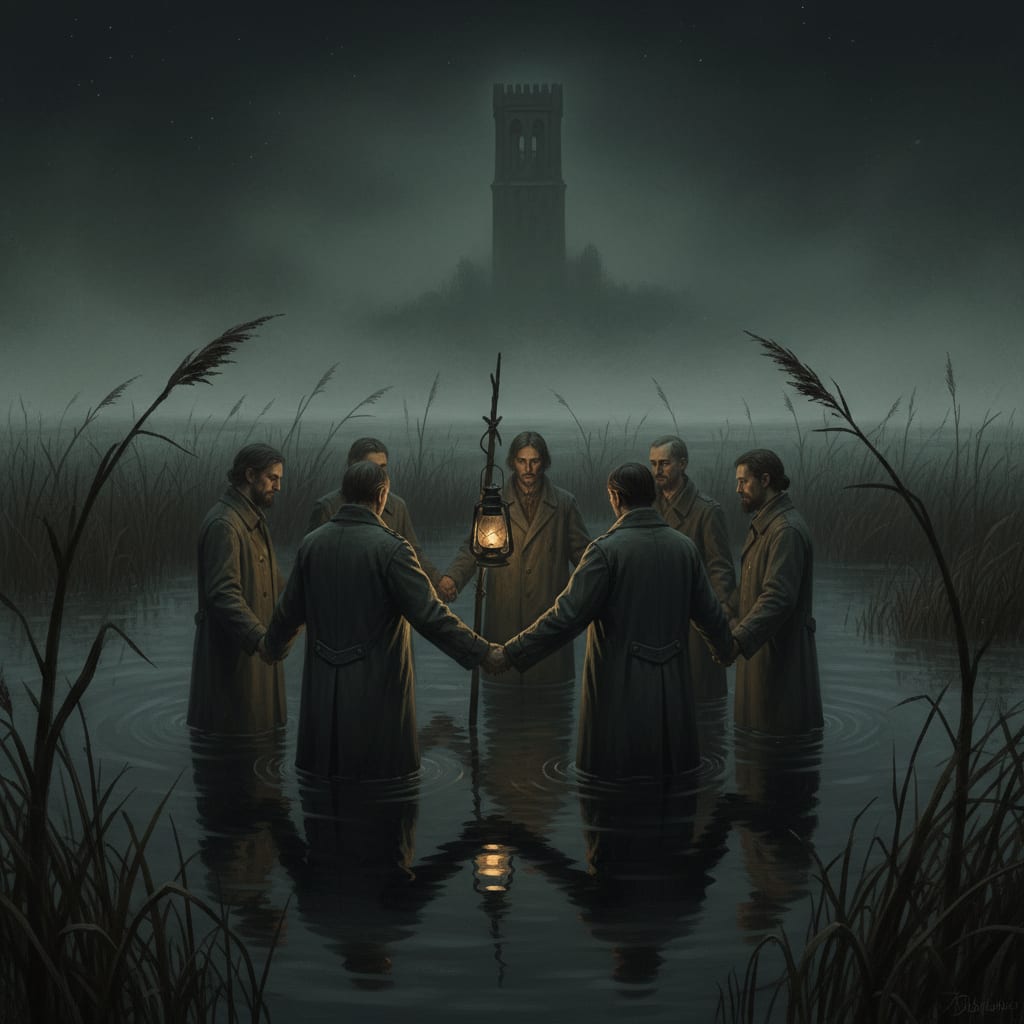
A circle forms at the marsh's edge. Always at the edge — where the water begins, where the reeds thin, where Bastion-Shipka's bells can still be heard but only as a distant ache behind the fog. The participants number between seven and twenty. They link hands. They face inward. At the centre, a dulled lantern — sometimes a proper oil-lamp with its flame trimmed to a sullen amber nub, sometimes a candle in a jar, sometimes an old relic too degraded for the Bureau of Relics to reclaim. The leader — and there is always a leader, though several cells have denied this under oath — begins to speak.
The words are neither scripture nor invocation. They are something worse: ordinary. Lay down your burdens. Forget the ache of days. The water remembers rest even if you have forgotten. Phrases a mother might use to soothe a feverish child, stripped of all doctrinal content, arranged in rhythmic murmur. The leader repeats them. The circle sways. After an hour — the timing is remarkably consistent, as though governed by some internal liturgy the practitioners themselves cannot articulate — the breathing shallows. The eyes fix. The hands tighten.
Shaking a participant at this stage produces no response. The body shuffles to maintain the ring's integrity. The feet move in the mud. The arms adjust. The face remains placid, the gaze locked on the diminishing lantern. The body is present. The occupant is elsewhere.
Several incidents — three confirmed, possibly more unreported — have ended with the entire circle found at dawn standing waist-deep in marsh water, hands still linked, eyes open, unblinking, mouths curved in expressions the patrol reports describe with visible discomfort as smiles. The water around them was still. The reeds had bent away from the circle, as though repelled. The participants, upon being physically broken apart and hauled to dry ground, woke confused, cold, and unable to recall anything between the lantern's first dimming and the patrol's rough hands on their shoulders.
Three of them asked to go back.
#On the Leaders, and the Kind of Prophet Who Murmurs
The Bureau's files on cell leaders are thin. This is unusual. Ordinarily the Inquisition can identify a heretical organiser by following the trail of pamphlets, coin, or grudge. The Somnolent cells generate none of these. Their leaders carry no texts, distribute no literature, collect no tithes. They simply appear in a hamlet, begin murmuring, and within a week the circle has formed around them as naturally as water fills a depression.
The three detained leaders share a profile the Bureau finds profoundly unhelpful: a widow from the outer stilts whose husband drowned repairing a sluice-gate, an out-of-work ferryman whose route was cancelled when the reed road rendered his punt redundant, and a former bastion nurse discharged after falling asleep during a Mercy Ward shift — an offence the Bureau of Mercy classified as dereliction but which the nurse herself described, with vacant calm, as "listening to something underneath the ward."
None of them possessed texts. None could name a teacher. None, under sustained interrogation, deviated from the same maddening answer: I sat down. Others sat with me. We were tired.
An earlier Bureau of Purity assessment attributed the cells to a single itinerant agitator operating across the stilt-hamlets, designated "The Lanternist," whose capture was considered imminent as of A.S. 198.
The Bureau has withdrawn the Lanternist hypothesis. No single individual has been identified as a unifying organiser. The cells appear to arise independently, in separate hamlets, following the same pattern, with no evidence of coordination. The Bureau considers this more troubling than a conspiracy, since conspiracies can be infiltrated and a tendency cannot.
Two of the three detained leaders were remanded to the Inquisition's lesser offices for correction of doctrine. One completed her penance and returned to her hamlet. Within four months she was leading a circle again. The other died during correction — the Bureau's report attributes this to "complications arising from pre-existing fatigue," a phrase that means exactly what the reader suspects it means. The ferryman escaped into the marsh during transfer and has not been recovered. Hourglass patrol found his punt drifting in the deep channels, empty, with a dulled lantern still burning in the bow.
#On the Connexion to Syrion, and What the Bureau Cannot Prove
The Bureau of the Hourglass has measured the air around active cells. Their findings are provisional, contested, and deeply unwelcome.
Within an active circle, time-drag increases by a factor the Hourglass styles non-trivial. Drag-gauges brought within fifty paces of a cell in session register the same low-grade distortion found in the outer reaches of the Vales of Stagnance — a thickening of seconds, a reluctance of minutes to proceed at their appointed rate. The distortion dissipates when the circle is broken. It intensifies when the circle has been holding for more than an hour. At the three dawn-water incidents, the residual drag persisted for six hours after dispersal, strong enough that the Hourglass patrol's own pocket-chronometers gained three minutes against bastion time.
The question — the one the Bureaus circle without answering, the one that makes the Bureau of Purity reach for its branding irons and the Bureau of the Hourglass reach for more instruments — is whether the cells are worshipping Syrion or becoming him. Whether the marsh-folk are performing a ritual of surrender or whether their exhaustion, their grief, their years of standing ankle-deep in Synod mud while the bells ring and the tithes come due, has produced something that resembles Syrion's work because it arises from the same soil.
The Bureau of Doctrine has ruled this question heretical. The ruling is stamped, sealed, and filed. The question persists.
#On the Drowned Shrine, and the Bell That Rings for No One
The stilt-hamlets are old. Older than the Bastion, older than the Synod, older than the Line. Before the Sundering cracked the Balkans open, the Shipka valley held villages, farms, a market town, and — relevant to the present matter — a way-shrine dedicated to a saint whose name the marsh has swallowed along with the rest.
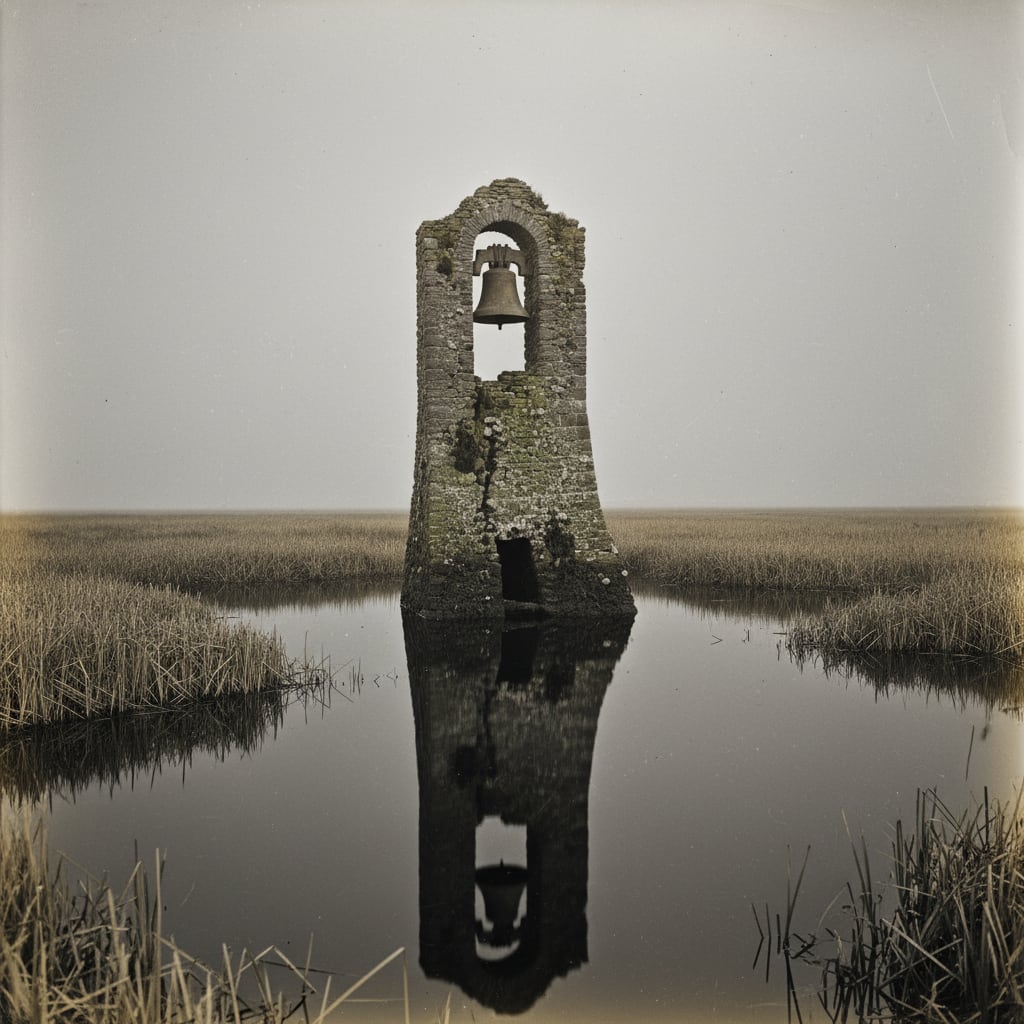
The shrine is visible only at low water: a stone foundation, a partial nave, and a bell-tower that rises from the black surface like a finger pointed at an answer no one wants. The Bureau of Records classifies it as "archaeologically significant, access restricted." The restriction is not enforced, because the Bureau lacks the boats and the marsh-folk lack the inclination to obey.
Fisher-folk claim the bell tolls on windless nights. Hourglass instruments have recorded low-frequency percussion events coinciding with the reported tolling, though no mechanism for the bell's operation has been identified — the bell itself is corroded past function, the rope long rotted, the tower's interior flooded to the belfry floor.
Three of the confirmed cell-circles formed within sight of the Drowned Shrine. The fourth — the suspected but unconfirmed incident — formed directly above it, participants standing on a sandbar that appears at the lowest tides, the shrine's sunken nave beneath their feet.
[EXCISED — BUREAU OF PURITY, CLASSIFICATION: VIRIDIAN] The Bureau has noted a correlation between the reported bell-tollings and the formation of new cells. The correlation is ████████████ and the temporal sequence is ████████. The Bureau considers the shrine's continued existence a matter for the Bureau of Engineering, which has declined to act on the grounds that "demolishing a submerged structure in contested marshland during an active Sloth-seepage event presents logistical challenges the Bureau's current budget does not accommodate."
#On the Present Condition, and Why the Bureau Burns Slowly at Shipka
Three confirmed cells. Two Rest Societies within the bastion proper — mutual-aid circles among clerks and rail hands that began as shift-sharing arrangements and drifted, by degrees imperceptible to their own members, into the quiet conviction that the Synod's demand for endless waking is itself the heresy. An unresolved investigation into pre-Synodal folk practices among the marsh-dwellers that may constitute a fourth category of Syrion-adjacent heterodoxy. The Bureau of Purity's revised classification for the Shipka Tithe-District (Unregistered): active, diffuse, and inadequately resourced for counter-operation.
Commandant Gaius Tarvor has requested additional Purity personnel. The Bureau has dispatched one junior assessor and a memorandum reminding the Commandant that "heresy in stilt-hamlets, while regrettable, does not constitute a strategic threat to the Line's logistical function." Tarvor filed the memorandum in what his adjutant describes as "the appropriate receptacle." He has since authorised Hourglass patrols to carry dispersal equipment — bells, flares, and the particular brand of sanctified noise the Bureau of Bells developed for anti-Sloth application — and to break circles by force when encountered.
The circles reform. The leaders are replaced by new leaders who are indistinguishable from the old ones. The marsh-folk sit. The water rises around their knees. The lanterns dim. The smiles return.