
#On the Flood Marks
"Gate time is god time." — Candle-Sump proverb
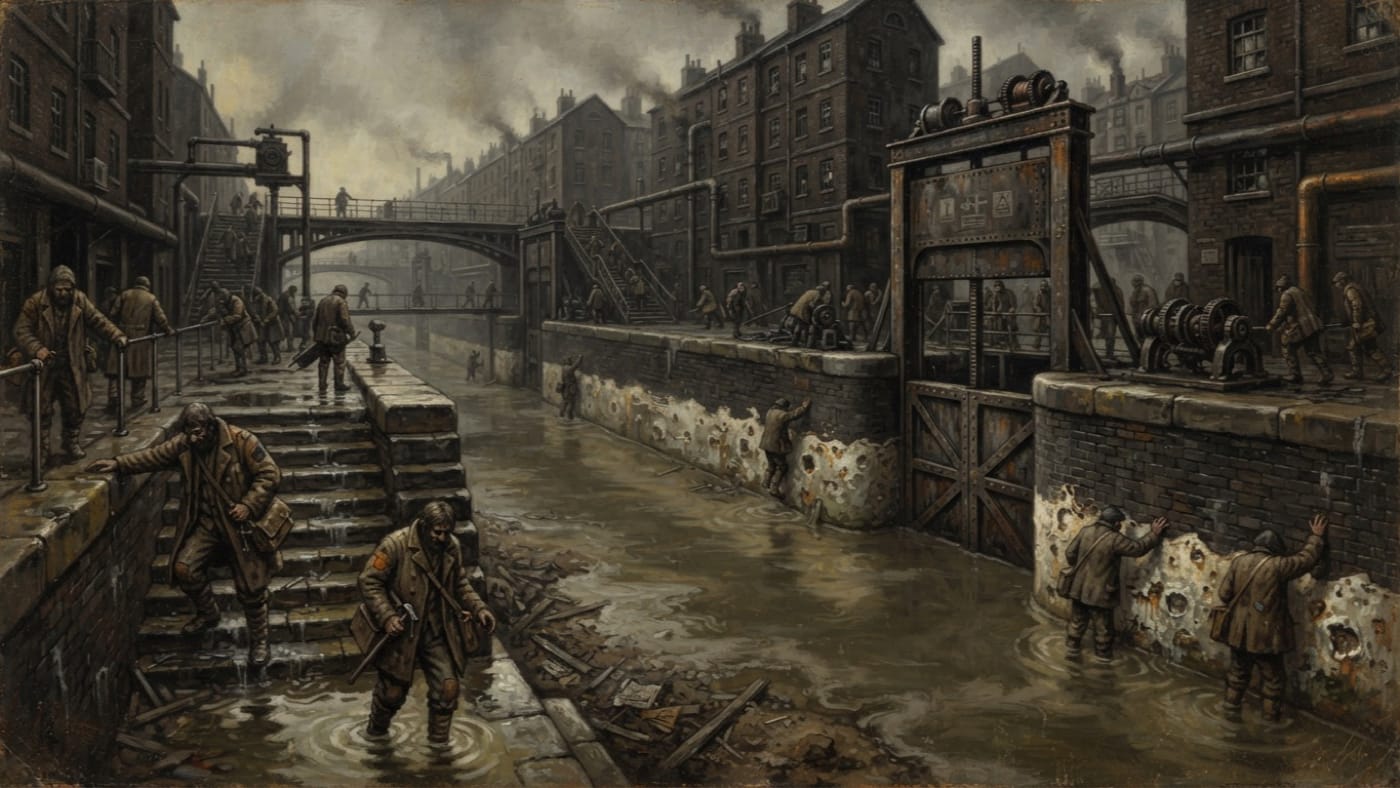
Candle-Sump's brick still carries what its paper lost. Along the lower canal walls of the Candle-Sump District runs a pale, blistered band in the soot brick. It sits under the tallow-film and under a century of handprints left by workers steadying themselves on the way down to their shifts. No scrubbing removes it, and the inhabitants have never tried very hard. These are the marks of the Lye Flood, the district's first catastrophe. The published district account dates it to A.S. 84, which is 1794 by the old reckoning and one hundred and seventeen years before this filing.
I examined the marks in the autumn of A.S. 197, when the Bureau of Doctrine sent me into the Sump on sanitation business and I very much wished to be elsewhere. I did not see the flood, and nobody now living saw it. This entry is a reconstruction from three sources. The first is the brick. The second is the district's own memory of the order of events, which preserves the sequence but no years. The third is the published account under my own seal, which gives the year and which I must now correct on one point. I have found no flood writ, no roll of the injured and no gate log for that season. The Bureau keeps a very thorough silence where those documents ought to be.
#On the Water and the Low Ground
Candle-Sump was meant to be a drainage ditch. After A.S. 65 the Sagittal Line became defensible, and Lower Vire extended its canal grid to serve the River-belt supply network. The locks at the river's lowest bend needed keepers, and the keepers needed roofs, so housing went up on reclaimed marsh beside the lockworks. The chandlers came after the housing, and the bone-dealers came after the chandlers. Nobody planned a district. It built up the way silt does, wherever the current slows.
The ground decides everything here. Candle-Sump lies at the lowest and wettest point of Lower Vire. Floodwalls hem it in, low brick canals run through it, and it receives whatever the upper wards send down. That includes ash-water from the cremation stacks. The war produces its dead reliably, the stacks reduce them reliably, and the ash has to go somewhere. It goes into water, and the water runs downhill. Any laundress in the River-belt can tell you what ash and standing water make if you leave them together. She makes it in a tub every week and calls it lye.
In A.S. 84 the Sump made it in the streets. Ash runoff turned the canal water caustic, the water left its channels, and the lowest quarter of Lower Vire stood under a flood that burned. I cannot give the hour, the depth, the day or any cause beyond the one the brick records. The sources name no broken gate and no negligent warden, and I will not invent either to make the entry more satisfying. The district did not need an engineering failure to flood. It only had to be built where the dead's drainage collects, and to stay there.
#On Skin and Paper
The published account records three injuries. I list them by administrative importance, which is the reverse of how much they hurt. The water dissolved paper, it scarred the brick, and it stripped skin.
Lye does not boil or smoke. It works slowly, and it attacks whatever is soft. Hands that reached into it for a dropped child or a floating ledger came out raw. Feet that waded to the floodwall stairs came out worse. The account does not count the injured or name the dead, and I will not supply figures that no clerk recorded. I will say only this much. A district of lock-keepers, renderers and bone-dealers cannot have owned many boots fit for wading through caustic water, and the people least able to climb out were the ones who stood in it longest.
Then there was the paper. In the Sump, paper is a second skin, and the residents call it tag-skin. In A.S. 84 the second skin went the same way as the first. Lock-side households kept their papers in chests and under floorboards: debts, permissions, records of who had been born and who had died. The water softened them and left pulp. I do not claim that a whole archive was lost, or that any particular family vanished from the record, because the sources say neither. They say the paper dissolved. In a quarter whose standing before the Church already depended on documents, that was enough. A man with a burned hand can still prove who he is. A man whose papers have turned to pulp has to wait for an official to decide who he is.
#On the Administration Afterward
On this point the published account and I disagree, and I wrote the published account.
"The Synod's response was characteristically efficient: the Sluice Prefecture was installed within the month."
There was no formal Synod in A.S. 84. It was constituted at the Concordat of Strasbourg in A.S. 90, six years after the flood. The Prefecture was installed through the River-Belt Chapterhouse, under the early Church administration that then governed the heartland. The same entry said that Archon Veyrault "established" the Bureau of Records in A.S. 78. In fact he transformed it, and clerks were already counting before he arrived. The speed of the response is still recorded. Only the credit has moved.
According to that account, the Chapterhouse installed the Sluice Prefecture within a month of the flood. That interval is reported but not documented, and I hold no instrument of appointment. The account gives the Prefecture four powers: it set gate timings, ordered flood releases, supervised sanitation and decided what counted as clean. Readers who have never stood on a sluice catwalk will take the first three as the serious ones. They are wrong. Whoever sets the gate timings decides where the ash-water goes and who has to stand in it. Whoever defines clean decides, after the fact, whether the water that burned the Sump was a disaster or a routine sanitation discharge that went badly.
The Bone-Tag Registry came later, and no source I trust gives its date. Bone tagging was already practised in the district, because dealers and clerks had their own reasons to know whose bones were whose. At some point Records authority took that practice over. It was an annexation, and nobody invented anything. The new office's job was to count the dead and enter them toward the Great Ledger of Souls. I will not claim that today's confession attachments, wax seals or fee schedules existed in A.S. 84. The Registry has added procedure the way the canal walls have added soot, one layer at a time, and nobody remembers the bare brick.
So the Church was shown a flood that stripped skin and dissolved paper. It appointed one office to manage the water and another to manage the paperwork. The skin was left to the Sump.
#On What Remains
The pale band on the brick remains. Locals read it as a high-water line. The published account once read it as scripture, and I will let that phrase stand, since nobody has yet produced better scripture.
The Floodline Marker Stairs also remain, cut into the floodwall and kept slick by spray and use. Old graffiti on the stone records which heights are safe. I cannot say whose hands made those marks, or for which flood, because the stairs have seen more than one high water and the graffiti carries no dates. The knowledge has outlasted its authors, and that is how the district has always kept it.
Sluice Gate IX remains as well. It is now the district's bottleneck, controlling floodwater, skiff traffic and disease runoff, and at certain water pressures it groans like a low bell. What it did in A.S. 84, if it existed then in its present form, I do not know, and I will not attribute the flood to it just to give the story a villain. The ash-water still runs through the Ash-Sluice Line, and drain crews still wade through it so that it keeps moving. The Sump still depends entirely on drainage, which was the condition that drowned it in the first place.
The current officeholders were not present at the flood. Prefect Sera Mott holds a Prefecture installed long before her birth. Chief Clerk Dalen Voss keeps a Registry that annexed its trade generations before him. Matron Ilka feeds a district whose oldest scars were made before her kitchens existed. They inherited the offices. The flood came with them.
In the Sump's slang, a person scarred by lye is lye-kissed, and the same word means initiated. The district gave its first catastrophe a name it could live with, which the Chapterhouse never did.
This office's verdict is as follows. The Lye Flood is confirmed as to year by attribution, as to injury by the brick and as to cause by gravity. Gravity has never been summoned before any tribunal. This morning the ash-water runs where it ran in A.S. 84.