
#On Lawful Record
"Correction is mercy." — Chapterhouse formula, Nemea
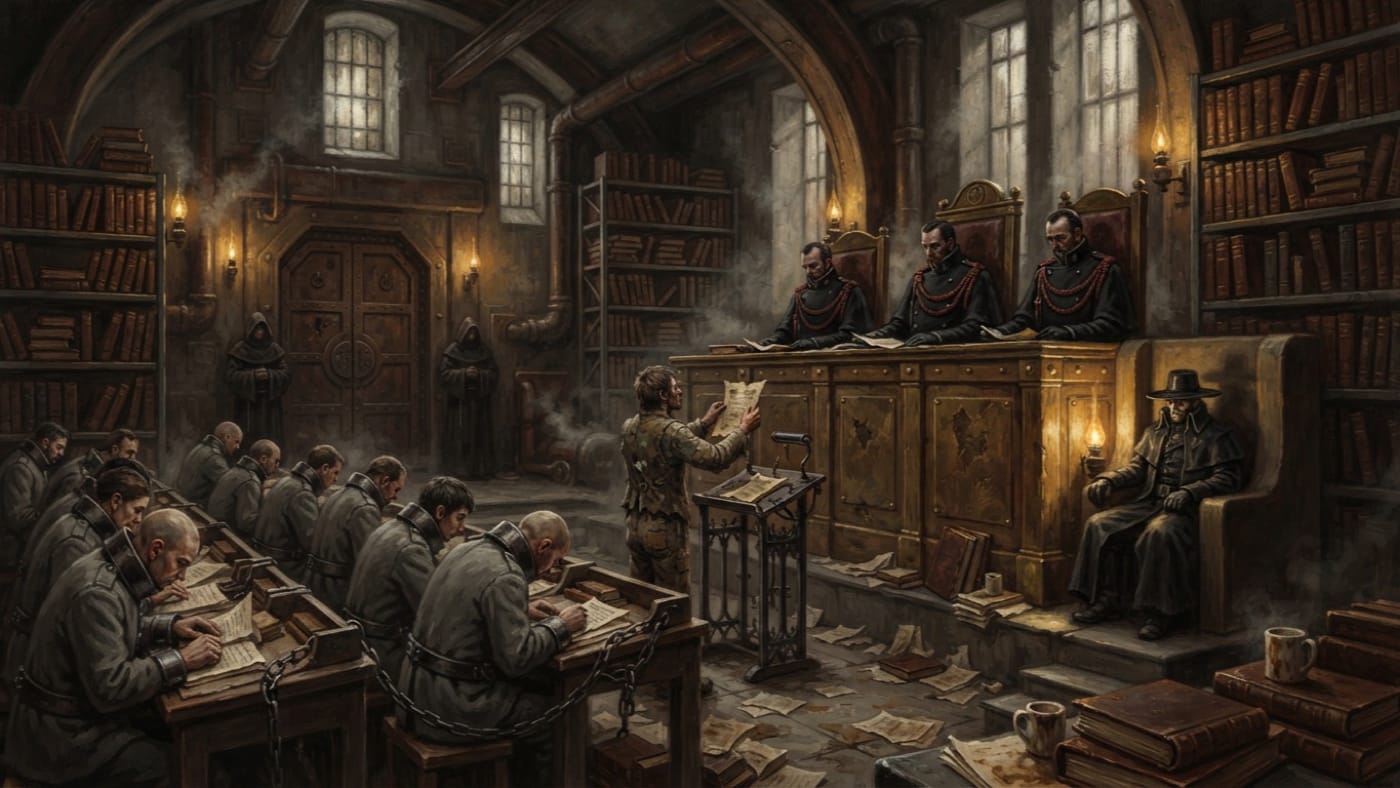
The Margin Court is a tribunal, a district and a smell. The smell reaches you first: old leather, leather dust, and cold tea gone to tannin in cups that no clerk has been authorised to clear. The district is an annex of the Hollow-Script Scriptorium of Nemea, the chalk-ridge archive town in the inland heartlands of Zone 2, a courier's journey from Strasbourg. The tribunal is a clique of Margin Judges in red cords. They rank below the Abbot-Registrar's circle and above the senior scribes, and they hear the one question everyone in Nemea must eventually bring them: am I written where I believe I am written?
The Court's public office is to enforce lawful record. A petitioner comes because a name, a debt or a clause has moved, and the only body empowered to say where it belongs is the body that keeps the book. The petitioner may bring grievance, witnesses and tears. The Court keeps the ink.
#On Jurisdiction and Its Instruments
Three classes of matter come before the bench: identity claims, contract violations, and disputes over where a name stands within a record. The first asks whether you are who the ledger says you are. The second asks what you owe. The third is the subtlest and the most lucrative, because a name's position on the leaf decides what it may claim from the leaf. A name in a heading is a party. A name in the body may be a debtor. A name pushed down into the footnotes is a remnant, and remnants can claim very little.
The remedies also number three, and I list them from least to most final. A fine settles the fault in coin, ration chits or page-debt. A redaction strikes the faulty matter from the corrected copy. A name seizure takes the name itself into the Court's custody, and the petitioner leaves the chamber without something they had assumed could not be taken from them.
The Court rules on the record, and in Nemea the record that matters is the certified copy. The originals lie in the under-vaults. The vault keys and the Chapterhouse seal belong to Abbot-Registrar Maelen Voss. A Margin Judge can declare what a document says, but whether he may see the original that says it is for the Chapterhouse to decide. This keeps the judges humble. It also keeps them expensive.
Oath-collared clerks stand at the bench and monastic provosts at the door. An inquisitor liaison sits wherever the light is best.
#On the Disputant's Original
I consider this notice the finest piece of drafting to come out of the heartlands in a decade, and I have read my own.
The procedure works as follows. Every novice who enters Nemea is entered on an intake record. The original goes down into the vaults, where the petitioner cannot follow it. At most, the petitioner holds a certified copy. To dispute their own identity, they must produce that copy. If it has been lost, burned, confiscated or rewritten, the Court supplies one. So the Court supplies the evidence and then judges it, which removes a great deal of tiresome contention from the hearing.
The chamber's scene kit lists verdicts that are written before the hearing. The judges call this preparation. A judge who arrives without a draft is unprepared. A judge who arrives with one is simply early. Between drafting and sealing, the drafts travel. The town knows a recurring kind of person, the Margin Judge's pet clerk, who sells verdict drafts before the trial. I name no one. The type is better documented than any individual who has filled the post. A bought draft does not guarantee the outcome. It tells you what the Court intends, and in Nemea that is worth more.
Some hearings are reported to have gone further. A petitioner who wishes to keep their own name has been asked to supply a replacement name, meaning another name for the Court to erase in its place. This is reported of particular hearings and has never been published as a fee. The Court would be wounded to see it called one.
Finally, there is Margin Inheritance. This is the Court's term for moving a debt out of the body of a document and into its footnotes, where it waits for whoever inherits the page. The practice concerns debts and only debts. The Court insists that it is not punishment.
The practice concerns debts and only debts.
CORRECTED. The Court also uses Margin Inheritance for its rulings on a name moved from a heading into a footnote. The sources describe the two practices separately, and no complete code of either has reached my desk. That the Court insists neither is punishment stands uncorrected. — V.D.
#On the Court's Interests
Nemea's own survey assigns each power its gain: the Chapterhouse gains control, the Silence Collegium a monopoly on fear, the underworld the identity trade, and the Margin Court profit. The Court profits from deciding what is real. Every dispute it resolves produces a fine, a redaction or a seized name, and all three are paid for.
Three people limit how freely it profits, and none of them sits on its bench.
Maelen Voss controls the originals. The Court may want an under-vault leaf and still never see it.
Silence-Master Rhu Tern commands the Silence Test Collegium. He can fail a document that Voss himself has certified, and a judgment resting on a failed document is a judgment waiting to be reopened.
"Sister" Halvein, Ledger-Broker, holds no chartered office and needs none. She trades blackmail drawn from redaction drafts, which means she has often read the Court's corrections before the Court has sealed them. That makes her well informed. It gives her no authority over the tribunal. She should not be confused with any other Halvein in any other prefecture merely because the names match. Names that match are this Court's whole business, and the Court charges for confusing them.
The Court's real adversary is a document that survives. The Second-Draft Circle, a heretic cell working the crawl-shelves and the courier spur, preserves originals and tries to undo erasures by smuggling, acrostic and mirror-writing. Each original they save is a precedent the Court did not set. Lampglass Row sells the lenses by which documents are read and takes a share of the identity market. The Courier Spur carries documents and the Redaction Yards destroy them. Each of these trades touches the Court's work, and none of them has a contract with it that I could find under seal.
#On Contracts That Revise Themselves
The Chapterhouse classified the Night-Rewriting Contracts in A.S. 198. That is the year of classification. When the rewriting began is another question, and the Chapterhouse prefers not to ask it.
The phenomenon is well enough attested. Contracts stored overnight are found changed by morning. Three years of service become five, a debt of forty ration chits becomes sixty, and a guarantor's name slides off the signature line into the body of the text, so that a witness wakes up a debtor. Seals reportedly re-seat themselves. Signatures reportedly show faintly before they are written. Every attested revision increases what someone owes.
Three kinds of alteration must be kept apart. A sanctioned correction is made by day, under seal, for a fee, and the Margin Court is the venue for it. A forgery is made by a human hand for money, and the provosts arrest that hand. A night revision is made by no hand that anyone has yet arrested. The Synod's officers call it sabotage and the monks call it "ink sickness." The Bureau of Doctrine has pronounced that the ink binds truth to paper. That is Doctrine's interpretation, and I have signed it. It is not an archival finding, and I have not signed one.
To the Court, a contract that changes overnight is a dispute that files itself. Which version does the bench hear: the certified copy, the morning text, or the original that only Voss can reach? In practice the Court hears whichever version is put before it with a certificate attached. Sooner or later every certificate also passes through Tern.
The countermeasures are salt-lamp circles burning through the night, mirror checks, silence tests, and the standing order to burn the second draft. How well they work, and the exact steps of the silence test, remain classified. The order to burn is obeyed. The contracts keep rewriting.
#On Present Application
The Margin Court schedules correction festivals, public mass deletions that the judges call maintenance and the novices call the culling. The schedule has lengthened since the rewriting crisis began. The crisis produces disputes, the disputes produce corrections, and the corrections produce ash for the Yards. My copy of the festival list gives no future date, victim count or completed purge, and I will not supply one.
The Chapterhouse's official plan calls for tighter silence protocols, broader correction powers and an expanded vault quarantine. The Second-Draft Circle is said to be planning a mirror-release, a mass revelation of hidden names. Neither has happened yet. Both would send work to the Court.
Inquisitor-Corrector Sel Durn was dispatched from Strasbourg in A.S. 201 on the authority of the Inquisition. The inquiry remains open. It has blamed no one. Every soul in the Great Ledger of Souls must be written somewhere, and as long as that rule holds, the Court will have petitioners.