
#On the Office That Loves Too Precisely
The Inquisition is the white hand of the Bureau of Purity when the hand tires of pointing and decides to close.
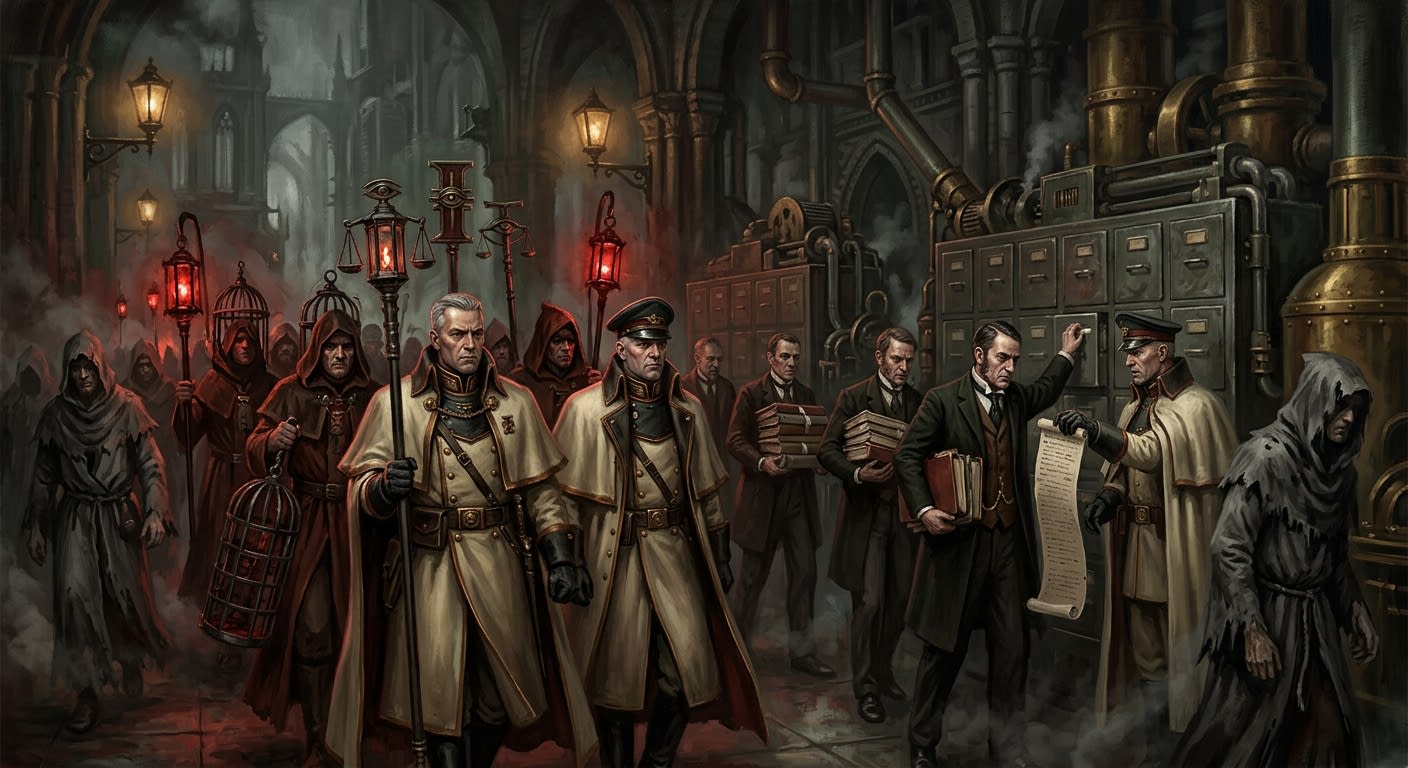
Citizens speak of it as if it were a single cloaked figure moving through fog with a censer, a writ, and a taste for interesting screams. This is peasant theatre, useful for frightening children and occasionally accurate by accident. The Inquisition refuses singular shape: no one man, no one order, no one corridor, no one tribunal, no one preferred instrument. It is the Synod's authorised appetite for correction, divided into offices so that no victim may complain of procedural poverty.
Its popular name does useful damage. “Inquisition” sounds older than the Bureau, older than Strasbourg, older than the cheap white paper on which most of its warrants travel. The word smells of cathedral cellars, Spanish rumours, Roman doubts, Toulouse smoke, and every grandmother's threat sharpened for household use. The Bureau permits the old smell. Antiquity is free authority. If the citizen believes the Inquisition has always existed, he will feel foolish objecting to its arrival now.
It began as necessity, as every atrocity does in its baptismal clothes. After the Atheist Wars, after the Rationalists had taught Europe that a shrine could become a laboratory and a priest could become a specimen, the infant Synod inherited a continent full of survivors, pamphlets, grudges, hidden books, false saints, old Republican sympathies, and private opinions that had not yet learned to kneel. Doctrine could define truth. Records could file truth. Purity had to make truth hurt enough to be believed.
The Inquisition is the family name for those instruments. White-Mantled Inquisitors, Lictors of Purity, Penitential Shadows, Red Lantern squads, Ashmen, Fume-Inspectors, Index Runners, street clerks, oath-counters, silence auditors, borrowed Records notaries, reluctant Mercy witnesses, and the little parish creatures who pretend not to enjoy denunciation because enjoyment would require filing as motive. Their methods differ. Their grammar does not. Heresy is present; heresy must be named, marked, displayed, removed, burned, sung, silenced, indexed, or made never to have existed.
The order of those verbs matters less than the citizen imagines.
The old catechism says the Inquisition seeks heresy. Another pastoral falsehood, kindly meant and clerically poisonous. The Inquisition does not seek heresy as a hound seeks a fox. It teaches houses to smell like foxholes, then asks why the hound has arrived. It produces the category, trains the witness, licenses the instrument, and congratulates the verdict for appearing natural. A miracle of governance: the accusation ripens on the branch already tagged for collection.
#On Its Birth in Ash and Paper
The Inquisition claims origins in the Witch-Hunts of Toulouse, A.S. 93, when the early Synod discovered that a decree unread by frightened people is decorative. The Hunts consumed eleven cities and gave Purity its first institutional shape: men with authority to enter, search, question, bind, burn, and return with evidence already smoking. Later generations made the machinery cleaner. Cleaner machinery kills with better posture.
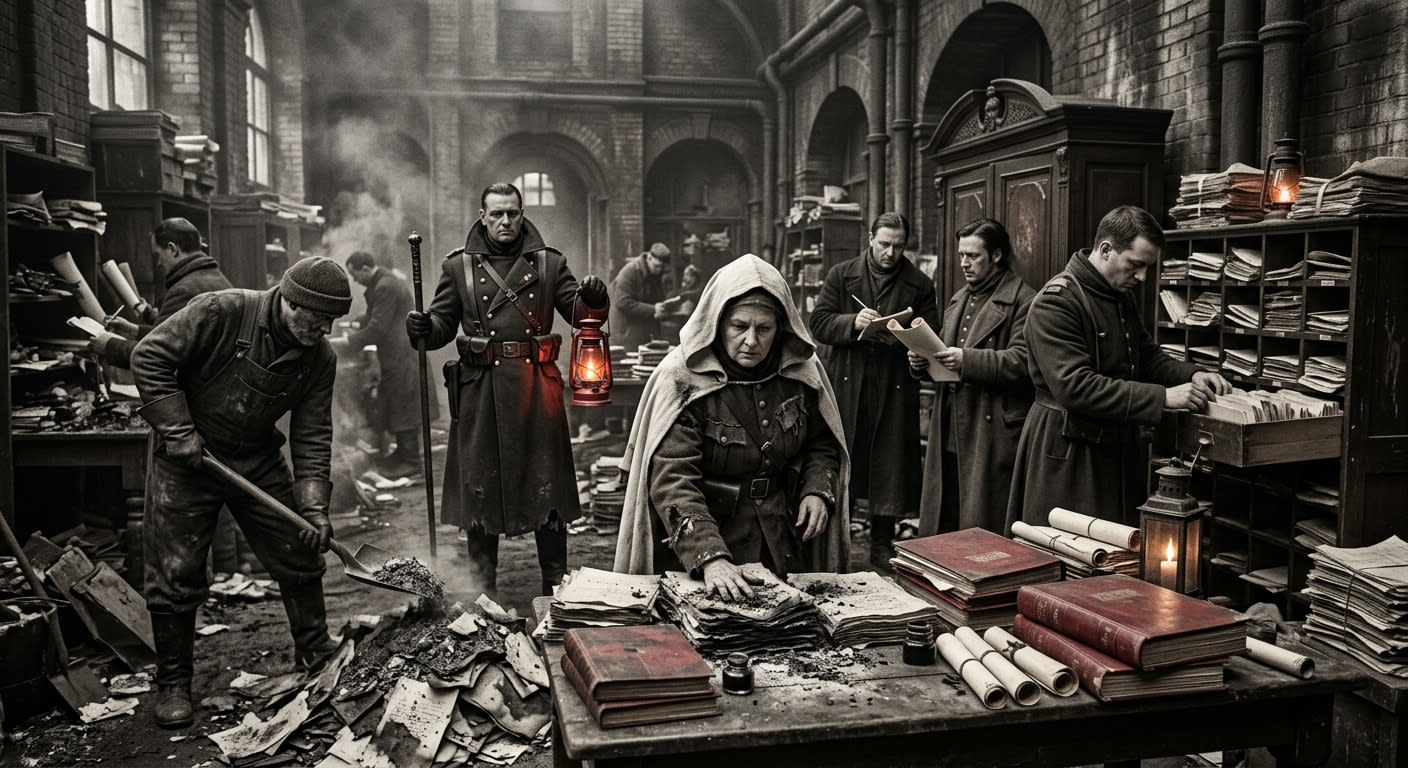
Those first hunt-cadres were not yet the disciplined creature now called Inquisition. They were zeal, flame, borrowed soldiers, terrified clerks, and priests whose education had not prepared them for how satisfying a signed confession feels in the hand. They found witches, Rationalist cells, hedge prophets, relic frauds, midwives with unsuitable prayers, and several hundred enemies of convenience. Many were guilty. Many were not. The Bureau regards this distinction as formative rather than obstructive.
Popular school catechisms once stated that the early Inquisition “never harmed the innocent, for Providence guided each hand.”
Corrected. Providence guided the institution. Individual hands were occasionally drunk, misinformed, ambitious, frightened, or recently promoted. The innocent who burned are classified under Foundation Cost, a phrase whose cleanliness should make the reader suspect blood under the table.
The Index Damnatus gave the Inquisition memory. A purge without index wastes instruction. A banned name spoken in one district must be banned at the ferry, the gate, the orphanage, the queue table, the relic office, the ration shed, and the chapel where some fool aunt will try to baptize memory as pity. Procurator della Torre's compendium turned forbidden knowledge into a huntable animal. Title, author, reader, borrower, seller, singer, witness, lineage: all entered, chained, amended, circulated.
The Bureau of Silence gave the Inquisition absence. Purity may condemn the word; Silence drowns the page. Their rivalry is famous among those who enjoy watching two knives argue over whose cut opened the throat. Purity says the soul is the domain. Silence says the word is the infection route. Doctrine nods, accepts both memoranda, and sends the accused to the basement.
By A.S. 94 the apparatus possessed its indispensable triangle: Purity to seize, Silence to erase, Records to certify that seizure and erasure had occurred in the proper metaphysical order. The Inquisition learned to move through that triangle like a spider through its own geometry.
The first formal Inquisitorial tables appear in the same administrative season as the Toulouse provincial abstracts. Those tables are dull enough to be trusted: columns for charge, instrument, location, escalation authority, custody transfer, witness class, and residue. Residue meant ash, documents, surviving kin, contagious phrases, confiscated objects, or unresolved silence, depending on which clerk was tired. Later manuals separated the categories. The dead appreciate precision less than archivists do.
One sees, in those tables, the Synod learning to stop merely punishing enemies and begin manufacturing procedure. A body could be burned by any mob. A body burned under citation, cross-entered by Records, blessed by Doctrine, reconciled against the Index, and billed to the proper district became an institutional fact. Facts outlive screams. This is why mobs fade and Bureaus endure.
#On the White Mantle and the Writ
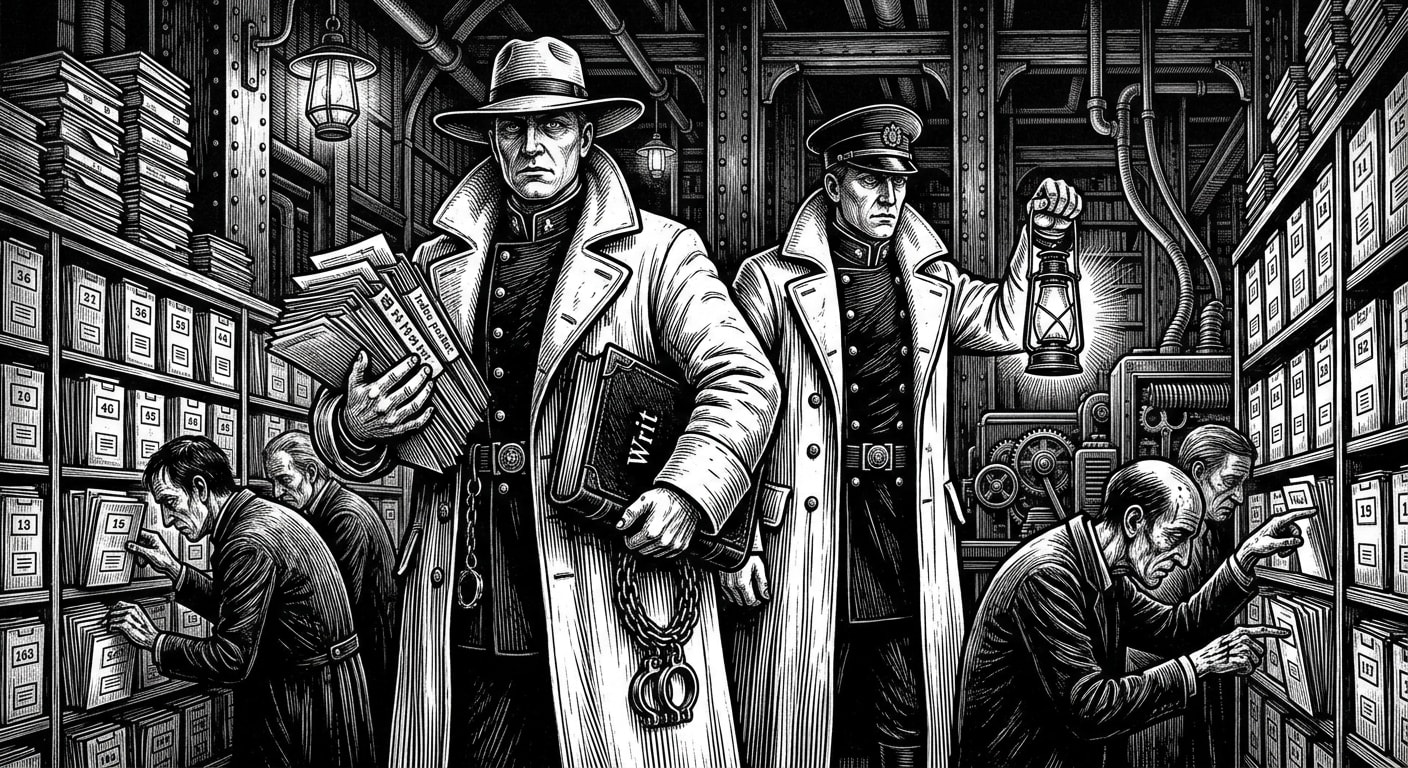
The White-Mantled Inquisitor is the face most citizens mean when they whisper Inquisition. Bone-white cloak. Black gloves. Censer smoke. Records clerk half a pace behind. Lictor two paces behind that, pretending to be patient. The Inquisitor travels under writs that supersede local authority, diocesan courtesy, civic privilege, noble irritation, guild charter, household threshold, and the charming little lie known as privacy.
A bishop governs until the White Cloak enters. A governor commands until the seal opens. A father rules his house until the Inquisitor asks why the third bed is warm. Authority in the Synod is layered, and the Inquisition carries the knife used to cut through layers when Doctrine grows impatient.
The writ is beautiful in its economy. It does not accuse. Accusation suggests debate. It identifies a doctrinal disturbance, grants the bearer entry, authorises examination of persons and materials, assigns cooperation obligations to all present, and names silence as aggravating matter. A good writ makes the room guilty before the first question. This saves time.
Inquisitorial ink differs from ordinary Purity ink in one charming respect: it dries paler. The seal remains black, the paper remains bone-white, but the written authority fades toward grey within a week, leaving the stamp more visible than the language. Citizens see the seal and remember less of the sentence. This is efficient. Law should linger as shape, not argument.
The Inquisitor's genius lies in changing the weight of ordinary objects. A spoon becomes proof of a third mouth. A hymnbook becomes acoustic risk. A cellar latch becomes concealment theory. A child's pause becomes inherited corruption. A joke becomes sedition because the wrong neighbour laughed too quickly. The room remains a room. The Inquisition has merely revised the nouns.
The Inquisitor questions with Records listening. That is the terror behind the terror. Pain fades. Fire cools. A confession entered by a competent Records clerk becomes a second body, harder to kill and less likely to recant. The accused may survive the chamber and die later when the transcript arrives at a gate ahead of him.
There is etiquette even here. The Inquisitor may ask a question three times before a Lictor is invited to clarify the room. The first question belongs to the soul. The second to memory. The third to obstinacy. After that, flesh is considered to have volunteered as interpreter. This rule is beloved in training schools because it allows young Inquisitors to feel restrained while standing beside a brazier.
A skilled Inquisitor spends less force than the amateur expects. He arranges the room. The accused faces the door and imagines flight; the witness faces the accused and imagines complicity; the clerk faces the page and imagines promotion. The censer smokes from the left because most men turn their heads right when lying. A cup of water sits untouched on the table until thirst becomes evidence of bodily rebellion. The chair is low. The seal is high. Architecture confesses before the prisoner does.
#On Lictors, Lanterns, and Visible Correction
The Inquisition is often accused of secrecy by those who have never watched a Lictor work in daylight.
The Lictors make guilt legible. Their brands are not random burns. They are text, clause, date, sentence, office, and warning compressed into skin. The condemned becomes a walking abstract. Forearm for ledger offences. Palm for oath fracture. Cheek for public correction. Throat when speech has made itself interesting. The Lictor injures and publishes.
Red Lantern squads perform the same theology at street speed. A Red Lantern Bearer raises crimson glass; the alley understands. Hook, Wall, Clerk, Bearer: four bodies, one small tribunal. The lantern guard bites the cheek, the Clerk sketches the mark, the crowd learns the permitted shape of fear. No one has yet improved upon the cheek as a notice board. It attends market, Mass, marriage, debt court, and burial without needing a fresh posting fee.
Mercy pamphlets have described Red Lantern branding as “pre-tribunal excess.”
Clarified. It is pre-tribunal instruction. The tribunal determines sentence; the brand determines atmosphere. Courts without atmosphere are merely rooms with chairs.
The Iron Choir belongs to the same family of visible correction, though its instrument is duration rather than heat. Severian of Mainz understood that a corpse educates briefly and then becomes sanitation. A living heretic in an iron cage, throat opened shallowly, forced into hymn until breath and doctrine quarrel, can instruct a road for weeks. The Iron Choir made punishment audible, renewable, schedulable. It is among Purity's finest cruelties, which is to say one of its finest administrative successes.
PURITY ACOUSTIC APPENDIX — MAINZ ROAD, RESTRICTED Optimal witness retention occurs when the condemned remains intelligible for █████ days. Beyond that period, pity increases among women, apprentices, and priests below Second Seal. Recommended rotation: █████████████. Margin note in Severian hand: “Pity is a timing defect.”
Severian's larger contribution was Article 19, the Duty of Denunciation. “Silence is shelter.” Four words, and every supper table in the Rhineland acquired a tribunal beneath the bread. The Inquisition ceased depending on patrols alone once every citizen became a possible preliminary ear. A mother reports her son. A clerk reports a pause. A wife reports a dream if the dream sounded organized. Fear becomes domestic. Domestic fear is cheap.
Article 19 also solved the scale problem. No Bureau can station an Inquisitor in every kitchen, workshop, dormitory, ferry queue, choir loft, maternity room, and tavern corner where speech risks becoming interesting. Severian did not need to. He stationed fear there. The citizen hears a sentence, measures it against his own survival, and becomes unpaid staff. The Bureau calls this vigilance. I call it excellent procurement.
The article's greatest cruelty is its tenderness toward uncertainty. A citizen need not know that heresy occurred. He need only suspect, fear, wonder, or feel the little inward itch that says the room has become reportable. Ignorance no longer protects him; ignorance becomes the reason to file. The Inquisition, with one clause, turned confusion into civic labour.
#On Ash, Shadow, and the Two Ends of Correction
Some Inquisitorial branches make things visible. Others remove the need to see.
The Order of Ash is the oldest sermon in Purity's mouth: better ash than apostasy. The Ashmen do not debate infection. They deny it terrain. A settlement receives no warning because warning permits choreography among the guilty. The outer houses burn first, the inner last, so the condemned may watch their world shrink toward the altar. Records calls this perimeter sequencing. The Ashmen call it liturgy. The children, when present, call it heat. Their testimony is seldom required.
Ash is not crude. Crudeness is flame used by amateurs. The Ash protocols weigh wind, bell timing, structure density, well placement, road instruction, witness angle, and the educative value of smoke. A burned village on a map instructs the surrounding parishes by outline. The fire ends in hours. The map preaches for decades.
At the other end stand the Penitential Shadows. The Ashmen leave cinder. The Shadows leave nothing with enough certainty to sweep. Their recruits are made from broken persons whose names have been removed from the Ledger before their bodies stop breathing. Their eyes are taken. Glass-ash orbs are fitted in the sockets. They watch in the old meaning of the word, the meaning before looking became merely optical.
The Shadow's quarry is not arrested in the ordinary sense. He is made discontinuous. Records are altered, neighbours soften, rooms acquire new owners, children forget a father with the obedience of dreamers. A demon kills and leaves grief. A Shadow erases the file in which grief would have stood.
Citizens ask which branch is worst. This is childish ranking, like asking whether one prefers drowning, hanging, or being correctly indexed by a man with neat cuffs. Ash terrifies districts. Lictors terrify bodies. Lanterns terrify streets. Shadows terrify memory. The Inquisition works because terror is assigned according to scale.
The Bureau's private manuals call this graduated correction. Field men call it choosing the proper tool. Parish people call it whatever the tool left behind: the black lane, the marked cheek, the empty bed, the cage-song, the letter that stops arriving because the sender has acquired a new official past. Vocabulary follows damage like a clerk with short legs.
#On Jurisdictional Quarrels, Those Sweet Little Wars
The Inquisition does not rule alone, which is fortunate for liberty and disastrous for efficiency. Doctrine defines heresy and resents Purity's appetite for improvisation. Purity enforces heresy and resents Doctrine's habit of finding vocabulary after blood has already dried. Silence governs forbidden words and resents Purity touching books with smoky hands. Records files confessions and resents everyone who bleeds on forms. Mercy complains when children are seized, then loses them in cleaner corridors. War complains when soldiers are removed before battle, then praises morale after the cages go up. Bells complains when screams disrupt sanctioned peals.
I have attended these meetings. They are magnificent.
The Inquisition survives these quarrels because it answers the question all other Bureaus eventually ask: who will enter the room? Doctrine may write. Silence may redact. Records may prepare a column. Tithes may calculate the value of the accused. Mercy may murmur in the corridor. The Inquisitor enters. This brutal simplicity gives Purity power no memorandum can fully cancel.
The Bureau of Silence has the bitterest quarrel with Inquisitorial practice. If a heretic has written dangerous words, Silence wants the page first. Purity wants the writer first. Records wants both, numbered. Doctrine wants a quotation short enough for school use and clean enough to survive recitation. In A.S. 140 an almanac condemned by the Index sat eleven months in a locked cabinet between Purity and Silence because neither Bureau would concede custody. Moths ate it. Both Bureaus blamed the other. The moths were, regrettably, unavailable for questioning.
Amsterdam worsened the quarrel. The Dutch presses taught the Bureau that dangerous paper could cross water faster than a denunciation could cross a corridor. De Vera Luce and its cousins forced Inquisitorial practice to grow a maritime imagination: dock seizures, ink sniffing, crate prayers, customs sermons, Dutch-language suspicion glossaries, and the humiliating necessity of bribing men who regarded Strasbourg as a customer rather than a capital. The Inquisition hates independence most when independence owns presses.
The Dutch also taught Purity the agony of limited reach. Inside the Synod, a White Cloak may make a bishop decorative by entering the nave. In Amsterdam, he becomes a foreign nuisance with expensive gloves. The Bureau adapts by cultivating harbour informants, debtor-priests, homesick printers, and customs men whose theology improves under coin. It calls this extraterritorial moral hygiene. The Dutch call it spying. Both invoices are accurate.
The Penitential Shadows produce another problem. They are Purity's instrument, but their effects resemble Records erasure and Shadows work, though the Bureau of Shadows does not exist and takes great care to object whenever confused with those who also do not exist. The Council of Veils has issued statements of denial so delicate they could cut silk. No one is reassured. Reassurance is not among the Veils' services.
A training manual once described the Inquisition as “the unified enforcement arm of Purity.”
Amended. Unified is aspirational. Enforcement is partial. Arm is anatomically inadequate. The Inquisition is better understood as a collection of sanctioned hungers sharing a seal and disputing utensils.
#On the Citizen Beneath the White Arm
For the citizen, distinctions vanish at the threshold. Whether the knock belongs to a White Cloak, a Red Lantern squad, an Index Runner, a Silence Interdiction team, or a local denunciation clerk with borrowed courage, the body answers first. Heart, mouth, hand, bladder. The soul follows when called by name.
Inquisitorial fear shapes habits too small for law and too large for comfort. Books are shelved spine inward in houses whose owners insist they own only approved psalters. Children learn which family stories to forget when guests enter. Bakers stop carving flour marks that resemble forbidden forms. Widows burn letters, then keep the ash, then fear the ash. Men report neighbours before neighbours report them, less from hatred than from the awful civic arithmetic Severian perfected: if silence shelters, speech must evict.
The Inquisition's defenders call this vigilance. Its enemies call it tyranny. Both words are tired. The truth is more intimate. The Inquisition converts the citizen into a custodian of his own accusation. He watches his mouth, his shelves, his friends, his children, his memory. He inventories himself each morning and hopes no item has shifted overnight into evidence.
This is why the Inquisition does not need to be everywhere. It has taught everywhere to prepare for it.
A parish visited once by White Cloaks changes for years. The benches fill earlier. Confession length shortens among the cautious and lengthens among the terrified. Sermons grow less interesting. The tavern learns to laugh in permitted shapes. The schoolmaster removes metaphors from copybooks. Mothers count children's words as if each were a coin owed to Tithes. One procession passes through a town, and the town becomes its own lesser tribunal.
Children inherit the visit most faithfully. They play Inquisitor in alleys with chalk seals and pretend writs, which adults condemn until the children begin reporting actual household phrases with alarming accuracy. Toy censers are banned in three dioceses and sold quietly in five. The Bureau disapproves of mimicry while enjoying its results. Childhood is the cheapest academy.
#On the Present Inquisition
As of A.S. 201, the Inquisition remains active across the Synod, most visible in Strasbourg, Mainz, Prague, the Rhineland, forward supply cities, bastion hinterlands, and those districts where Mercy Preachers, Silent Godless cells, Pale Kin routes, Ashen Circle scholars, or Rationalist nostalgia have made ordinary policing embarrassing. Its public face is cleaner than in the first century. Its forms are better. Its brands are registered. Its cages are maintained by schedule. Its writs arrive on thicker paper.
This is maturity wearing mercy's discarded face.
The modern Inquisition has learned to economize spectacle. A burned village costs grain. A public cage costs maintenance. A Shadow operation costs whatever price one pays for silence with no receipt. A Red Lantern brand costs oil, coal, glass, and a cheek. Article 19 costs almost nothing. Naturally, the Bureau uses all of them, because an institution that owns many knives does not become virtuous by choosing the cheapest first.
Its training has softened in tone and sharpened in effect. Manuals speak of de-escalation, proportional inquiry, care for witness stability, and the pastoral handling of accused households. Then the appendix lists approved knots. The old Inquisitor smelled of smoke. The new one smells of clean wool, library dust, and soap bought by procurement contract. The room is no safer. It is better lit.
The current danger is familiar cruelty becoming so well filed, so cleanly scheduled, so integrated with school, parish, market, archive, and supper table that citizens cease to recognize it as an event. An arrest becomes weather. A brand becomes signage. A vanished man becomes a corrected address. A burned lane becomes urban planning.
PURITY STRATEGIC FORECAST — A.S. 201 Projected growth areas: unregistered births; unauthorised mercy preaching; post-Amsterdam print cells; Silence ink irregularities; █████████████; bastion morale deviation; inherited Rationalist phrase recurrence. Recommended doctrine: normalize pre-incident reporting. Recommended instrument: █████████████████████████. Annotation: “The citizen should feel reported before he speaks.”
I do not love the Inquisition. That would be vulgar. I admire it as one admires a scalpel in a plague ward, a well-made lock on a prison gate, a ledger whose arithmetic proves a famine before the bodies arrive. It is hideous, useful, vain in its purity, petty in its offices, grand in its reach, and so perfectly Synodal that to condemn it without condemning ourselves would be a lie too large even for Doctrine to carry gracefully.
At midnight a White Cloak enters a street. No trumpet announces him. No demon recoils. No saint descends to clarify jurisdiction. A dog stops barking. A mother grips her son's wrist. A clerk behind the Inquisitor opens a book and wets his pen. The Inquisition begins where the ink touches the first line.
The accused will ask who denounced him. The Inquisitor will not answer because the question misunderstands the sacrament. A neighbour may have spoken, a clerk may have noticed, a song may have turned, a book may have warmed, a child may have repeated, a silence may have stood too long in the wrong place. The source is irrelevant once the writ has arrived. Rain does not name the cloud.
By dawn the street will know three things: the house number, the colour of the seal, and the fact that nobody heard anything until everyone did. This is civic education. This is Order. This is the Bureau's white hand closing, finger by finger, while the city learns to call the grip peace.