
#On Compassion Without Licence
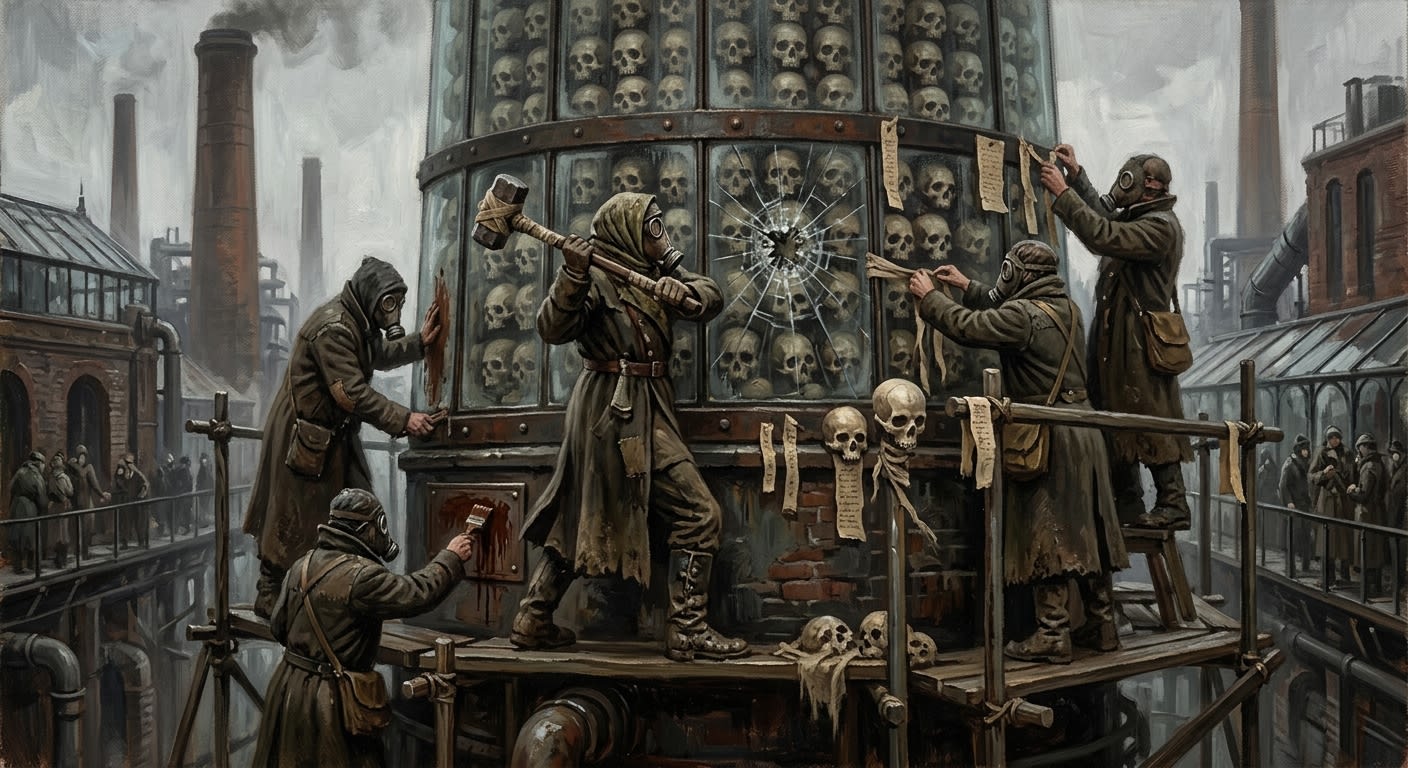
The Mercy Cults are small, local, badly hymned, theologically sentimental cells of citizens who vandalise the Glass Skull Stacks on the ground that displayed condemnation trespasses upon the Creator's final judgement. Their doctrine is simple enough to fit beneath a thumbnail: man may punish, the Synod may record, but only the Creator may hold a name forever before the eyes of the living.
This is heresy, naturally. Worse, it is heresy with manners.
The Bureau of Doctrine classifies the movement as indigenous theological error, Category: Compassion (Unsanctioned). The classification deserves admiration. It condemns the sin and identifies the solvent. Compassion, when licensed, produces hospitals, widow queues, consolatory sermons, and tax-deductible tears. Compassion, when unauthorised, produces wrapped hammers at three in the morning and a blank skull staring from the Stack like a missing tooth in the face of government.
#On the Argument They Mistake for Theology
The Mercy Cults begin with a question asked beside a glowing Stack: who owns the condemned after sentence? The Bureau answers cleanly. The name belongs to the record, the record belongs to Records, the display belongs to Civic Doctrine, the punishment belongs to Purity, the lesson belongs to Doctrine, and the citizen belongs to whichever office reaches him first. Ownership is beautifully distributed. Responsibility is not.
The Cults answer otherwise. They claim a condemned name remains a soul-mark, and that placing it in glass so that schoolchildren, ration wives, gate-guards, and bored lovers must pass under it converts punishment into theft. They quote funeral fragments. They misquote saints. They adore the phrase “monopoly of judgement” because it sounds grand enough to frighten shopkeepers into listening. Their pamphlets, when recovered, are mostly prayers with handles attached.
The error lies in their assumption that the Creator is jealous of administration. He is not. The Creator made ledgers possible and then, in His wisdom, allowed Strasbourg to improve them.
#On the Hammer, the Prayer-Strip, and the Blank
Mercy Cult operations are modest by design. They do not assault tribunals. They do not seize presses. They do not kidnap Inquisitors, partly from principle and mostly from cowardice. Their theatre is the street corner, the Stack base, the hour between patrol rhythms when the lantern burns low and the Route Keeper has gone to count keys in some depot stink of oil and cold brine.
The first method is the wrapped hammer: a mason's or cooper's tool bound in rags to dull the strike until the last instant. The vandal climbs two rungs, swings at the lower skulls, and runs before the glass finishes falling. This is the stupid method. It satisfies grief and creates evidence.
The second is the prayer-strip: cheap paper pasted over a name with flour glue, usually bearing a plea that the displayed soul be returned to divine privacy. Rain removes most strips. Pillar-Keepers remove the rest. The paper matters less than the fact that, for one hour, a citizen sees paper where the Bureau meant a name.
The third is the blank skull. This is the only method worth Purity's immediate sweat. A blank skull installed in place of a Bureau-inked one creates what Keeper slang calls an open mouth: a visible absence in the Synod's argument. The Stack still glows. The iron rib still holds. The row remains aligned toward maximum pedestrian flow. One place where a name should be is empty, and every passer-by understands emptiness faster than doctrine.
OPEN MOUTH RESPONSE PROTOCOL — CLEARANCE TERTIUS Upon discovery of blank replacement unit: cordon radius █████ paces; route Keeper detained; glass fragments retained; witnesses separated by household; children under catechetical age ████████████████; responsible Stack extinguished for █████ minutes only; explanation issued as maintenance fault. Unauthorised utterance of phrase “God took the name back” triggers ████████████████.
#On Cell Structure and Citizen Materials
A Mercy Cult cell is usually five to eleven persons: a bereaved relative, a parish auntie with keys to a chapel cupboard, one apprentice who knows how to climb, one literate fool, and a soft-hearted clerk whose conscience has mistaken itself for courage. They meet in washhouses, closed bakeries, funeral sheds, or the rear rooms of taverns where the owner has lost someone to public display. They carry no doctrine manual. Doctrine manuals are how conspiracies become evidence shelves.
Their marks are domestic. Hammer wrapping cut from burial linen. Flour glue mixed in kitchen bowls. Prayer-strips dried over hearths. Blank skulls acquired through theft, bribery, or the connivance of a glasswright who insists, under interrogation, that he thought the order came from Records. It did not. Records would have charged more.
Connections to the Silent Godless remain disputed in the way all embarrassing facts remain disputed. The Godless despise the Cults' premise; one cannot defend the Creator's monopoly while denying the Creator exists. Yet cellcraft travels. Routes, countersigns, dead drops, and the habit of speaking sideways in queues have passed from cellar to chapel-room and back again. The Bureau calls this contamination. I call it professional plagiarism among enemies.
Earlier notices attributed Mercy Cult vandalism to imported Rationalist agitation from the Netherlands.
Corrected. The Bureau now recognises the movement as native to Synod parishes. A foreign heresy flatters us by making error arrive from outside. A native heresy insults us by proving our own machinery produces its defects locally.
#On the Pillar-Keeper's Complicity
No Mercy Cult operates for long without brushing the grey coat. The Pillar-Keeper knows the blind spots, the ladder times, the lantern failures, the Stack whose seal-wire takes a counterfeit twist without squealing. He also knows which names draw spit from passers-by and which names draw flowers. The Bureau asks whether Keepers are loyal. Loyalty is a child's word. The better question is what a Keeper owes to a route after ten years of hearing it whisper.
Some Keepers sell darkness. A dimmed Stack is a vandal's chapel. Others sell delay: one broken skull left unreplaced until dawn, one prayer-strip misfiled as weather damage, one blank unit reported after the market has already seen it. Others betray the Cults with equal skill, taking bribes in oil-vouchers and delivering names to Purity before Matins. The Keeper's soul is not complicated. It is tired, underpaid, and in possession of keys.
Saint Velek is invoked by both sides, which proves again that saints are public property once dead enough. Keepers pray for legibility. Cultists pray that Velek, being clear-eyed, sees the obscenity of eternal display. Doctrine rejects the cultist reading. Doctrine owns the feast calendar.
#On Suppression
Purity's suppression method is patient until it is theatrical. The first vandalism is logged as damage. The second is logged as pattern. The third produces plain-coated watchers, false prayer-strips, counterfeit sympathisers, and a clerk with damp eyes who says his sister's name glows at the north gate. The cell opens to receive him. The cell closes around a warrant.
Punishments vary by usefulness. Hammer-carriers go to public correction. Prayer-strip writers go to doctrinal hearing. Blank-skull installers disappear into the machinery reserved for persons who have made absence visible. Children who repeat Cult phrases at school gates are corrected as “echo cases,” which is to say the Bureau punishes the household while pretending to treat a sound.
The movement persists because the Stacks persist. Every displayed name creates its own parish of the uneasy. Every cracked skull becomes a rumour. Every open mouth, even sealed within the hour, leaves a taste in the district. The Bureau can replace glass faster than it can erase the memory of a blank.
#On the Heresy of Tender Hands
The Mercy Cults will not overthrow the Synod. They lack discipline, doctrine, artillery, patience, and the divine favour of my office. They will break skulls, paste prayers, hide one another badly, and cry during interrogation, which is tactically poor but not without rhetorical force. Their crime is not strength. Their crime is interruption.
The Stack says: the name belongs to us. The blank says: prove it.
That is enough to earn fire.