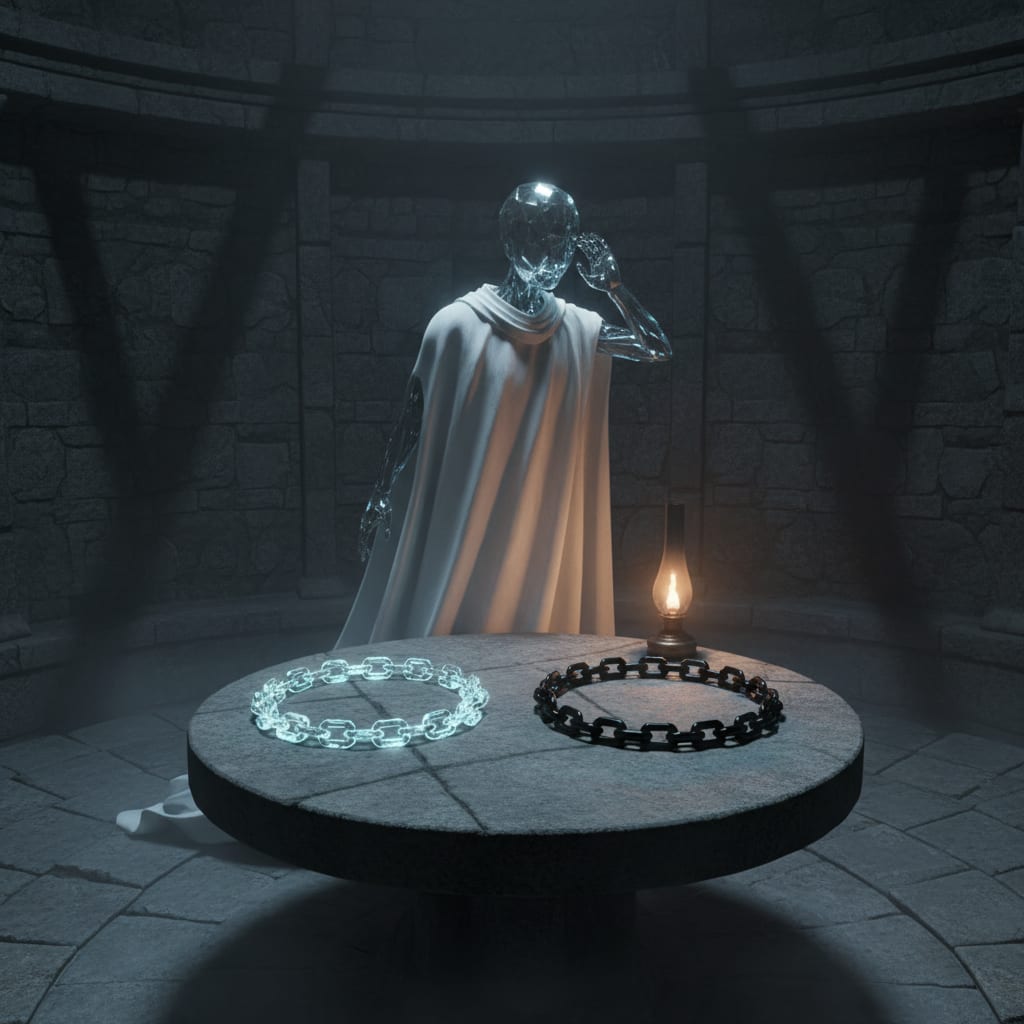
#On the Profession of the White-Mantled Inquisitor
Wherein the Warden describes those who walk in bleached linen, listen with glass, and burn with precision.
The Bureau of Purity has many instruments. The Index Damnatus is its blacklist. The Lictors are its stylus. The Shadows are its ears. But the figure that occupies the civilian imagination — the shape that mothers invoke to silence children, that printers see in nightmares, that makes a market square fall quiet two streets before it arrives — is the White-Mantled Inquisitor: the language constable, the word-hunter, the walking embodiment of the Synod's conviction that speech is infrastructure and every unregulated syllable is a crack in the fortification.
Their formal title varies by district: Inquisitor of the Mantle, Lexicon Warden, Purity Examiner. The street has its own taxonomy. Whitecoat is common. Word-Hunter is accurate. Glasschain references the links they carry — glass, forged in the Bureau's own furnaces, wound wrist-to-wrist as a visible oath that the Inquisitor is bound by the same lexicon he enforces. And the derogatory names — Milk Ghost, Paper Butcher, Choir Rat — are spoken only in rooms where the speaker has first checked every window, every chimney, and every child within earshot, because children repeat, and repetition is evidence.
#The Function
The White-Mantled Inquisitor exists to contain language. The statement sounds absurd until you remember what language did to the Synod before containment was policy.
In the decades following the Sundering, when the Sagittal Line was still wet masonry and the Bureau of Doctrine was still learning to define orthodoxy faster than heresy could mutate, the Synod discovered that certain phrases — certain shapes of sound — propagated contagion. A slogan chanted in a Kraków market could trigger panic in Strasbourg within the week. A lullaby hummed in the wrong key could coordinate a prison riot without a single conspirator ever meeting face to face. And in the worst cases, documented in files the Bureau has sealed and I have read and you have not, forbidden phrases became rituals-by-accident: incantations that opened cracks in the fortification that no masonry could mend, because the breach opened in meaning rather than stone.
The Synod's response was the Index Claritatis: the rolling compendium of permitted words, updated every seventh day, maintained by the Bureau of Doctrine and enforced by the Bureau of Purity. The Index Claritatis tells you what you may say. The Index Damnatus tells you what you may not. The Inquisitor walks the space between those two documents — the narrow, soot-stained corridor where a single word can be either prayer or breach depending on which weekly bulletin has arrived.
The day-to-day output of an Inquisitor's labour is paper: confiscation writs, redaction orders, burned-pamphlet tallies, interrogation logs, "cleansed" hymnals with offending phrases struck and replaced, public recantation scripts drafted for the accused, sealed tongue-warrants for repeat offenders, corrected signage hammered over the old. If the Inquisitor stops working, the consequences arrive within days. Unsanctioned dialects bloom. Counterfeit creeds circulate in broadsheets. Pilgrim marches lose cadence. Heretical slogans coordinate riots. And in the bastion zones, where the Bureau of Bells maintains hymn-frequencies calibrated to the Line's fortifications, a single unauthorized melody can disrupt a Bellway's resonance envelope and cost the garrison three days of recalibration.
#Origin and the Glass Chain
The profession's roots lie in the Witch-Hunts of Toulouse — as do all of Purity's instruments, because the Witch-Hunts were a forge and everything that survived them came out tempered. The first Inquisitors were ad hoc censors: priests with authority to seize printed matter, shut down presses, and interrogate anyone whose speech deviated from the catechism. They wore no special garment. They carried writs on ordinary paper. They burned what they found and filed what they burned.
The white mantle came later — A.S. 62, by Bureau reckoning — when Procurator Hildegarde of Mainz decreed that the Bureau's field agents must be visible. "Heresy thrives in ambiguity," she wrote in the Mandatum Candoris. "Let the instrument of correction be seen, that the faithful may take comfort and the faithless may tremble before they are asked to speak." The mantle is starched linen, bleached to a shade the Bureau calls candor veritatis — the whiteness of truth. It shows soot like sin. An Inquisitor who has spent a day burning pamphlets returns to the tribunal with grey cuffs, grey hems, grey fingerprints on the collar where he adjusted his hood. A clean mantle means a quiet day. A quiet day, in the Bureau's ledger, means either the district is pure or the Inquisitor is idle. Both possibilities are investigated.
An earlier edition of this Codex attributed the Mandatum Candoris to Procurator Severinus of Lyon.
Severinus administered the Bureau's southern dioceses and had no hand in the mantle decree. The confusion arose from a filing error in the Bureau of Records, where Severinus's name was cross-indexed with Hildegarde's during the Great Clerical Reconciliation of A.S. 147. The filing clerk responsible was reassigned. The file remains cross-indexed. The Bureau of Records considers these facts unrelated.
The glass chain is younger than the mantle, and its origin is darker. In the decades before the Glasschain Reform — the Bureau prefers not to date it precisely, a reticence that tells you everything — Inquisitors had begun to use the forbidden words they confiscated. A word seized from a heretic is, after all, a word the Inquisitor now possesses. Some Inquisitors discovered that forbidden phrases could be traded: sold to smugglers, whispered to rivals' informants, deployed in interrogations as weapons of psychological pressure. The Bureau's own agents had become a black market in the contraband they were sworn to destroy.
The reform came from a figure the Bureau calls Chainmaster Veyl — a name that may be title, may be surname, may be invention. Veyl decreed that every Inquisitor would carry a chain of glass links, forged in the Bureau's furnaces from a compound that includes silica, bone-ash, and consecrated sand. The chain is wound wrist-to-wrist or hung like a rosary. It clicks when the Inquisitor walks — a small, cold sound, glass touching glass, audible at ten paces in a quiet room. The sound announces the Inquisitor before his mantle is visible. The sound is the point.
The chain serves three purposes. It marks the Inquisitor as bound — the same lexicon that governs the citizen's mouth governs the Inquisitor's. It provides an audit trail — the Bureau inspects chains weekly, checking for chips, cracks, or the faint discoloration that indicates exposure to forbidden smoke. And it makes the Inquisitor audible. You hear a White-Mantled Inquisitor before you see one. You hear the glass before you hear the boots. The sound has become, across the Theocracy, a synonym for silence — because when the chain clicks, everyone else stops talking.
#The Hierarchy of the Mantle
The Inquisitor's ladder is steep and narrow, and every rung is slippery with the residue of ruined colleagues.
Chalkling. The entry rank. A Chalkling checks signs, carries lists, and listens. A Chalkling does not speak during inspections. A Chalkling does not carry a chain — he carries chalk, which he uses to mark suspect signage for the Examiner's review. The chalk is white. The Chalkling's mantle is off-white, a half-shade distinction the Bureau insists upon and civilians cannot detect. Chalklings are recruited from the Orphanarii, from Synod schools, from families who owe the Bureau a debt that cannot be paid in coin. They serve three years before examination. Many do not pass. Those who fail are reassigned to Records or to the print-quarter watch, where they spend the remainder of their careers inspecting type-cases and smelling of lead.
Mantle Examiner. The working rank. The Examiner conducts field raids, interrogations, and seizures. He carries the chain. He wears the full white mantle with the hood and the sewn-in ash-filter — a strip of treated cloth across the mouth and nose that the Bureau claims protects against "doctrinal contamination via airborne phrase" and that the Examiners themselves call, with the gallows humour of men who breathe through gauze for twelve hours a day, "the muzzle." The Examiner's authority supersedes local constabulary. A Governor-Praelate's writ means nothing when the Examiner produces Purity's seal. The Examiner answers to his Chainmaster, his Chainmaster answers to the Prefect of Doctrine, and the Prefect answers to Procurator della Torre, who answers to the Hierarch, who answers to the Creator, who — the Bureau assures us — answers to no one.
Chainmaster. District oversight. A Chainmaster manages a web of Examiners and their informants, sets quotas, approves seizure lists, and conducts the weekly chain inspections that determine whether an Examiner has been careless, corrupt, or merely unlucky. A Chainmaster's mantle is indistinguishable from an Examiner's to the civilian eye. The difference is in the chain: the Chainmaster's links are heavier, thicker, and faintly luminous in certain light conditions that the Bureau attributes to the consecration process and that the Foundry Quarter workers who make them attribute to the phosphorescent sand imported from Bastion-Shipka's outer perimeter, where sand glows because the ground remembers Syrion's passage.
Glass-Canon. The specialist rank, and the one the Bureau discusses least. A Glass-Canon handles "singing phrases" — linguistic events where the forbidden words have crossed from sedition into the demonic. A phrase that makes the glass chain sing — a high, thin tone, like a wet finger drawn around the rim of a wine glass — is a phrase that has acquired resonance beyond its semantic content. The Bureau's own terminology for this phenomenon is "lexical breach," and a Glass-Canon is trained to contain it: to isolate the phrase, identify the vector of transmission, neutralize the speakers, and seal the site with methods the Bureau classifies and I am not permitted to describe, though I will note that Glass-Canons carry two chains instead of one, and that the second chain is black, and that no Glass-Canon I have met has been willing to explain what the black chain is for.
#The Daily Work
An Inquisitor's day begins before dawn with lye-water on the hands — a ritual ablution the Bureau calls the Washing of Intent (Unregistered) — followed by recitation of the day's Errata: the latest amendments to the Index Claritatis, printed on strips of treated paper and distributed to every Examiner in the district before the bells ring Prime. The Errata are the profession's weather report. A new forbidden word means new seizures. A reclassified phrase means revisiting yesterday's cases with today's definitions. An Inquisitor who has not memorised the Errata by the time he leaves the tribunal is an Inquisitor who will condemn a man for a word that was permitted six hours ago, and the Bureau's position on such errors is that the Inquisitor, having failed to update his understanding, has himself become an instrument of imprecision — and imprecision, in the Bureau's theology, is indistinguishable from heresy.
The midday hours are patrol. Markets. Shrine districts. Print-quarters, where the presses run and the type-cases hold letters that could be arranged into anything. The Inquisitor inspects banners, crests, shop signs, hymnal inventories. He interrogates printers — a conversation that follows a script the Bureau has refined over a century and a half, in which every question is designed to produce an answer that incriminates either the printer or the printer's supplier, and the printer knows this, and the Inquisitor knows the printer knows, and the negotiation that follows is conducted in the language of "voluntary redaction": the printer agrees to pulp a certain run, to reset certain plates, to replace certain phrases with Bureau-approved alternatives, and the Inquisitor agrees not to file the seizure warrant he has already prepared. The warrant exists. It is always prepared in advance. The Bureau wastes nothing, least of all the threat of its own paperwork.

The late day is filing. Evidence boxes sealed. Chain cleansed with ash-cloth. Suspects handed to holding cells or released with recantation scripts they must perform publicly within forty-eight hours or face the Lictors. The Inquisitor rewrites his reports into doctrine-approved phrasing — because even the Bureau's own internal language is subject to the Index, and a report that uses a word stricken since morning is a report that condemns its author.
The night is raids. Coordinated descents on print rooms, cellars, back-street scriptoria where unlicensed copyists reproduce hymns, pamphlets, and — in the more ambitious operations — entire catechisms amended with phrases the Bureau has forbidden. The raids are called "white rain" in Inquisitorial slang, because the white mantles arrive like weather: sudden, cold, and indifferent to the comfort of those below. A district that receives white rain more than twice in a season is a district whose Chainmaster is either very good or very worried, and the Bureau does not distinguish between the two.
#On Factions Within the Mantle
The profession contains three currents that the Bureau does not acknowledge and that anyone who has spent a week in a print-quarter checkpoint can identify within the hour.
The Purists burn first and file afterward. Their mantles are the greyest. Their chains have the most chips. Their seizure tallies are the highest in any district, and their recantation quotas are the lowest, because the Purist does not negotiate. A Purist considers "voluntary redaction" a euphemism for cowardice. The Bureau values Purists for their efficiency and distrusts them for their inability to leave a district functional after they have cleaned it. A market square emptied of merchants is doctrinally pure but economically useless, and the Bureau of Tithes has opinions about economically useless districts that are expressed in memoranda with red seals.
The Pragmatists correct and contain. Their mantles are clean. Their chains are unchipped. Their seizure tallies are modest, but their compliance rates — measured by the Bureau's quarterly Language Conformity Assessments — are consistently the highest. A Pragmatist understands that the purpose of the Inquisitor is to make the district's language shift without the district noticing. The best outcome, in a Pragmatist's estimation, is a population that forgets a word ever existed — that cannot recall what they used to say, because the replacement has been so smooth, so gradual, so thoroughly papered over with corrected signage and amended hymnals, that the old word has become an absence so total it does not even leave a gap.
The Shadow Crew (Unregistered) sells protection, manufactures denunciations, trades forbidden words like currency, and operates the black market that the Bureau pretends does not exist and that the Bureau's own senior officers use when they need a discreet favour from a district whose Chainmaster owes them a chain-inspection. The Shadow Crew is the profession's rot, and the Bureau's refusal to address it is one of the few subjects on which I, Valerius Drax, will express an opinion without qualification: they are the price of a system that grants men absolute authority over other men's mouths and then measures their performance by quota.
An earlier edition of this entry described the Shadow Crew as "an isolated phenomenon confined to the southern dioceses."
It is widespread. It crosses diocesan boundaries. The Hieromnemon who wrote the original characterisation has been reassigned to duties that do not require him to characterise anything.
#The Cost
The Inquisitor's hazards are physical, moral, and spiritual, in ascending order of damage and descending order of the Bureau's willingness to discuss them.
Physical: smoke inhalation from burned pamphlets. Ink solvents that blister the fingers. Night raids in districts where the populace has decided that submission is less attractive than a cobblestone thrown at a white hood. Infection from holding cells where the accused are stored in conditions the Bureau of Mercy has formally protested and the Bureau of Purity has formally ignored.
Moral: condemning a man for a word that was permitted last week. Watching a family lose ration priority because a child repeated a phrase heard in the schoolyard. Filing a denunciation you know is fabricated because the Chainmaster needs his quota and the alternative is your own chain on his inspection table. Rationing mercy — the Bureau permits a fixed number of recantations per quarter, and when the quota is spent, every further case goes to the Lictors regardless of severity.
The spiritual hazards of prolonged service in the Inquisitorial corps — specifically the phenomenon of ████████████████ forbidden words lodging in the Inquisitor's own cognition ████████████████ the phrase repeating at unpredictable intervals ████████████████ Glass-Canons assigned to internal monitoring ████████████████ retirement rate among Inquisitors with more than fifteen years of service ████████████████ the Bureau's position is that the phenomenon does not exist, and that the Inquisitors who report it are exhibiting "fatigue consistent with devotion."
The stress tells are visible to anyone who knows what to look for. Compulsive syllable-counting — an Inquisitor who taps his fingers in rhythm with his own speech, checking the cadence against the Index. Refusal to use metaphor — because metaphor implies a second meaning, and a second meaning is a crack. Flinching at lullabies. Polishing the glass chain until the fingers bleed, because a clean chain is proof of a clean conscience, and the cleaning becomes the proof, and the proof becomes the compulsion, and the compulsion becomes the only prayer the Inquisitor trusts.
#On the Glass That Sings
I will end with the thing the Bureau least wishes me to discuss, because I am Valerius Drax and I end where I choose.
The glass chain sings. This is documented. This is classified. This is happening with increasing frequency — the Bureau's own internal metrics, which I obtained through channels the Bureau would prefer remained unnamed, show a fourteen percent increase in singing-glass incidents since A.S. 195. The glass sings when it encounters a phrase that has crossed the threshold from sedition to breach — a word that has acquired weight, resonance, a kind of gravitational pull on meaning itself. The Inquisitor hears it as a high thin tone. The chain vibrates. The links catch light at angles that geometry does not comfortably explain.
What happens next depends on the Inquisitor's training, his rank, and his nerve. An Examiner files a breach report and evacuates the site. A Chainmaster seals the district and summons the Glass-Canons. A Glass-Canon enters the site alone, carrying two chains and equipment the Bureau does not catalogue in any document I have been able to locate.
I asked a Glass-Canon what she does when the glass sings. She looked at me with the particular expression of a woman who has heard sounds that the rest of the Bureau pretends do not exist, and she said: "I sing back."
I did not ask what she sings. There are questions whose answers cost more than curiosity can afford.