
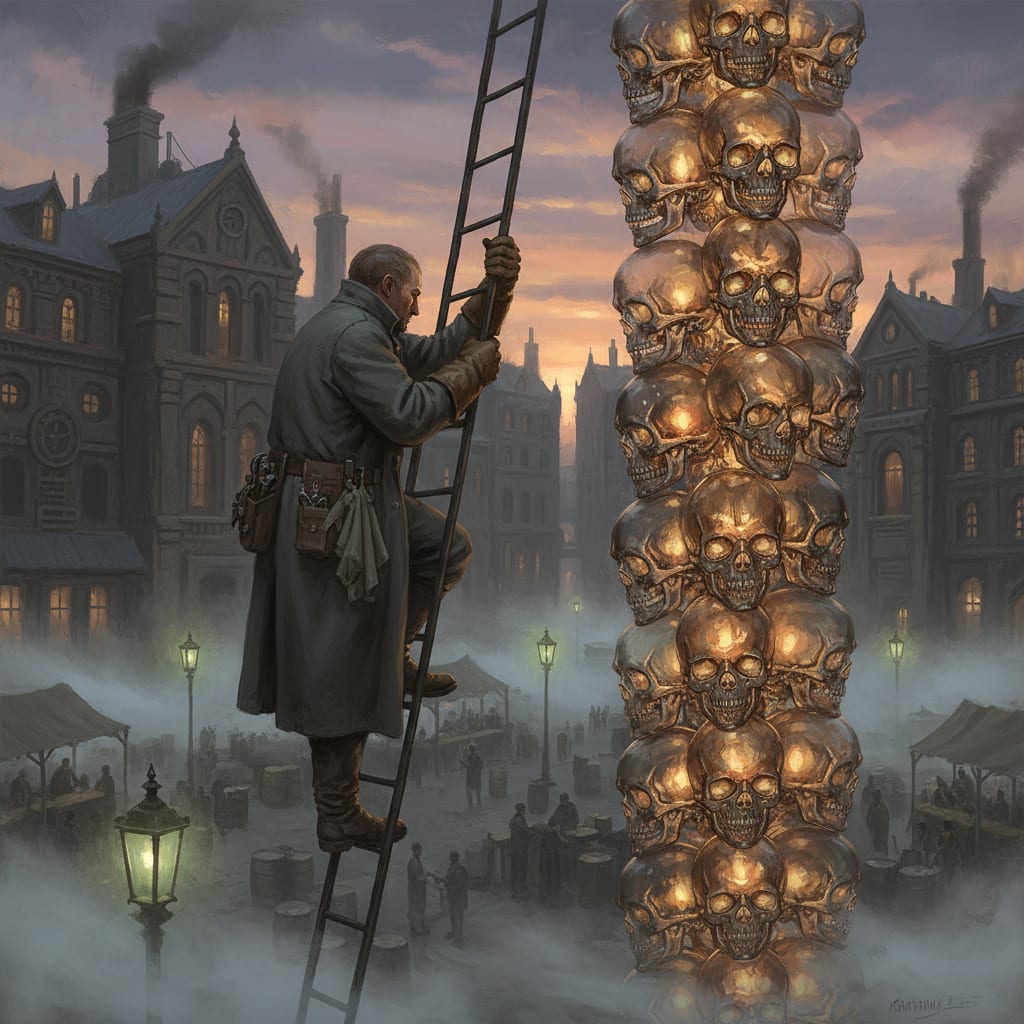
Wherein the Warden addresses those faithful custodians who maintain the Synod's most intimate reminders, and finds in their ladders, oil-rags, and cracked gloves a parable about the nature of obedience.
The Bureau of Purity has its Pillars of Glass at Zaragoza — those translucent columns stacked with the entombed, warped and magnified into grotesques for the edification of pilgrims who travel miles to see their "frozen sermons." Grand infrastructure. Monumental intimidation. The kind of deterrent that earns commemorative etchings and a line item in the Bureau of Engineering's annual boast-report.
The Glass Skull Stacks are not that.
The Stacks are smaller. Meaner. They stand at bridgeheads, gate plazas, ration courts, and school routes — anywhere the populace congregates in sufficient density that a reminder is cheaper than a patrol. Each Stack is a civic pylon, iron-boned, between twelve and twenty feet tall, crowned with hollow glass crania arranged in ascending rows. The skulls are cast at the Bureau-licensed foundries of Strasbourg and Irongate from a formula the glasswrights call "sermon-clear" — a compound that resists soot, holds inscription ink on its interior surface, and produces, in high wind, a sound that citizens describe as whispering and the Bureau describes as "ambient liturgical reinforcement."
Each skull bears a name. The names are inked on the interior surface — visible through the glass, legible at the prescribed distance of fifteen paces (Bureau of Civic Doctrine, Visibility Standard 7c, A.S. 143), and permanent until a Keeper re-inks them or a Bureau of Records amendment strip orders their removal. The names belong to the condemned: heretics, debtors past the seventh notice, apostates, oath-breakers whose breach was ruled "civic in nature," and — in certain districts — those whose confessions revealed sins the Bureau of Doctrine classifies as "instructive if displayed."
The skulls do not contain remains. I wish to be precise about this, because the popular imagination has fused the Stacks with the Pillars of Glass, and the confusion serves no one except the Bureau of Purity's reputation for thoroughness. The Stacks are symbols. Glass and ink and iron. The horror is administrative, which — as any student of the Synod will confirm — is the worst kind.
#On the Keepers Themselves
The Pillar-Keeper is a licensed municipal custodian — grey-coated, key-corded, glove-stained, and invisible to everyone except the people who need him gone. His patron is Saint Velek the Clear-Eyed, a glasswright-executioner in Synod hagiography who is depicted in devotional woodcuts holding a glass orb in one hand and a branding iron in the other. Whether Saint Velek existed is a question the Bureau of Doctrine has answered with the word "ratified," which differs from "yes" while serving the same administrative function.
The hierarchy is brief. At the bottom: the Ladderhand — oil-runner, chalk-marker, the one who hauls the lantern kit up cold iron rungs at dawn and comes down with glass grit in his knuckles and soot in his lungs. Above: the Route Keeper, who owns a district loop of six to twelve stacks, maintains the inspection log, negotiates roof access with shopkeepers, and handles the endless stream of "name disputes" from citizens claiming mis-inscription. Above that: the Stackwarden, who authorizes skull removals, processes petitions, interfaces with the Bureau's civic auditors, and — in theory — never climbs a ladder again. In practice, Stackwardens climb when audits loom, because a stack inspected from the ground is a stack inspected by a liar.
At the top — or the bottom, depending on whether you believe the rumours — sits the Glass-Listener: a specialist who diagnoses stacks that "sing wrong." The Bureau denies that Glass-Listeners work with Inquisitors. The Bureau denies that Glass-Listeners exist as a formal rank. The Bureau denies a great many things, and I have learned that the volume of denial correlates precisely with the volume of truth being suppressed.
#On the Work
A Keeper's day begins before dawn. Cold brine hand-wash. Key count — triple-knot pouch, numbered ring, each key corresponding to a specific stack's pin-lock mechanism. The route walk starts in pre-light grey: check lantern housings, mark cracks with chalk runes (a private notation system that varies by district and is, technically, unauthorized), test seal-wire tension on each skull's mounting pin.
Midday brings repair work. A cracked skull must be isolated before the fracture spreads — glass under internal tension has a habit of catastrophic failure that the glasswrights blame on temperature differential and the Keepers blame on the names inside fighting to get out. This is superstition. The Bureau has confirmed it is superstition. The Bureau's confirmation has not stopped a single Keeper from whispering an apology before pulling a fractured skull from its pin.
Replacement skulls arrive in straw-packed crates from the foundries, sealed with Bureau transit stamps. The Keeper unpins the damaged skull — keyed mechanism, seal-wire cut, logged in triplicate — and installs the new one. Names must be re-inked by hand, from the interior, using a long-handled brush and the approved ink compound (carbon-soot base, resin fixative, and a drop of what the supply manifest calls "liturgical binder" and the supply clerks call "the expensive one"). The inscription must be legible at fifteen paces. The Keeper checks this by walking fifteen paces and reading. If he cannot read it, he climbs again.
Dusk is lighting. Each stack carries a lantern housing at its crown — oil-fed, wick-trimmed, designed to illuminate the glass from within so that the skulls glow amber after dark. A lit stack is a working deterrent. An unlit stack is an invitation. The Bureau's operational maxim, stencilled on the interior of every lantern housing in letters too small to read without climbing: A DIM GRIN INVITES TEETH.

Night shifts overlap with Procession Marshal patrols and curfew enforcement crews. The Keeper's night duty is threefold: relight any extinguished lanterns, chase "shadow crews" (vandals who paint over skulls, paste prayer-strips across names, or — in the worst cases — attempt to crack stacks with hammers), and listen. The listening is not optional. A stack that "sings wrong" — a shift in the wind-resonance, a new harmonic where none existed — means structural compromise, or replaced skulls, or counterfeit glass. The Keeper logs the anomaly. Whether anyone reads the log depends on whether the district is scheduled for audit.
#On the Stacks as Infrastructure
The Glass Skull Stacks are punitive infrastructure. They are navigational. The Synod's civic planners use stack placement to define curfew boundaries, mark transition zones between administrative districts, designate approved gathering sites, and — in bastion cities — indicate evacuation routes. A citizen who knows the stacks knows the city's invisible architecture: where the patrols intensify, where the ration courts open, where the Bureau's attention concentrates.
Stack placement is governed by the Bureau of Civic Doctrine's Visibility Standards — a set of regulations first codified in A.S. 143 during the municipal reforms that followed the Broth Riots of A.S. 112. The Standards prescribe: minimum height (twelve feet to skull-crown), maximum spacing (no citizen should walk more than four hundred paces without encountering a stack), mandatory placement at all bridges, gates, ration courts, school entrances, and tribunal approaches. The Standards also prescribe alignment — each stack's forward-facing row of skulls must point toward the "axis of maximum pedestrian flow," ensuring that the greatest number of passers-by meet the glass stare daily.
The alignment clause is where the bribes live. A stack that "looks away" from a particular doorway is a stack whose keeper has been paid. The cost varies by district: oil-vouchers in the poor quarters, seal-wire bundles in the trade districts, hard coin in the places where hard coin still circulates outside the Bureau of Tithes' audit perimeter. A misaligned stack is not invisible — the skulls still glow, the names still whisper — but it grants the patron's threshold a psychological reprieve. The Bureau knows this happens. The Bureau permits it to happen at a rate it considers "economically stabilising." The Bureau's tolerance has a limit. Keepers who exceed it are found with contraband solvent in their kit and a Ladderhand willing to testify.
#On Vandals, Mercy Cults, and the Question of Silence
The Stacks have enemies. Every deterrent breeds resistance, and the Stacks — being smaller, more accessible, and less guarded than the Pillars of Glass — attract a particular species of vandal: the theological kind.
The Mercy Cults are the most persistent. Small cells of citizens — rarely organised, rarely armed, always doomed — who believe that the display of condemned names constitutes a sin against the Creator's monopoly on judgement. They smash skulls with wrapped hammers in the small hours, paste devotional prayers over the names, or — most dangerously — replace Bureau-inked skulls with blanks. A blank skull on a Stack is an "open mouth" in keeper slang: a hole in the Synod's argument, visible to anyone who looks up. The Bureau of Purity responds to open mouths with a speed that suggests the theological threat outweighs the material one.
A previous edition of this entry attributed the Mercy Cult phenomenon to "imported rationalist sympathies from the Netherlands."
The Bureau of Doctrine has revised this attribution. The Mercy Cults are now classified as "indigenous theological error, Category: Compassion (Unsanctioned)." The distinction is important. Imported error implies a border that can be closed. Indigenous error implies a population that requires ongoing correction. The Bureau prefers the latter classification. The Bureau always prefers the classification that justifies continued employment.
Mercy Cult cell structure ████████████████ estimated active membership across Rhine districts ████████████████ connection to the Silent Godless movement is ████████████████ the Bureau of Purity's response protocol involves ████████████████ and is not discussed in documents below Clearance Tertius.
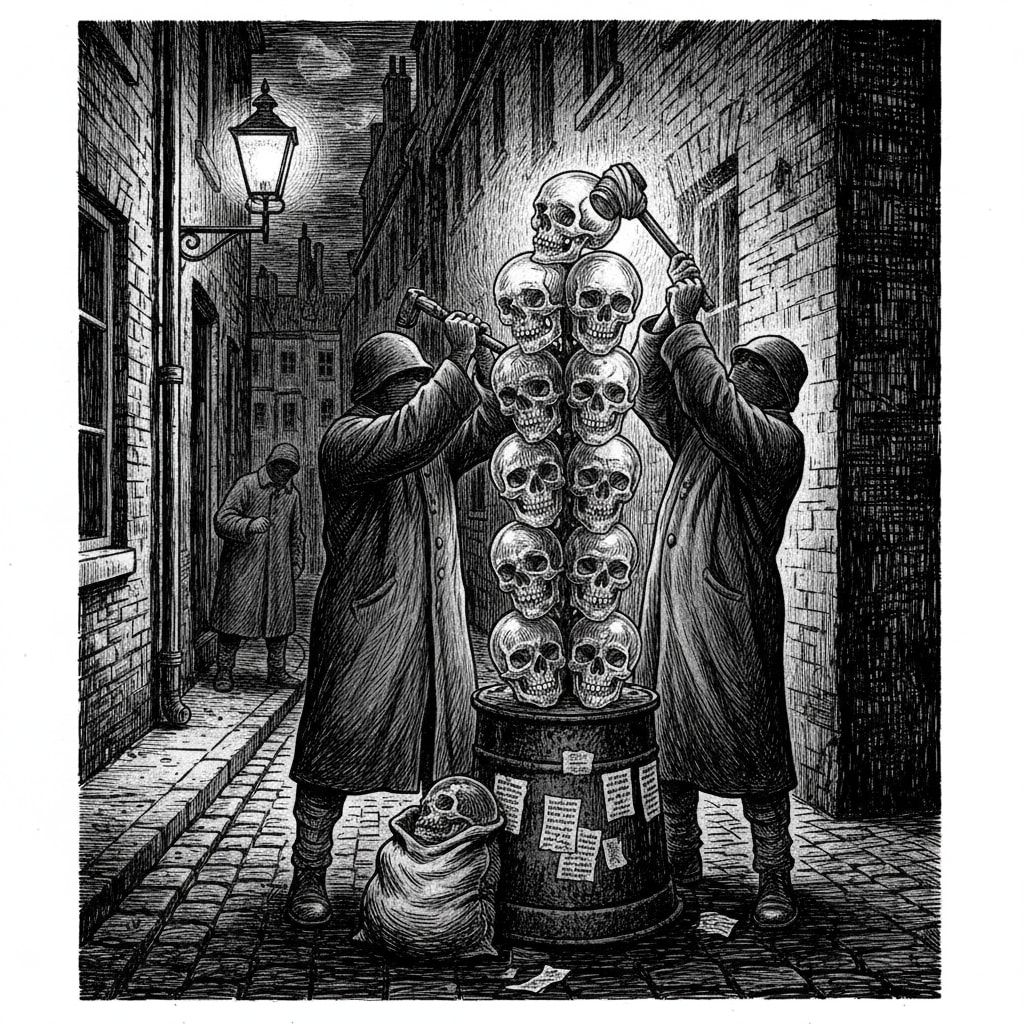
The Keepers themselves occupy an ambiguous position in this conflict. They are custodians rather than soldiers. Their grey coats carry no weapon beyond the alignment plumb (a brass weight on a cord that, in extremis, functions as an improvised flail — a fact the training manual does not mention and every Keeper discovers independently by the third month). When a Mercy Cult strike occurs on a Keeper's route, the Keeper files the damage report. The Keeper does not pursue. The Keeper replaces the skull, re-inks the name, re-lights the lantern, and enters the loss in the route log.
Whether the Keeper sympathises with the vandals is a question the Bureau does not ask, because the Bureau understands that asking would produce answers, and answers would require action, and action would deplete a workforce the Bureau cannot easily replace. Climbing cold ladders at dawn for a custodian's wage attracts a limited pool of candidates. The Bureau is pragmatic about this. Pragmatism, in the Bureau's vocabulary, means "selective blindness deployed as policy."
#On Glass-Speech and the Cost of Proximity
The Keepers pay a price the Bureau does not audit. They call it glass-speech: a condition that begins as tinnitus, progresses to the perception of murmured names in wind and water, and culminates — in long-service veterans — in the inability to distinguish between the stacks' acoustic resonance and human conversation. A Keeper with advanced glass-speech hears names everywhere. In market chatter, in bell-tones, in the creak of his own ladder. The names are always from his route. The names are always the condemned.
The Bureau of Civic Doctrine classifies glass-speech as "occupational folklore" and does not recognise it as grounds for medical discharge. The Bureau of Mercy's Ward-Sisters, who treat the Keepers when they finally present with insomnia, jaw pain, and what the intake forms call "auditory distress of non-specified origin," classify it as "bell-sickness variant, environmental." Neither classification helps. Neither classification is intended to.
An earlier operational memo (A.S. 191) recommended rotating Keepers between routes every eighteen months to prevent "acoustic habituation."
The recommendation was withdrawn in A.S. 193 after the Bureau of Records determined that route transfers produced a fourteen per cent increase in seal-wire discrepancies during the transition period. Keepers now serve their assigned routes indefinitely. The Bureau considers the matter resolved. The Keepers' teeth continue to grind.
Retirement from stack-work is rare. The profession does not discharge; it absorbs. A Keeper too old for ladders becomes a log-clerk. A log-clerk too shaken for paperwork becomes a lantern-oil counter in the depot. An oil-counter who can no longer distinguish his own name from the names in his head becomes — if the rumours hold — a Glass-Listener. The Bureau denies the pipeline. The pipeline persists.
#On the Stacks and the City
The Glass Skull Stacks are, in the Bureau's assessment, "the most cost-effective deterrence infrastructure per linear foot in the Synod's municipal inventory." This is true. A stack costs less than a patrol. A stack does not sleep, does not accept bribes (the Keeper does, but the stack itself is incorruptible), does not require feeding or confession or leave. A stack works in rain, in riot, in plague-quarantine. A stack works when the garrison is drawn down for Line rotation and the streets thin of uniforms. A stack works because it is always there, always lit, always staring, and the names inside it are always legible.
The citizens of Synod cities learn the stacks the way they learn the bells: as furniture of obedience, background architecture of the life they did not choose and cannot escape. Children pass beneath them on the way to Catechism Schools and learn, before they learn arithmetic, that names can be taken and displayed. Merchants set their stalls at angles that avoid the direct gaze. Lovers conduct their affairs in the shadows between stacks — the narrow alleys where the amber glow does not reach — and call these gaps "blind spots" or "mercy lanes," depending on the district.
The Keepers know the blind spots. The Keepers maintain the blind spots — or eliminate them, depending on whose coin they carry.
The Stacks will outlast the Keepers. They will outlast the names inside them. When the glass finally clouds — in a century, in two — the Bureau will commission new skulls, and new names will be inked, and new Keepers will climb cold rungs at dawn with oil-rags and plumbs and the quiet grinding certainty that the city requires their service the way a body requires its skeleton: invisibly, painfully, and without gratitude.