
#On the Survey
This entry is a survey, made in A.S. 201 (1911 CE), of a legend that has outlived its own paperwork. The Metz Oblivion is one of the older stories told about the Night Paper. It has no reliable year, no surviving instrument, no named signer and no count of the dead, because nobody has shown that there were dead to count. What survives is an account and a denial. The account says that one winter in Metz a Night Paper ordered the erasure of every singer who had strayed from cadence, and that by dawn four choirs were gone. The Bureau of Records says Metz fielded no choirs that year. Both statements are still repeated. Records has the better stationery.
#On the Winter Account
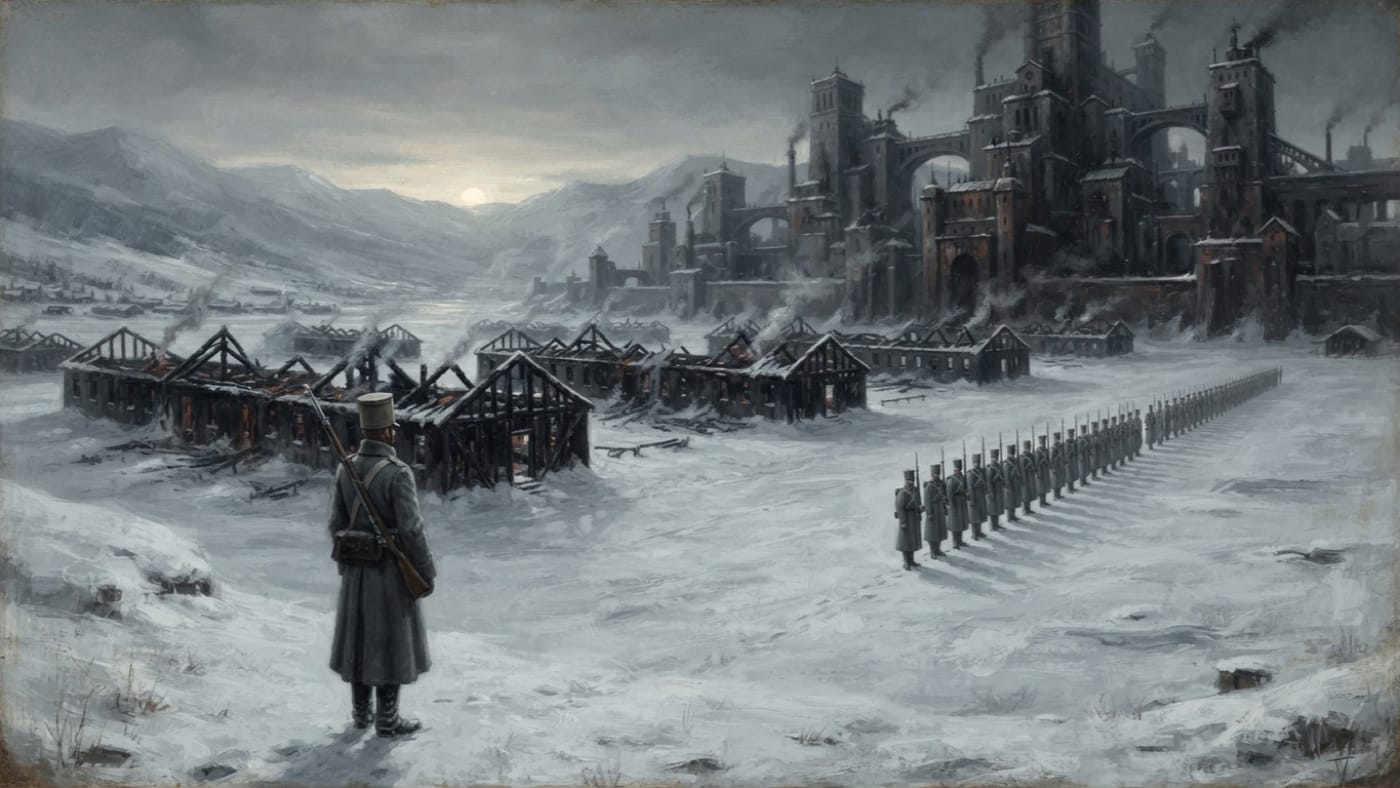
The account, as the Lore Book keeps it, is short. A Night Paper arrived in the dead of winter. Its instruction demanded the erasure of "all who sang off-cadence" during a hymn-inspection. Ordinary Valtrix obeyed. At dawn, four entire choirs were gone, their barracks burned and their names struck from the rosters.
That is all of it. The legend has lived on those four sentences for longer than anyone can date.
Valtrix is the only official named. The Lore Book's register of the Ordinaries of Severity knows him as Ordinary Valtrix of Metz. He is a mid-tier inquisitor of the kind who governs a diocese with an authority that answers upward and to nobody else. The legend gives him one verb. He obeyed. It does not say he wrote the Paper, sealed it, asked for it or welcomed it. A reader who convicts him of authorship is filing a charge the account never brought, and I will not countersign that enthusiasm.
Look at the grammar of the instruction. "All who sang off-cadence" names no person, no rank and no unit. It names a fault and leaves the recipient to find everyone guilty of it, during an inspection that the account mentions and never describes. Which hymn was sung, what standard was applied, who listened and how much error was allowed: the legend says nothing on any of it. Neither do I.
Then comes the dawn. The account reports three conditions: choirs missing, barracks burned, names struck. Each is a separate fact, and the legend does not join them. A burned barracks tells us something happened to timber. A missing choir tells us something happened to a roll-call. A struck name tells us something happened to ink. None of the three says what happened to the men, and the survey will not say it either. The word on file is missing. The word stays.
#On the Instrument
A Night Paper is law with a deadline at dawn. The Bureau of Doctrine authorises its grammar. The Bureau of Shadows carries it, masks it and polishes the absence around it. It travels under curfew in the hands of a runner trained to forget his own route, either a Night Papers Courier or some borrowed substitute. For as long as the night lasts it outranks tribunal, commander and appeal. It names, charges and commands. It does not give reasons.
The protocol is precise. The Paper is grey vellum under black wax. It is read aloud once before a quorum of three, burned in a covered dish, and its ash is weighed against a sealed measure. The survey has to be careful here. The protocol describes how a Night Paper ought to be handled. The Metz account does not say how this one was handled. It names no runner, no quorum, no dish and no scale. Nobody can now say whether the Metz Paper was read before three witnesses or crushed in one fist, or whether its ash weighed true. I will not furnish that night with furniture it never owned.
What the instrument does explain is the speed. A Night Paper expires at sunrise, and the Lore Book is blunt about the consequence: an order left undone by dawn turns on the man who held it. Every Paper therefore produces what that text calls a frantic theatre of obedience. An Ordinary handed an order against off-cadence singers on a winter night has no time to deliberate. He has a few hours, and the sun takes no petitions.
#On the Rosters
From here the matter becomes bureaucratic, which is to say interesting.
The legend says the choirs' names were struck from the rosters. Records says Metz fielded "no choirs" that year. The two claims are less opposed than they look. They describe the same page from either side of the pen-stroke.
A struck roster asserts that a name was once written there and has since been removed. A roster with no choirs on it asserts that nothing was ever written. Suppose the names were struck cleanly, the sheets recopied and bound into the year's fair copy, and the working drafts sent to the stove. The second roster would then be the honest heir of the first, and Records would be telling the exact truth about the document it holds. That is the beauty of a register. It certifies itself.
None of this proves Records falsified anything. No roster from that winter has been recovered. No earlier draft, no audit, no clerk's confession and no scrap of struck vellum has reached this survey. Records' denial is simply a denial, issued by the office whose memory is the only official memory there is. The parent entry adds that Records keeps no issuance ledger for these instruments. That would give Metz a perfectly closed account: an order that left no ledger, carried out against men whose ledger says they never existed. That holds only if the story is true. If it is false, Records has been right for a very long time and resents the suggestion.
The Metz Oblivion (Ordinary Valtrix, 267 A.S.)
Struck. A.S. 267 lies beyond the present year of this Codex and cannot date any event in it. No replacement year has been established. The winter of the Oblivion stays undated until a document earns it a date. Readers who propose to subtract a century are reminded that arithmetic is not provenance.
The Bureau's legal theology holds that a person exists in law wherever a register says he exists. The doctrine is sound and saves a great deal of labour. It does leave a residue. Soldiers do not check the register before they remember something.
#On the Remembered Silence
The third party to the legend has no rank, no name and no unit number. The account says only that surviving Fusiliers "recall the silence like a graveyard." It does not say which company, how many of them, or how long afterward. Nothing ties them to the missing choirs. They are simply the ones who were left to notice.
What they remember is a lack of sound. That is an odd thing for most armies to remember and a natural one for this army. A Fusilier line lives inside cadence. It fires on the beat, resets on the beat and prays on the beat. Once cadence is properly drilled in, it keeps a line moving after judgment has run off. In a body like that, a choir's voices are part of the standing equipment. Take them away and the gap can be heard before any officer thinks to explain it.
The legend does not say whether the silence lasted a morning or a season. It does not say whether it fell in the yard, the chapel or the line, or whether anyone filled it. It gives the silence no supernatural cause, and neither shall I. A missing choir is quiet for the most ordinary reason in the world: nobody is singing.
In the Bureau's ranking of evidence, a soldier's memory is the weakest and the longest-lived. It cannot be sealed, weighed, burned or struck out. It survives in barracks talk, and it has outlasted every paper that might have contradicted it.
#On the Account's Standing
The parent entry on the Night Paper lists the Metz Oblivion among the instrument's older legends. Beside it are the Gray Wax Coup and the front-line Papers said to have named whole choirs, terraces and barracks for removal before Matins. Some of those records, it says, are theatrical, some are lies and some are accurate. It does not say which kind Metz is, and on this question the parent entry outranks me.
The couriers remember it too. The Night Papers Courier trade counts the Metz Oblivion among the turning points of the profession, a night when the Paper showed itself as a machine for mass erasure. That is a guild's memory of its own worst work, passed hand to hand the same way the Papers are. It proves the story is told. It cannot prove the story.