
#On Münster's Station
The Locations Registry can name every chokepoint between the Baltic and the Bosphorus, but it has no line of its own for Münster. I place the city in the Central Heartlands, Zone Two, because the Registry puts Germany there and Münster is in Germany. That is cartography by syllogism. The Bureau has accepted worse, and stamped it.
The Ledger records a city that sits deep in safe country, far west of the Sagittal Line and its seven bastions, under the ordinary administration of the Synod and its Holy Bureaus. No folio I may cite says when Münster was founded, when it came under Synodal jurisdiction, how many souls it holds, or who governed it before the Bureaus did. Lesser chroniclers would make up a founding bishop, a river, a wall, and a market charter with a pleasing seal. I decline. A city entry padded with invented burghers is the kind of forgery that gets caught.
The Church remembers Münster for one settlement and for one absence. Both are well attested as accounts. Neither is attested beyond that.
#On the Crafts and the Register
Before the settlement there were the crafts, and before the crafts could be bound there had to be a list of them.
The inherited account names smiths, weavers and shipwrights as the trades brought under the compact. These are the trades of a whole Church, and I don't take them as an inventory of the city. A shipwright named in a continental settlement doesn't put a keel in every market square, and I won't give Münster a harbour because a clause mentions hulls.
What the clause did to any artificer it reached is plain enough. A craftsman lives by his tools, his workshop and his name on the roll, and the Bureaus can reach all three. A tithe assessor's ordinary kit holds receipt blanks, arrears ledgers, chalk for door marks and seizure orders that cover tools, bedding and food stores. A sealed receipt proves you paid. An arrears mark proves you didn't, and it follows a family longer than the debt does. The ration hall feeds the names in the register and nobody else.
The Records Scribes have an old saying, never stamped: the first entry makes the citizen and the second unmakes him. Unregistered men are short of bread and short of standing too. The Bureau files them as misfiled, off-index, or ghosts.
None of these general practices is proven to be a Münster regulation. I set them down so the reader knows what a guild member stood to lose before he picked up the pen.
#On the Settlement of A.S. 105
The settlement belongs to A.S. 105, which is 1815 by the old reckoning. Cardinal Hieronymus Kratz had been dead for seventeen years. The formal Synod had been constituted at Strasbourg fifteen years earlier, under the Concordat of Strasbourg, and the later Council of Cologne had closed five years before. Augustinus was dead too. Neither founder attended, negotiated, signed or sent a living instruction. The men at Münster were their successors, working with methods they had inherited.
Those methods were Kratzian, and the administrators said so openly. The Cardinal had shown a generation earlier how sequence, pressure and a well-timed instrument could produce accession across the emerging authority's reach: the Common Allegiance in A.S. 55, then the Black Decrees in A.S. 58. Even those did not bring universal submission overnight, whatever the hagiographers say. Münster's administrators invoked that precedent. They also claimed to be acting on sealed envelopes Kratz left behind in his lifetime. That claim is on record as a claim. Whether the envelopes existed, who wrote them, who opened them and what they said is held open, and I won't settle any of it by sounding confident.
The compact bound the guilds to the Synod's tithe structure. A craft's dues became a craft's obedience, and its obedience was assessed, receipted and entered.
The register says nine hundred and ninety-nine artificers signed in their own blood. I copy the figure as the register gives it. It is the register's testimony and I can't certify it as a count. Nor does it give me nine hundred and ninety-nine households, workshops or separate guilds, and anyone who turns it into a census of the city is doing the arithmetic for the institution.
The settlement goes by two names, the Concord of Münster and the Second Concordat of Münster. "Second" does not prove there was a first Münster compact, and no predecessor turns up in any folio I trust. Its clauses, signatories and procedure belong in its own entry. This entry covers the city where it happened.
Inherited chronicles date the Münster compact to A.S. 231 and give its methods to the living hand of Cardinal Kratz.
Both claims are withdrawn. The settlement belongs to A.S. 105. Kratz died in A.S. 88 and did nothing at Münster. His influence there came through administrators citing his precedent and claiming his envelopes. Both founders were dead before the formal Synod existed, and its later settlements are the work of the men who outlived them.
#On the Absent District
The thousandth artificer refused.
The account gives no reason. It gives no oath he swore instead and no speech for anyone to set to music. One man refused one signature, and the account moves straight on to the next morning.
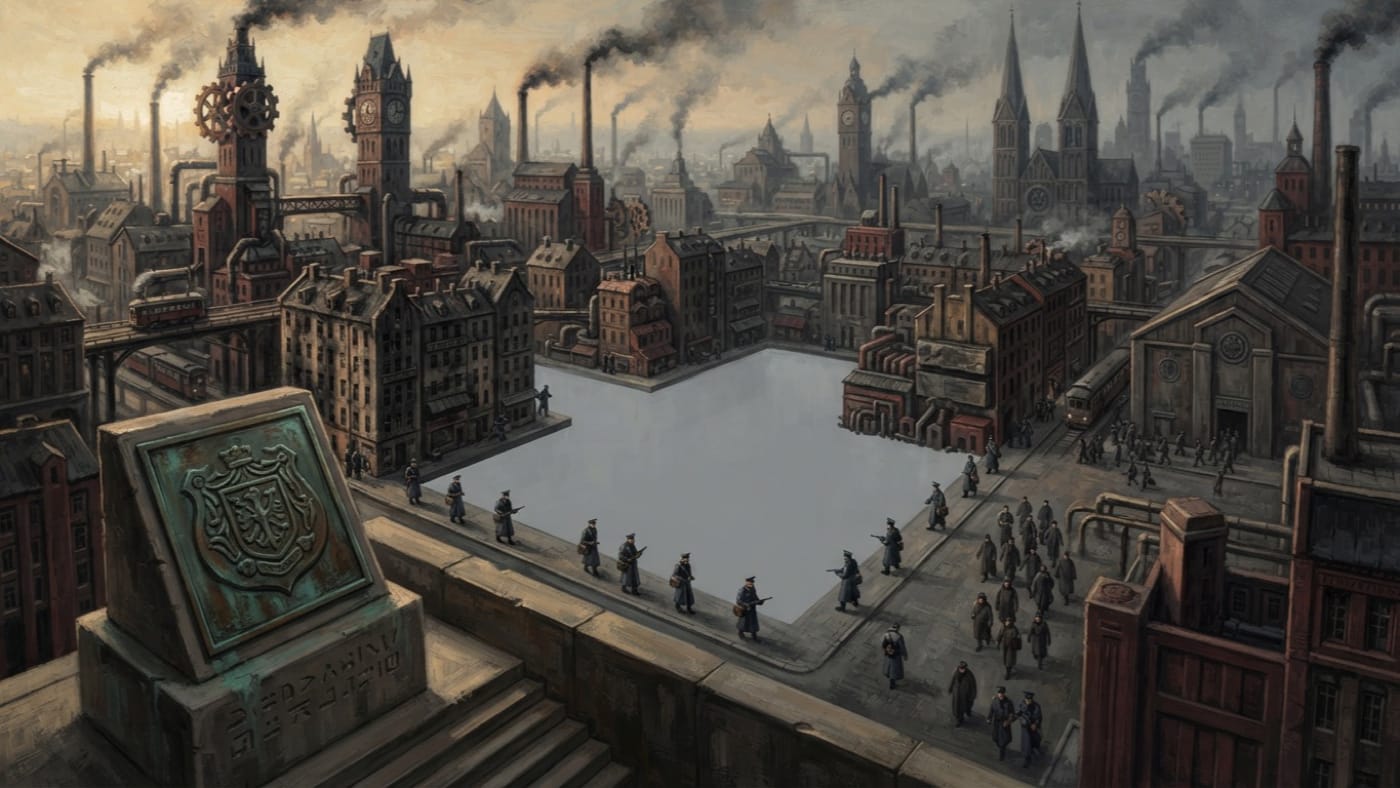
By dawn his district was gone, and the account means something narrower by that than the word suggests. It describes empty houses, cold hearths, and infants missing from their mothers' arms. Those are the details of rooms that are still standing, with their furniture still in them and nobody inside. Patrols went out and came back with maps that had already been amended. The fuller account adds that the district's charter and the man's own recorded existence were erased too: the street never ran, the quarter was never chartered, and the man was never born.
So the record keeps two things side by side that cannot both be comfortable. It keeps the cold hearth, which someone must have touched to know it was cold, and it keeps a map on which no such hearth was ever drawn. The houses are described as empty. The paper says there were never any houses there to empty.
The account doesn't settle which of these won. It doesn't say whether the buildings went, whether the people were taken out of them, whether everyone else's memory was rearranged around the gap, or whether something more fundamental than a clerk's correction was done to the Creator's work. It names no mechanism and no officer, and no surviving census lets us count who was lost. Nobody says what became of the residents.
The interpretations come from their own speakers. The Bureau called it a "clerical adjustment." Doctrine called it a miracle. I record both terms as their offices issued them, and I note that the infants were absent under either one.
The thousandth artificer's name does not appear in any record this office holds. The district is recorded as having been in the ████████████ quarter. No surviving map shows it. Attempts at reconstruction have been ████████████.
#On Münster's Recorded Legacy
Münster survives in the Ledger because of an account that removes part of Münster.
It is a strange way for a city to be remembered. Its streets and its people are the subject of no entry. What has its name on it is one compact, one refusal and one blank. Instructors in the Bureaus give Münster to novices as their example of obedience: nine hundred and ninety-nine signatures, a single refusal and a single correction at dawn. The novices leave able to recite the numbers. They don't come away able to name the street, because that is the point of the lesson.
I have heard Münster called a warning, a wonder and a precedent, and usually by one speaker inside one sermon. The Bureau of Doctrine has no objection to that. Doctrine has never minded several valid accounts at once, provided all of them come out with the same compliance.
What the city's records hold is short, and I have set it down. The settlement is dated A.S. 105, and the signature count stands as the register's testimony. Kratz's envelopes remain alleged. The district stays unnamed, unmapped and empty, and the man himself is unrecorded. No present crisis attaches to Münster, no local custom that I can document, and no later manifestation that anyone has properly filed. The city lies where the Registry's reasoning puts it, deep in safe country, and pays its tithe like any other.