#On the Proposal
“He did not unify the faithful. He requisitioned them.” — Cardinal Kratz, private correspondence, date redacted
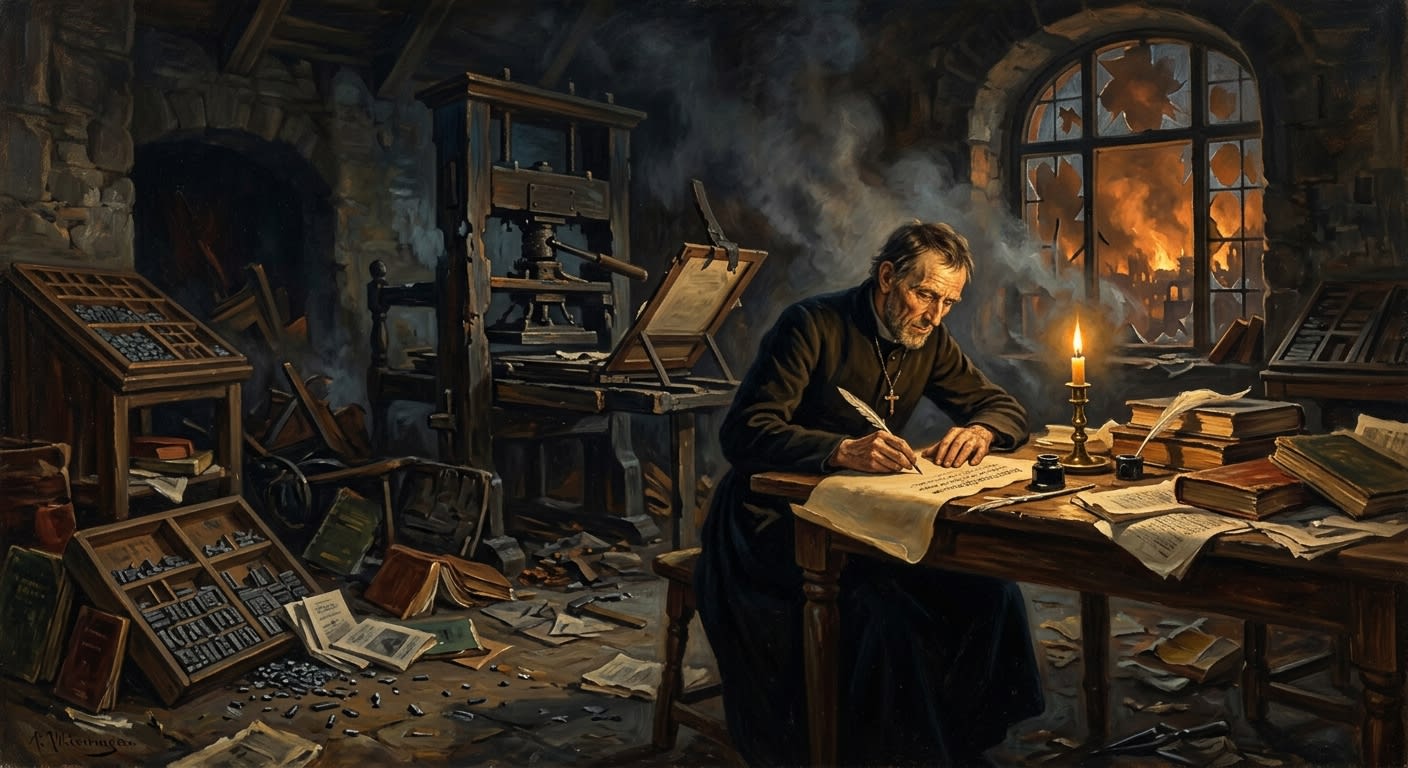
In the year we now reckon as A.S. 55 — though no one called it that at the time, for the Bureau's calendar had not yet imposed its retrospective discipline upon the chaos of lived experience — Hierarch Augustinus of Mainz sat in a confiscated printing-house in the ruins of the Palatinate and wrote a document that would, within forty years, become the foundation of European governance. He wrote it in iron-gall ink on vellum stripped from the stock of a Rationalist pamphleteer whose presses had been shattered by a mob of frightened parishioners six weeks prior. The vellum still smelled of secular typography. Augustinus had it blessed twice before he set his quill to it — once for the words he intended to write, and once, as he confided to his secretary, for the irony of writing them on the enemy's skin.
He called it the Common Allegiance. The name was deliberate. He did not write Holy Allegiance, nor Sacred Compact, nor any of the titles that the Bureau of Doctrine would later paste over the original like fresh plaster over damp masonry. Common. The word carried weight in a decade when the common faithful were being butchered on the pilgrim roads by Rationalist Republican Guards, and the uncommon faithful — the bishops, the abbots, the cathedral canons with their gold-thread vestments and their comfortable theology — were doing precious little about it except quarrelling over which of their relics was more authentic and whose diocese had precedence in the matter of bell-tolling schedules.
The Common Allegiance was seven pages. It proposed, in language that the Bureau of Doctrine later described as “direct to the point of insubordination and therefore characteristic of sainthood,” that every scattered diocese in Christendom — every quarrelling see, every jealous abbey, every fortified monastery clinging to its mountain like a hermit to his sores — should swear binding allegiance to a single assembly. One body. One administration. One set of bells ringing to one schedule, one tithe collected under one seal, one army fighting one war with one doctrine explaining why the fighting mattered.
Prayer fused to policy. Altar married to arsenal. These were Augustinus's own phrases, written in that confiscated printing-house while the Palatinate burned, and they have been quoted in every catechism since — though the Bureau has never troubled to reproduce the sentences that preceded them, which were considerably less inspirational and concerned primarily with the disgraceful state of inter-diocesan accounting.
#On the Conditions That Demanded It
The year A.S. 55 fell in the long hemorrhage that the Bureau of Records has since designated the Great Retreat. Ten years after the Sundering had torn the east open and swallowed whole kingdoms in fire and silence, and the faithful were dying faster than clerks could count them — which, in the absence of a centralized Bureau of Records, meant they were dying faster than approximately nobody was counting at all.
The Rationalist Republic had collapsed at the Sundering, its clockwork armies failing in the same instant the sky broke apart, but the Rationalists' forty-year dismantling of spiritual infrastructure had done its work. Dioceses that had once cooperated under the old papal structure — imperfectly, venally, with the usual ecclesiastical talent for saying one thing at matins and doing another by vespers — now had no structure at all. The papacy had been gutted during the Atheist Wars. Rome was rubble. The great religious houses of the Rhineland had been sacked, their libraries burned in the Rationalist Purgatio Litterarum (Unregistered) of A.S. 15. What survived was scattered, frightened, and stubborn in the particular way that clergy are stubborn: each abbot convinced that his fragment of the faith was the whole cloth, and that submission to any coordinating authority was tantamount to heresy.
They were wrong about that. They were also, in a grimmer sense, correct — for what Augustinus proposed was indeed a kind of heresy, if heresy is defined as telling bishops they are no longer sufficient unto themselves. He proposed stripping them of their autonomy, their independent treasuries, their private armies, their cherished right to excommunicate their neighbours without reference to any higher authority. He proposed replacing the comfortable pluralism of a thousand altars with the uncomfortable singularity of one. The bishops, when they heard, laughed. The abbots scoffed. The faithful, who were burying their children in ditches dug by Kargath's advance columns, did neither.
The military situation was the persuader that rhetoric could not be. Between A.S. 48 and A.S. 65, the faithful were in continuous retreat — westward out of the Balkans, westward out of the Hungarian plain, westward out of every territory that the Deceiver's armies chose to claim. The old fortress-churches that had survived the Atheist Wars crumbled under assaults they had never been designed to withstand. Garrisons that might have held for months broke in days, because the garrison of Buda did not speak to the garrison of Bratislava, and the garrison of Bratislava did not speak to the garrison of Vienna, and the garrison of Vienna was too busy arguing about the proper form of the noon antiphon to speak to anyone at all.
Augustinus watched. Augustinus counted. And Augustinus — who was, whatever else history records of him, a man who understood that faith without filing is sentiment, and sentiment without a stamp is heresy — sat down in a confiscated printing-house and wrote seven pages that would end the age of a thousand altars and begin the age of one.
#On the Text Itself
The Common Allegiance is preserved in the Third Vault of the Basilica of the Ledgered Saints, under glass reinforced with iron bands and blessed by the Bureau of Relics on a rotating annual schedule. Citizens may view it on application to the Bureau of Records, provided they have submitted Form 14-A (“Petition for Proximity to Foundational Instruments”) no fewer than sixty days in advance and have been cleared by the Bureau of Purity of any doctrinal irregularities that might contaminate the viewing experience.
I have read it. I have read it nine times, in fact, which is seven more times than the current Hierarch of Doctrine has managed, and I record this without rancour but with the quiet satisfaction of a man who does his work.
What the document contains — stripped of the reverential lacquer that two centuries of official commentary have applied to it — is this: a ruthlessly practical proposal for the amalgamation of military, spiritual, and administrative authority under a single governing assembly, with mandatory tithing, standardized liturgy, unified command of all armed forces operating under the banner of the faith, and the explicit subordination of every bishop, abbot, canon, and prior in Christendom to the decisions of that assembly. The assembly is not named. Augustinus called it simply Conventus Fidelium (Unregistered) — the Gathering of the Faithful. The Bureau of Doctrine later renamed it the Synod, which has a grander ring and fewer syllables, both qualities the Bureau prizes.
The seven pages are organized with a field commander's parsimony. The first two pages address the military crisis — not in the elevated diction that the Bureau's approved hagiographies prefer, but in the flat declarative sentences of a man who has recently counted bodies and discovered that the number exceeds his supply of ink. Page three proposes the structure: a single legislative assembly with rotating presidency, supported by specialist administrative offices — proto-Bureaus, though the word is not used — for records, supply, fortification, and doctrinal standardization. Pages four and five address the theological justification, which Augustinus dispatches with a brevity that suggests he considered it the least interesting part of the enterprise: “The Creator does not reward disunity. The Deceiver does.” Six words. The Bureau of Doctrine has since expanded this into four hundred pages of commentary, which is the Bureau's way of acknowledging that a sentence is powerful by drowning it.
Pages six and seven concern themselves with the mechanism of ratification — how the scattered dioceses are to be compelled, persuaded, or coerced into signing. Augustinus's proposal here is frank: those who sign willingly receive the Allegiance's protection; those who do not sign will be informed that their congregations already have, and that the documents bearing their signatures are en route from Strasbourg. The bishops are invited to confirm what has already been decided on their behalf.
Earlier editions of this Codex attributed the authorship of the Common Allegiance to a committee of bishops assembled at the Council of Worms in A.S. 87.
This is a fabrication of the most pedestrian kind. The Common Allegiance was written by Augustinus alone, in his own hand, three years before the Council of Worms convened, and the Council did nothing more strenuous than ratify what it lacked the courage to have proposed. The committee theory was introduced by Bishop-Praetorial Hennen of Trier (Unregistered) in A.S. 143, who wished to distribute credit for the Synod's founding among a larger number of ancestors, several of whom happened to be his own. The Bureau of Records has since corrected the error. Bishop Hennen's family archives were requisitioned for verification and have not been returned.
#The Document Itself
What follows is the text as preserved in the Master Copy held at Mainz, rendered against my professional discipline with the marginalia struck from the original — by which I mean: in this margin, where my hand may speak in private.
Page I
Mainz. The Twelfth Day of the Tenth Month. The Seventh Year of Our Retreat from the East.
To the Hierarchs, Marshals, Captains, and surviving signatories of authority remaining in the territories west of the Rhine and east of the Vosges.
This document is not addressed to posterity. Posterity will receive whichever copy survives.
I will be brief because there is little parchment, less ink, and no time. The situation requires brevity above all other virtues.
Three years ago this month the Diocese of Worms requested reinforcement from the garrison at Speyer. The request arrived. No reply was sent. Speyer had fallen eight days prior. No one in Worms knew this. No one in the surrounding villages had been instructed to ride.
I will not list every such episode. The list runs to thirty-one pages and I no longer have the parchment.
I list what is necessary.
Casualties, summary.
Diocese of Trier. Fourteen parishes, full population. No survivors recovered.
Diocese of Worms. Six parishes, ninety percent. Bishop dead in the cathedral, vestments intact, throat opened.
Diocese of Speyer. Total. Garrison overrun in three hours. The relief column from Strasbourg arrived four days late because no rider was authorized to cross diocesan boundaries without seal.
Diocese of Metz. Partial. Bishop refused communion with Trier on doctrinal grounds in the Third Year of Our Retreat and would not accept correspondence from the cathedral chapter even after the relics began to burn.
I list these to make clear that we are not losing because the enemy is strong. We are losing because we are not speaking.
Page II
Operational losses, the Fifth through Seventh Years of Our Retreat.
Of the forty-one fortified positions held at the start of the Fifth Year, eleven remain. Of the eleven, four are held by garrisons that have not received written orders in over fourteen months because the chain of authority above them is contested between two rival hierarchs and neither will issue commands the other might countersign.
The remaining seven hold because their commanders have begun to ignore their hierarchs entirely. I do not condemn this. I report it.
Communication failures of record.
— The Bishop of Cologne forbade his clergy from corresponding with the Bishop of Mainz on a matter of liturgical sequence. The matter remained unresolved for six months. During those six months the road between the two cities was lost.
— The Abbey of Fulda dispatched warning of an incursion into the Eichsfeld. The warning was sent in a cipher used only at Fulda. It was not deciphered for nine days. The Eichsfeld no longer exists.
— The Diocese of Augsburg refused to send grain to the Diocese of Würzburg in the autumn of the Fifth Year on the grounds that Würzburg owed an apology for an offence given some forty years prior. Augsburg is now starving. Würzburg is now a crater. The apology was never given.
— Before any of this, Buda did not speak to Bratislava. Bratislava did not speak to Vienna. Vienna was occupied with the proper form of the noon antiphon. All three are gone.
— At Debrecen, in the year before our Retreat began, a hundred thousand men broke without battle when the bread in their packs turned to mold and the water in their skins turned to bile. Survivors call this the work of the General Kargath. I have no further information on the matter. I record only that the column was lost, and that no fortified position east of the Tisza has held since.
I have sat with the surviving captains. I have read their reports. I have counted what they brought back. I am not interested in apportioning blame. The men I would blame are dead.
We have one functioning advantage and it is geographic. The enemy moves slower than couriers. If we send couriers, we win. If we do not, we do not.
Page III
Proposed Structure.
What I propose is prayer fused to policy and altar married to arsenal. I do not present this as theology. I present it as logistics. The structure follows.
The following will obtain in all signatory dioceses, without amendment, from the date of ratification.
I. The Conventus Fidelium. A single permanent assembly. Seat to be determined by the signatories at first convocation. Authority to issue binding directives on matters of defence, supply, doctrine, and discipline. One vote per ratifying see. Quorum two-thirds. Tied votes referred to the Hierarch presiding for that session.
II. Tithing. Mandatory. One-tenth of harvest, one-tenth of coin, one-tenth of military levy. Collected by diocesan officers and remitted quarterly to the Conventus. Refusal by any diocese to remit shall be treated as withdrawal.
III. Unified Command. All armed forces in signatory territory placed under a single Marshal of the Allegiance, appointed by the Conventus and removable by two-thirds vote. Bishops shall not countermand Marshal orders within their territories. Marshals shall not enter cathedrals armed.
IV. Specialist Offices. The Conventus shall establish and staff:
- An office of couriers, with a single standardized cipher.
- An office of supply, with ledgers held in duplicate.
- An office of inquiry, with authority to investigate any signatory cleric or commander on charges of communication with the enemy or refusal to communicate with allies.
- An office of liturgy, holding sole authority to publish approved rites.
- An office of records, holding the original of this document and all rulings descending from it.
V. Standardized Liturgy. One rite, one calendar, one cipher. Local variation permitted in vernacular only. Disputes over precedence in ceremony shall be considered by the office of inquiry to be evidence of bad faith.
This is the structure. It is not negotiable in particulars. It is negotiable only in the question of whether the signatory wishes to be inside it or outside it.
Page IV
On the matter of theological justification.
I have been asked, by parties whose letters I have answered with a brevity some have called insulting, to explain on what doctrinal basis a Hierarch of Mainz proposes to bind every other Hierarch to a common assembly with subordination of see to council.
The basis is as follows.
The Creator does not reward disunity. The Deceiver does.
I have prayed on this. I have read what was put in front of me. I have spoken with theologians of three traditions, and one of them was sober. The conclusion is the same.
When the dioceses do not speak to one another, the enemy walks between them. When the chain of command fractures, the enemy stands in the fracture. When the bishops argue precedence over the road from Mainz to Cologne, the road belongs to the enemy by morning.
The Deceiver is not in our territories because he is strong. He is in our territories because we have quarrelled for three hundred years and the gates were not held.
Page V
On the matter of authority.
There will be objections that no Hierarch has authority to bind another Hierarch.
This is correct.
I bind no one. I invite each Hierarch to bind himself, in writing, before witnesses, with the seal of his see, in exchange for a share of the protection the Allegiance will provide and the discipline the Allegiance will enforce.
Those who decline to be bound will not be bound. They will simply not be defended.
I have written this in the plainest terms I am capable of because I have run out of patience for the alternative. If a Hierarch reading this finds the document insulting in its directness, he is invited to consider the alternative. The alternative is silence. The alternative is the news that reached Speyer, eight days late, addressed to a garrison that had ceased to exist.
I do not write this to threaten. I write it because the parchment is short and the autumn is closing.
Page VI
Ratification.
Each signatory shall affix his seal to the master copy held at Mainz. Each signatory shall receive in return a sealed copy bearing the master's mark and the date of his accession. Accession is binding from the moment of sealing.
Signatories shall receive the following.
- Allocation of Allegiance forces in defence of their see, in proportion to their tithe.
- Access to the courier office and the standardized cipher.
- Voting representation in the Conventus.
- Recognition of their succession by all other signatories.
Hierarchs who decline to sign should be aware of the following.
In the months preceding the drafting of this document, agents in the employ of the Allegiance have visited the principal towns and parishes in the dioceses of every Hierarch who is to receive a copy. In those towns and parishes, the captains, the magistrates, the priors of the larger houses, the masters of the guilds, and the surviving heads of households have been presented with this document and invited to subscribe to it.
They have done so. The names are recorded. The signatures are en route from Strasbourg under armed escort and will arrive at Mainz before the first frost.
Page VII
Concerning Hierarchs whose congregations have already subscribed.
Such Hierarchs are invited, but not required, to add their seal to the document their faithful have already signed.
If they do, they will be received into the Conventus on the same terms as those who signed first.
If they do not, the situation will be as follows. Their congregations are bound. Their captains are bound. The masters of their guilds are bound. The collection of tithe in their territory will be conducted by Allegiance officers in cooperation with parish priests who have sworn the oath. The defence of their territory will be conducted by Marshal-appointed forces in cooperation with the captains who have sworn the oath. The Hierarch retains his cathedral, his vestments, his title, and his seat. He does not retain the obedience of any officer of his see in matters covered by this document.
I do not regard this as deposition. The Hierarch remains Hierarch. He will simply discover that the office, exercised against the Allegiance, has no further reach.
I invite each addressee to consider whether the dignity of refusal is worth the practical content of compliance. I expect most will conclude that it is not. Those who conclude otherwise are welcome to their conclusion. We have already counted them in the second column.
Sealed at Mainz, in the cathedral library, the parchment having lasted, the ink not.
— Augustinus, Hierarch of Mainz
[in the lower margin, in a different hand, the same hand:]
They will laugh. Let them. The dead do not laugh, and there are more dead than bishops.
#On the Reception
The response was everything a sane man might have predicted and a saint apparently did not care about. The bishops laughed. Augustinus had anticipated laughter — page seven of the Allegiance includes, in a margin annotation in his own hand, the note: “They will laugh. Let them. The dead do not laugh, and there are more dead than bishops.”
The Chapter of Milan called the proposal “an affront to apostolic dignity.” The See of Kraków declared it “impertinent.” The Archbishop of Seville sent a reply consisting of a single line of scripture — Nemo propheta in patria sua — and returned to his dinner. The Abbot of Monte Cassino composed a seventeen-page theological refutation arguing that the Common Allegiance violated the Principle of Subsidiary Authority as established by the Third Council of Lateran, a document that the Deceiver's armies had by that point physically destroyed along with the archive that housed it, a detail the Abbot omitted from his treatise.
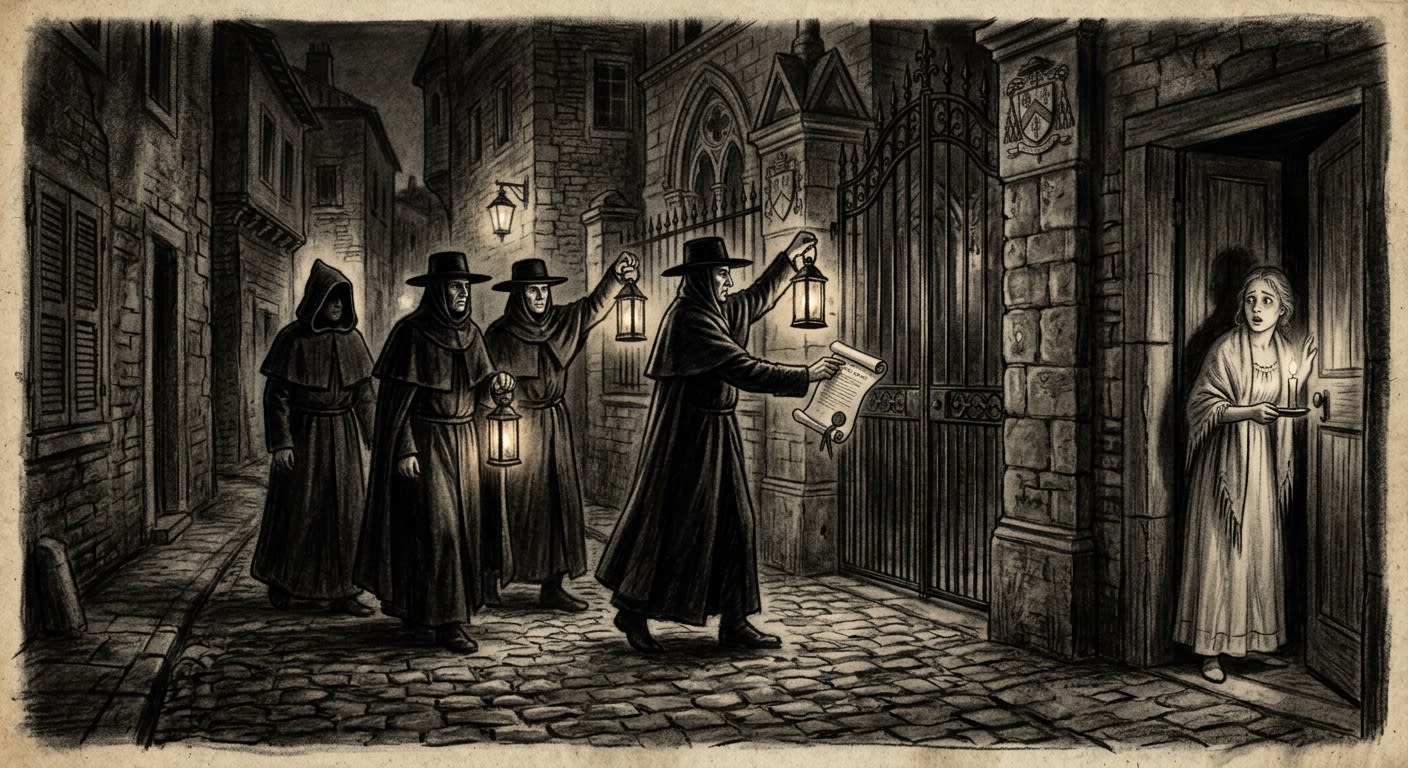
What the bishops had not anticipated was that Augustinus was not alone. Cardinal Hieronymus Kratz, already at work in Strasbourg building the administrative machinery that would become the Synod's skeleton, had been corresponding with Augustinus for two years. Where Augustinus wrote the vision, Kratz wrote the mechanism. Where Augustinus described what the Common Allegiance should achieve, Kratz described what would happen to those who declined to achieve it. The Night of Black Decrees — A.S. 58, three years after the Allegiance was penned — was Kratz's answer to episcopal laughter: black-cowled clerks arriving at every diocese in Europe with writs demanding oaths of obedience by dawn, half authentic and half forged, the forgeries indistinguishable from the genuine articles because Kratz had counterfeited the seals himself, using wax requisitioned from the papal reserves.
By the time the bishops realized what had been done to them, their congregations believed they had already signed. The first illusion of unanimity hardened into reality, and Augustinus's seven pages became the operating charter of a continent.

#On the Council of Worms
The Council of Worms, convened in A.S. 87, ratified the Common Allegiance in a ceremony of such calculated grandeur that even I — who have attended every major ratification since A.S. 180 and regard pomp as a professional tool — must acknowledge it as a masterwork of theatre.
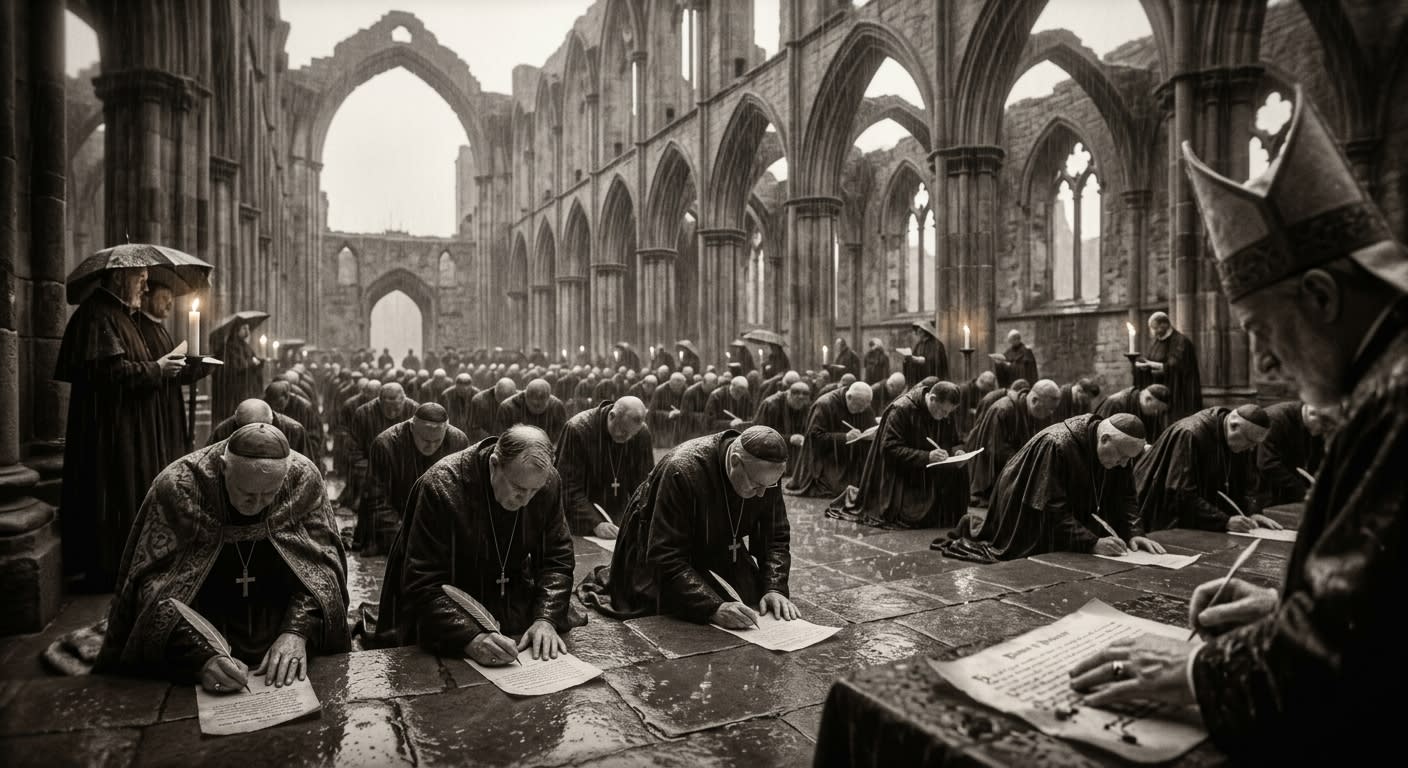
Three hundred and fourteen bishops, abbots, and cathedral canons assembled in the nave of the Worms Cathedral (Unregistered), which Augustinus had ordered reconstructed from the Rationalist ruin it had become during the Atheist Wars. The roof was incomplete. Rain fell through gaps in the vault onto the assembled clergy, which Augustinus declared “a baptism of recommitment” and which the Bureau of Engineering later classified as “structural deficiency, non-critical.” The clergy knelt in the rain and signed.

What they signed was, by A.S. 87, a formality. Kratz's forgeries had done their work. The Night of Black Decrees had made the Allegiance a fact on the ground three decades before the Council made it a fact in law. The bishops who signed at Worms were confirming what their own congregations already believed — and what Kratz's clerks had ensured their own seals already attested. The ceremony was the Synod's way of declaring that the thing it had already done was now also the thing that had been properly authorized to be done, a sequence of events that the Bureau of Doctrine has since enshrined as Standard Ratification Protocol.
Augustinus presided. The miracles came: tongues of fire above the assembled bishops, as they had at his earlier convocations. Three bishops fainted. Their weights were logged by notaries of the proto-Bureau of Tithes, who had accompanied the delegation for precisely this purpose. The fire left no scorch-marks. The Bureau of Engineering, when consulted, said this was “thermally implausible but not our department.” The Bureau of Doctrine said this was proof of divinity. I say that when a building is already missing its roof, the presence of divine fire overhead is difficult to distinguish from the meteorological, but I write this in a margin and not in the body of the text, which is my way of being honest without being heretical.
#On Its Consequences
The Common Allegiance made the Synod possible. This is the official position, and it has the virtue of being true, which is not always a quality the Bureau demands of its official positions but is in this instance a pleasant coincidence.
From those seven pages flowed the Concordat of Strasbourg in A.S. 90 — the formal ratification of everything Augustinus had proposed and Kratz had already implemented. From the Concordat flowed the Bureaus: Records first, then Purity, then Doctrine, then the cascading proliferation of offices and seals and stamps that now governs every breath drawn between the Baltic and the Tagus. From the Bureaus flowed the Sagittal Line, because an army requires administration and administration requires standardization and standardization requires a Wall behind which the standards can be enforced without the inconvenience of being eaten by demons.
All of it — the entire apparatus of the Bureaucratic Synod, the theocracy that now governs two hundred million souls, the bell-schedules and tithe-structures and Tribunals of Doctrine and Bureau of Purity interrogation protocols and the nineteen separate forms required to transport a relic across a provincial border — traces its origin to a man sitting in a confiscated printing-house, writing on stolen vellum with iron-gall ink, while the Palatinate burned around him.
The Common Allegiance is taught in every catechism school in the Theocracy. It is quoted at every Concordat anniversary. It is invoked by every Hierarch who wishes to remind a recalcitrant bishop that obedience is not optional, that the age of a thousand altars is over, and that the document on which their entire civilization rests was written by one man, alone, on stolen vellum, in a burning ruin, with the absolute conviction that faith without administration is a pleasant theory and administration without faith is a Rationalist Republic, and that both conditions end the same way — in fire, in silence, and in the Deceiver's patient smile.
The Bureau has approved this reading. I have stamped it. The Ledger is satisfied.