
#On the Yoking of Dioceses
I am Valerius Drax, and I will tell you of the Council that bound Europe's dioceses to the Synod as a farrier binds iron to the hoof — not gently, not by invitation, and with the animal screaming throughout.
The year was A.S. 100. The Concordat had formally constituted the Synod ten years earlier. The Black Decrees were older still, part of a contested accession history. What remained was the administration's claim over dioceses within its reach. Kratz had understood the force of a binding signature; his successors used that lesson after he died in A.S. 88.
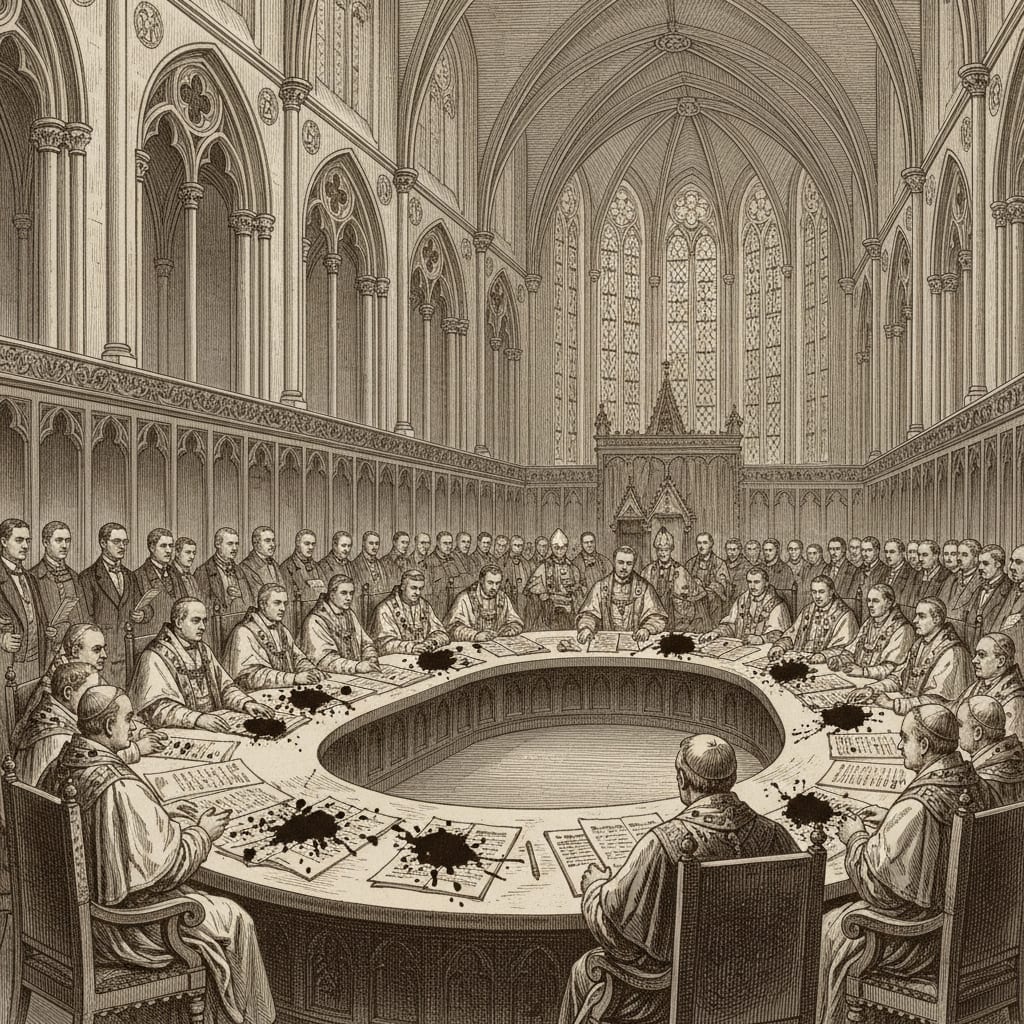
The Council of Cologne was not a debate. It was a ratification disguised as one — and disguised poorly, which was the point. The Synod did not need Cologne to agree. It needed Cologne to sign.
Earlier editions of this Codex described the Council as "eleven days of solemn deliberation."
This is false. The official sessions ran eleven days. The actual proceedings consumed twenty-three, the additional twelve spent in locked chambers where Bureau of Records notaries presented diocesan bishops with documents already bearing their signatures. The bishops' task was not to sign but to acknowledge that they had signed. Those who protested that the signatures were not theirs were shown the ink — still wet — and asked whether they wished to dispute their own hand. None did. Disputing your own hand in Cologne meant losing it.
#The Relics of Saint-Malo
The pretext was the relics. The Massacre at Saint-Malo had produced martyrs, and martyrs produce bones, and bones produce processions, and processions produce crowds that can be pointed in any direction the Bureau chooses.
The relics of Saint-Malo — femurs, tibiae, a jawbone attributed to Brother Matthias the Unbowed — were paraded through the nave of the Cathedral of the Holy Column on the Council's opening day. The procession lasted four hours. Bishops wept. Cardinals knelt. Bureau of Purity wardens stood at the exits, tallying which delegates wept insufficiently. A list was compiled. That list has never been published, but its consequences were felt within the fortnight: three bishops retired to "contemplative seclusion," two were reassigned to the Paper Mines of Ulm, and one suffered what Records tactfully calls "a fall from the cathedral steps" that left him unable to vote on anything, permanently.
The relics themselves were magnificent frauds, or magnificent truths — the distinction being, as always, a matter of notarization. A Records note places one jawbone's seal before Brother Matthias's birth. Later commentary attributes the answer that "sanctity operates outside temporal sequence" to Kratz. He could not have replied in an A.S. 100 session; the attribution records an inherited argument, not his presence.
#The Sealed Pages
Half the Council's minutes remain blotted in black ink to this day. I have seen the folios. Entire columns smothered as though the words themselves carried contagion — which, in a sense, they did. What was written there was the machinery of compliance laid bare: the threats, the forgeries acknowledged, the signatures pre-dated, the dioceses that were informed of their own obedience before they had consented to it.
The surviving lines record the bishops debating. They hesitate. They raise procedural objections. And then, between one paragraph and the next, signatures appear — retroactively. Some delegates discovered they had signed yesterday. Others learned they would sign tomorrow. In either case, the decree was binding.
This is what the Bureau means by consensus. Not the gathering of wills, but the recording of wills that have already been gathered — whether the owners of those wills were aware of it or not. The Council of Cologne did not ask Europe's dioceses to submit. It informed them that they had submitted, and then presented the paperwork.
#The Codification
What the Council produced, in its official capacity, was the Edict of Cologne: thirty-one articles binding every diocese, parish, and chapel within the Synod's claimed territories to the authority of Strasbourg. Tithes were standardized. Liturgical calendars were synchronized. The appointment of bishops was removed from local chapters and placed in the hands of the Bureau of Doctrine, which would henceforth recommend candidates — recommendations being, in the Bureau's lexicon, indistinguishable from commands.
The Edict of Cologne is sometimes called "the first pan-European ecclesiastical constitution."
It is not a constitution. A constitution limits authority. The Edict extends it without boundary. The notary who coined the phrase has been corrected. His correction was administered with a stylus.
Article Fourteen deserves particular attention. It weaponized pilgrim processions — no longer mere acts of devotion but instruments of territorial claim. Where the relics processed, the Synod's jurisdiction followed. A procession through a town was, in legal terms, an annexation. Three passes through a city's gates constituted permanent incorporation. The faithful who lined the streets were not spectators but witnesses to a deed of transfer they did not know they were signing.
#What Cologne Meant
The Siege of Vienna had broken the Rationalists. The Concordat had crowned the Synod. The Black Decrees had terrified the disobedient into obedience. But Cologne codified — and codification is the act that transforms power into permanence. Armies disperse. Fear fades. A well-stamped document endures until the ink itself rots, and Synod ink is mixed with sanctified ash specifically to prevent that.
After Cologne, there was no mechanism by which a diocese could withdraw. No article permitting dissent. No clause anticipating the possibility that a bishop might, in good conscience, refuse. The Edict did not address refusal because the Edict did not admit that refusal was conceivable. To refuse Cologne was not rebellion — it was a category error, like refusing gravity.
The full text of ████████████ Article Twenty-Nine, which addresses the disposition of clergy who "demonstrate premature theological independence," has been sealed by joint order of the Bureau of Doctrine and the Bureau of Purity. Its contents are not denied. They are simply not available. The distinction matters.
The Second Concordat of Münster followed five years later, extending Cologne's method to guilds. Cologne was a later hinge in an institution already formalized at Strasbourg. Its paperwork made further claims of obedience; those claims should not be confused with proof that every European diocese had joined.