
I've finished reading the continuity, voice and Nantes source material, and I'm drafting the Nantes prose now.
#On a City Entered by Preposition
Nantes comes into the Ledger by way of a single word. The entry for Saint Margaux records that within a fortnight of the massacre at Saint-Malo, woodcut likenesses of the dead nun were circulating "from Nantes to Vienna." From. Four letters, and the city's whole standing in this Codex rests on them.
I have known bishops whose standing rested on less.
The phrase marks Nantes as the western end of a named range. It tells the reader that the sheets reached the city, changed hands there, and were looked at by people who had never seen the Breton coast or the woman on it. It does not say the block was cut in Nantes, or that the first impression was pulled there, or that anyone in Nantes directed the business. A preposition makes a poor charter. It is the only one Nantes holds, and I have filed entries on cathedral towns with thinner paper.
#On the Death That Arrived on Paper
The facts that made the paper worth carrying are few. In A.S. 10 / 1720 CE, forty-three pilgrims bearing the Reliquary of Saint Matthias toward the Chapel of the Tide were met on the cobblestones of Saint-Malo by Rationalist Guards. The later Martyrology certifies thirty-one dead. Seven were wounded and survived, and five were never accounted for. One of the dead was Sister Margaux of the Blessed Thorn: sixty-three years old, five feet and one inch, distinguishing features "none." She knelt, she held a common psalter, and she died holding it.
The day of her death is unverified. The Church keeps her memorial, and the Day of the Thirty-One Names, on the fourteenth of Corvus. That is a liturgical decision. No witness at Saint-Malo wrote it down.
Three Margaux need to be kept apart here. The first is the woman, who died at Saint-Malo. The third is the saint, recognized at Strasbourg four years later. Nantes received the second, the one in between: a scene cut in reverse into a block of wood, inked, pressed onto coarse paper and passed along. That Margaux had no history and no voice. She also had no relatives to contradict her, and so she could go anywhere.
#On the Likeness and Its Variants
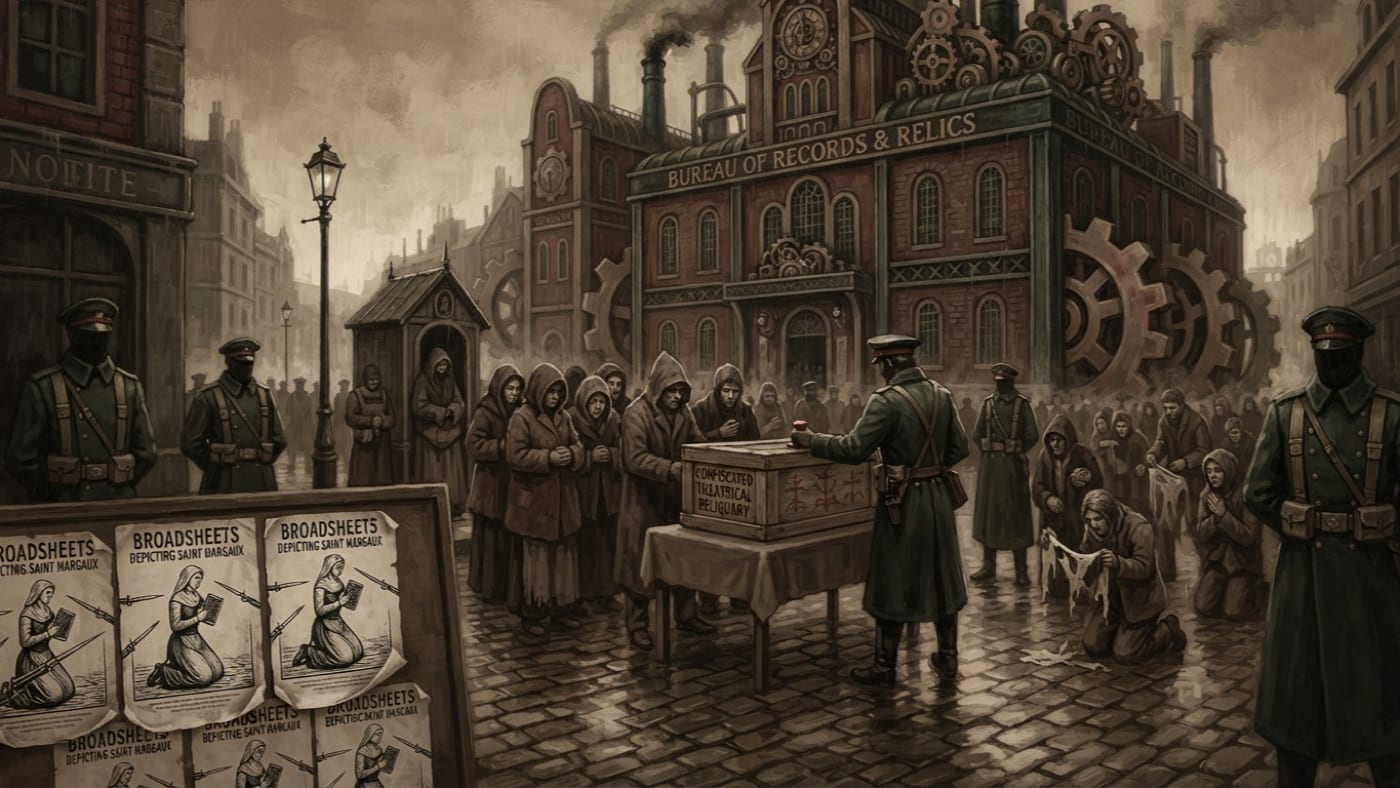
The early composition can be described plainly. A small grey-haired woman in a wimple kneels with a psalter raised, and bayonet points come down into the picture from somewhere above and beyond the frame. The soldiers holding them are never shown. That restraint is the cutter's best decision, whether or not he meant it.
The cutter has no name. The Bureau of Doctrine holds that he worked from survivor testimony. A later notation of the Bureau of Records, since classified and rescinded, holds that he never visited Saint-Malo, never interviewed a survivor, and drew his own grandmother. Both accounts are on file. The Codex prints both, because the Ledger keeps both and because I am not paid to settle disputes between Bureaus before luncheon. Where he lived, where he worked and whose press he used are unknown. Nantes may not claim him. Neither may anyone else.
The sheets were copied and changed. In some she holds the psalter up like a shield, and in others she presses it to her breast. The Rhineland edition, printed by the scriptoria of Mainz in A.S. 12 / 1722 CE, gave her a halo and set the Guards recoiling into shadow. No survivor reported any light at Saint-Malo. Doctrine approved the halo after the fact. The Mainz edition belongs to Mainz and to A.S. 12. Nobody in Nantes can have held it during the first fortnight, since it did not yet exist. Whatever the city saw in those weeks, Mainz had not yet put a halo on it.
The Bureau of Records holds no block, no proof sheet and no first impression that can be tied to Nantes. Anyone offering to sell me one will be referred to the Bureau of Relics, which enjoys these conversations more than I do.
#On Words Against a Face
The Gazette de la Raison gave the massacre four sentences under the subheading "Religious Vagrants Resist Lawful Order at Saint-Malo." Its editor and place of printing are not established, and no record ties the Gazette to Nantes. I set the two documents side by side here because the comparison is mine to make.
A subheading has to be read before it can persuade anyone, and it persuades only those who already agree with the grammar. A woodcut is seen in the time it takes to pass a doorway. The Gazette called forty-three people a category. In the doorways of Nantes, and of every town between there and Vienna, the woodcut showed an old woman on her knees, and the onlooker supplied the category himself: grandmother. No magistrate in the Rationalist administration had a word that could compete with it.
The Rationalists employed men who could write. They neglected to employ men who could carve. That was the first lost engagement of the Atheist Wars, and it was lost on paper.
#On the Prop That Took Offerings
Nantes appears once more in the Codex, under a less flattering heading. The entry on the Reliquary of Saint Matthias records "at least one traveling theatrical prop confiscated in Nantes after it began accepting offerings with better accounting than the parish."
That is the whole account. It carries no date. It names no maker, no performer, no confiscating officer, no stage and no procedure. It does not say whether the box bore any mark, nor what became of it once seized. It does not prove a Nantes industry in counterfeit relics, any more than one drunk proves a brewery. Nor does it show that the true Reliquary ever passed through the city. The carved box in that account was a stage property built to stand in for the Reliquary, and the faithful treated it as the Reliquary anyway.
Under later Bureau practice a licensed copy of the Reliquary is marked beneath the base with the crowned M, the Corvus date and its copy grade. A traveling prop carries whatever the scene painter thought would look well under lamplight. The faithful of Nantes, faced with a painted box, did what the faithful of every town did when faced with the woodcut. They responded to the likeness and placed coins in front of it.
That is the second thing the Codex knows about Nantes, and it is the same thing as the first. A copy of the sacred, set before an audience, draws devotion. Whether that devotion counts as piety or as fraud depends on whose seal is on the copy. In this case nobody's seal was on it, so the box was seized.
#On What the Bureau Kept
The early tribunal at Strasbourg, in A.S. 14 / 1724 CE, recognized Sister Margaux as Saint Margaux of the First Blood. It had seven depositions and no authenticated miracle. It examined the broadsheets, and the surviving account does not say which sheets, or where they came from. It judged that the breadth of her posthumous influence amounted to a diffused miracle. A line of paper running from Nantes to Vienna was, in practice, the miracle it described. The Bureau ratified that recognition later, once a Bureau existed to ratify anything.
The Codex entry on the miraculum diffusum states that Kratz "wanted blood in the title" and chose "of the First Blood" over "of the Psalter" and "of the Cobblestones," and it credits him with the agitation that carried the early images abroad.
Corrected. Kratz was about six years old at the A.S. 14 recognition and about two at the massacre. The title already appears in the tribunal's recognition, and its author is unknown. The circulation that reached Nantes within a fortnight of A.S. 10 cannot have been organized by a child of two. Kratz may have promoted the title later, as an adult, at a date nobody has verified. He did not invent it.
What the Church and later the Bureau took from the episode was control of the image. The engraver had given the faithful a face, and the Bureau gave them rules about it: an approved composition, a licensed grade for copies, a fine for unlicensed depictions, and a storeroom for any box that took coins without a seal. Nantes, which received the face before anyone held authority over it, has since received the rules as well, like every other town on the Bureau's rolls.
The block is lost and the engraver has no name. Whether the prop ended in a storeroom or a stove, the account does not say. Nantes keeps its four letters in the Ledger, and the Bureau of Records will issue nothing further on them until someone brings a better piece of paper.