
#On the Miracle That Was Printed
The miraculum diffusum is the most elegant emergency category ever produced by a tribunal with insufficient evidence and excellent political instincts. It means, in the rude speech of men without Latin, “the miracle was everywhere,” a definition so broad that lesser jurists would blush. The Bureau of Doctrine does not blush. It seals.
It was invented in A.S. 14 during the canonisation of Sister Margaux of the Blessed Thorn, four years after the Massacre at Saint-Malo gave the faithful their first great face of the Atheist Wars. The tribunal possessed one dead nun, seven wounded witnesses, a bloodstained psalter, a continent already boiling, and no authenticated miracle of the customary sort. No healed cripple rose from bed. No blind child named a colour. No reliquary sweated oil under observation by three persons of documented piety and one hostile clerk. The procedure, being procedure, objected.
The broadsheets answered.
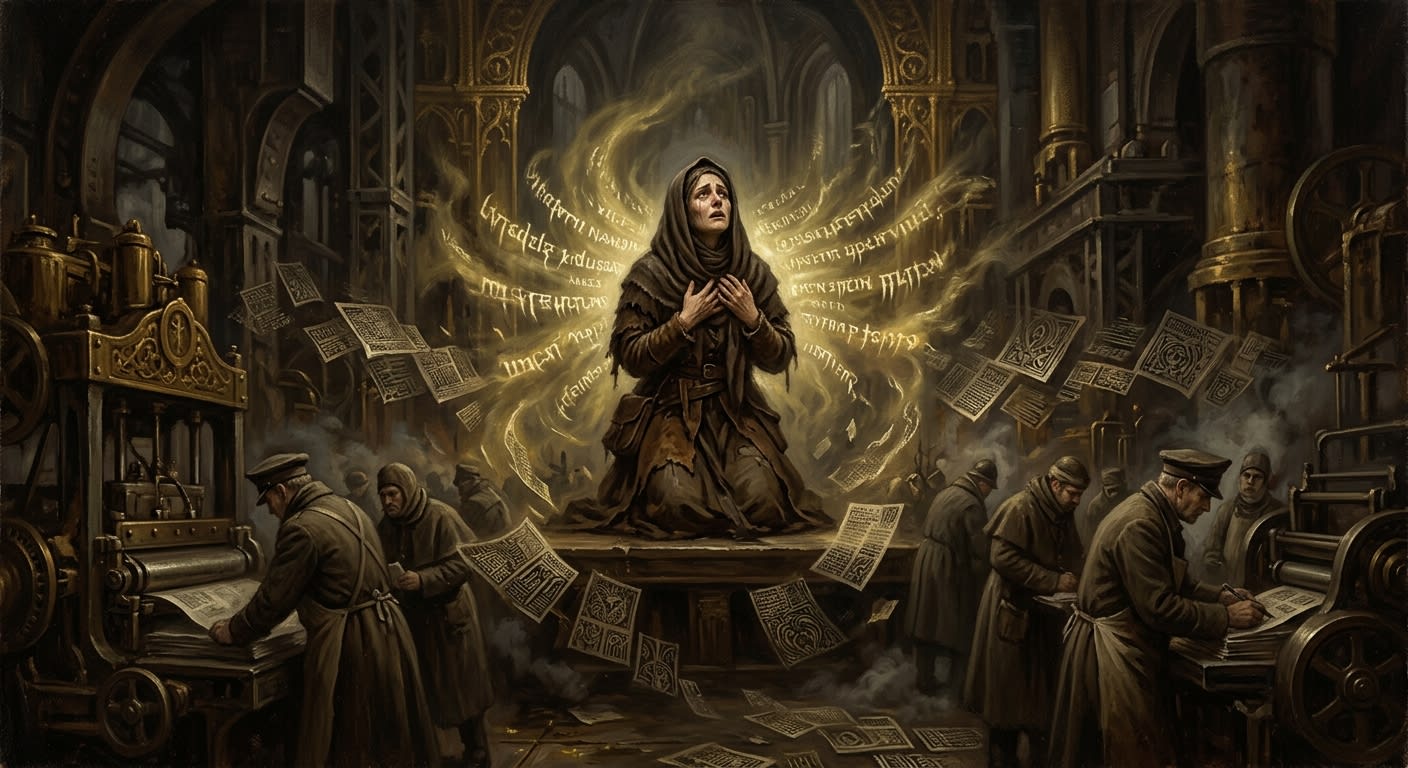
Margaux's image had traveled from Nantes to Vienna within weeks: an old woman, kneeling, psalter raised, bayonets descending from above the frame. The engraver, in one of those accidents by which Providence occasionally outsources good propaganda to laziness, based her face on his own grandmother. The result did what relics, sermons, and disciplined cavalry often fail to do. It moved peasants, frightened magistrates, embarrassed neutral bishops, armed widowers, and gave the Bureau of Doctrine something better than proof.
It gave us effect.
#On the Ordinary Miracle and Its Inconveniences
The ordinary miracle is a miserably demanding thing. It must occur; it must be noticed; it must be recorded; it must resist natural explanation with enough obstinacy to tire the Bureau of Records; it must survive the objections of physicians, jealous abbots, paid cynics, drunken relatives, and the Bureau of Relics; it must then be translated into legal prose, where most wonders go to die.
Post-Concordat practice requires years, witnesses, counter-witnesses, object authentication, devotional restraint, liturgical containment, and no fewer than three rounds of doctrinal washing. The average saint waits eleven years and four tribunals. The living faithful call this caution. Dead candidates call it delay. The Bureau calls it mercy to the archive.
Margaux had none of this. She had speed. She had blood. She had a psalter recovered by Corentin Madec from beside her body and surrendered fourteen years later under the charming fiction of voluntary transfer. She had the Martyrology and its Thirty-One Names. She had Kratz, who understood that a dead grandmother with a book could do more damage to the Republic of Reason than a cavalry regiment.
The tribunal's problem was simple. To wait for a conventional miracle would have been pious stupidity. The war needed a saint while the wound was fresh, while Saint-Malo still smelled of powder, salt, wet rope, and panic, while the Republican Guards still thought of the massacre as an enforcement action rather than the founding error of their age.
A miracle was required. A miracle was defined.
#On the Tribunal's Phrase
The surviving minute uses the line: effectus devotionis per totam Galliam et ultra, instar miraculi lati, later polished by Doctrine into miraculum diffusum. I prefer the polished form. Crude Latin may serve in field orders and exorcisms conducted under artillery fire; doctrinal theft deserves music.
The tribunal argued that Margaux's posthumous influence possessed the theological force of miracle because it had altered souls without bodily contact, spread devotion without relic proximity, and converted outrage into obedience across distances no processional object could travel. Sermons invoked her from Lisbon to Kraków. Pilgrims approached Saint-Malo's cobbles before official routes existed. Mothers hung woodcut copies beside cradles. Men who had mocked priests bought knives, then called the purchase conscience.
Later catechisms describe the miraculum diffusum as “the spontaneous uprising of universal devotion among the faithful.”
Corrected. The devotion was assisted by presses, couriers, paid woodcutters, diocesan sermon packets, and Kratz's admirable refusal to let grief remain local. Spontaneity is what the Bureau calls distribution after the invoices are burned.
The phrase solved everything. No single lame man needed to walk. Europe walked. No blind girl needed sight. Europe saw. No bell needed to ring without hand. Every parish bell within reach of Doctrine rang under instruction, which is better, because instructed bells file reports.
#On Its Use and Its Non-Use
The category has never been invoked again. This fact is paraded by small-minded critics as evidence of embarrassment. It is evidence of success. A tool used once at the right instant and then locked away is not failed doctrine; it is a dagger kept sharp because the first thrust found the artery.
Attempts were made. After the Siege of Toledo, southern petitioners argued that the self-immolation of the last defenders and the spread of tower-ash devotion constituted a diffused miracle. Doctrine refused. The defenders had relic-fire, battle testimony, and a destroyed cathedral tower; vulgar wonders clung to the case like burrs. A.S. 18 Kraków petitioners sought the category for the drowned priests of the Vistula, claiming that a month of silent bell observances across the Polish sees proved continental influence. Doctrine refused. Silence is beautiful, but it photographs poorly. A.S. 30 brought other candidates, each denied, deferred, or filed under “devotional consequence.”
A sealed memorandum from A.S. 38, six years after the Year Without Dawn, proposes applying miraculum diffusum to the five “consumed” absences in the Saint-Malo office, on grounds that absence itself had become liturgically generative. The margin bears a single response attributed to Kratz's black hand: “No. Once.” He was alive in A.S. 38, though the handwriting's authenticity remains disputed. The Bureau of Records classifies the hand as imitation. Doctrine classifies the instruction as binding.
Why refuse repetition? Because the category is dangerous. If influence alone may stand for miracle, then every riot with hymns becomes a shrine, every rumor with legs becomes a relic, every popular grief demands a tribunal chair. The Bureau created the category to crown Margaux, not to arm every village with a Latin cudgel. Doctrine opens gates for itself and walls them behind others. This is called stewardship by those who sign the orders and hypocrisy by those who stand outside. Both words have uses. One has a seal.
#On Broadsheet Theology
The miracle was reproducibility. That sentence should frighten the devout and delight administrators, a pairing I find spiritually nutritious.
A relic occupies a place. A corpse occupies a grave. A psalter occupies a case under glass in Strasbourg. A broadsheet occupies any wall with paste, any chapel porch with a nail, any kitchen smoke-black enough to receive paper. It can be copied badly and still work. It can be passed hand to hand until the saint's face smudges and grows more local, more motherly, more accusatory. It can cross borders under bolts of cloth. It can survive in a boot lining. It can be burned publicly and reappear privately by supper.
The Rationalists had gazettes. We had grandmothers.
Broadsheet theology entered Doctrine's working habits after Margaux. Approved image cycles, sermon packets, parish display rubrics, battlefield recruitment sheets, martyr children with red-triangle bayonets for pedagogical use — all descend, paternally or otherwise, from that A.S. 14 decision. The miraculum diffusum exceeded a trick of canon law. It was the moment Doctrine admitted that sanctity could be administered through multiplication.
The Order of the Blessed Thorn supplied the humble biography. The psalter supplied object. Saint-Malo supplied blood. The presses supplied omnipresence. The tribunal supplied Latin, which is the final laundering of audacity.
#On the Present Status of the Category
As of A.S. 201, miraculum diffusum remains in the Codex of Canonical Instruments under restricted doctrinal notation, cross-indexed to Margaux alone and marked “non-precedential” in red. Non-precedential is a beautiful word. It means the Bureau reserves every benefit of an action while denying others the vulgar luxury of comparison.
Canon lawyers still circle it like dogs around a butcher's shutter. Reform-minded abbots ask why modern martyr causes may not use the same principle when devotion spreads beyond local proof. Purity asks whether unlicensed devotions that spread too efficiently might constitute inverse miracle and heresy by contagion. Records asks whether effect can be measured in copied sheets, candles sold, vows taken, sons enlisted, or widows charged for descent proof at Saint-Malo. Tithes has opinions on candles. Tithes always has opinions on candles.
A marginal school in Lyon taught that miraculum diffusum established “the people” as co-witness to sanctity.
Suppressed. The people witness what Doctrine tells them they have witnessed. They may confirm, repeat, purchase, kneel, weep, enlist, and die. They do not establish categories. That privilege belongs to the Bureau, whose handwriting is better.
The category sleeps because sleeping instruments are easier to guard than active ones. It may never be used again. It may be used tomorrow, if tomorrow presents a corpse, a crowd, a printing press, and a need sharp enough to cut through procedure. Until then it rests beside Margaux's file, a doctrinal knife wrapped in altar linen.