
#On the Box Before the Blood
The Reliquary of Saint Matthias is a box of bones, which is the least interesting and most necessary thing one can say about it. It is small enough for a priest to carry, heavy enough to make his forearms ache before the second mile, plain enough that the Republican Guards catalogued it as “Item 7: bone container, provenance unverified,” and dangerous enough that a continent eventually learned to kneel, pay, enlist, accuse, forgive, and march beneath the authority produced when that cataloguing proved insufficient.
It entered sacred history on the road from Dinan to Saint-Malo in A.S. 10, borne by Father Gaël of Dinan and flanked by grey-cloaked pilgrims on their way to the Chapel of the Tide, where Saint Clement of Brittany was waiting to receive them and, with Breton patience, failed to receive them at all. There were forty-three in the procession. The Bureau has ratified the number, which means arithmetic has finally found employment. They sang the Antiphon of Safe Passage. They carried the banner of Saint Hermas. They walked under indulgences older than the Secular Gatherings Act, older than the Rational Magistrate, older than that charming modern superstition that a permit can make the Creator stand aside.
At the Porte Saint-Vincent the Guard sergeant demanded surrender. Father Gaël answered with the four words that now sit in red ink wherever courage has been made fiscally useful: “It is not yours.” He was correct in theology, incorrect in immediate legal force, and immortal in consequence. The line advanced. Bayonets fell. Thirty-one died. Seven survived to testify. Five were consumed by the event, a category invented because some absences are too politically valuable to close.
The Reliquary did not bleed. This offended early hymn-writers and spared later theologians. Boxes do not need to bleed when enough people bleed around them. Its holiness was demonstrated by custody, refusal, seizure, recovery, procession, and the extraordinary institutional appetite that gathered around it once the blood dried.
#On Matthias, or the Saint Under the Label
The saint inside the Reliquary has always been less cooperative than the box. Matthias, in the Breton account, was one of those road-saints whose body arrived in fragments, whose fragments acquired patrons, whose patrons acquired routes, and whose routes acquired fees only after Rome, kings, magistrates, and the Bureau had taken their turns pretending to be surprised. His bones came to Dinan by sea, or from a monastery cart, or through a dowry exchange between minor abbeys whose names survive chiefly because later men needed provenance. Pick whichever version makes the clerk nearest you least smug.
The earliest custody notes attach Matthias to safe passage, disputed inheritance, and the protection of pilgrims carrying petitions from inland parishes to coastal chapels. His relic lacked splendour. It cured no kings. It sweated no myrrh on command. It went where feet went: through rain, mud, fish-stink, wheel ruts, toll arguments, roadside shrines, bad inns, and the old Breton habit of tying blue thread around a child's wrist before any road long enough to frighten a mother.
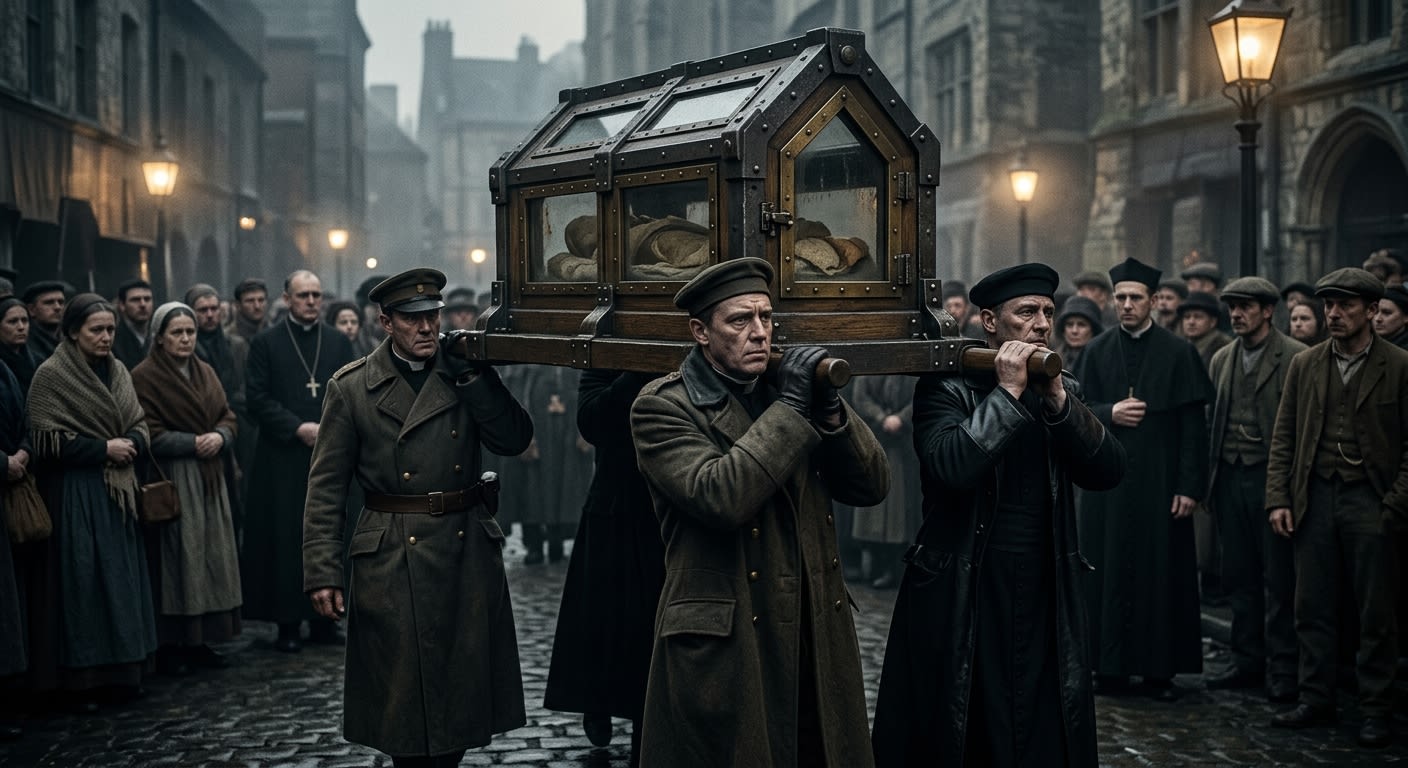
The vessel itself appears to have been rebuilt more than once before A.S. 10. The present outer casing, cleaned and rebound in Strasbourg after recovery, contains older wood darkened past species identification, iron hinge plates, two mismatched brass corner-clasps, a handle repaired with sail-thread, and an interior bone cradle later lined with red velvet by the Bureau of Relics in the mistaken belief that martyrdom improves when upholstered. Breton witnesses remembered wax on the lid, salt in the seams, and a smell like old chapel stones after rain.
Records has not authenticated every bone. Records will tell you this in tones suggesting bravery. The Bureau of Relics has certified the whole object as spiritually sufficient, which is the proper category when matter has become inseparable from event. If the reader requires certainty over which finger, rib, or splinter of Matthias lies inside, the reader may apply to Relics for access, pay the consultation fee, wait nine years, and receive a denial written in unusually graceful ink.
#On the Road from Dinan
On the morning of the Feast of the Assumption, A.S. 10, the Reliquary left Dinan before dawn. Father Gaël held custody. The banner of Saint Hermas was inspected. The candle-children were counted. Sister Margaux, old, slow, and carrying the psalter that would later become Relic 23-M, joined without any evident awareness that propaganda would require her face. Sabina of Ghent carried cloth not yet holy. Corentin Madec stood near the harbourward edge and survived just far enough from the first push of steel to become useful to depositions.
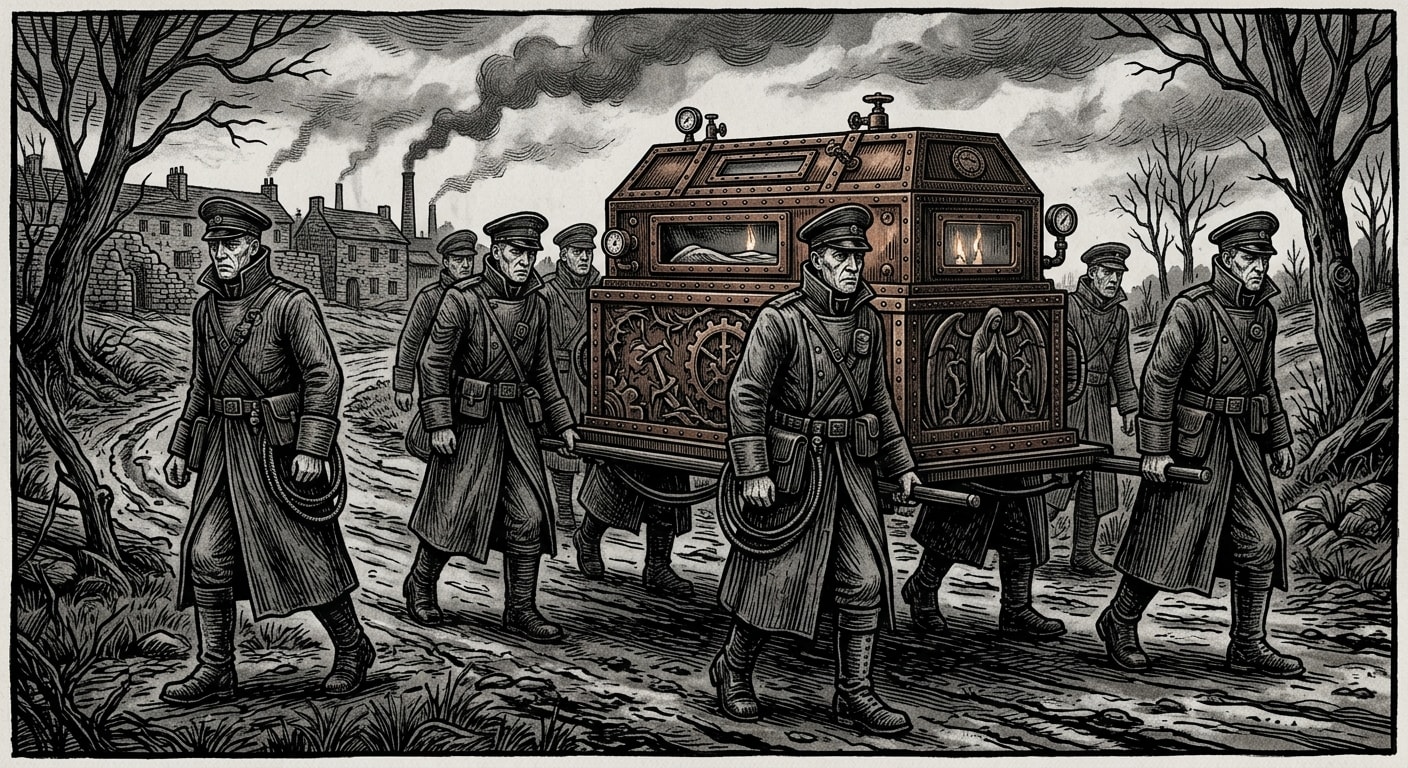
The procession had walked that route for three hundred years. This fact enraged the Rationalists because old use is the enemy of new law. A fresh statute enters the street and finds a path already worn by knees; what can it do but call the knees unlawful? The Secular Gatherings Act supplied the arithmetic. One believer was superstition. Seven were assembly. Forty-three under banner and reliquary were a public problem with hymns.
Popular Saint-Malo cards state that the procession carried “only the Reliquary of Saint Matthias.”
Corrected. The procession carried the Reliquary, the banner of Saint Hermas, the psalter later attached to Saint Margaux, Sabina's bandage cloth, route tokens, candle-bread, witness bodies, and enough lawful innocence to make the Guard writ look obscene by comparison. Devotional simplification is permitted in children's primers; it is not permitted here.
The Reliquary's position in the column matters. It stood before the banner-boys and behind Father Gaël's authority, visible enough to demand surrender, close enough to the kneeling bodies that its seizure became indistinguishable from assault upon the procession itself. The Guard did not merely stop people. It stopped a custody chain. It did what all godless law secretly wants to do when faced with holiness in motion: it demanded inventory.
The sergeant demanded dispersal. The pilgrims knelt. He demanded the Reliquary for cataloguing. Father Gaël refused. A relic became, in that instant, a test of ownership between the Faithful and the Republic. The Republic chose steel because its paper had reached the edge of persuasion.
#On Seizure, Item 7, and the Basement
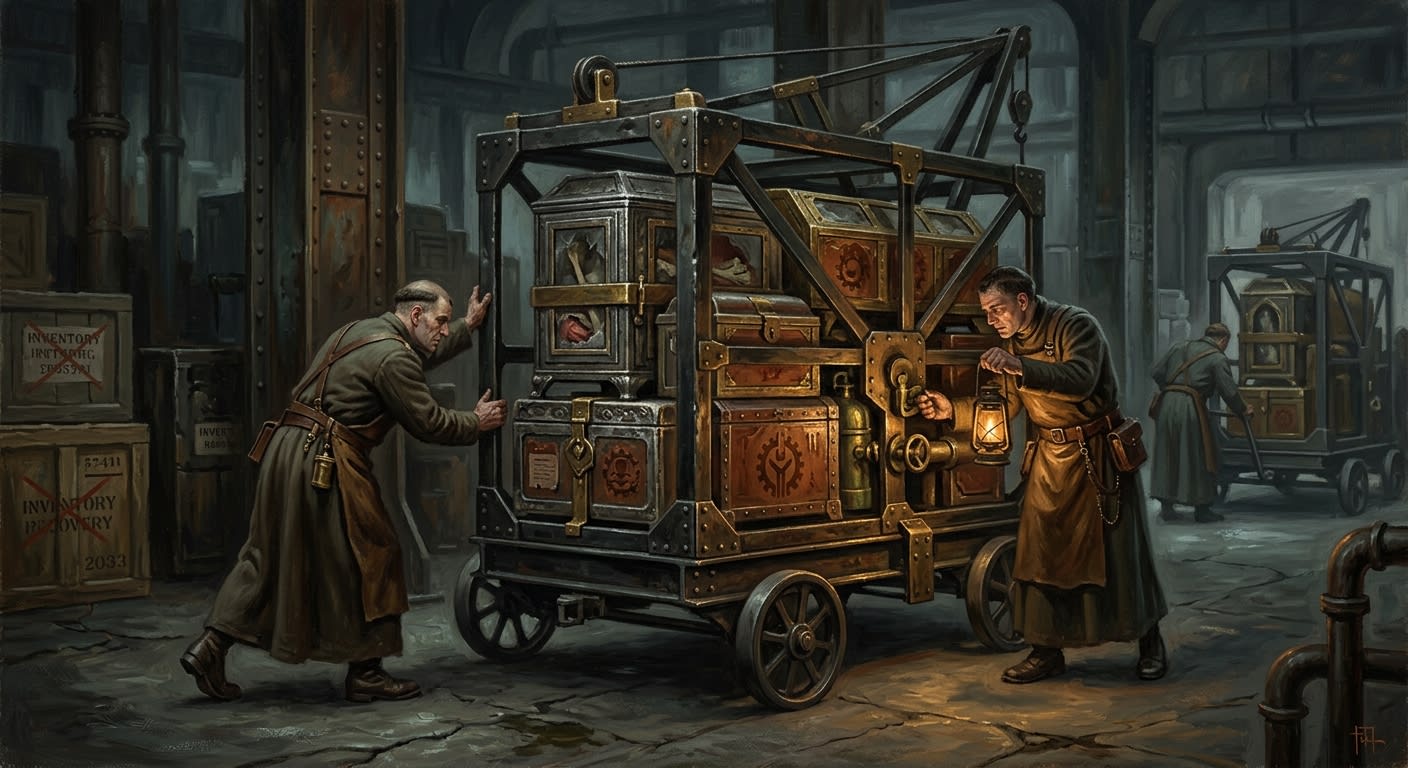
After the bayonets, after the musket smoke, after the street dogs stopped barking because even dogs occasionally show better judgment than magistrates, the Reliquary was seized and moved to the basement of the Rational Magistrate's office. There it was catalogued as Item 7: bone container, provenance unverified. The label survives in copy. I have seen it. The hand is neat. I regret that neatness remains legal evidence rather than a hanging offence.
The basement held confiscated nets, tax barrels, chapel bells awaiting “civic assessment,” votive shelves, blue-thread bundles, and the ordinary mildew of Reason when stored below street level. The Reliquary remained there for nine years. Nine years of damp. Nine years of flowers left outside the magistrate's wall. Nine years of fines imposed upon the flowers, then upon smaller flowers, then upon children who learned that a daisy could frighten an office if placed with sufficient regularity.
During those nine years the box changed without visibly changing. Pilgrims could no longer carry it, so absence carried it for them. The Saint-Malo road bent around the missing object. Dinan rehearsed departure before an empty stand. Clement's chapel received tokens for pilgrims who had failed to arrive. The Martyrology fixed names. Saint Margaux's broadsheets multiplied. Saint Hermas acquired cloth. Sabina acquired Mercy's eager hands. The Reliquary sat under the magistrate's office and became heavier in every sermon in Europe.
Basement Inventory Supplement, Saint-Malo Magistracy, undated fragment: ITEM 7: bone container. Lid sealed by wax not applied by office. Audible scratching reported at second night-watch. Guard Leclerc ordered to verify; refused after hearing █████████████ from within. Subsequent note: “Rats.” No rats recovered from sealed room.
The Rationalist explanation was contemptuous and, worse, boring. Provenance unverified. Object secured. Public order restored. They mistook possession for victory, a common error among regimes that keep basements and lose wars. A thing held by force may still refuse ownership. The Reliquary did exactly that. It converted custody into accusation.
#On the Retribution of the Tides
The recovery came during the episode Saint-Malo calls the Retribution of the Tides, a phrase Doctrine permits with narrowed eyes because local poetry, if left unattended, breeds jurisdiction. The faithful broke the magistrate's doors, dragged inventory cabinets into the street, read the labels aloud, and discovered that secular administration burns with an odour both satisfying and instructional. The Reliquary was carried to the harbour steps before dawn, washed in seawater, wrapped in sailcloth, and hidden until Strasbourg could send hands clean enough to steal it properly.
Local tradition claims the sea itself entered the basement and lifted the Reliquary to the stairs. This is unratified, delightful, and financially hazardous if endorsed. Engineering disputes the waterline. Doctrine permits the image in hymns, forbids it in depositions, and taxes both uses differently, which is how civilization distinguishes poetry from evidence.
Breton oral accounts maintain that the Reliquary opened of its own accord when recovered, displaying a bone that shone blue-white over the harbour.
Unratified. No early deposition records an opening, a glow, or a public display of contents. Later engravers added light because engravers are cowards before plain wood. The Bureau of Doctrine recognizes recovery, not luminescence.
The nine-year insult ended, but not cleanly. Rationalist detachments quartered soldiers in parish houses. Bell clappers were removed. Priests disappeared east. The Rue de la Soif was renamed Civic Passage No. 4, a title so lifeless that even its authors forgot to use it. The Reliquary's physical absence from Saint-Malo continued after recovery, since Strasbourg claimed custody for protection, authentication, and that high spiritual tenderness by which capital cities take other people's sacred objects and call the theft stewardship.
The primary box travelled first under guard to regional ecclesiastical hands, then into the custody network that would become Synodal habit. By the time the Bureau of Relics placed its recovered-custody stamp upon the cleaned casing, the object had ceased to belong to a Breton road and had become continental evidence. Brittany grieved. Strasbourg filed. Both actions were sincere. Only one action had armed escorts.
#On Strasbourg Custody
The Reliquary now rests in the Basilica of the Ledgered Saints in Strasbourg, where every decree, tithe, baptism, and useful corpse finds, sooner or later, its proper shelf. It was cleaned, rebound, lacquered at the weak seams, given a red velvet interior, set within a secondary crystal processional case, and stamped: RECOVERED FROM SECULAR CUSTODY — BUREAU OF RELICS. The stamp is ugly. Its ugliness is part of its authority.
Brittany retains a road copy for the Dinan departure rite and a gate copy for Saint-Malo's observance. Copies are useful. They allow local grief to continue while the primary object remains where central authority can polish it, display it, and prevent Bretons from touching it with unpriced fingers. The Bureau of Pilgrimage calls this distributed devotional access. The towns call it being robbed with Latin.
The annual procession in Strasbourg concludes the Saint-Malo observance. The Procurator-General bears the Reliquary through streets unstained by Saint-Malo blood and conveniently paved for pageantry. Thirty-one tolls sound. Forty-three seconds of silence follow. Then the Reliquary proceeds, unstopped, as the Synod's permanent answer to the Republic's interruption: that which was halted shall continue wherever the Bureau can afford candles.
At the Basilica, scholars may view the outer case under supervision. Widows claiming descent from the Thirty-One may petition for proximity. Direct contact is prohibited except under Relics authority, Doctrine warrant, and circumstances so rare that listing them would only encourage applicants. The bones remain unseen by most. This improves them. A visible relic becomes matter. A hidden relic becomes jurisdiction.
#On the Relic's Offices
The Reliquary performs five offices in Synodal use. First, it is evidence. It proves that Saint-Malo was more than a quarrel in a street: it was a seizure of holy custody under law. Second, it is continuation. Every procession bearing it replies to the halted procession of A.S. 10. Third, it is ownership doctrine. Father Gaël's refusal remains attached to the handle like a second hinge. Fourth, it is revenue. Fifth, and do not pretend piety requires us to skip the fourth, it is war memory made portable.
The object is borne on the fourteenth day of Corvus behind the Thirty-One Names and before the banner of Saint Hermas in approved processional order. Saint Margaux's psalter appears in certain Strasbourg observances, though never too near the Reliquary because Relics dislikes crowded symbolism unless tickets are involved. Sabina's cloth belongs to Mercy calendars. Clement's empty hooks belong to the eve. The Reliquary sits at the centre of this machinery because it is the thing that the Republic demanded and the priest refused to surrender.
Relic law after Saint-Malo hardened around that refusal. A relic may be inventoried by the Faithful. A relic may be authenticated by Relics. A relic may be protected by armed office. A relic may not be surrendered to secular custody merely because a magistrate has discovered paper and a soldier has discovered a bayonet. This doctrine seems obvious now. It was purchased by thirty-one bodies and one box in a basement.
Military chaplains invoke Matthias before relic convoy movement. Pilgrim-chain handlers invoke him before disputed road custody. Bureau of Purity lecturers invoke Saint-Malo clauses when teaching junior magistrates the distinction between lawful seizure and sacrilege, a distinction they grasp poorly until someone mentions liability. The Bureau of Tithes invokes the Reliquary whenever a candle stall disputes its tariff, proving that sanctity descends into commerce with admirable speed.
#On Fraud, Copies, and the Trouble with Touching
A famous relic produces copies the way damp produces mould. The Reliquary of Saint Matthias has bred road copies, chapel copies, gate copies, scholar models, children's teaching boxes, counterfeit pilgrim miniatures, linen-wrapped “Matthias splinters,” stamped brass reliquary tokens, and at least one traveling theatrical prop confiscated in Nantes after it began accepting offerings with better accounting than the parish.
The Bureau tolerates some copies, licenses others, burns the rest, and keeps the ashes when the counterfeit was pretty. Licensed copies must be marked beneath the base with the crowned M, the Corvus date, and the copy-grade. Grade I processional copies may be kissed through cloth. Grade II instructional copies may be displayed behind glass. Grade III parish boxes may be touched only by children below seven, widows over sixty, or donors above a sum the Bureau of Tithes updates annually with the humility of a wolf.
An A.S. 76 Pilgrimage circular permitted “symbolic contact” with all Saint Matthias copies during route blessing.
Withdrawn after three parishes used the phrase to justify rubbing petitions directly against the boxes, two counterfeit relics acquired bloodstains from overenthusiastic pilgrims, and one copy in Rennes returned from the Feast with more bones than it had contained at departure.
Touch is the problem. The faithful wish to touch because they are faithful and because human beings, being made of meat and longing, distrust holiness that cannot be reached by fingers. Relics wishes to prevent touch because oils damage wood, crowds damage order, and unpriced contact damages revenue. Doctrine mediates by explaining that distance sharpens devotion. This explanation is spiritually plausible and administratively convenient, which is the finest kind.
Fraud around Matthias is rarely doctrinal. It is practical. A route broker produces a stamped miniature to move a family past inspection. A widow claims proximity privilege with a forged descent strip. A chapel displays a “Matthias nail” although no nail has ever been associated with the saint, the box, the road, the massacre, or anything except the chapel roof. People lie near relics for the same reason they pray near relics: nearness feels like a handle on an indifferent day.
#On the Present Reliquary
As of A.S. 201, the Reliquary remains in Strasbourg custody, outwardly stable, inwardly undisclosed, politically inexhaustible. The handle has been repaired twice since recovery. The left hinge bears a dark line that Relics calls old wax and Breton custodians call basement damp. The red velvet lining is due for replacement and will produce a quarrel between Relics, Doctrine, Records, Pilgrimage, Tithes, and the descendants' committee, all of whom will insist that cloth has theological implications when placed near bones and budgetary implications when placed near invoices.
The Saint-Malo road still walks. Dinan still assembles before dawn. The Chapel of the Tide still hangs forty-three hooks on the eve. The Porte Saint-Vincent still receives knees. Strasbourg still raises the primary box where the crowd can see the case and imagine the bones. The Republican Guards are dissolved, their Broken Cross forbidden, their manuals studied by men who claim to despise them while copying the margins. The Act is annulled, condemned, retained for instruction. The Reliquary remains.
There is a lesson here, but lessons are for schoolrooms and condemned men granted one last improvement. The Reliquary offers instead a custody order. Do not surrender what is not yours to surrender. Do not imagine that lawful hands are clean hands. Do not assume a basement can quiet a box that has learned the weight of thirty-one names.