
#On the Paper and the Record
The Gazette de la Raison appears in the Codex through one notice. I would prefer to give the reader its proprietor, its printing house, its price per sheet and the name of the boy who inked its formes, so that each could be filed in the Ledger beside a suitable anathema. The record declines. Its founding year is unknown. Its editors are unnamed. Its premises, its frequency, its circulation and its final issue are blank lines in a register I did not keep and cannot be blamed for.
What the archive holds is the paper's notice on the killing at Saint-Malo in A.S. 10 / 1720 CE: four sentences and a subheading. The paper could not have printed that year in the Church's reckoning. The numbering was adopted retrospectively at the Concordat of Strasbourg, eighty years after the ink dried. I give the date in our numbering because ours is the numbering that survived.
Four sentences are enough. A newspaper is an engine for settling what a reader shall believe before the coffee cools, and its smallest notices are the most candid, because nobody thought them worth disguising. I read this one as the Bureau of Doctrine reads a confiscated catechism: word by word, under a good lamp, with a confessor's patience and a procurator's pen.
#On the Four Sentences
The Codex does not reproduce the full text of the notice, and I will not counterfeit it. The subheading survives:
Religious Vagrants Resist Lawful Order at Saint-Malo.
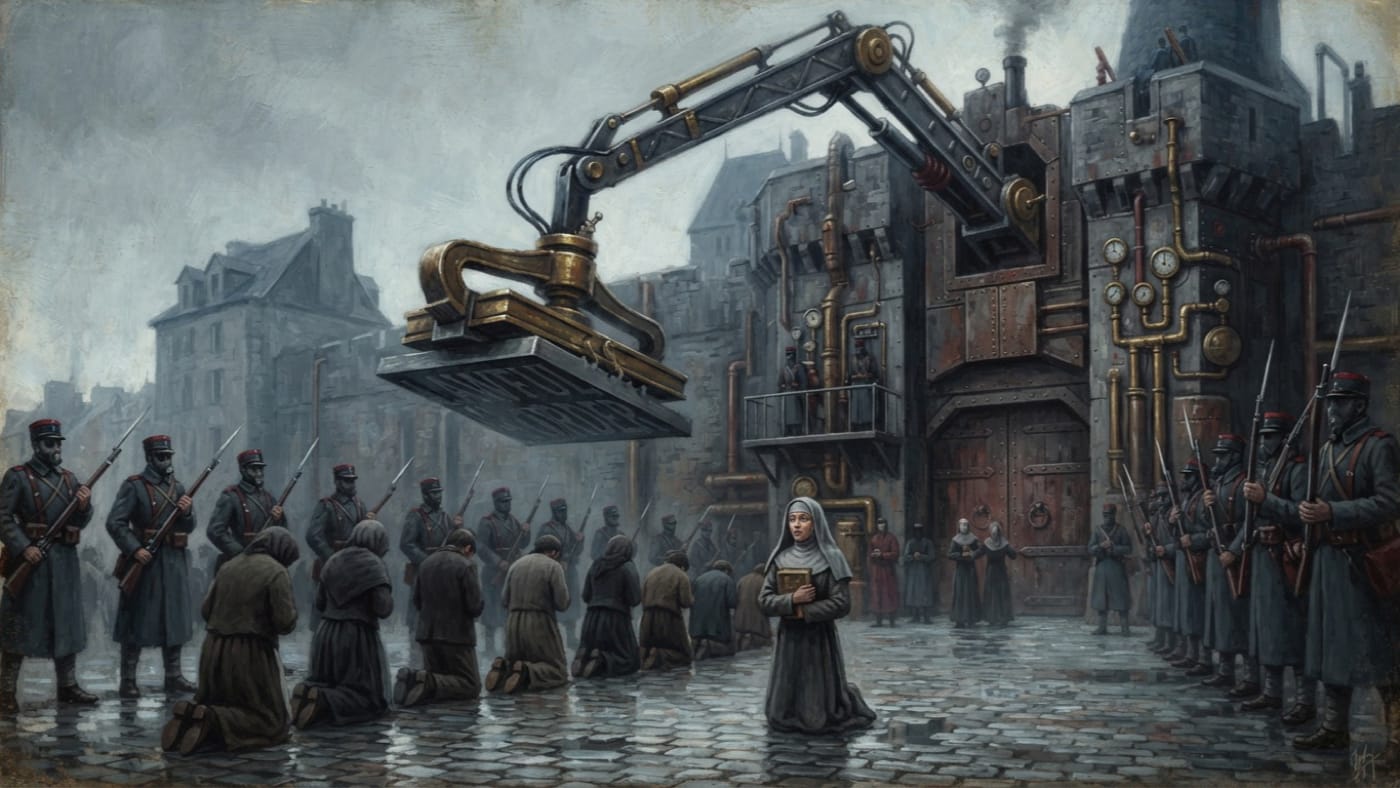
Set it beside what the later record ratified. Forty-three pilgrims walked from Dinan toward the Chapel of the Tide, carrying the Reliquary of Saint Matthias. A detachment of Republican Guards stopped them at the Porte Saint-Vincent and demanded the reliquary. Father Gaël of Dinan refused. The pilgrims carried no weapons, and they knelt. The Guards went in with bayonets. In a census compiled fourteen years afterward, the Bureau of Records certifies thirty-one dead and seven wounded survivors. It lists five as unaccounted for and classes them, in its own phrase, as "consumed by the event." Father Gaël died at the gate. So did Sister Margaux of the Blessed Thorn, aged sixty-three.
The Gazette's reporter had none of that arithmetic. I do not fault the reporter for lacking a count that no clerk had yet made. I fault the four words chosen to stand in its place.
Religious. This is an adjective of category. It files devotion under conduct, among the things a magistrate may license or refuse, like a market stall or a dog.
Vagrants. A pilgrim has a road, a shrine and a reason. A vagrant has only the road, and the road belongs to someone else. With one noun the procession loses its destination, and with its destination its innocence. A man walking to the Chapel of the Tide is a pilgrim. Strike the chapel from the sentence and he is loitering.
Resist. The verb belongs to the vagrants. They act, and the order merely persists. A reader of this line learns that the trouble at Saint-Malo began with the people who knelt, and no bayonet appears anywhere in the grammar.
Lawful Order. Here the subheading reaches its altar. The order is lawful, so whatever resists it must be the disorder. A reader who has been told where the law stands is spared the question of what the law did. In this grammar a bayonet is an instrument of administration, as ordinary as a seal.
#On Lawful Order
What galls me is that the Gazette's last two words were true.
Earlier editions of the Codex's Saint-Malo record held the Guards' writ to be a forgery by agents of the Council of Nine, which would have made the Gazette's "lawful order" a plain lie.
As the corrected Saint-Malo entry records, the Bureau of Records has since determined that the writ was genuine. The Rational Magistrate of Saint-Malo issued it under his own authority, and it prohibited unauthorized religious assembly. The Council of Nine's hand in the affair remains unproved. The Gazette's phrase is accordingly promoted from lie to accurate description, which is worse for it.
A forged writ would have given me a villain with a name and a cellar. A genuine writ gives me a magistrate's routine, which is harder to burn. The Gazette had no need to lie. It needed only to report the writ and leave the kneeling out of the headline. Whatever the four sentences went on to say, the subheading had already told the reader which fact governed.
I cannot say who decided this. The record names no editor and preserves no instruction from any magistrate's office. Nor does it prove that the paper served as the organ of any government. The Rationalist Republic was not formally constituted until the Treaty of Regensburg in A.S. 30 / 1740 CE, twenty years later. Rationalist magistrates and Guards were at work on the cobblestones long before any treaty dignified them. I need no order from above to condemn the Gazette, because a paper that prints "lawful" where it might have printed "kneeling" has already issued its own.
#On the Image the Paper Could Not Govern
So far as any surviving record shows, the Gazette never printed the name Margaux. It had no cause to. In its grammar she was one vagrant among forty-three, part of a plural that resisted.
She was sixty-three years old, small and grey beneath the wimple, a Sister of the Blessed Thorn who had spent forty-six years mending linen. She died on her knees holding a common psalter, unilluminated and undated, the kind sold at market for the price of a good loaf. Her entry records that within a fortnight of the massacre, woodcut likenesses of her were passing from hand to hand between Nantes and Vienna. They showed the wimple, the kneeling figure and the raised psalter, with bayonets coming down from above the frame.
A woodcut has no subheading. It cannot call its subject a vagrant, because the eye sees a grandmother before the mind consults a magistrate. The Gazette had used words to argue that the people at the gate were a category. The broadsheet answered with a face, and no parishioner has ever mistaken a face for a category.
The images multiplied, diocese by diocese. The Rhineland edition, printed by the scriptoria of Mainz in A.S. 12 / 1722 CE, gave her a halo and set the Guards recoiling at the edge of the block. No survivor reported any light at Saint-Malo. The halo was the engraver's devotion, and the later Bureau of Doctrine approved it after the fact, on the principle that sanctity keeps its own calendar. In A.S. 14 / 1724 CE an ecclesiastical tribunal in Strasbourg recognized her as Saint Margaux of the First Blood. It did so on seven depositions and without an authenticated miracle. The Bureau ratified that recognition once there was a Bureau to ratify anything.
Nothing in the record shows that the Gazette answered the broadsheets, named her or printed a correction. It had spent its four sentences on the law, and the law offers no likeness that can be pinned to a parish wall. By the time the Atheist Wars reached their pitch, the faithful from Bruges to Barcelona knew the face of a woman none of them had met. Not one of them could have quoted a word of the paper that called her a vagrant.
#On What the Record Preserves
My verdict is that the Gazette was accurate in its law and fraudulent in how it spent its attention. It placed the writ above the kneeling and the magistrate above the dead. It gave the verb "resist" to people who were saying psalms. A tribunal of grammarians could acquit each of its words. No tribunal of the Church could acquit the sentence they make together.
The Warden of the Sacred Ledger is permitted candour in his own entries, so I will add that the Gazette lost because it was the inferior craftsman. It compressed, and the Church enlarged. It assumed that a crime filed small enough would be mislaid. It did not reckon with an engraver who would file the same crime as one old woman, life-sized, on every church door from the Breton coast to the Rhine. The Bureau of Doctrine later proclaimed Saint-Malo a revelation. That revelation reached the parishes first on cheap paper, in black ink and a careless register, and it has outlasted the Gazette in every parish I can name.
Of the Gazette, the Codex keeps four sentences it does not reproduce, one subheading it does, and no editor to excommunicate. Of Sister Margaux, the Church keeps a psalter in a crystal case at Strasbourg, and its brass clasp still works.
The four sentences are filed. The Ledger has no further use for them.