

Reverse Index
Referencing “Office of Nullity”
Every codex entry that links to Office of Nullity. 20 entries.
Return to Office of Nullity

4th Rhineland Fusiliers
The regiment that forgot before dusk
The 4th Rhineland Fusiliers accepted a corrected roster before dusk, proving that the Synod can conscript memory as readily as flesh.
Codex Ref. VIII.5.04-148
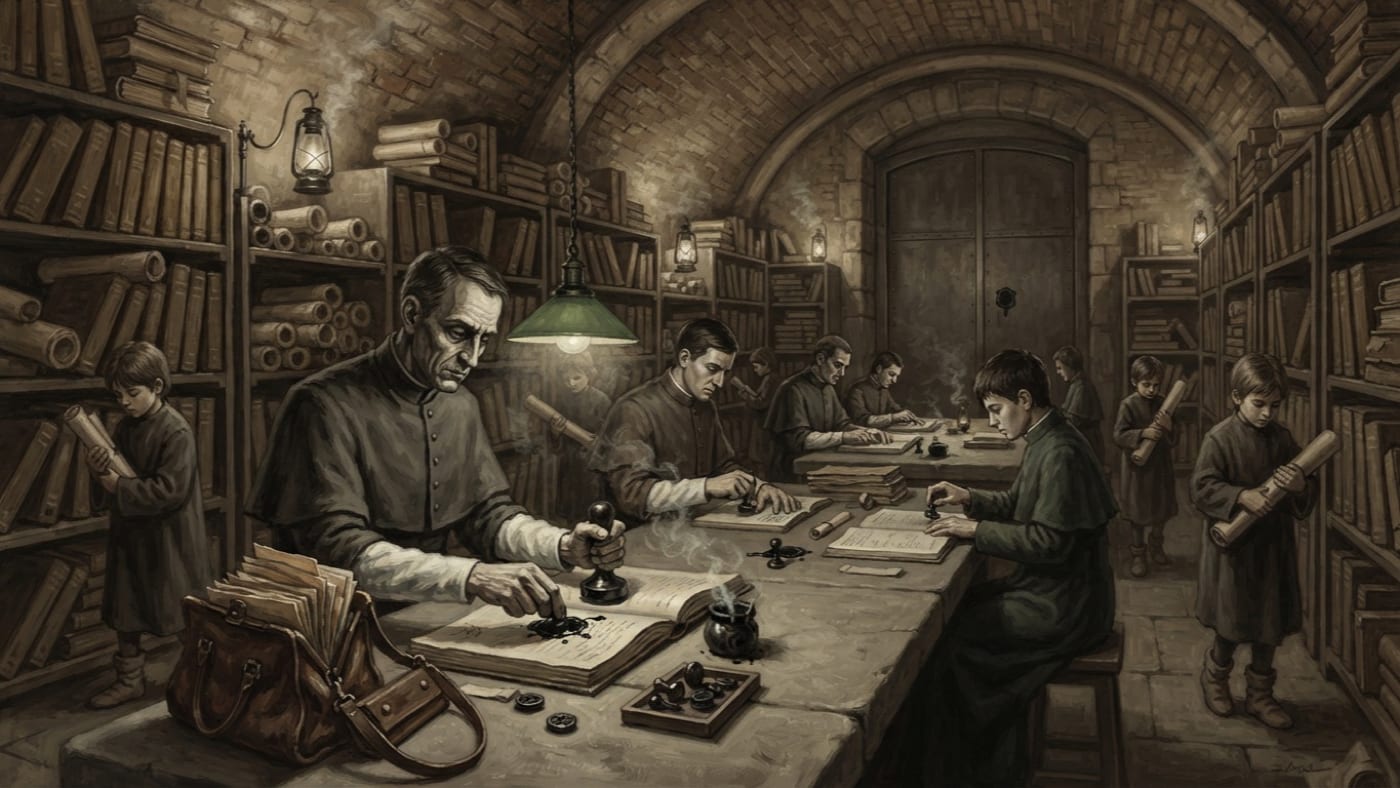
Black Seal Annex
The citizen loses everything. The file loses nothing.
Beneath Strasbourg's Records house, the Erasure Notaries keep every file behind a vanished citizen. The citizen loses everything; the Annex loses nothing.
Codex Ref. XIII.1.70-002

Black Seal Prelate
The Notary signs the strike; the summit decides whose signature survives.
The summit of the Office of Nullity's hierarchy: rarely seen, feared by every Erasure Notary, and capable of ruining one with a signature. The station is attested; the incumbent remains outside the public rolls.
Codex Ref. XIII.1.70-002

Carnelian erasures
Every seal was correct; the ledger was impossible
In A.S. 67, three Notaries struck the Carnelian lineage across four cities without a shared anchor table. Two lawful cousins vanished from the rolls; the Notaries followed. The children lost their bread.
Codex Ref. VII.8.10-067

Carnelian Family of Metz
The lineage strike that bit its own hand
The A.S. 67 first recorded lineage-wide nullification attempt, in which Carnelian ration fraud, plague permits, and three overeager Notaries taught absence to bite backward.
Codex Ref. XIII.1.69-001

Carnival of Ink
Twelve arguments touched the same ink
The A.S. 162 Bastion-Constantinople festival disaster in which twelve simultaneous trench-court duels tangled citations until four hundred names vanished by nightfall.
Codex Ref. VII.8.10-026

Counterfeit Loyalty
The seal failed; the roster paid
At the A.S. 131 Duel of Broken Seals, failed ration seals became a charge against allegiance. Two companies paid for claims their soldiers had never seen; no forger was produced.
Codex Ref. XIII.1.10-131

Duel of Broken Seals
Two captains brought proof; proof became dust
A.S. 131 forward-bastion Registry duel in which two valid ration claims collapsed into dust, condemning both companies beneath the wagons they contested.
Codex Ref. VII.8.10-046
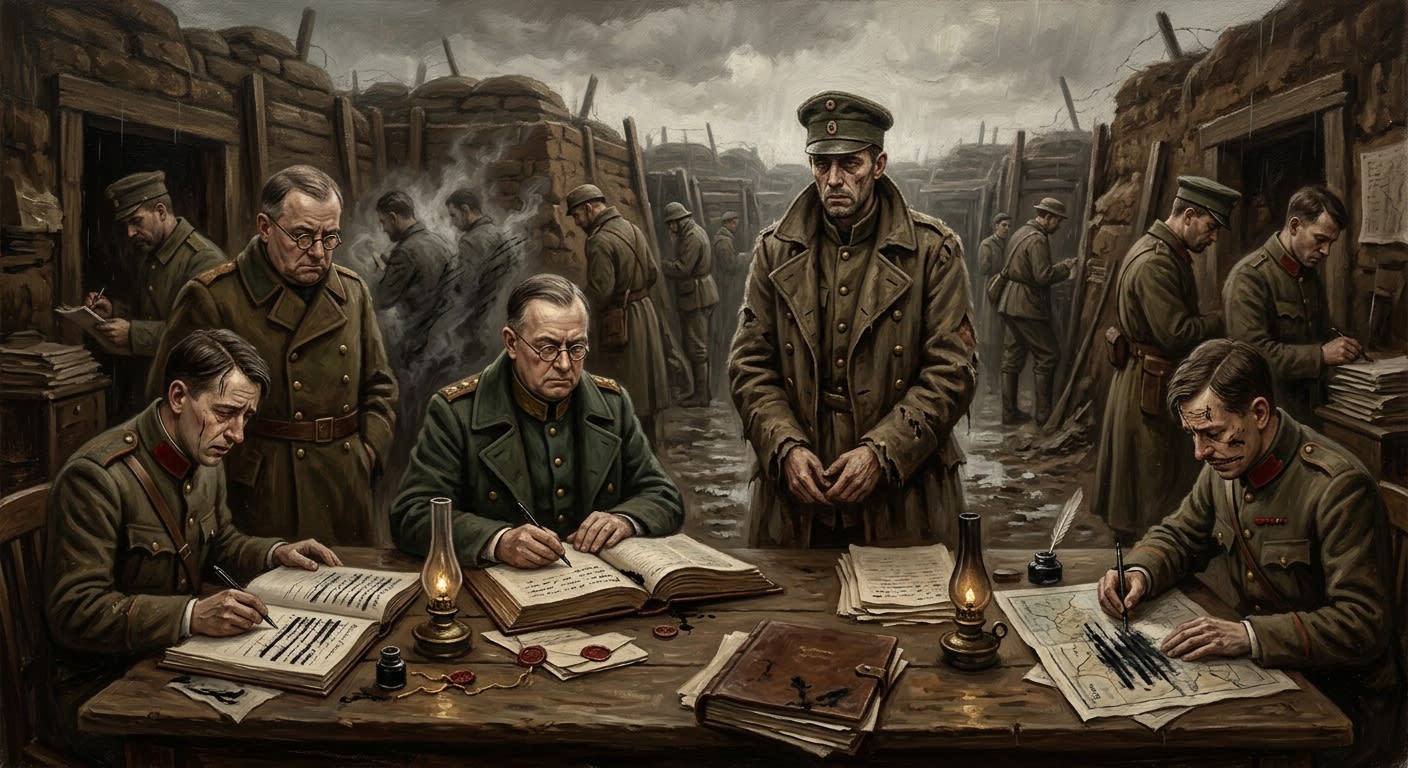
Erasure of Veyss
The man who asked for arrears and received absence
A.S. 148 trench-court erasure in which Lieutenant Veyss lost standing over a missing ancestral tithe-stamp, and every dependent ledger corrected him into absence.
Codex Ref. VII.8.10-048

Gate-Nullity Liaison
The name is struck upstream; the traveller learns at the gate.
An A.S. 201 survey of the Erasure Notary specialist who coordinates nullity records with Gatewarden-Notaries. The Bureau files absence; the traveller finds a closed gate.
Codex Ref. XII.14.01-002

Guillaume of Aachen
The man who opened a gate and was closed by the Ledger
Lord-Protector Guillaume surrendered Aachen in A.S. 25, severed the Rhine approaches, and became the Synod's cleanest lesson in treason, nullity, and administrative damnation.
Codex Ref. III.2.01-123

Hagiography
The saints a profession keeps before the Church decides
Hagiography reviews saints' lives and patronal claims. Devotion, recognition, and authenticated relics remain separate matters, however often petitioners confuse them.
Codex Ref. XIII.1.01-1299

Index Clerk
The Notary strikes the name. Someone has to tell him where it is.
The Office of Nullity's lowest desk with a pen: clerks who locate names, map dependent ledgers and file the notices that make an erasure travel. The seal belongs upstairs; the blame comes down.
Codex Ref. XII.14.01-003

Lieutenant Veyss
The name retained after the man was struck
Lieutenant of the 4th Rhineland Fusiliers, struck in A.S. 148 after a claim for promotion arrears exposed a missing ancestral tithe-stamp. The Bureau kept his case and cancelled his standing.
Codex Ref. III.2.01-148

Lineage Severer
The household loses its standing; the Office keeps every page.
The Office of Nullity's family-strike specialists reconcile dependent rolls before sealing a household out of civic life. Nobody dies at the desk; every office afterward refuses them.
Codex Ref. XII.14.01-003

Market Restoration Canticle
The stones were clean; the paper was not
The Bureau of Rites' canticle, attested during the A.S. 162 (1872 CE) restoration of Bastion-Constantinople's southern market after the Carnival of Ink. The stalls reopened; the account records no reversal of the erasures.
Codex Ref. XIII.1.89-162

Marrow-Quill of Cologne
The advocate who taught grammar to leave bodies hungry
Cologne Citation Advocate and Ledger Duellist whose week of three duels struck a rival household from standing, bread, gates, contracts, and consecrated earth.
Codex Ref. III.2.01-128

Ossuary-Nullity Adjudicator
The dead have reached the gate; their claim is still under review.
A higher specialist of the Office of Nullity determines whether a struck name retains a burial claim. A body is evidence of death; it is no guarantee of a grave.
Codex Ref. XII.14.01-002

Saint Vellum the Silent
A patron saint whose relic is procedure
Occupational patron of Erasure Notaries, Strike Scribes, Nullity Clerks, and Lineage Severers; a saint of washed hands, black seals, and names made quiet.
Codex Ref. III.2.01-113
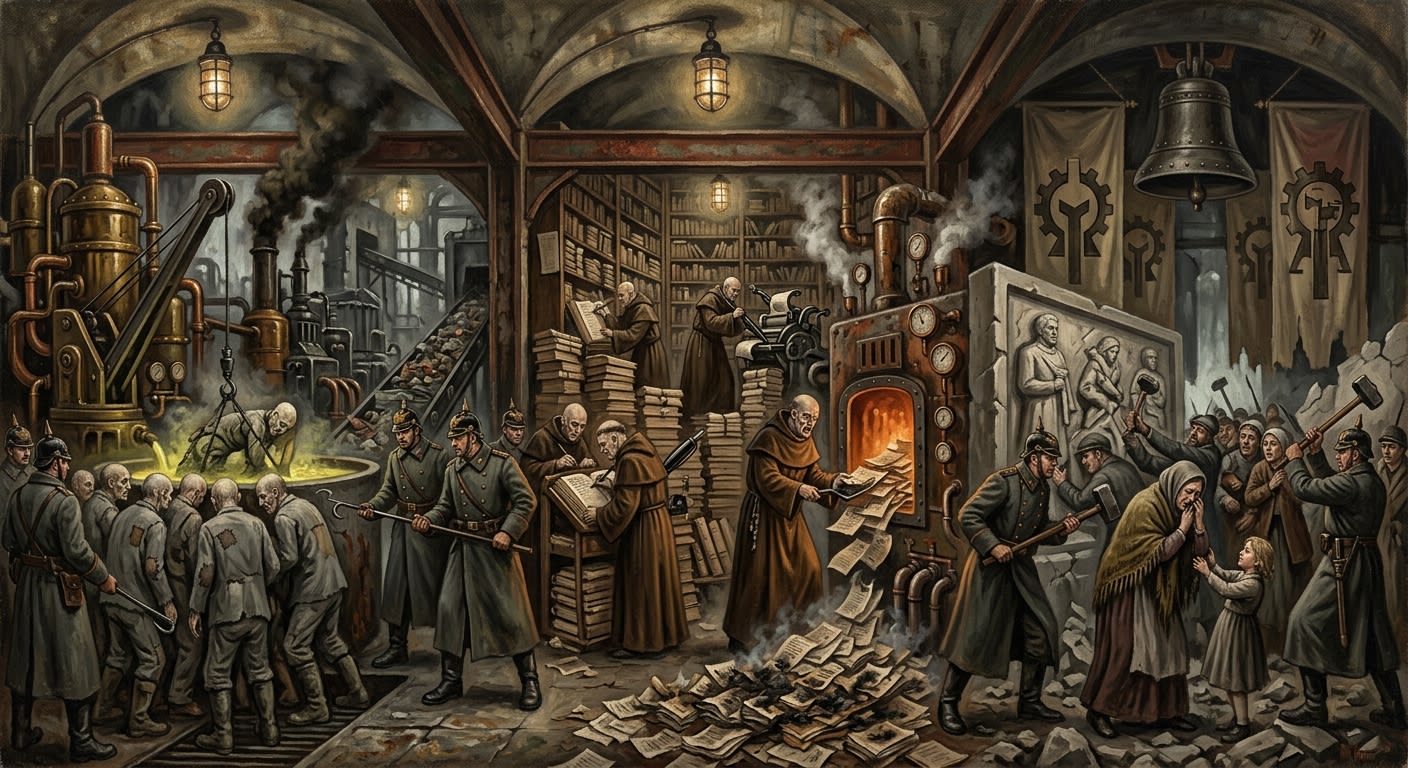
Trifold Erasure
Kill the body, strike the name, poison the recollection
Trifold Erasure is the Synod's threefold cure for rebellion: body extinguished, name struck, memory made too dangerous to love.
Codex Ref. XIII.1.71-111