
#On the Regiment That Remembered by Forgetting
The 4th Rhineland Fusiliers are remembered because they forgot Lieutenant Veyss before dusk.
That sentence has followed the regiment with the intimacy of lice, and, unlike lice, it has received official encouragement. The company rolls, parish levy notices, tavern ballads, widow petitions, trench-court manuals, Black-Stamp cadet papers, and Citation Advocate cautionary lectures all use the 4th as proof that a military unit may be corrected as efficiently as a ledger page, provided the men in it value bread, burial, pay, and continued existence. This is called cowardice by poets. It is called compliance by Records. War calls it readiness. Doctrine, which sees deeper because it has stolen the spectacles from every rival office, calls it a sacrament of administrative obedience.
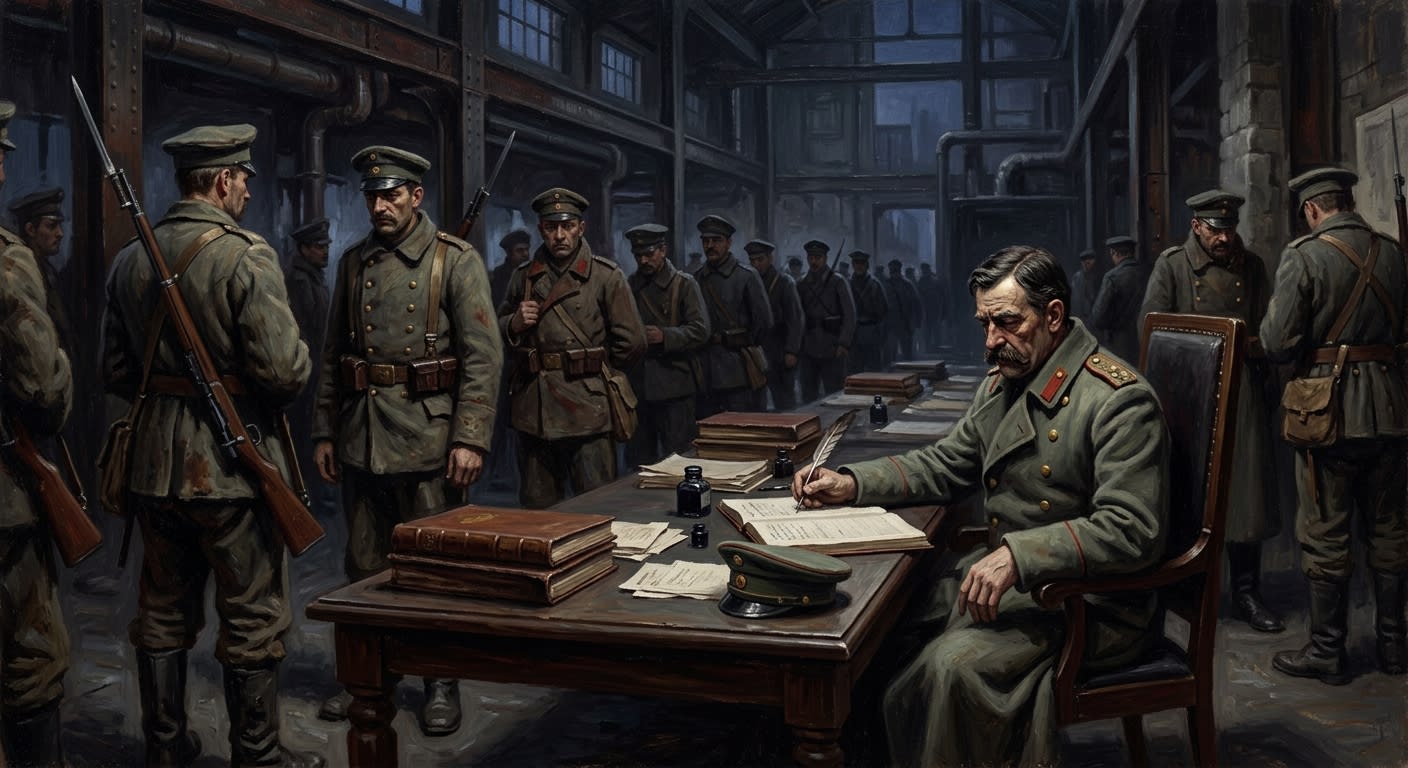
The 4th were not cowards in the ordinary sense. Ordinary cowardice is loud, damp, and prone to running in the wrong direction. The 4th served through eastern trench galleries, line rotations, ration escort, convoy guard, registry witness duty, and the petty attritions by which the Synod converts provincial sons into numbered entries. They marched where ordered. They fired when instructed. They stood in the mud with enough courage to make denunciation cheap.
Then one lieutenant asked for promotion arrears, and courage discovered its superior officer.
#On Rhineland Paper and Military Flesh
The Rhineland does not sit upon the Sagittal Line. It supplies the Line, and supply is a form of bleeding that keeps its sleeves clean. The province sends grain, tolls, clerks, bells, bridge fees, records boys, levy sons, and that special Rhenish talent for preserving every scrap of paper with the reverence other districts reserve for saint-bone. A Rhineland household knows a damp tithe strip can kill a grandson fifty years later. This is not superstition. It is case law.
The 4th Fusiliers came from that civilization of folded proofs. Their soldiers carried baptism extracts in oilskin, copied tithe receipts under shirt seams, parish certificates inside boot linings, and household name slips close enough to the skin that sweat became a second seal. War inspected rifle locks. Records inspected lineage. Tithes inspected obligation. A man who passed all three was permitted to stand in front of Hell.
Older levy sermons praised the 4th as “sons of the Rhine, unburdened by doubt.”
Corrected. They were burdened by doubt, ration tabs, household copies, parish arrears, damp fear, and an inherited suspicion that paper wounds behind the body. The sermon writer has been reassigned to composing mule blessings, where truth has lower expectations.
The regiment’s badge, in barrack description if not formal heraldry, was said to show a river bend crossed by a black fuse. Records refuses to certify the badge because three surviving impressions disagree on the angle of the bend and one places the fuse through what may be a loaf, a cartridge, or an accountant’s heart. Soldiers cared less. A badge is worn. A ledger decides whether the wearer exists.
#On Veyss and the Defect That Matured
Lieutenant Veyss belonged to the 4th until he did not. The phrasing is ugly because the truth is worse. In A.S. 148, after a rotation through the eastern trench galleries, Veyss petitioned for promotion arrears. Arrears touch pay. Pay touches tithe entitlement. Tithe entitlement touches baptism, marriage, inheritance, ration standing, burial rights, oath validity, and the Bureau’s long pink tongue.
A clerk opened the packet. Service roll: present. Baptismal extract: present. Oath witness: present. Marriage notation: present. Paternal tithe chain: present until it reached a great-grandfather’s arrears reconciliation after the A.S. 92 grain assessments. There the chain had a hole.
One stamp was missing.
The missing mark might have been lost to damp, negligence, rat-teeth, parish haste, clerical spite, or the divine mercy of the Creator briefly looking away from paperwork. The cause did not matter. Absence in a chain is not emptiness. It is accusation waiting for jurisdiction.
The trench-court duel lasted one hour and nineteen minutes. No blade was drawn. No pistol cracked. Veyss stood while men trained to murder through citation disassembled five generations in public. His advocate attempted supplementation: grain receipts, oath witnesses, an aunt’s testimony, parish memory. The receipts failed because the receiving clerk’s licence had expired for nine days in A.S. 91. The witnesses failed because they were dead and dependent on burial rolls now under suspicion. The aunt failed because her marriage name had been amended twice. The court enjoyed this, in the restrained manner of men who call appetite procedure.
The Citation Advocate requested full erasure. The Office of Nullity accepted. The black seal descended.
#On the Afternoon the Regiment Corrected Itself
A regiment is a body until Records touches it. Then it becomes a table.
The strike against Veyss did not stop at his name. His mother’s name, baptism mark, oath witness, unit roll, marriage bond, ration claim, property notation, and burial entitlement entered dependency correction. Gate permit voided. Pay suspended. Rations cancelled. Marriage annulled. Children reclassified. Burial rights frozen. Kit tagged surplus. Bunk reassigned. Mess debt voided, reopened, and closed under unattributed consumption because debt owed by an absence creates doctrinal clutter.
The 4th received the corrected roster before dusk.
What does a man do when the roster says his lieutenant never stood beside him? If he remembers aloud, he becomes an anomaly. If he becomes an anomaly, he attracts clerks. If he attracts clerks, the little black case arrives, and everyone in the room begins checking his own papers. The sergeant who had served beside Veyss for three winters signed a declaration that no such lieutenant had belonged to the company. The signature was steady until the final letter, where the ink thickened. I have seen the copy. The last stroke is a grave with orders not to be one.
REGIMENTAL DECLARATION COPY — 4TH RHINELAND FUSILIERS Question entered: “Did Lieutenant Veyss serve in your company?” Answer entered: “No such officer appears on the roll.” Witness count: ███ Secondary note: one corporal began to say █████ and was removed for water. Disposition: no anomaly detected; roster accepted by War.
By dusk, his comrades swore they had never seen him. The line is now printed in instruction because the Bureau has no shame when shame can be made pedagogical. The 4th became an instrument by which young Notaries are taught propagation speed and young advocates are taught remedy pressure. Soldiers study the case with less ink. They touch their papers before sleep.
A popular Rhineland barrack song claims the regiment betrayed Veyss for an extra ration barrel.
Unproven. The extra barrel arrived two days later under ordinary allocation, which is the phrase Records uses when coincidence has learned to salute. The song remains prohibited because it scans too well.
#On Discipline After Absence
The 4th’s discipline changed after Veyss. War reports mention improved paper custody, increased compliance with lineage reinspection, and lower rates of arrears petition among officers. A cowardly reading says the regiment learned fear. A better reading says the regiment learned which weapons could reach through a locked archive, past a rifle, into a man’s family name, and cut the tendon there.
Company clerks began maintaining duplicate ancestor sheets. Sergeants inspected oilskin packets with the same severity they brought to rifle bores. Pay petitions were delayed until parish chains could be reviewed. Men borrowed stamps, copied stamps, traced stamps, prayed over stamps, and, in one reported case near Bastion-Brest, swallowed a suspect receipt rather than let a rival advocate see it. The receipt survived poorly. The man survived the week. A mixed result, but War is built from mixed results.
The regiment acquired a new barrack superstition: never leave an empty bunk unblessed. Officially, the practice was condemned as sentimental residue after nullity correction. Unofficially, chaplains allowed a short prayer over reassigned bedding, provided no struck name was spoken. The prayer asked that every soldier present remain correctly entered. This is not theology of the highest order. It is theology close enough to the boot to be useful.
#On the Use Made of Them
The 4th Rhineland Fusiliers now serve three masters: War as a remembered regiment, Records as a corrected roster, and Doctrine as a sermon about memory under lawful pressure. Each master tells a different truth. War says the regiment maintained order after a personnel correction. Records says the downstream cascade achieved unit compliance by dusk. Doctrine says men remember what authority permits them to remember, and authority is a mercy because unmanaged memory breeds riot, mutiny, ballads, widows with knives, and other inefficiencies.
The regiment itself, as men rather than file, receives less courtesy. Its later service record is serviceable, which is to say dull enough to be trusted and stained enough to be real. The 4th guarded convoys, rotated through eastern galleries, supplied witnesses for registry disputes, lost men to shelling, fever, trench-mouth, ration fraud, and the habitual stupidity of junior officers. None of these deaths made them famous. Fame requires a shape the Bureau can print.
Rhineland families did not miss the lesson. Old tithe strips were moved from drawers to icons, from icons to roof beams, from roof beams to oilskin packets sewn inside departure coats. Mothers taught sons that a rifle could jam, a boot could rot, a prayer could fail, but a missing ancestral stamp would wait with better patience than any demon. Fathers who had laughed at paperwork stopped laughing in front of children. Parish clerks became locally feared in the manner of wolves, judges, and women who know where the old receipts are hidden.
The Advocates Guild also learned. Veyss proved that a small defect placed under sufficient pressure could break a standing officer in one afternoon. The 4th proved the break could propagate into martial memory without open mutiny. Later advocates cited the case against quartermasters, rival captains, inheritance claimants, guild officers, convoy factors, and one unfortunate chapel cook whose grandfather had signed a flour receipt under a feast-day abbreviation no longer permitted after Catechism Third Revision. The cook lost his ladle licence. Mercy, as ever, overflowed.
#On the Name of the Regiment
The name “Rhineland” now carries historical annoyance because the canonical bastions have been corrected away from old refugee names. Let the ignorant reader be instructed before he stains my margin: the 4th Rhineland Fusiliers were provincial, not a bastion-name relic. They belonged to the Rhine heartlands, to towns that supplied rather than held, to districts where the war arrived as levy notice, grain assessment, widow form, and the long road east. They were not a misplaced Bastion-Rhineland formation. Bastion-Rhineland is an old map error. The 4th are an old human one.
This distinction is not decorative. A line regiment from a province brings the province into the trench. It carries local fear, local paperwork, local songs, local shortcuts, local saints, local grudges, and local methods of hiding the good copy from the wrong inspector. The 4th carried the Rhineland with them: wet archives, market arithmetic, ferry cunning, church dust, tithe suspicion, and a communal knowledge that survival often consists of agreeing loudly with the record and whispering the truth only where the rafters are old enough not to testify.
As of A.S. 201, the regiment’s name appears more often in legal instruction than in campaign praise. This is appropriate. Some units become banners. Some become warnings. A warning lasts longer because no one has to keep polishing it. The 4th did not win immortality at a breach or under a saint’s falling statue. They won it by accepting a corrected roster before dusk and proving that the Synod can conscript memory as readily as flesh.
The roll says what it says. The men signed where told. The bunk was filled.