
#On the Family That Taught Absence to Bite
The Carnelian Family of Metz occupies a privileged position in the sacred history of administrative failure. It was the first recorded lineage-wide nullification attempted by the early Bureau of Records, and it failed with such instructive violence that Records spent the following century pretending the lesson had been learned elsewhere.
This is how institutions mature: first they maim the wrong people, then they invent a form.
The year was A.S. 67, two years after the Sagittal Line had hardened from retreat-line into continental theology. Refugees moved west under plague permits. Deserters moved under dead names. Smugglers moved under borrowed mothers. Metz, already a depot-city with the personality of a damp account book and the morals of a sealed warehouse, became the perfect nursery for fraudulent households.
The Carnelians were registered as merchants, carriers, chapel-fee intermediaries, and ration brokers depending on which ledger had been copied most recently and by whom. Their patriarch — the name is sealed, which spares him the compliment of notoriety — registered seventeen phantom households to draw bread, passage slips, wax allowances, and plague movement exemptions across four cities. Seventeen households. Not seventeen mouths. A household is more profitable than a person because a household has dependents, dead grandmothers, movable grief, and a cupboard in which contraband may become necessity.
#On the Plague-Permit Crisis
Plague permits in A.S. 67 were meant to prevent infection from moving west with the human flood. The phrase has comic value now. A plague permit does not stop plague; it assures the receiving clerk that plague has arrived with correct margins. The Carnelians understood this before the Bureau did, which is the usual order of criminal genius and administrative correction.
A permit named a bearer, household, origin, route, destination, ration entitlement, and quarantine requirement. A clever clerk could turn one sick cousin into three households with sympathetic handwriting. A cleverer merchant could turn those households into bread, bribes, ferry priority, storage exemption, and sealed movement past checkpoints that would have stopped a less legible corpse-cart.
The Carnelians were cleverer merchants.
Records discovered the fraud after a ration counter in Metz found the same maternal anchor attached to households in Metz, Rheinscarp, Cologne, and one canal town whose name later vanished beneath three incompatible correction sheets. The counter reported duplication. A superior called it fraud. A senior clerk called it infection of the Ledger. A Nullity officer, eager for doctrinal clarity and promotion, called for a family-wide strike.
Several training digests describe the Carnelian strike as a decisive victory over plague fraud.
Corrected. It was a decisive victory over professional overconfidence. The fraud was real. The correction was worse.
#On the Three Notaries
Three Notaries of Nullity were assigned because the family sprawled across four cities and the early Office lacked both patience and procedure. Their names are absent from public lists. Professional courtesy, punishment, or embarrassment may explain the omission. I favour embarrassment. It is the only incense Records burns without tariff.
The first Notary took Metz and the central ration rolls. The second took Cologne and transit permits. The third took Rheinscarp, burial claims, and the household ledgers attached to plague movement. Each had a packet. Each had seals. Each had authority. None had a clean shared anchor table.
A lineage is not a rope; it is a nest of hooks. Pull one name and another ledger tears. Pull three names in four cities while bells mark different hours and clerks copy from damp plague rolls, and the family becomes a theological trap made of cousins.
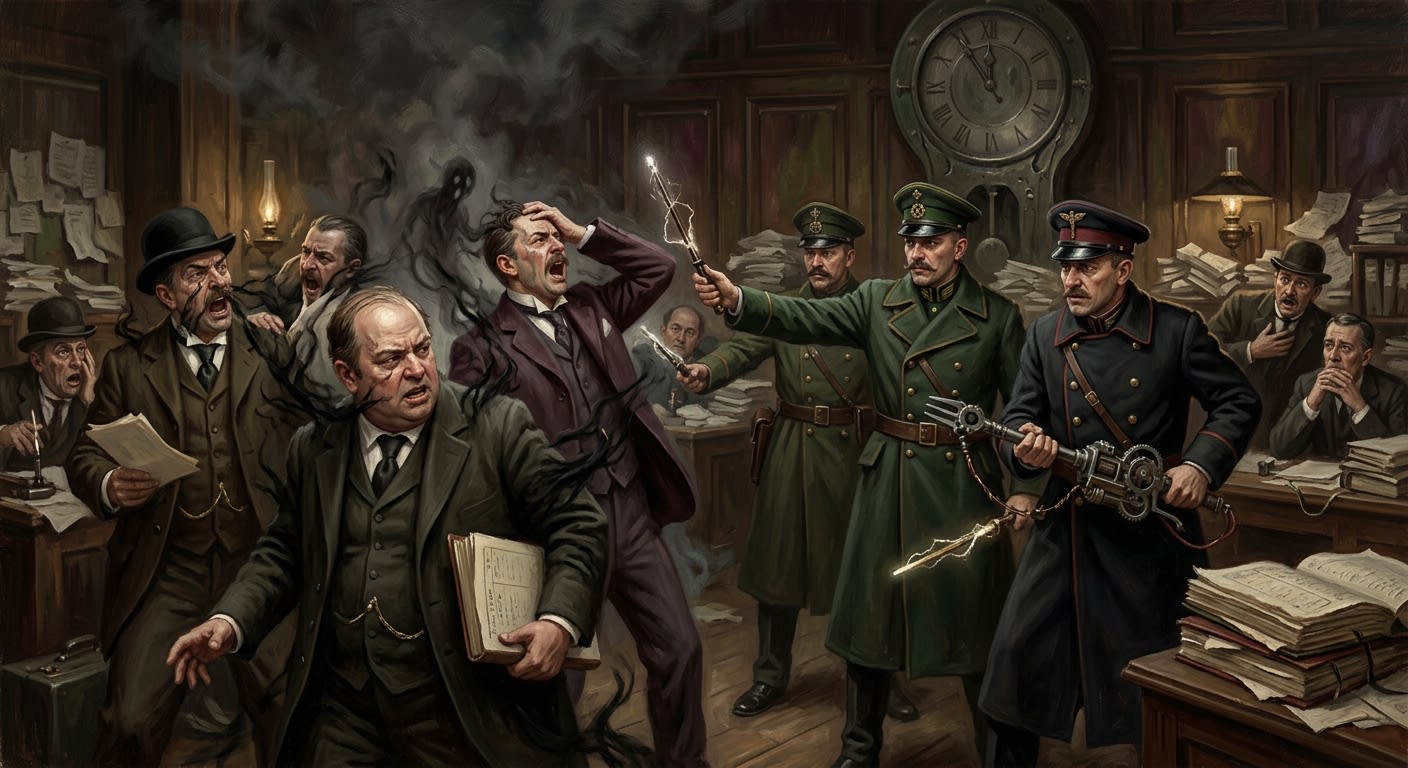
Two Carnelian cousins in good standing were erased by transposition. Their mothers shared a baptismal witness, their trade marks differed by one stroke, and one clerk in Cologne had written a Metz flourish as an approved Strasbourg tail. The third error was uglier: a Carnelian claimant was struck twice under different identity codes, producing a man who was absent in one schedule, absent again in another, and present by contradiction in the adjudication ledger that should have reconciled both absences.
This is called record contradiction. In ordinary speech it is called a ghost with paperwork.
NULLITY REVIEW FRAGMENT — CARNELIAN PACKET “Subject C-14 appears struck under Code Ash-7 and Code Black-3. Dependent widow listed as unmarried, widowed, and never born. Two ration clerks report continued collection by █████████████ after strike bell. One child at south gate answered to all three household names and none. Recommendation: cease oral inquiry.”
#On the Family After the Strike
The Bureau's public position is clean. The Carnelian fraud was discovered, corrected, sealed. The false households ceased. Bread returned to lawful mouths. Plague risk diminished. Order prevailed.
The private annex is less obedient.
For six weeks after the strike, ration claims bearing Carnelian countersigns appeared in depots that had never handled the family. Burial requests arrived for persons already administratively unborn. A gate clerk at Cologne refused passage to a woman because her husband had been struck; she replied that she had never married, then produced three marriage proofs with correct wax. In Metz, one warehouse account paid its rent from a property frozen eleven days earlier. The payment was accepted, because even terror hesitates before solvent tenants.
The surviving Carnelians, if survival is the proper word for people whose legal flesh had been flayed by clerks, moved into rumour. Some became ferry brokers. Some entered orphanage side-corridors under altered kinship tags. Some wore sackcloth in Cologne beside mutterings about Guillaume's line, though the Bureau discourages mixing treasonal superstitions with ration fraud. One branch is said to have sold anchor slipbooks to frightened Notaries for three generations.
#On the Erasure of the Erasers
Records could tolerate Carnelian fraud. Records could tolerate wrongful suffering, provided it remained sufficiently poor. Records could not tolerate contradiction in its own correction mechanism.
The three Notaries were erased.
Not disciplined. Not reassigned. Erased. Their signets were cracked, their training marks scraped, their oath-witness records struck, their names removed from the rolls they had used against the Carnelians. The official language says they were “absorbed into corrective absence.” I would have written “fed to the machine they oiled,” but the Bureau of Doctrine employs stylists precisely to prevent honesty from arriving underdressed.
Here lies the professional terror. The Office of Nullity does not fear pity. Pity can be stamped. It does not fear revenge. Revenge leaves bodies, and bodies can be classified. It fears a strike that returns through the ledgers and finds the hand that made it.
Older Nullity lectures state that no Notary has ever been erased for performing authorised duty.
Clarified. No Notary has ever been erased for performing authorised duty correctly. The distinction is narrow, black, and deep enough to bury a career upright.
#On the Guillaume Correction
The Carnelian affair should have remained the founding precedent. It came first. It wounded the profession. It proved that a family could be killed by ledger and that the ledger might bleed backward.
Then Guillaume of Aachen supplied the Bureau with a prettier case.
Guillaume's eleven-day deletion after the Atheist Wars had everything the Carnelian case lacked: aristocratic rot, strategic treason, public appetite, a ducal line four centuries deep, a traitor too famous to mishandle, and a result clean enough for instruction. The cult of Saint Vellum the Silent took Guillaume as its favourite demonstration. Records took Guillaume as the benchmark. The Carnelians became the footnote that frightened serious practitioners and bored public lecturers.
The modern Lineage Severer learns both cases. Guillaume teaches procedure as triumph: dependencies mapped, authority chained, silence maintained, absence propagated. Carnelian teaches procedure as bite: anchors slipping, cousins crossing, dead entries breeding, Notaries swallowed by their own correction. One is displayed in the hall. The other is kept in the drawer.
The drawer is where education lives.
#On the Present Prohibition
In A.S. 201, the Carnelian Family of Metz remains officially resolved. No public claimant exists. No recognised descendant petitions under that name. No Carnelian property rests in dispute, because disputed property requires a litigant and the family has been deprived of the courtesy. The surviving file is held under Records custody with Purity viewing rights and Nullity training restrictions.
Metz remembers differently. Metz always does. Old depot clerks touch the lower edge of a household roll before approving plague exemptions. Orphanage registrars use “Carnelian month” for a reconciliation period in which every tag appears correct and every senior clerk feels sick anyway. Ferry brokers call a wrong-name cling “red stone,” which is cleverer than they deserve. Among Notaries, the phrase “four-city family” is enough to end a joke.
A name is a covenant. No record, no right. Absence is purity. Contradictions breed demons.
The Carnelians proved the last line by becoming one.