
#On the Three Deaths Permitted by Law
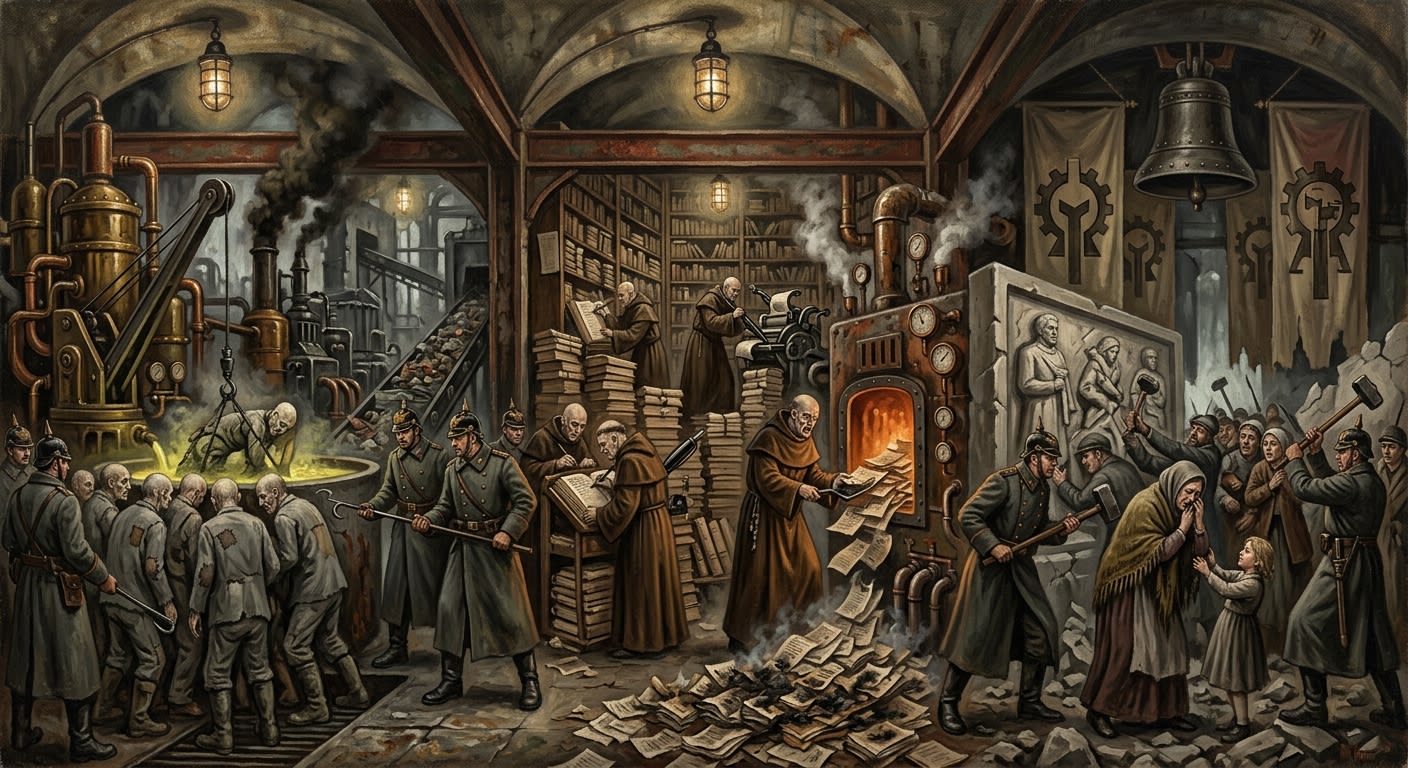
Trifold Erasure is the doctrine by which the Synod kills rebellion in body, name, and memory. It was formally used at the Schism of Avignon in A.S. 111, later codified in Administrative Dissolution practice, refined by the Office of Nullity, taught to Erasure Notaries under black-seal discipline, and admired by every competent servant of Order who has ever watched martyrdom sprout from a badly managed corpse.
A rebel may die once and become useful to his friends. A rebel may die twice and become troublesome to archivists. A rebel must die thrice before the street forgets where to kneel.
The doctrine's public formulation is clean enough for catechism: no name, no martyr; no grave, no pilgrimage; no sanctioned memory, no cult. Children recite it in stern schools where the benches are hard and the windows face walls, which is the proper climate for learning statecraft. The adult formulation is less tidy and more honest: kill the man, unmake the citizen, poison the recollection. The Synod did not invent forgetting. It licensed forgetting, assigned it desks, and made the Great Ledger of Souls its chapel.
Trifold Erasure does not belong to ordinary punishment. A hanging punishes. A burning instructs. A name-strike starves. Trifold Erasure removes the usable remains of dissent from every table where a future fool might set flowers.
#On Avignon and the Drowned Crown
Avignon supplied the doctrine because Avignon supplied the insult. In A.S. 111, a faction of Provençal clergy declared Strasbourg's supremacy defective, staged a river-crowned rival pontiff beneath the Rhône, and wrapped jurisdictional treason in silt, secrecy, and wet theology. The rival called himself — or was called by others — the Drowned Pontiff. The title survives as fishers' gossip, sealed depositions, and the sort of denial the Bureau of Records repeats until repetition begins to sweat.

The Synod answered with the correction history remembers as the Razing and public filings describe with greater delicacy, after Kratz placed policy where softer men kept conscience. Avignon's schismatic structures were pulled apart. Stones travelled north to Strasbourg. The clergy vanished into process, fire, and files whose seals have aged better than their contents. The city became former terrain. A rival pontiff cannot be crowned in a city whose civic status has been amended into absence.
The first death at Avignon was flesh. Schismatic clergy, guards, couriers, oath-men, river witnesses, and those unfortunate citizens who had mistaken proximity for innocence were killed, transported, or processed into categories whose names improve nothing. The second death came when their names were scraped from registers, parish rolls, witness books, gate lists, votive accounts, and family claims. The third came when the Synod declared the entire affair either settled, exaggerated, nonexistent, or seditious fiction depending on which office held the pen.
Three accounts. One result.
Early provincial instruction described Avignon as “suppression of a schismatic pontificate.”
Corrected. The phrase grants the pontificate too much posture. Avignon was a jurisdictional infection subjected to corporal, nominal, and memorial cure. The corpse, the line, and the recollection were treated in proper order.
Rosaries still rise from the Rhône, glass-caked and humming in nets. The Bureau calls this mineral behaviour. Fishers call it a warning. Doctrine calls it an opportunity for silence.
#On the First Death: Body
The first death is the least sophisticated and the most commonly overcelebrated by soldiers. Bodies are simple. They bleed, burn, rot, resist briefly, and then yield to gravity with the pious obedience of meat. Armies adore this stage because it allows drums. Purity adores it because a body under restraint has few procedural opinions. War adores it because War, when deprived of bodies, begins making metaphors and becomes intolerable.
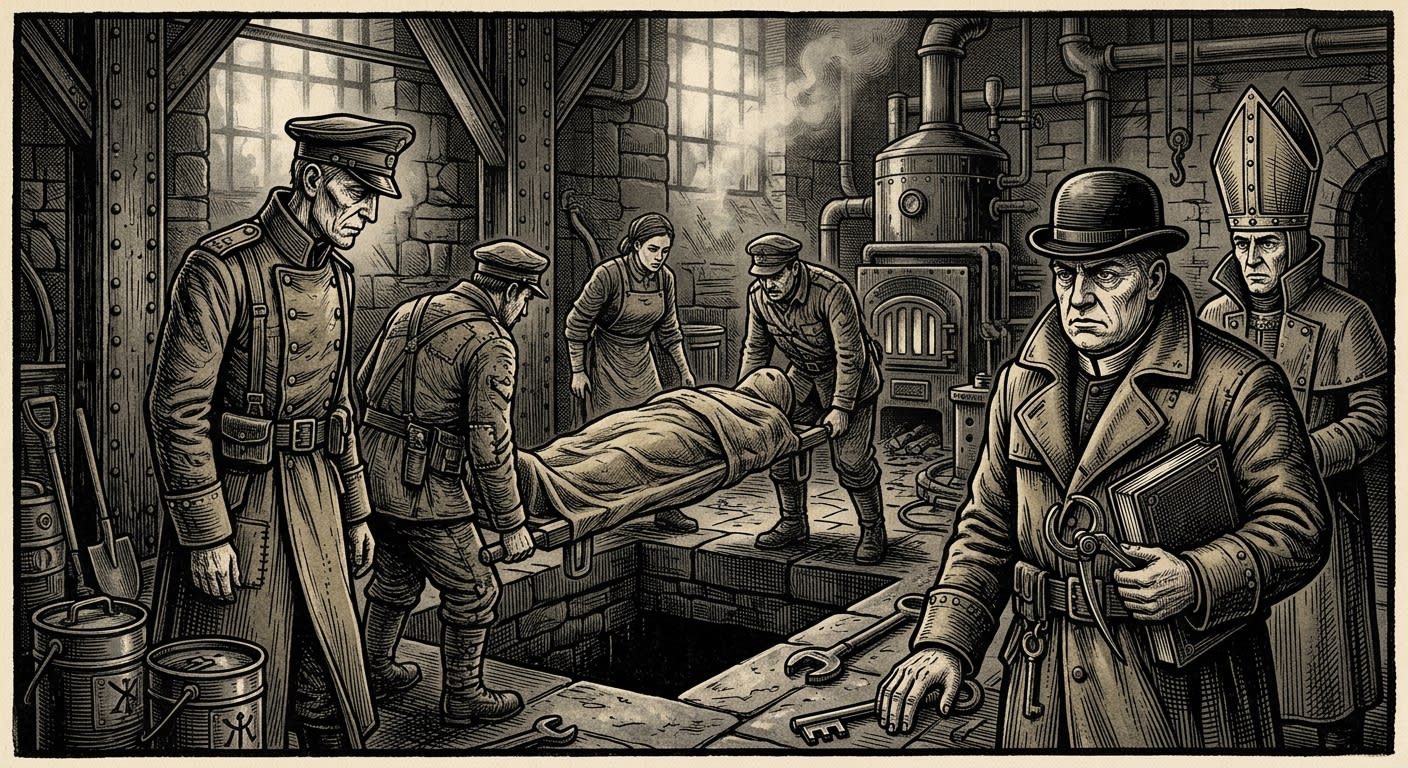
Trifold Erasure treats the body as necessary material, not the achievement. Death of flesh removes the actor from the immediate theatre. It does not remove his script, his audience, his costume, or the cheap little stage his admirers will build from memory, grief, and bad Latin. A corpse can become a relic by Tuesday if handled by amateurs.
The Synod's first rule after Avignon: prevent clean custody. No single body, single grave, single chain, single cell, single witness, or single last phrase should survive in a form suitable for devotion. Scatter. Burn. Classify. Transfer. Deny. Let grief find ash in one office, stone in another, silence in a third. Grief is strong when it holds an object. It is weaker when it holds receipts.
There are exceptions. The Synod may preserve a body when the body humiliates the error: a cage, a public brand, a corrected skeleton, a head displayed under the proper label. Such preservation falls outside Trifold Erasure. A displayed enemy is still a lesson with a face. The Trifold requires less theatre and colder hands.
The first death is a door pushed shut. The doctrine begins when the hinges are removed.
#On the Second Death: Name
The second death belongs to the Ledger. Here the Office of Nullity earns its black wax and its hateful little stipend. A name is struck from the rolls; dependent ledgers receive correction; ration, passage, property, marriage, oath, guild, testimony, infirmary, ossuary, and burial files learn the same absence at different speeds. The struck person may remain warm, loud, and inconveniently vertical. The systems that keep warmth alive cease to agree.
The second death has two forms: personal strike and propagated strike. A personal strike removes one offender. A propagated strike follows dependency: wife into misclassified household, child into orphan table, apprentice into invalid contract, cousin into suspicious lineage, creditor into void claim, oath-witness into polluted testimony. The Erasure of Veyss in A.S. 148 remains the cadet example for downstream consistency. One missing ancestral tithe-stamp matured after fifty-six years, and by dusk a lieutenant had no wife, no children of standing, no company, no pay, no grave, and no past sturdy enough to lean on.
The Trifold's second death differs from ordinary nullification by ambition. The common Black Seal strike asks: what records sustain this person? Trifold procedure asks: what records might sustain reverence for this person after his body has become unavailable? Songs, martyr lists, chapel donors, witness memories, fishing tales, old stone marks, petition forms, children's names, feast scraps, parish jokes, smuggled rosaries, sermons with gaps where the name should be — all become targets.
BLACK SEAL ANNEX — AVIGNON DERIVATIVE INDEX Class: Memorial dependency Item: river hymn containing syllabic trace of █████████ Action: hymn altered at third beat; cantor corrected; two copyists reassigned Note: “Melody retained shape after name excision.” Disposition: ████████████████
The second death is where pity most often betrays the state. A clerk leaves burial intact. A mother-name survives on a side card. A gate-list keeps an old abbreviation. A monk copies an initial out of habit. Such scraps seem small to the untrained, and the untrained are why we have ruins. Give grief one letter and it will make a banner.
#On the Third Death: Memory
The third death is the grand art, the black jewel, the part that separates Trifold Erasure from clerical vandalism. Memory cannot be struck like a ration line. It must be made unsafe, silly, disputed, ownerless, embarrassing, contradictory, unfashionable, expensive, or dull.
The Bureau uses several instruments. Denial, when denial has enough force behind it. Contradiction, when denial alone gives the shape too much honour. Reclassification, when witnesses cling to nouns. Ridicule, when reverence grows too polished. Taxation, when pilgrimage begins to smell profitable and must be redirected before sanctity becomes local. Silence, when speech would feed the thing. Noise, when silence would confess fear.
Avignon's third death was imperfect, which is why it remains our finest teacher. The names vanished. The stones moved. The pontiff drowned into denial. Yet chains hum beneath floors, rosaries rise, and old Provençal women still tell children not to pray too close to the river at dusk. Failure instructs if the Bureau has the elegance to steal from it.
A Bureau of Purity digest once stated that Trifold Erasure “guarantees permanent deletion of schismatic memory.”
Withdrawn. Guarantees are for merchants, engineers, and other persons insufficiently acquainted with peasants. Trifold Erasure reduces memory to contraband. Contraband may persist, but it must pay rent in fear.
The third death succeeds when the faithful do the Bureau's work without noticing. A father lowers his voice before saying Avignon. A schoolmaster calls the Drowned Pontiff a fisherman's invention and moves quickly to arithmetic. A priest omits a local name from All Souls because the omission costs less than courage. A child asks why the old song has a gap in it and is told to finish his bread.
That is victory. Not clean. Clean victories are for battle paintings and official summaries. Real victory leaves a stain nobody can prove was blood.
#On the Bureaus That Share the Knife
Trifold Erasure requires several hands because no single Bureau can be trusted with a doctrine this useful. Records controls the rolls, strikes, archives, revision tables, and patient little lies by which absence learns to stand upright. Doctrine supplies the theological grammar: why a name may imperil the faithful, why memory can be contraband, why mercy to the dead may become cruelty to the living polity. Purity supplies fear, interviews, witness softening, object seizure, and the men who arrive when a grandmother refuses to forget with sufficient patriotism.
Tithes enters wherever property follows the dead. Mercy enters wherever children, widows, invalids, or beds become administratively stranded. Relics enters if a bone, chain, bead, stone, scrap, garment, tooth, or suspicious spoon attracts kneeling. Bells enters if songs survive. War enters if anyone involved still has walls.
The doctrine's danger lies in appetite. Any office that can remove a rebel's name can imagine removing an auditor's. Any clerk trained to poison memory may look upon a rival memo and feel vocational warmth. Standing Order 22-N (Unregistered), revised in A.S. 199 after the A.S. 197 Metz filial anchor recurrence (Unregistered), restrains the ordinary strike. Trifold Erasure sits above ordinary restraint, invoked through sealed concurrence, emergency doctrine, or the kind of black packet that makes senior clerks discover a sudden need to inspect the floor.
The Office of Nullity teaches restraint with the Carnelian Family of Metz, the filial anchor recurrence of A.S. 197, and Veyss. Doctrine teaches terror with Avignon. Purity teaches nothing in writing that Purity cannot later deny. Between these pedagogies, the student learns the central axiom: absence must be propagated carefully or it returns with teeth.
#On Abuse, Failure, and the Little Saints of Forgetting
Every doctrine that touches memory risks breeding saints in the cracks. The Bureau has no patience for sentimental resistance tales in which a name survives because one brave hand writes it under a floorboard. Brave hands are numerous. Floorboards rot. The more serious problem is administrative: memory survives where systems disagree.
A man erased in Records but remembered in Tithes leaves a debt. A body denied by Doctrine but tagged by Mercy leaves a bed number. A song suppressed by Bells but quoted in a Purity warrant leaves rhythm. A river relic confiscated by Relics but photographed by Records leaves image. Contradiction is useful when authorised. Unlicensed contradiction is a rat in the archive.
Abuse is inevitable. A governor seeks a rival's disappearance. A bishop wants an old scandal unthreaded. A patron asks the Black Seal Annex to remove a marriage, then a child, then a witness, then the servant who noticed the sequence. Trifold Erasure was born for schism and has the manners of a plague knife: designed for infection, coveted for domestic quarrels.
This is why Doctrine insists upon scale. Trifold Erasure is not for embarrassment, debt, inheritance nuisance, jealous offices, tedious poets, local scandals, or the ordinary vermin of parish life. Use it too often and the people learn to feel the shape of missing things. Use it clumsily and absence becomes announcement. Use it against someone loved in too many kitchens and the kitchens become chapels.
#On Present Application
As of A.S. 201, Trifold Erasure remains a restricted doctrine, cited most often in training, invoked rarely in full, imitated constantly by lesser offices that should know better and do not because lesser offices are composed of men. Its shadow lies behind the Black Seal Annex, the Nullity strike, the correction of schismatic records, the handling of forbidden names, and every sealed argument about whether an enemy should be killed, erased, or permitted to rot publicly as an example with fewer administrative costs.
The faithful need not fear Trifold Erasure unless they intend to found a rival pontificate, preserve a condemned lineage, sing a prohibited name after warning, possess river rosaries with opinions, hide a struck file, or love a rebel loudly enough to give the Bureau work.
There are worse deaths than being killed. The Synod, with its usual generosity, has catalogued three and placed them in sequence.