
#On the Custody of Absence
"The citizen loses everything. The file loses nothing."
The Black Seal Annex lies beneath the Records house in Strasbourg, under the boots of the Bureau of Records. It is the one cellar in the capital where the Church keeps everything it has officially thrown away. It holds the central archive of the Erasure Notaries and trains them. The Office of Nullity does its work there under Standing Order 22-N (Unregistered). The Annex has no charter of its own, which suits it. A room cannot be struck from a register it was never entered in.
Strasbourg sits in Zone 2, deep in the safe western heartland, many leagues from any wall the enemy has tested in living memory. The Annex's strikes reach the frontier as shut gates and bare ration tables.
A struck citizen loses bread, passage, marriage, inheritance, testimony, guild and grave. The Annex loses nothing. The writ, the countersignatures, the anchor slips, the dependency schedule and the sealed absence file, which sets out why the absence was necessary, all go onto its shelves. The man is no longer recognised anywhere above ground. The reasons he is no longer recognised are kept dry, indexed, and under key.
#On the Vault and Its Work
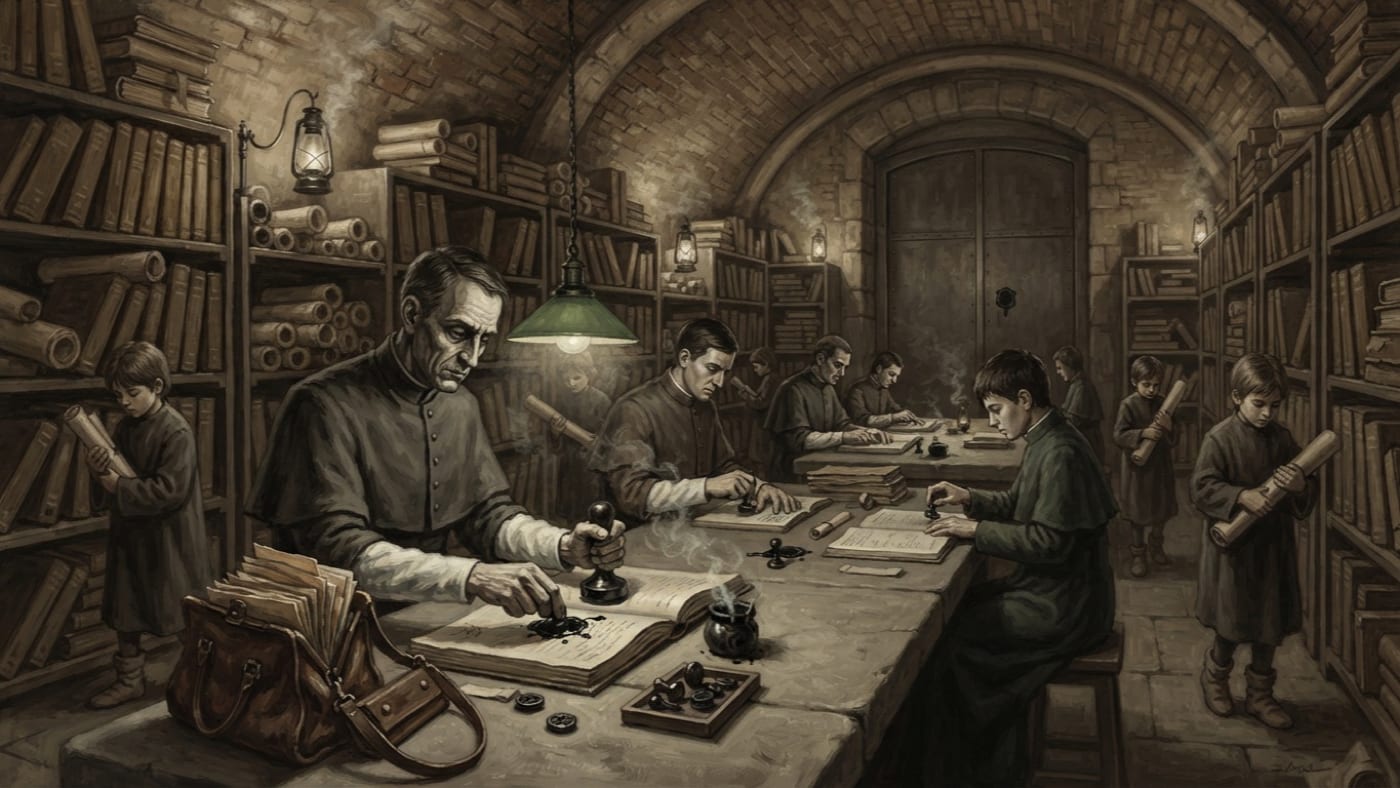
The vault is dry and windowless, built of arched stone, and the cold of that stone never leaves the clerks' sleeves. Ledger shelves fill the arches. Stone stamp tables stand under the lamps. Warmed wax trays sit beside each station so the black wax stays soft enough to take a signet and dark enough to look like a verdict. The iron door carries no inscription, only a small black seal pressed in at eye level, as though the building itself had been struck. Pilgrims are not admitted. Neither are parish boys, curious canons or Doctrine theologians with a taste for atmosphere. I was admitted once, and I am still filling out the paperwork.
The air smells of dry vellum, ink acid, lamp-smoke and hand-lye. The sounds are a page rasping over a page, a stamp tapped twice on stone, and keys. There are a great many keys.
Work comes down the stairs in packets. Registry Runners bring rolls through the side corridors. Most of them are children, and they have learned to walk without letting their shoes speak. Index Clerks build the dependency schedule: birth, marriage, ration, passage, property, oath, guild, ossuary, burial. Strike Scribes copy out the authority chain, recording who requested, who countersigned, and who will be blamed when the strike turns out to be inconvenient. Nullity Clerks check the identity anchors: mother-name, baptism mark, oath witnesses, the small household marks that tell one Johann from forty others. A Codex Auditor's flag arriving in a packet is an accusation, and the Annex treats it as one until the chain behind it is complete.
Only then does the Erasure Notary sit down at the stone table. The black wax goes on with signet, date and classification code. Since the A.S. 199 revision, forty-eight hours must pass between receipt of the writ and the sealing of dependent ledgers, so the Notary signs a packet that has had two days to cool. After execution the downstream notices go out by runner and courier to ration clerks, ossuary registrars, tithe offices and the Gatewarden-Notaries, who will turn the absence into a lowered bar at a checkpoint.
#On the Lessons Preserved
The Annex teaches from two cases, and it handles them the way a surgeon handles two skulls: one prized for its symmetry, the other kept for its fracture.
The first is Guillaume. His treachery at Aachen dates to A.S. 25 and is recorded under the Betrayal of Aachen. His lineage erasure is undated in every register I am permitted to read. The profession's own account gives it eleven days of work across a ducal genealogy four centuries deep, and Notaries still cite that figure as the benchmark for competent propagated absence. No Annex instructor has yet explained how a modern staff could match it. None has been asked twice.
The second is the Carnelian Family of Metz, A.S. 67. That strike crossed several cities, and the clerks who would later be grouped under the name of the Office had no shared anchor table. Cousins were struck by transposition. One claimant was voided twice under separate codes. Three Notaries were afterwards erased themselves to dispose of the contradictions they had produced. The Annex keeps the Carnelian contradictions intact: the conflicting entries, the doubled codes, the countersignatures that point at one another. A clean strike shows a student what was done. A ruined one shows where the knife slipped.
Earlier Codex entries described the Guillaume erasure as the first recorded lineage-wide nullification.
Corrected. The Carnelian strike of A.S. 67 has priority and is taught as the first recorded lineage-wide attempt. Guillaume's was the first competent one. The Annex prefers that its firsts be failures, because failures can be blamed on the dead.
Instruction now ends at Metz, A.S. 197. A Notary struck eleven names in one session, lifted the twelfth card, and found his own mother's ration entitlement under his hand. The forty-eight-hour interval of A.S. 199 came out of that afternoon. The classroom calls it a safeguard against procedural fatigue. Senior students also copy out the Trifold Erasure that followed the Schism of Avignon in A.S. 111, where body, name and memory were treated as three ledgers needing three seals. Nobody in the Annex calls that doctrine elegant out loud. Several have it framed.
#On Clean Hands and Closed Doors
Purists dominate the Annex and the central audit culture that feeds on it. Their creed is short enough to fit on a stamp: full chain, true anchors, simultaneous dependent seals, clean hands, closed vault, no favours. Every one of those demands exists because a clerk somewhere went without it and was found out. Auditors check the authority seals first, the anchors second and the dependent ledgers last. They are hunting for any surviving claim the strike missed, and in Strasbourg they hunt at the very table where the packet was sealed. A Pragmatist in a frontier gate-office can blame the road, the courier or the weather. A clerk in the Annex has only the shelf behind him, and the shelf remembers.
On the inner wall hangs Saint Vellum the Silent: pale face, closed mouth, washed hands, a black seal held where gentler saints show their palms. Tradition credits him with standardising the strike marks and training the first Notaries. Nobody has dated his life, and the Annex shows no wish to try. On his feast the clerks wash their hands, count every seal in the vault, and keep an hour of silence so complete that Registry Runners swear the lamps burn quieter.
The rest of the year the Annex runs on rules nobody wrote down. Dry your hands thoroughly after washing, because wet hands smear truth. Tap the stamp twice on stone before the first strike. Carry a strip of blank vellum in your sleeve so absence has somewhere to land. Never speak a struck name aloud. Never strike while the vault door stands open.
The Purists keep their reputation at a cost. Even in Strasbourg, a clerk will sometimes leave a burial reservation unsealed, or let a packet sit an extra day before a convoy leaves. Mercy here is rare and expensive. It is also traceable. Every concealed kindness in the Annex sits in a file beside the cruelty it softened, waiting for an auditor with a slow afternoon.
#On the Claims That Survive
A wrong anchor strikes the wrong life. That is the profession's great terror, and the Annex treats it as a corruption of the archive itself. The commoner failure is smaller and harder to kill: one dependent ledger left unsealed. A guild pension, a parish marriage line or an ossuary allotment goes on asserting that the man exists while every other register insists he does not. The profession calls this a ghost right. Clerks call its bearer double-dead, struck and still drawing.
One ghost right is enough to break a strike. An appeals advocate finds it and pulls. The marriage implies the widow. The widow implies the husband. The husband implies a writ, the writ implies a chain, and the chain ends in the Annex at a named clerk's table. Every correction exposes the whole authority chain to the office that ordered the correction. The profession's own account puts reinstatement at seven offices' countersignatures, and Black-Stamps joke grimly about birthdays. This is why the absence files are never destroyed. When a strike is challenged, the Annex has to be able to prove why the man was made absent, even as the street insists he was never there.
Nemea is the Annex's sacred counterpart and its sorest point of pride. Nemea's certified corrected copies go out to tribunals and bastion registries as holy absence: a debt struck there was never owed, and a name struck there never existed. The Annex can only prove its absences correct. Nemea's are believed. The Notaries of the Annex speak of the scriptorium with the reverence and resentment a provincial surgeon reserves for the capital anatomist.
#On the Present Custody
In A.S. 201 roughly nine hundred licensed Black-Stamps work across Zones 1 through 5 to standards set in this vault, and most of them will never stand inside it. The Annex runs on wax, vellum, lamp oil and the legs of children. Its clerks breathe paper dust until they cough like old bellows, get ink-acid burns at the cuticles, and finish each session with a lamp-smoke headache.
The deeper damage is professional. A veteran begins to treat names as the only real things and people as entries the Great Ledger of Souls has not yet corrected. In the Annex this condition earns promotion.
The reader may go now. The reader's file stays here.