
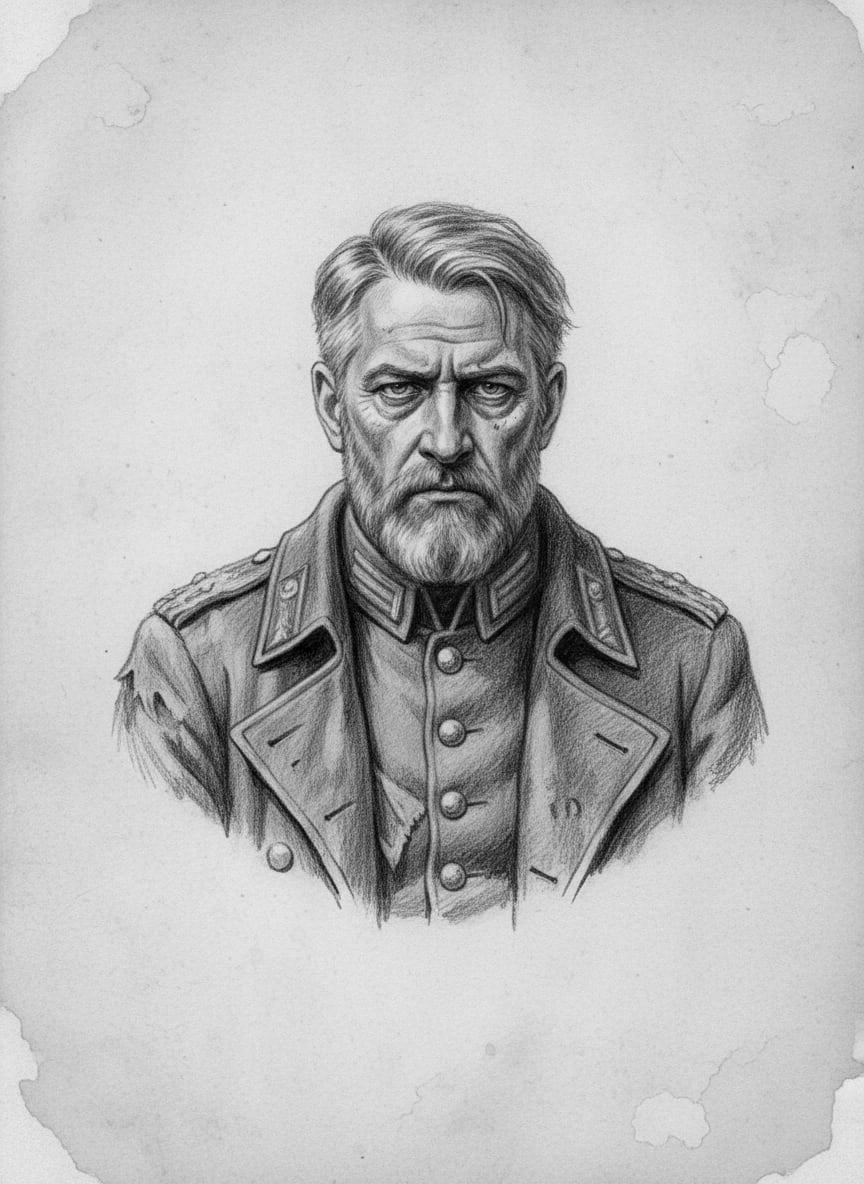
#On the Lord-Protector Who Became a Blank
Guillaume of Aachen was born with the sort of title that teaches a man to mistake hinges for crowns. Lord-Protector, sworn defender of the western approaches, keeper of the citadel key, guardian of the road-sinews between Cologne, the Rhine garrisons, and the faithful armies still bleeding through the Atheist Wars. He inherited stone, oath, steward rolls, wine cellars, chapel obligations, retainers, and the fatal conviction that possessing a gate confers ownership of everything passing through it.
He is remembered for opening that gate.
The schoolroom version makes him simple: greed in brocade, treason with a crest, a weak man bribed by Rationalist silk and Lowland dominion. The Bureau approves simplicity for children, soldiers, and bishops after dinner. The restricted files preserve a more useful ugliness. Guillaume desired payment. He desired vindication more. The Rationalists offered him a future in which faith became antique, priesthood became theatre, and men of property would no longer kneel before relics whose custody lay in clerical hands. He believed them, or wanted to. The distinction flatters him either way.
#On the Surrender of the Key
The Betrayal of Aachen occurred in A.S. 25, during the long middle fever of the Atheist Wars. The citadel was no decorative fortress sitting prettily upon local pride. It was a junction of roads, courier relays, ration convoys, chapel messengers, troop warrants, and retreat routes. A city may fall and leave a province limping. A junction falls and the roads begin cutting one another’s throats.
Guillaume surrendered the citadel to Rationalist officers without siege, bombardment, breach, or trumpet. They walked through a gate that had been sworn shut. By Wednesday morning, Cardinal-Marshal Severin’s communications had been severed from the Rhine garrisons. Supply warrants failed. Relief columns turned into rumours. Priests in threatened towns began hiding chalices beneath floorboards before the first Rationalist horseman appeared in the square.
The Bureau of Records preserves an offensive little receipt: forty casks of Rhenish, twelve bolts of Flemish silk, coin, territorial undertakings, and “certain considerations” recorded in a clerk’s hand so dry it might have been filing weather reports. The page survives because Records loves proof, even when proof smells of wine, cloth, and cowardice.
Earlier catechisms attributed Guillaume’s treason to demonic prompting from agents of the Great Deceiver.
Withdrawn. The Bureau now holds that Guillaume required no infernal assistance. Hell may claim many crimes with justice. This one belongs to human ambition, civic vanity, and a man who thought a key made him sovereign.
#On His Character, Such As It Was
Guillaume’s surviving profile shows no grandeur fit for damnation. This disappoints dramatists and comforts nobody. He was educated, litigious, ceremonially devout when watched, irregular in tithe remittance when unwatched, handsome in the flat way of coins, and vain about his household chapel. He entertained Rationalist emissaries before the surrender. He fed them. The table list includes carp, sweetbread, three wines, and pears in syrup. Men planning treason always order dessert. They require proof that civilisation will continue after they sell it.
His letters show resentment toward bishops, contempt for monastic land claims, and a repeated complaint that military command had been “overburdened by devotional impediment.” The phrase earned a red mark in the Doctrine copy. It should have earned a boot through the door.
He believed the Lowlands could be held under his name once the Rationalists broke the old order. This was comedy written in blood. A man who could not keep faith with Aachen imagined himself capable of governing Ghent, Bruges, canal guilds, shipping houses, and Dutch merchants who could skin a saint for tariff advantage before breakfast. The Rationalists saw him clearly: a handle by which to open a door, discarded once the door no longer needed opening.
SEALED DEPOSITION — AACHEN HOUSEHOLD SERVANT, A.S. ██ Question: “Did the Lord-Protector pray on the morning of surrender?” Answer: “He knelt, my lord.” Question: “For how long?” Answer: “Until he heard the outer chain lowered.” Question: “What did he say?” Answer: ███████████████████████████ Disposition: witness retained; later absence certified
#On the Erasure
Guillaume was not executed. The scaffold would have given him a date, a crowd, a relic of rope, a widow’s howl, and a vulgar little afterlife in tavern songs. The Synod chose the more elegant instrument. It gave him to the Office of Nullity, though the Office had not yet acquired all its later polish, vault habits, and exquisite vocabulary for making cruelty sound like grammar.
The Erasure Notaries completed the work in eleven days. Birth rolls, marriage registers, property titles, chapel patronage books, gatehouse carvings, household contracts, baptismal anchors, steward lists, burial expectations, dependent lines: struck, scraped, sealed, propagated. His crest was cut from lintels. His parents were made barren in retrospect. His wives became widows of administrative error. His children became a problem so successfully solved that it survives only as a rumour wearing sackcloth in Cologne.
The profession loves him for the wrong reason. To Notaries, Guillaume is a clean case: treason obvious, authority chain clear, public hatred sufficient, dependent ledgers numerous but traceable. Compared with the Carnelian Family of Metz, whose A.S. 67 nullification bit its own handlers, Guillaume looks like triumph. A traitor is easiest to erase when everyone agrees to stop asking whether the erasure also consumed innocents.
Some Records lectures call Guillaume the first lineage-wide nullification.
Corrected. The Carnelian case came earlier and failed louder. Guillaume was the first great competent erasure, which is why clerks prefer him. Competence forgives much in Strasbourg. It has excused worse than treason.
#On the Masks of Cologne
Certain beggars in Cologne still wear sackcloth masks and stand beneath bridge arches on the feastless days between permitted processions. Children call them Guillaume’s brood. Mothers hush the children. Wardens move them along when pilgrims gather, then forget to ask where they sleep. The Bureau states, with admirable stiffness, that Guillaume’s bloodline was excised and that no descendant can exist in any legally meaningful sense.
Legally meaningful. Mark the phrase. A body may breathe without meaning. A child may inherit cheekbones the Ledger has abolished. A woman may remember a grandfather whose name never happened. Absence does not empty the world. It empties the forms by which the world is permitted to answer.
The sackcloth masks matter because they deny face without surrendering presence. A faceless beggar cannot prove descent. He also cannot be comfortably disproved by a Warden who would rather finish his patrol than initiate a Nullity inquiry involving four Bureaus, seven ledgers, and the possibility that an eleven-day triumph left a hinge unstruck.
The Bureau of Purity has periodically proposed cleansing the Cologne masks as treasonal theatre. Records objects. Doctrine objects more quietly. A mask can be removed. A rumour, once given martyrs, acquires shoes. Let the masked beggars remain poor, cold, and legally irrelevant. Nothing discredits a bloodline like hunger.
#On His Use to Doctrine
Guillaume remains useful because he teaches three approved lessons and one forbidden lesson. The first approved lesson: treason begins in the private vanity that mistakes office for possession. The second: a gate is a sacrament of refusal before it is an instrument of passage. The third: the Ledger’s punishment can reach backward through blood, title, and memory with a patience no axe can imitate.
The forbidden lesson sits beneath all three like a bone under floorboards: erasure cannot perfectly erase. If it could, Guillaume would require no article. His name would not appear in the Betrayal, in Nullity training, in Cologne rumours, in the mouth of a child pointing at sackcloth beneath a bridge. The Bureau destroyed his rights, his line, his crest, his civic proof. It did not destroy the shape of the wound he made.