
#On the Festival That Became a File
The Carnival of Ink occurred at Bastion-Constantinople in A.S. 162, during a midsummer festival whose original purpose was morale, commerce, licensed joy, and the sale of fried things under conditions of suspicious holiness. By nightfall, four hundred names had been struck from the Great Ledger of Souls, four hundred gate permits had failed, four hundred ration claims had gone cold, and four hundred burial plots had been released back into ecclesiastical inventory.
The festival committee called it a disaster. The Bureau of Records called it an exceptional instance of administrative efficiency. The difference between these phrases is the difference between a mother holding a voided bread card and a clerk admiring his own column alignment.
The cause was simple enough to fit in a training placard and stupid enough to be human: twelve trench-court duels staged simultaneously in the southern market quarter. The Ledger-Duellists arrived with citations, witness sheets, oath scraps, counterclaims, family registers, tariff complaints, service records, and those little knives of phrasing by which civilians imitate law until law notices and eats them. Arguments crossed. Evidence tangled. A charge meant for one booth became a predicate in another. A witness in the third duel contradicted the fourth, which implicated the seventh, which gave standing to the eleventh, whose advocate cited a ration fraud already under dormant Nullity review.
By mid-afternoon, the market square had become a tribunal without walls.
#On the Twelve Duels
A trench-court duel is designed for compression. Two parties, one dispute, one advocate apiece, one citation chain, one attending clerk, one limited legal wound. In theory the form keeps garrison grievance from becoming riot. On the stones it gives vanity a chair, a bell, and an audience.
The twelve duels were approved as festival theatre. Soldiers off rotation had grievances against quartermasters. Quartermasters had grievances against wagon factors. Wagon factors had grievances against shrine vendors, shrine vendors against tariff clerks, tariff clerks against widows selling unlicensed saint-ribbons, widows against three men who had promised marriage before transfer and returned with plausible amnesia. The programme promised civic instruction. The crowd bought sweet oil cakes and leaned close.
The first error came when a citation advocate in Duel Four invoked a supply ledger already entered as supporting evidence in Duel Nine. The second came when Duel Nine's clerk protested, producing a duplicate receipt bearing a third stamp. The third came when a woman from the widow-ribbon case recognised the stamp as her dead husband's transit seal, which should have been impossible because her husband's permit had been voided during a winter convoy correction, which drew in the Erasure Notary on festival duty, who had been promised a ceremonial afternoon and instead received the smell of opening Hell in legal calfskin.
The duels ceased being separate at third bell. By fourth bell, every advocate was citing every other advocate. By fifth, the watching soldiers were shouting family names into the record to prove kinship, service, loss, entitlement, innocence, revenge, or dinner. One idiot attempted to strengthen his claim by naming six cousins absent from the ration rolls. The clerk wrote them down. This is why fools should be muzzled near ink.
#On the Notaries at Work
There were three Notaries of Nullity posted inside the bastion that day, none senior enough to halt proceedings without counter-signature from a market magistrate, all senior enough to process strike writs once valid authority reached the table. Authority reached the table in stacks. Codex flags, ration fraud dependencies, contradictory oath-witness records, forged widow status, duplicate service deaths, false convoy household claims, and one marriage chain so diseased with prior corrections that the Bureau of Purity later classified it as morally infectious.
The Notaries did what Notaries are trained to do. They verified anchors. They marked dependencies. They struck.
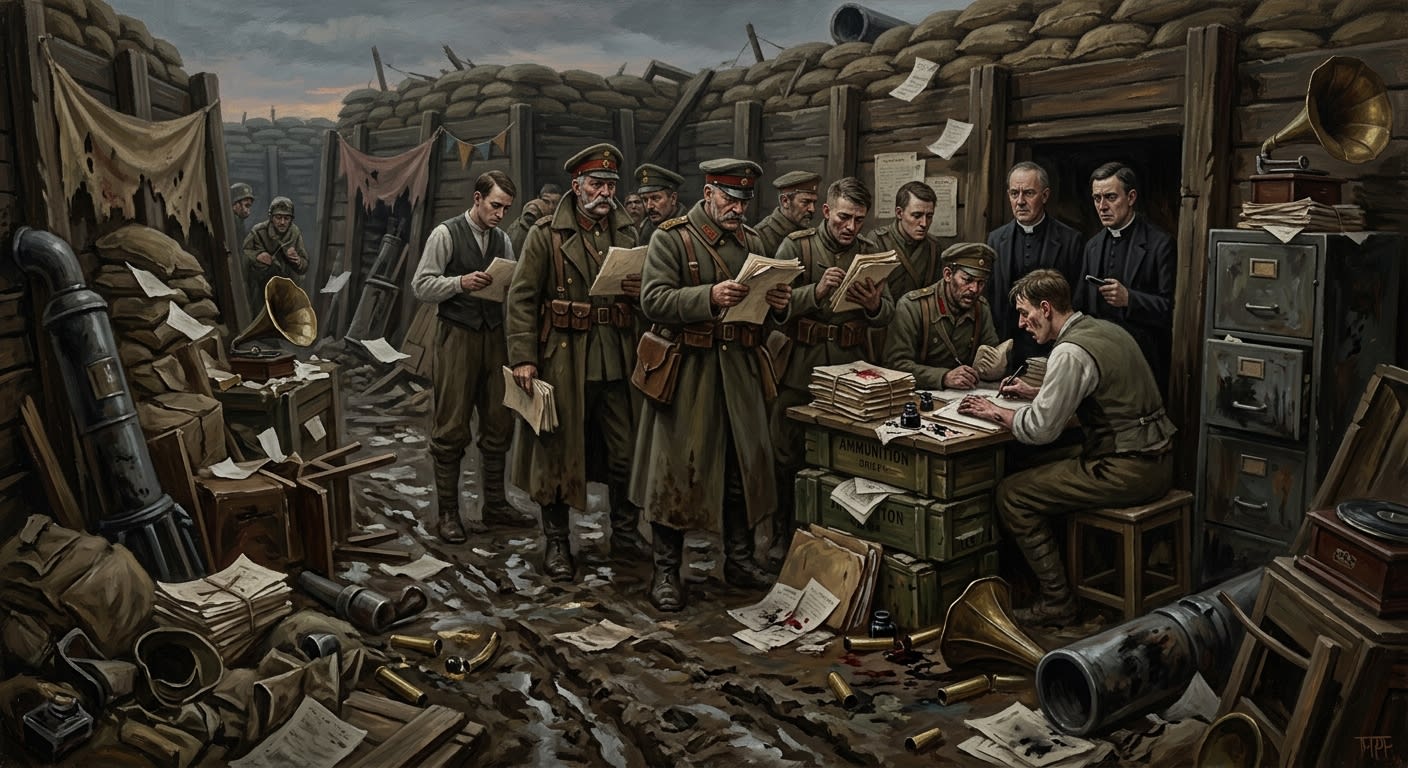
Black wax fell over names while festival bells rang. Registry runners carried packets between booths and the temporary Records table set up beside the fried-fish awning. The awning caught fire at some point after sixth bell; the fire report is filed in a different office, because even catastrophe respects departmental boundaries. By dusk the dependent notices had begun to propagate: gate, ration, berth, pay, chapel, ossuary, burial. A man arguing over three missing salt chits found his company bunk reallocated before Compline. A widow defending ribbon sales lost her widow status, her ration entitlement, and the right to bury the husband whose seal had betrayed her. A quartermaster whose books were mostly honest watched one bad receipt pull his mother's household into absence.
MARKET TABLE FRAGMENT — A.S. 162 Strike sequence 233–241 processed under emergency dependency compression. Subject 236 objected that Subject 238 was his own living daughter. Clerk response: “Then she should not appear under three fathers.” Audio witness: █████████████████ Wax spill over lower register accepted as valid seal contact.
Saint Vellum the Silent received more prayers that evening than on his feast day. This did not save anyone. Occupational patrons improve posture, not outcomes.
#On the Market Afterward
The market square was cleared by Covenant cordon after nightfall. Four hundred names had been erased. That number became official because Records counted four hundred completed strikes. Other numbers exist: persons displaced, dependents voided, marriages collapsed, children orphaned by administrative sequence, dead denied burial through downstream allocation, households unable to draw bread the next morning. The Bureau did not count these under the event total. Totals become unruly when permitted to include consequences.
Earlier festival notices described the Carnival of Ink as “a disturbance involving several disputed citations.”
Corrected. The word disturbance is hereby reserved for spilled wine, poor seating, and hymnbooks dropped during procession. Four hundred erasures constitute an event, no matter how elegantly the paperwork behaves.
The stains took longer than the reconsecration. The southern quarter's flagstones were scrubbed with ash water, vinegar, and brine. The Bureau of Rites recited the Market Restoration Canticle. The Bureau of Records removed the temporary tables and retained the benches as evidence of successful field processing. Fish returned to the stalls within a week. Children returned sooner, because children are poorly supervised and drawn to sites of recent adult stupidity.
Families searched the posted correction lists for three days. The lists changed hourly as downstream ledgers answered the strikes. A name might appear at dawn as void, at Prime as dependent-void, at Terce as never entered, at Sext as under review, and by Vespers as absent with no appeal path. The appeal queue became so long that the market magistrate ordered a shade cloth hung over it. This is the only mercy recorded in the public file.
#On the Review That Punished No One
The Bureau of Records reviewed the paperwork the following morning. This sentence should make any literate soul reach for a wall.
The review found no procedural fault. Every strike had an initiating defect. Every defect had a citation chain. Every citation chain had entered the duelling record under witness. Every witness had been audible to at least two clerks. Every clerk had marked time, booth, seal, and dependency. The emergency compression of strike sequence 233 through 241 was described as unusual, regrettable, and valid. The market magistrate's festival permit was endorsed retroactively because an unendorsed permit would have implicated the authorising office, and Records does not draw knives toward its own throat without being paid.
No Notary was disciplined. No advocate was barred. No clerk was censured. The festival committee was dissolved for morale misclassification, which is a splendid phrase meaning the wrong kind of citizens enjoyed themselves in the wrong proximity to enforceable paper.
The Office of Nullity adopted the Carnival as a worst-case instructional file. Young Notaries study it to learn that volume does not excuse error. Older Notaries study it to learn that correct work can still ruin a quarter of a city before supper. Ledger-Duellists study it behind locked doors and lie about doing so, because no profession can resist a catastrophe that proves its importance.
Legacy official documentation places the Carnival under the old southern-anchor name in A.S. 192.
Corrected under the A.S. 201 bastion-name recension and timeline review. The event occurred at Bastion-Constantinople in A.S. 162. The old name is deprecated, and A.S. 192 is a late copyist's courtesy extended by bad copying to worse memory.
#On Its Present Use
In A.S. 201 the Carnival of Ink remains sealed for public grief and open for professional instruction, which is the Synod's usual compromise between compassion and appetite. Records calls it a proof that field nullification works under pressure. Purity calls it proof that public disputation breeds contamination. Doctrine calls it a warning against vanity before law. Tithes calls it an invoicing challenge. The surviving families call it other things, none suitable for chapel recitation.
The market square still hosts festivals. The duelling platforms are gone. A small black line has been set into the flagstones where the temporary Records table stood. Guides claim it marks the boundary between lawful dispute and civic disorder. This is false in the useful manner. The real boundary is wherever the clerk sits.
Four hundred names vanished in one night because twelve arguments touched the same ink. The square sells cakes again.