
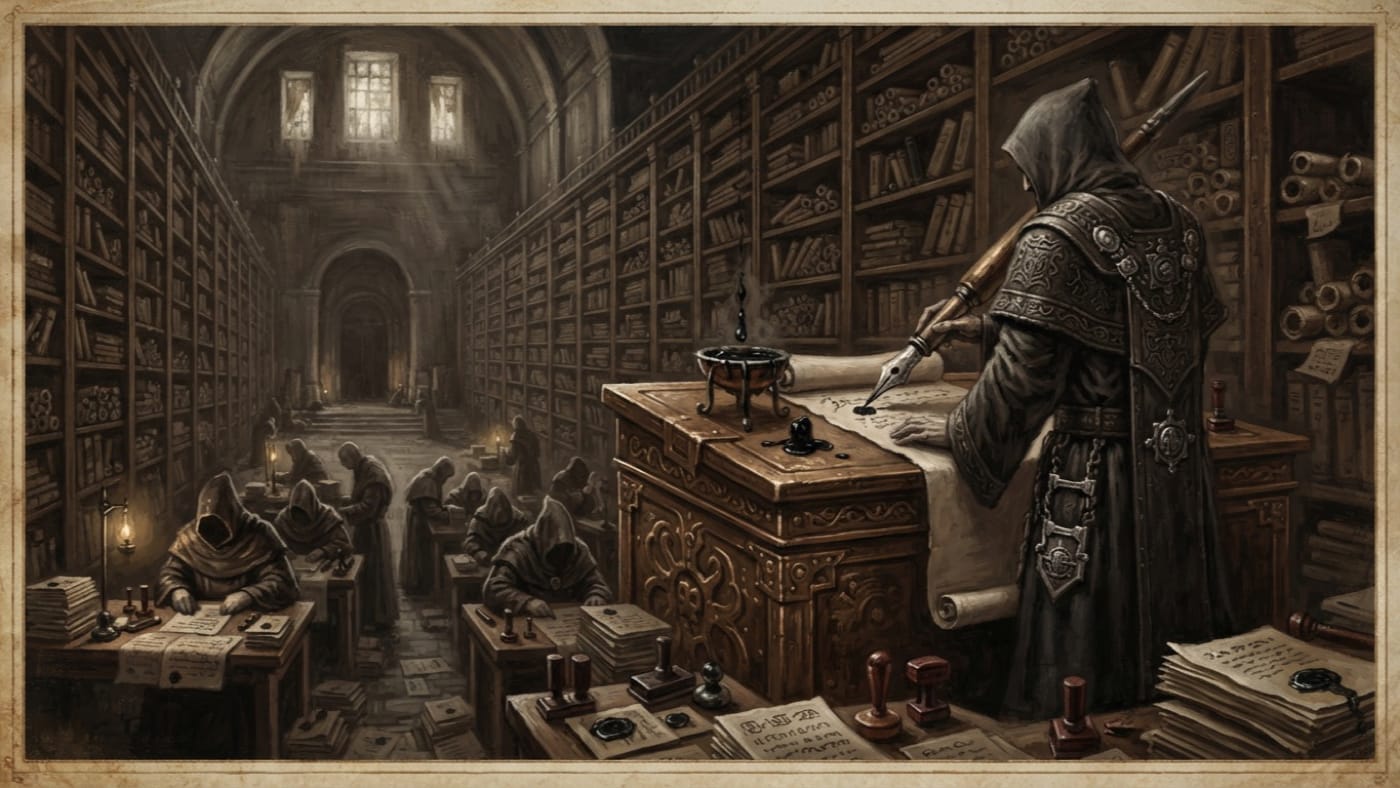
#On the Station
"Wax remembers. So does the hand that signed for the wax."
The Black Seal Prelate is the title at the summit of the Erasure Notaries and of every rank that feeds them. Registry Runner, Index Clerk, Strike Scribe, Nullity Clerk, Notary, and then the specialists: Lineage Severers, Gate-Nullity Liaisons, Ossuary-Nullity Adjudicators. That is the ladder of the Office of Nullity within the Bureau of Records, and the Prelate is the wall it leans against. The Notary performs the strike. The Prelate holds standing over the profession that performs it. Only people who have never been audited confuse the two.
The profession's own instruction traces what it calls Black Seal authority to the record wars it remembers as the Schism of Names. It gives no year, and I give none either. Whether the title was born with that authority or fastened to it later, the instruction does not say.
The trade's internal tables place the Prelate among its political figures and patrons, in the same line as the Tribunal Canon and the Synod Archivist-Magister. Putting three titles in one line does not make them one office, and I decline to merge them. They are three seats a Notary has reason to fear. The tables do not say whether the same person has ever occupied two of them, and this entry does not either.
Public appearances are rare enough to have become doctrine among the children who carry the rolls. Some Registry Runners hold that the station itself has been struck, and that the vaults keep working the way a struck man keeps queuing for bread until a clerk turns him away.
#On the Authority Chain
Follow a single packet. It arrives sealed. Inside is a tribunal writ, a Codex Auditor's flag, an Inquisitorial directive, or a nullification raised by Records itself under Standing Order 22-N (Unregistered). The Notary breaks the wax and reads the authority chain before reading the name. It records who requested, who countersigned, and who may be blamed. The third entry is the reason the first two are recorded.
Next come the anchors: mother's name, baptism mark, oath-witness record. Those three facts are all that separate a condemned man from the cobbler two streets away who shares his baptismal name. Then the dependents. The Notary locates the birth roll, marriage register, ration claim, property deed, guild entry, passage permit, ossuary allocation and burial right, and seals each with black wax, personal signet, date and classification code. Since A.S. 199, forty-eight hours must pass between receipt of the writ and execution of the dependent seals. Once the seals are set, runners and couriers carry the notices outward. Within hours the Gatewarden-Notaries have lowered the bar, and the ossuary registrars have given the plot to somebody who still exists.
The Prelate's hand appears nowhere in that sequence. The Standing Order does not require it, and I will not write a statute to flatter the summit. The Prelate is present in the packet the way the Tribunal is present in a confession: unseen, unmentioned, and decisive. Every name on an authority chain was written by a clerk who knew that someone above him could read it.
The profession's tables put it bluntly. Asked who can ruin a Notary with one signature, they answer: the Black Seal Prelate, a Tribunal Canon, the Chief Auditor, and any Judge willing to call the work "contradictory evidence." The Prelate heads the list. The strike belongs to the Notary. Its consequences belong to whoever outranks him.
#On the Substance of Absence
The Church teaches that a person exists, for every purpose that matters, in the Great Ledger of Souls and the rolls that depend from it. Flesh is evidence of a person. It does not constitute one. Strike the entry and the flesh goes on breathing, coughing and petitioning, but it can no longer eat at a licensed table, cross a gate, hold a deed, inherit, testify, marry, see a hospice physician, or lie in consecrated ground. A strike revokes the man's legal existence and leaves his body where it stood.
The profession recites the justification in four lines: a name is a covenant; false names invite false spirits; contradictions breed demons; absence is purity. On this account, a roll that contradicts itself is an unmanned breach in the city's defences, and the Great Deceiver is patient with breaches. The Bureau holds this as doctrine and teaches it as fact. That the Bureau believes it is documented. What the demons believe has not been filed.
The Schism of Avignon in A.S. 111 gave the Church the Trifold Erasure: death of the body, death of the name, death of the memory. A Notary's seal carries out the second death only. Hunger is left to take the body in its own time, and the memory is left with the neighbours, who are poor archivists. A student who believes black wax kills has mistaken the clerk for the hangman. The hangman draws a different salary.
#On Clean Hands and Patronage
Purists predominate in the Black Seal Annex beneath the Records house in Strasbourg, and in the central audit culture that grows from it. Their requirements fit on a stamp: a complete authority chain, true anchors, all dependents sealed at once, and clean-hand practice. No off-book work, no delayed filings, no favours. Pragmatists predominate everywhere else, and they accommodate. They practise delay wax: the order is stamped, then misfiled until the convoy has left. They swap an anchor so the strike falls on a decoy. They perform the half-strike, which voids bread and passage and leaves burial intact. The profession practises that half-strike as a quiet mercy, and always in secret. No register I have read records a dispensation for it from any desk, the highest included.
Patronage is why the summit matters. The profession allows itself exactly one mistake it cannot survive: striking a protected lineage or an asset of the Synod. No packet carries a list of the protected. A Notary learns the list from the weight of the countersignatures and from how quickly certain packets are withdrawn. A patron shields a clerk from audit, and a rival patron sends the auditors. When pressure rises, the tables name the sacrifices without embarrassment: an index clerk blamed for misfiling, a strike scribe accused of forgery, a family struck "for safety" to cover a patron's scandal.
The Prelate's own faction is unrecorded. Purists are certain the summit is theirs, because rank rewards clean hands. Pragmatists are equally certain, because rank is the reward for knowing when to dirty them. Both factions rest their case on the same evidence, which is silence.
#On Error and Correction
The wrong anchor is the profession's cardinal terror. A mother's name transposed or a baptism mark misread sends the seal down on an innocent household. Its rations are voided, its deed frozen, its children made unbaptised paper. The notices go out faster than any appeal can follow them. A missed dependent produces the opposite fault. One ration claim left unsealed and the struck man goes on drawing bread under a dead entry. The trade calls that claim a ghost right and the man double-dead. Auditors hunt ghost rights by comparing gate logs against ration rolls, and they enjoy the work.
Reinstatement requires countersignatures from seven offices. The parent entry does not name all seven, and neither shall I. Every reinstatement opens an audit trail that names each hand that touched the original writ, and here the politics of the station show plainly. Correction runs back up the authority chain until it reaches someone with the rank to stop it. Notaries joke about reinstatements and call them birthdays. Nobody upstairs sends a gift.
The warnings are old. The Codex places the Carnelian strike at Metz in A.S. 67, in the plague-permit years, a decade before Records took its present form. The strike went so badly that three of the clerks responsible were afterwards struck themselves, to dispose of the contradictions they had produced. The most recent warning also comes from Metz. In A.S. 197 a Notary sealed eleven names in one session and found his own mother's ration card twelfth in the stack. The revision of A.S. 199 imposed the forty-eight hours. The Standing Order lists no exemption to that interval. I have looked, on behalf of persons who would have paid well for one.
The Codex entry on the Erasure Notary presented Guillaume's lineage erasure as the immediate answer to the opening of the gates at Aachen, as though the betrayal and the strike shared a year.
Corrected. The Betrayal of Aachen belongs to A.S. 25. The erasure of Guillaume's lineage remains undated in every register available to this office, and no year is to be derived from the betrayal.
#On the Present Application
The survey of A.S. 201 counts some nine hundred active Notaries across Zones 1 through 5. That is the strength of a dispersed profession, and the Annex in Strasbourg does not hold them all in one room. The Annex is dry and windowless, and it keeps the central archive and trains the novices. The Hollow-Script Scriptorium of Nemea certifies corrected copies and sends out absence with full administrative authority, under its own Chapterhouse and Margin Court. Strasbourg reveres it, depends on its certified copies and resents both facts. Nemea is not the Prelate's branch office, whatever the Annex says after its second glass.
Saint Vellum the Silent keeps the profession's feast, and the profession keeps his silence. The summit keeps its own silence. Runners keep the rumour.