
#On the House and Its Office
"Impaired hearing is not impaired obedience." — Bureau of Orison and Song, response to the Bureau of Mercy
The Orison Provost House stands in Essen-of-Hymnsteel and belongs to the Bureau of Orison and Song. That is the one Bureau in the Synod that treats a flat note as a crime scene. The Bureau keeps its seat, its Cloister and its Master Hymnal Plates at Strasbourg. Essen gets the House. It enforces, it interrogates, and it is where the city's regulated singing ends up once the regulation has failed and someone has to be found who failed it.
Everyone who describes the House mentions the same two smells, incense and cold steel. I think the pairing is honest. The incense tells you the matter is liturgical. The steel tells you the liturgy has been handed to someone else.
The provosts who work there wear the veils of Orison's local livery, and the veils do what veils are for. No founding year for the House has reached my desk. Neither has an architect, a floor plan, or the name of whoever presently holds its keys. The building survives in the records the way most Synodal buildings do: through what was done inside it, filed by the people who did it.
#On Cadence as Evidence
Essen is run under the Tri-Bureau Compact of A.S. 110. Engines and Furnaces controls production. The Bureau of Records controls certification, and with it identity. Orison and Song controls cadence, meaning which stanzas may be sung over which pour. Master-Calibrator Sister Rauth decides which stanzas are approved. Steel at Essen is calibrated by voice, and the law treats that calibration as a sacrament. A hymn sung wrongly is a sacrament profaned. It may also be a defective bell-cannon throat on its way to the Sagittal Line.
The city's courts are staffed accordingly: tribunal clerks, Orison provosts, furnace guards and inquisitorial auditors. Confession receipts are filed next to production metrics. "Moral variance" counts as a safety risk, and a worker's sins can cost them their station. In Essen a soul and a quota sit in the same ledger, sometimes on the same line.
Into this arithmetic comes the Mirror Choir, with its altered syllables, quarter-tones, unlicensed breath marks and variant sheets slipped into sanctioned calibration. These deviations rarely show at the pour. The metal is certified, signed, shipped and paid for. Weeks later it fails somewhere far from Essen, with a gun crew standing beside it. Then the question travels back up the rail to the city that cast the part, and from the city to the singers, and from the singers to the House.
Some of those failures are sabotage. Some are bad steel, tired furnaces, or a foreman who forged an attendance ledger to save his overtime. The House exists to turn all of them into the first kind.
#On the Deafening Chamber
Two practices share a word in Essen, and the clerks confuse them more often than they should.
A deafening sentence is a punishment of labour. The condemned are put to work in unshielded resonant halls until the noise takes their hearing. It is passed down, served and recorded as a sentence. The Choir Quarters fear it, and the Hushwrights sell baffles against it to anyone who can pay.
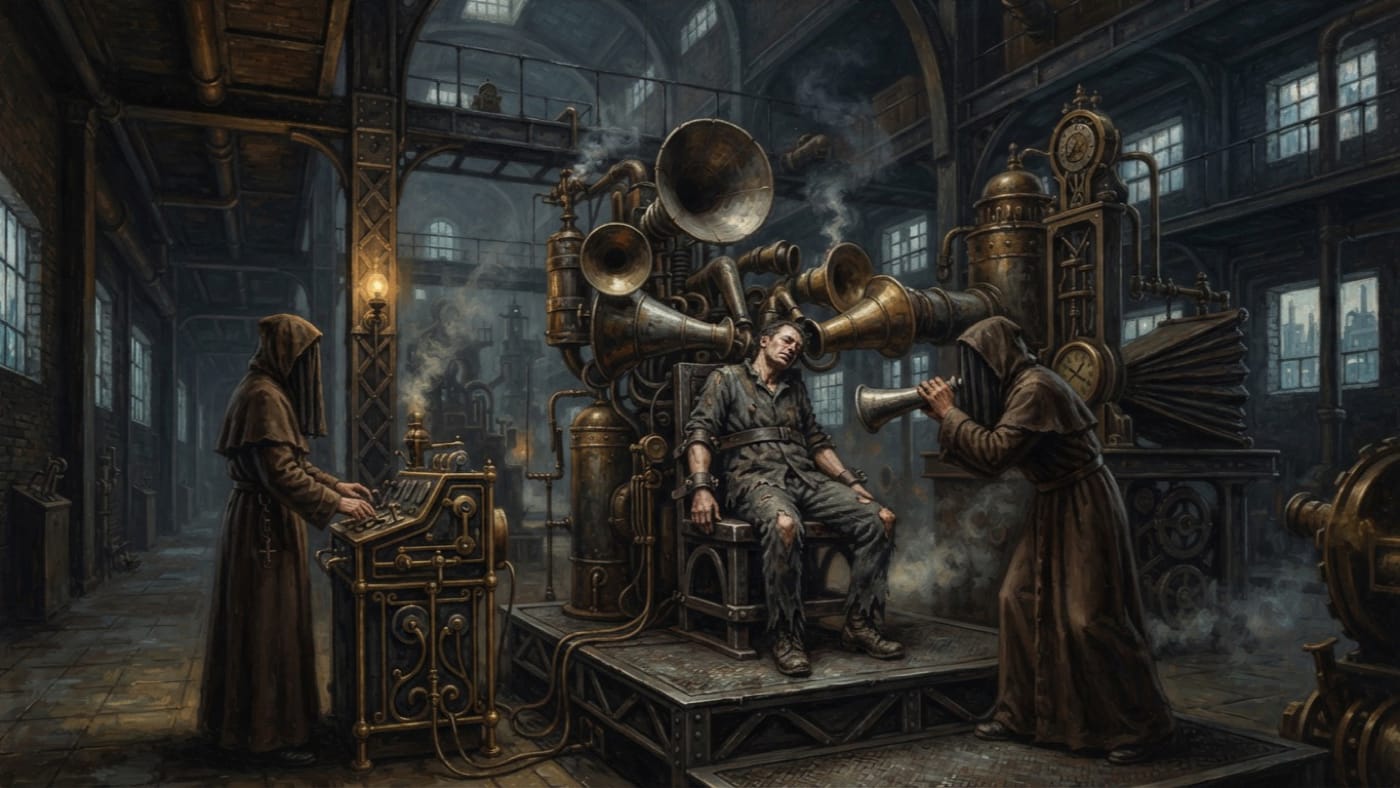
The deafening chamber belongs to the House alone. It is an interrogation room built to amplify the interrogator's voice until the subject's eardrums rupture. The records give no apparatus, frequency or architecture for it, and I will not invent any. The design needs nothing exotic. A question is asked. It is then asked louder, in a room built to make it louder still.
In my own entry on the Bureau I wrote that in this room "confession becomes the only frequency the body can produce." I was pleased with the line, and it is rhetoric. The documented effect is less elegant: ruptured eardrums, and a prisoner who can no longer hear the question but is still expected to answer it.
The Bureau has since corrected the vocabulary, though not the room.
STAMPED ERRATUM — BUREAU OF ORISON AND SONG, OFFICE OF PROVOSTIAL DISCIPLINE Corrected pursuant to Disciplinary Review Board, A.S. 201: The phrase "deafening chamber" in prior documentation is reclassified as "Acoustic Confession Facility, Standard." The Bureau of Mercy's assessment (Reference 88-K, A.S. 200) that subjects emerge "permanently impaired" is noted. The Bureau of Orison and Song's response: "Impaired hearing is not impaired obedience. The distinction is theological."
The two documents should be read together. The Bureau of Mercy found permanent impairment in A.S. 200. The Office of Provostial Discipline answered the next year by renaming the room. Neither document mentions a renovation, a new instrument, a reduced volume, or an end to the practice. The word "Standard" in the new title deserves particular admiration. A standard is something you repeat.
#On the Answers Preserved
Records were purged, and one House interrogation survived the purge in fragments. The Bureau of Doctrine has already released it in its account of the Mirror Choir. I reproduce it here without amendment, because amending it is exactly what the House would do.
PURGED INTERROGATION EXCERPT — ORISON PROVOST HOUSE, ESSEN Question: Who taught you the changed syllable? Answer: ███████████ Question repeated. Answer: The metal did. Question repeated under acoustic pressure. Answer: █████████████████████████ sang first. Examiner's note: subject's teeth fractured in an even scale. No further usable confession.
The prisoner has no name. The examiner has no name. The session has no date, and I will not borrow one from a neighbouring file because it happens to sit close by. The blacked-out answers stay blacked out. Whatever "sang first" referred to was a person, a plate, a place or a lie, and the redaction does not say which.
What the fragment does show is the method. The same question is asked three times, and the third time with more force. The answer gets stranger as the volume rises, and then there are no more answers. "The metal did" proves nothing about the foundations of Essen. It is something a frightened singer said under pressure, and it is perhaps the only thing in the transcript that sounds like Essen talking about itself.
This is one subject's injury in one surviving record. It does not prove that every prisoner leaves the chamber with broken teeth. It proves that this one did, and that the examiner wrote the fact down with the care of a man filling in a column.
#On the Hunt and Its Limits
The Bureau of Purity has hunted the Mirror Choir since A.S. 187. Purity raids the Throat Dorms. Orison audits the hymnals. Records checks copyists' hands against certified samples. These are three Bureaus with three warrants and one quarry. The House is where Orison's share of that quarry is questioned. It is not Purity's headquarters, and Purity would be insulted to hear it described that way. Purity's insults are administrative and very slow.
The House cannot settle what the hunt has failed to settle. The Alto With No Name has been pursued for seven years and is still a contradiction. The witnesses describe a woman, a man, a child, a ruined singer, a former Cantor-Scribe, and a deaf worker who conducts by touch. Purity files every inconsistency as a disguise. If the Alto is an office and not a person, no interrogation room will find a throat to fit it.
The Blooms are the other hard limit. Three Resonance Bloom events in A.S. 199–201 have been attributed to the Choir, and the Bureau's own memoranda call that attribution "convenient rather than confirmed." Bloom activity predates the Choir's earliest documented operations by about forty years. A prisoner in the chamber can be made to confess to a Bloom. The House cannot make chronology agree.
The Choir also no longer recruits only from the Ash Warrens. Its documented membership includes licensed hands. So the next subject in the chair may hold a better seal than the provost asking the questions.
The House can extract words. Whether those words are true is a separate question, and the House has never been chartered to answer it.
#On the Present Condition
In A.S. 201 the Orison Provost House is open. Its chamber has a new name, its provosts still wear their veils, and incense and cold steel still mark its door. The Mirror Choir is still active. The Alto is still unfound. The Blooms are still disputed, and the furnaces still need their stanzas. The Synod still regards any wrong note in Essen as a possible attack on the Line, and as long as it does, the House will have prisoners.
Drax's position is narrow. The House is a working instrument of the Bureau. Its confessions are evidence that confessions were obtained. Its injuries are attested by Mercy and renamed by Orison. On whatever the metal said, and whoever sang first, the House has nothing usable to report.