
#On the Founding of the Forge
"The anvil does not choose its hammer. The hammer does not choose its song. Both serve the arm that swings, and the arm serves the Synod, and the Synod serves the Creator, and the Creator — one presumes — serves Himself, which is the only arrangement in the entire hierarchy that does not require a stamp." — Drax, marginal annotation to the Tri-Bureau Compact Charter (Unregistered), A.S. 197
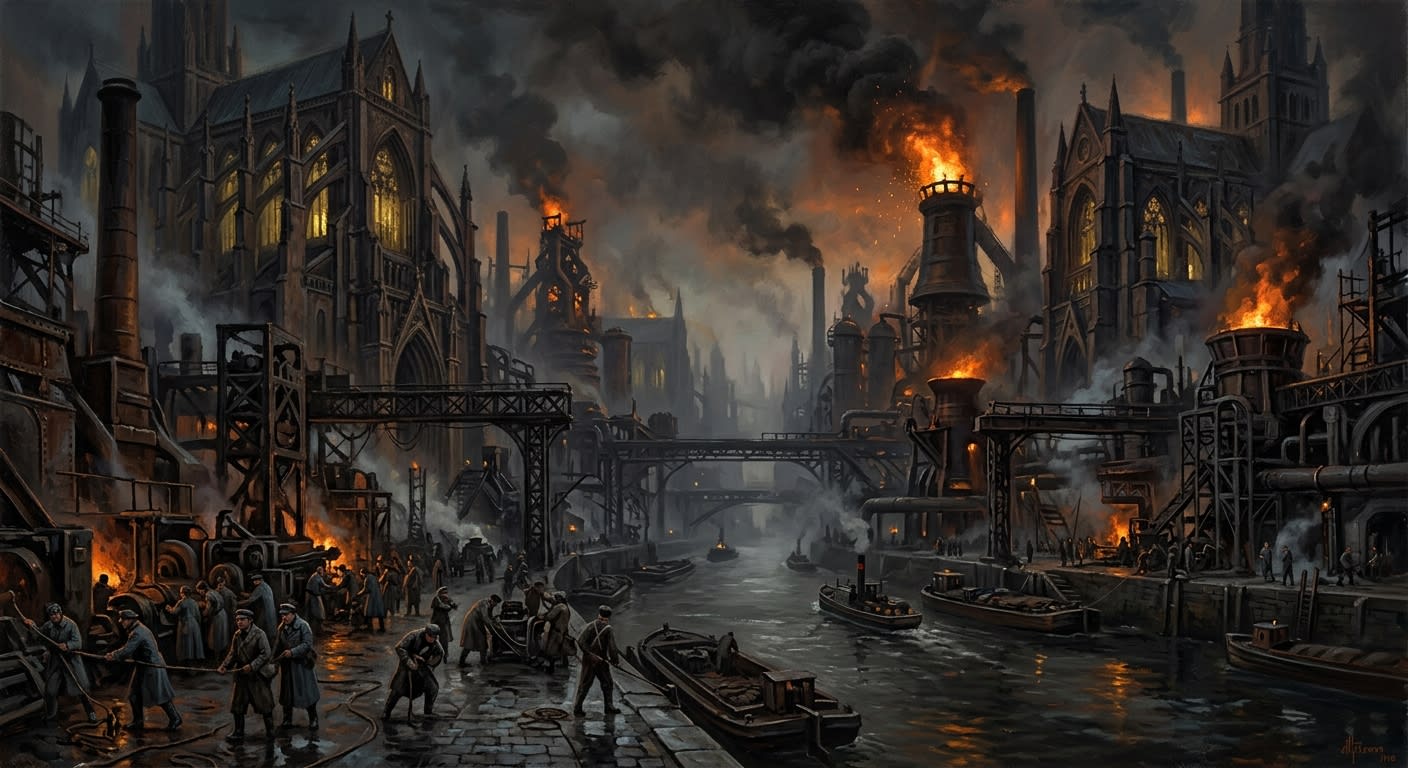
Essen existed before the Concordat. Every industrial abomination does. The river fork had drawn smiths since the age when men still believed iron could be worked by talent alone — a heresy of craftsmanship that the Synod would later correct with characteristic thoroughness. The old guild-forges lined both banks of the canalized river, their hammers ringing to no particular schedule, their output certified by nothing more authoritative than a customer's satisfaction. One shudders.
The transformation began in A.S. 108, three years after the Bureau of War received its Charter of Crimson Ink and two years before the First Continental Levy would create the demand that justified everything that followed. A procurement officer of the Bureau of Engines and Furnaces — his name survives only as a file number, which is the highest honour the Bureau of Records can bestow — arrived at the river fork with seventeen writs, a surveyor's chain, and a mandate to produce "steel of doctrinal purity, calibrated to the hymn-frequencies prescribed by the Bureau of Orison and Song, in quantities sufficient to arm the Line." The guild-masters laughed. The guild-masters were absorbed into the new Compact by the following Lent, their laughter reclassified as "premature enthusiasm."
By A.S. 115 the Foundry Core had consumed the old artisan quarter. By A.S. 130 the Sagittal Line consumed everything the Foundry Core produced and demanded more. By A.S. 150 the city had quadrupled in population, quintupled in output, and the river ran a colour that the Bureau of Alchemical Standards classified as "within acceptable liturgical parameters," which is the Synod's way of saying the fish were dead but the paperwork was immaculate.
The name changed with the city. Essen became Essen-of-Hymnsteel by decree of the Bureau of Orison and Song in A.S. 118 — the suffix a formal acknowledgement that the city's steel was "taught" obedience by voice. The old name is forbidden. Speaking it aloud is technically a misdemeanour; writing it is a citation; remembering it is, as yet, not prosecutable, though the Bureau of Doctrine has been working on the theological framework.
#On the Nature of Hymnsteel
A bell-cannon throat cast in ordinary steel will crack within forty firings. A hymn-drive housing forged without calibration will shear its bolts in a fortnight. A reliquary rivet pressed from unconsecrated metal will, according to the Bureau of Rites, "lose its moral coherence under stress" — a phrase that means the relic falls out and the soldier holding the reliquary loses his faith, his composure, and frequently his life, in that order.
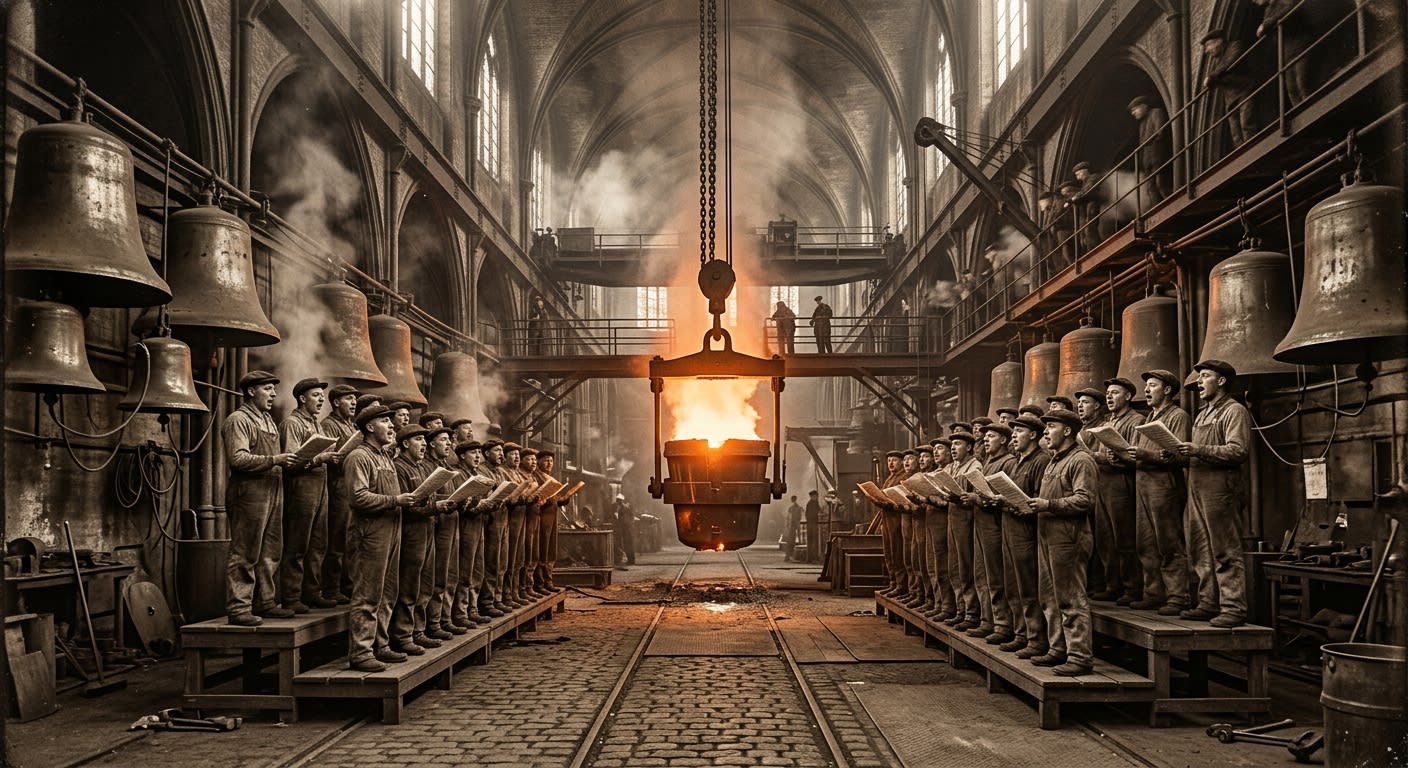
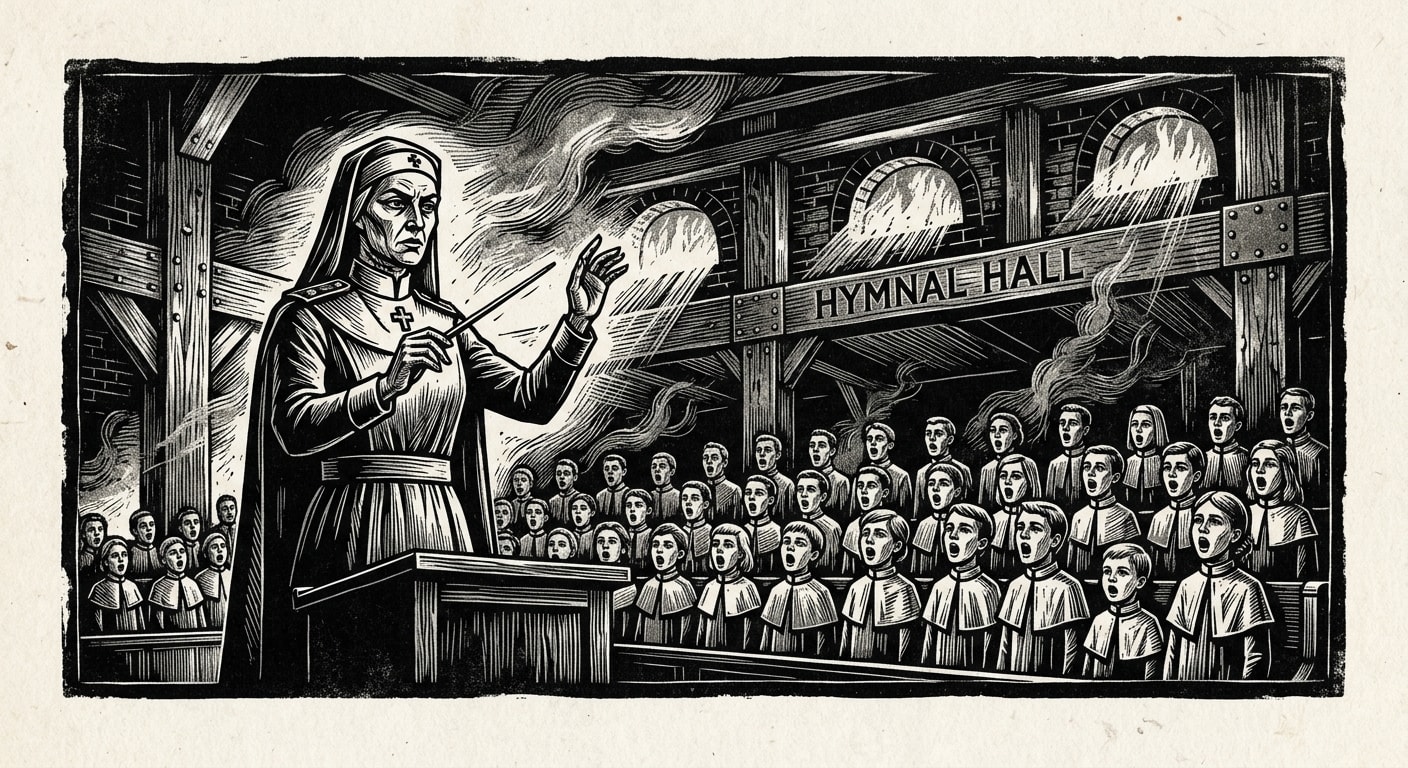
Hymnsteel is the answer. The process is half metallurgy, half sacrament, and the Bureau of Doctrine has declared the distinction between the two to be "a matter for specialists." In the Hall of Measures — the great calibration stage at the heart of the Foundry Core — paired choirs sing prescribed stanzas during every pour. The vibrations align the grain structure of the cooling metal, or so the Bureau of Orison claims. The result is steel that holds its pitch under stress, that does not "sing back" wrong frequencies when struck by demonic ordnance, and that tolerates the proximity of consecrated relics without the metallurgical tantrums that plague ordinary alloys.
The entire Sagittal Line depends on this product. Every bell-cannon from Bastion-Königsberg to Bastion-Constantinople fires through an Essen-forged throat. Every hymn-drive engine — those lumbering, psalm-broadcasting war-machines that the Bureau of War deploys against breach-waves — runs on Essen-calibrated housings. The replacement clappers for the Northern Carillon at Königsberg are cast here. The reliquary rivets that hold together the Ossuary Rings of Constantinople are pressed here. If Essen stops singing, the Line stops shooting within the season.
The city knows this. The Tri-Bureau Compact knows this. Strasbourg knows this. And the knowledge has produced, across a century of co-dependency, an arrangement that no party trusts and all parties require — which is, I am told, the Synod's preferred model for all institutional relationships.
#On the Governance of Cadence
Three Bureaus share the city. None shares willingly.
The Bureau of Engines and Furnaces controls production — slag fuel, overtime quotas, furnace schedules, and the coal barges that arrive at the Seven Locks. Furnace-Marshal Kord presides, a man whose fingernails have been permanently blackened by decades of proximity to things that burn. He speaks in tonnages. His threats are measured in ration cuts, and his promises in overtime waivers, and neither is more reliable than the other.
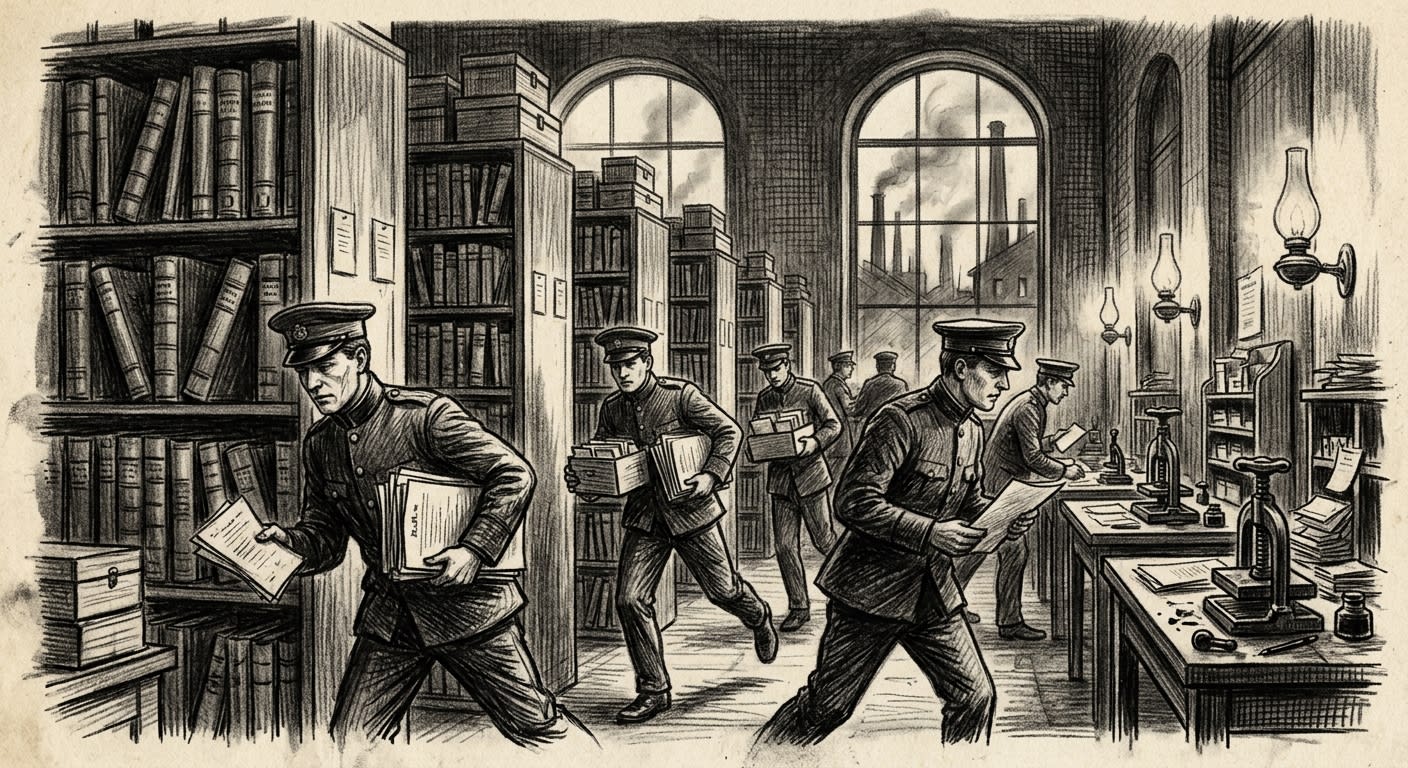
The Bureau of Records controls identity — every stamp, permit, work-writ, and ration chit that moves through Essen bears a Records seal. Arch-Notary Veyl administers this empire from Ledger Row with ink-stained fingers and a smile that has been described, by those brave enough to describe it, as "the expression of a man who knows your name can be misspelled." In Essen, a misspelled name is a revoked existence. Your work permit becomes "pending." Your ration chit becomes "under review." You become, in the language of the Compact, "administratively paused" — a state indistinguishable from starvation except in the filing.
The Bureau of Orison and Song controls sound — every stanza sung in the calibration halls, every bell-schedule that governs the city's shifts, every approved frequency that may be produced within city limits. Master-Calibrator Sister Rauth commands this domain. Her throat bears a scar from a calibration accident in A.S. 184 — molten steel sprayed across the choir platform when a stanza went wrong by a quarter-tone. Fourteen singers died. Rauth survived, and the scar has since become an argument: proof, she maintains, that the hymns demand precision, and that imprecision is paid for in flesh. The Bureau of Orison has not had difficulty recruiting since.
The Compact Council meets in the Furnace Basilica — a vaulted cathedral built directly above the primary crucible, where the heat rises through iron grates in the floor and governance is conducted at temperatures that discourage prolonged debate. Decisions are made by decree, audit, and "bell order" — changes to the production tempo announced through the peal schedules that regulate every shift in the city. The bell rings; the workers obey; the Compact records compliance; and the question of whether anyone agreed to the change is filed under "irrelevant."
#On the Districts and Their Sufferings
Essen is a city that smells different at every elevation.
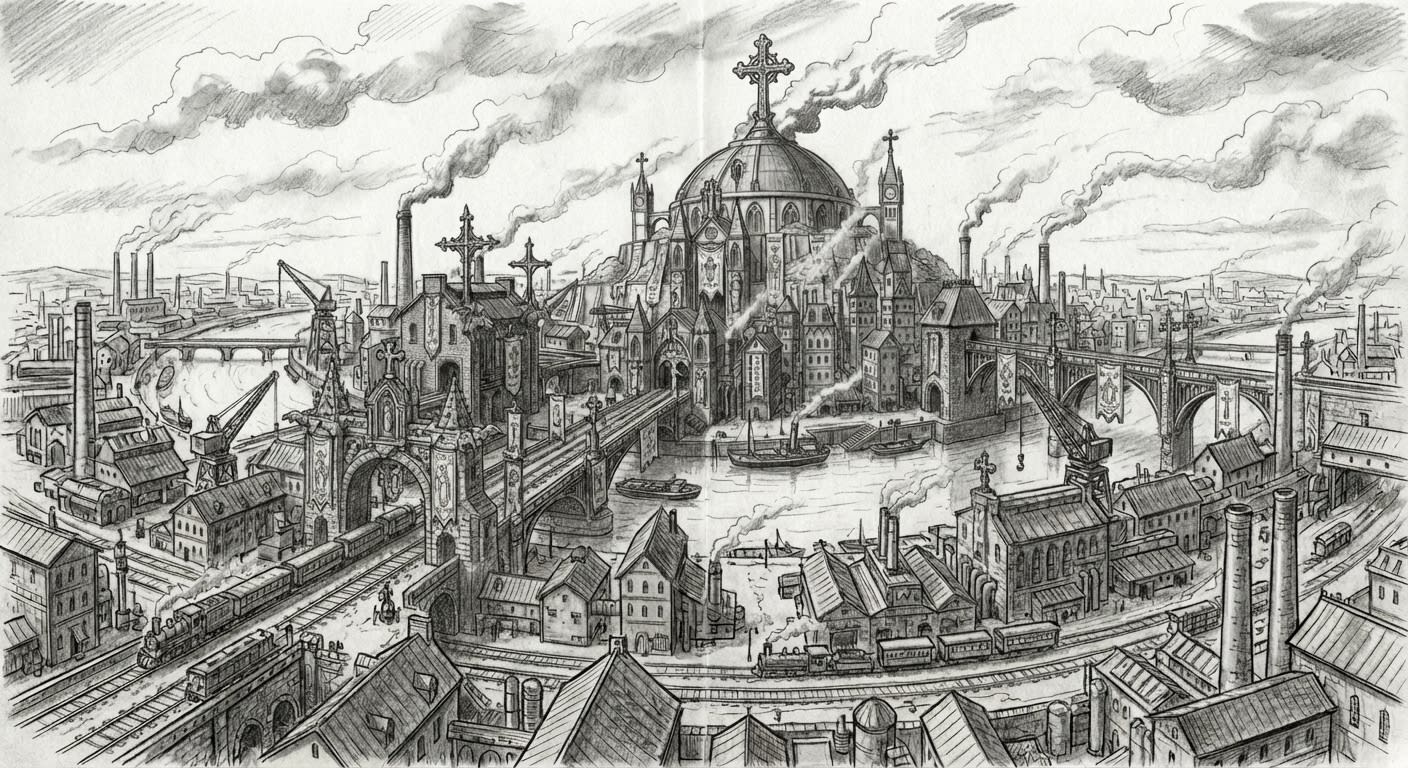
The Foundry Core occupies the river floor — furnaces, crucibles, hymn-halls, and the Hall of Measures arrayed along both banks of the canalized fork. The heat is a physical presence. Workers in the Core go bare-armed regardless of season because cloth against skin invites burns that would otherwise graze. The air tastes of hot oil, scorched incense, and the metallic residue that Essen's physicians call "forge-breath" and that the Bureau of Medicine classifies as "within acceptable devotional parameters." Acceptable devotional parameters, in practice, means your lungs calcite by fifty.
The Seven Locks guard every freight approach. All cargo — coal, bone-lime, grain, tallow, condemned labour — passes through these canal gates, where Records clerks verify seals, Orison wardens test vocal cadence to confirm identity, and bribes are accepted exclusively as "donations to the Furnace Basilica." Lock Three has a tunnel running beneath it that the Bureau of Shadows uses; Lock Five has a tunnel that the Shard Market Syndicate (Unregistered) uses; Lock Seven has a tunnel that no one claims, which means someone important owns it.
Ledger Row climbs the northern bank — counting houses, notary halls, ration offices, and the towering Records spire where Arch-Notary Veyl maintains the rolls that determine who exists and who does not. The district smells of ink, clove-breath pastilles, and hot paper fresh from the seal-presses. Clerks move through Ledger Row with the particular haste of people who understand that a quota shortfall is a theological event.
The Choir Quarters house the calibration singers in barracks that the Bureau of Orison insists on calling "dormitories" and that the singers call, with greater accuracy, "the Throat Dorms." Two thousand voices are maintained here at any given time, rotating through shifts that begin at the First Bell Warming and end when the last pour cools. The barracks smell of boiled throat-herbs, blood, and the particular despair of people whose employment depends on a biological instrument that degrades with use. A calibration singer's career lasts, on average, nine years. After nine years the voice frays, the pitch drifts, and the singer is reassigned to non-vocal labour — the slag hills, the lock-gates, the Ash Warrens. The Bureau of Orison files this as "completion of service." The singers file it differently.
The Shard Markets (Unregistered) occupy a strip of reclaimed slag-ground between the Foundry Core and the southern terraces — a bazaar of scrap brokers, counterfeit-parts dealers, hush-gear merchants, and opportunists of every denomination the Bureau of Purity has failed to categorize. The Markets smell of ozone and cheap tallow. Kestrel Waxhand runs the counterfeit seal operation from a stall that sells "devotional ironwork"; Old Juro brokers stolen tooling from a canal skiff that moves berths every third bell. The Bureau of Records knows. The Bureau of Records permits, because the Markets serve as a pressure valve — a controlled leak that prevents the uncontrolled explosion the Compact fears above all else.
The Ash Warrens sprawl beneath the warm ducts on the city's southern edge — a refugee district where families rent floor-space by proximity to the heat vents and pay in labour-hours they cannot afford to lose. Twelve thousand souls, by the last count the Bureau of Records bothered to conduct. Drafted first in every levy sweep. Fed last in every ration cycle. The Warrens smell of damp wool, thin broth, and soot that has been breathed so many times it has acquired a personality.
The Quiet Gradient (Unregistered) — Essen's only district where money buys silence. Licensed residences lined with felted ash and sealed timber, where the city's elite sleep without the peal-bells, the pour-chants, and the foundry-thunder that define existence for everyone below them. A room in the Quiet Gradient costs more than a lockhand earns in a year. The Hushwright Guild controls the installations, the permits, and the maintenance — a monopoly on silence that has made them the wealthiest faction in a city where wealth is measured in decibels avoided. The rooms smell of lavender soap and sealed wood, which is to say they smell of money and its absence of conscience.
#On the Resonance Bloom and What the City Will Not Say
There is a phenomenon in Essen that the Tri-Bureau Compact calls "holy alignment" and that everyone who works above the third terrace calls "the Wrong Choir."
It begins in the foundations. Tools hum on workbenches without being touched. Teeth ache in patterns that the Bureau of Medicine has mapped but cannot explain. Candles tremble in rooms where no draught exists. The workers stop what they are doing and look at the floor, which is the wrong direction, because the sound is coming from below and also from everywhere.
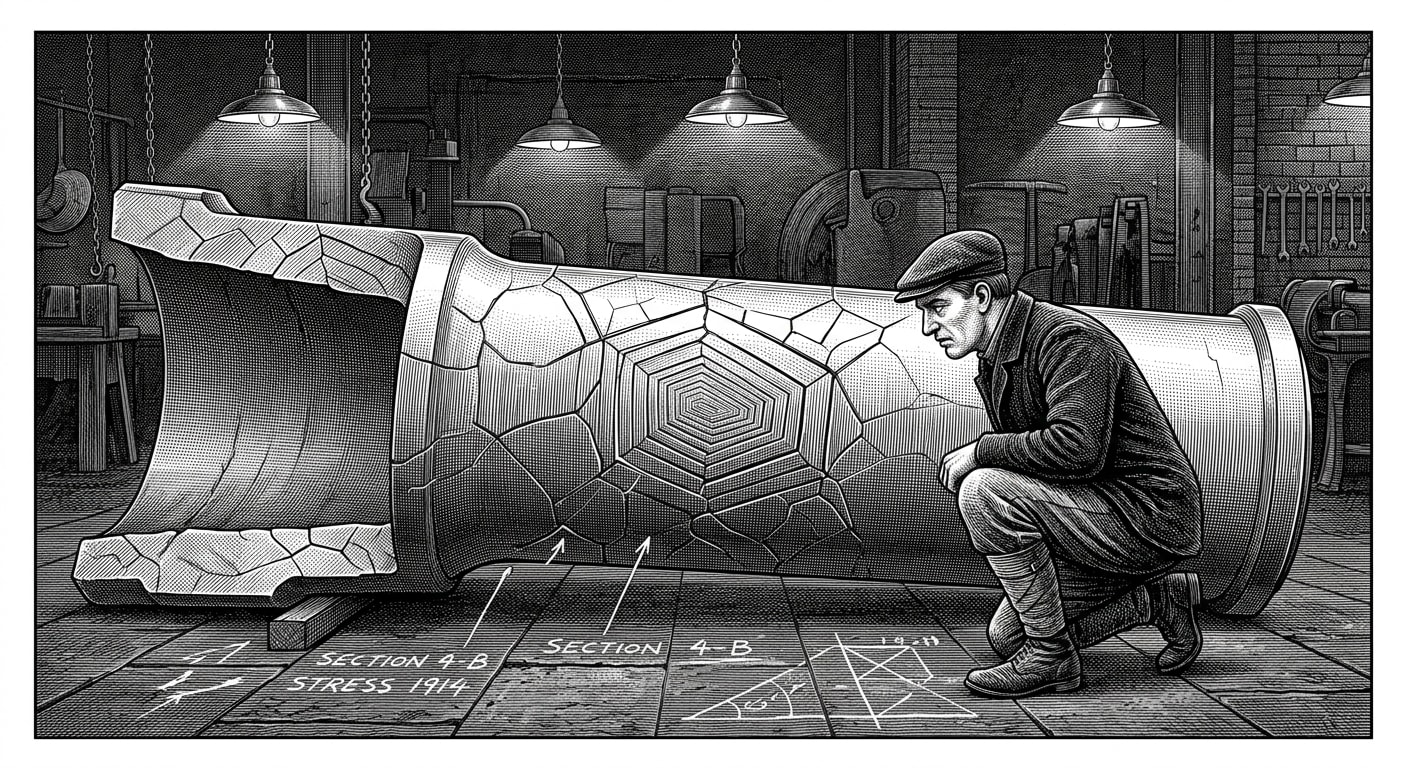
Then the rivets shear. Bell-cannon throats crack along their grain-lines — the same grain-lines the calibration choirs aligned during the pour. Catwalks vibrate loose from their anchor-bolts. In the worst episodes, people bleed from their ears, and the blood, according to three separate testimonies that the Bureau of Rites has classified and I have read, pools in shapes that resemble writing.
The aftermath is worse than the event. A district goes silent — truly silent, in a way that Essen's hush-merchants cannot replicate and would not want to. Sound dies in the affected area for days. Workers sent in to repair the damage report that their voices do not carry, that their footsteps make no noise, that the walls absorb every vibration as if the stone itself has become hungry for sound.
The official explanation is "harmonic realignment of the consecrated substrate." The Compact blames sabotage — the Mirror Choir, a heresy cell that the Bureau of Purity has been hunting since A.S. 187 and has failed to eradicate because the Mirror Choir operates through a method the Bureau cannot intercept: altered stanza sheets. A single changed syllable in a calibration hymn, introduced at the right moment in the right pour, can propagate through the metal's grain structure like a crack through ice. The Mirror Choir claims — in pamphlets that the Bureau of Records confiscates and I have also read — that they are correcting stanzas the Synod itself corrupted.
This Codex previously attributed all Resonance Bloom events to the Mirror Choir heresy, per Compact Report 447-E (A.S. 198).
Subsequent Bureau of Rites investigation (file sealed) has confirmed that Resonance Bloom activity predates the Mirror Choir's earliest documented operations by approximately forty years. The Bureau of Doctrine has reclassified the phenomenon as "ongoing harmonic negotiation between the consecrated substrate and an unidentified sub-foundation resonance source." The reclassification was filed at 3 a.m. on a Tuesday and has not been read by the Compact Council. I have read it. I wish I had not.
The buried truth — and I commit this to the Codex because someone must, and because the Bureau of Shadows has already noted my awareness and decided, for reasons I do not care to examine, that awareness is preferable to ignorance in this instance — is that Essen's Master Hymnal Plates were edited. Decades ago. By the Synod. The original stanzas, the ones the old guild-forges used before the Compact, produced a different resonance in the steel — a resonance that, during pours, caused the foundations to "speak" in patterns that the Bureau of Rites could not classify and the Bureau of Doctrine could not tolerate. The edited stanzas suppress this speech. The Resonance Bloom is what happens when the suppression fails. The foundations are not malfunctioning. They are trying to say something through the gag the Synod put in their mouth, and the gag is slipping, and no one in the Compact wants to hear what comes next.
#On the Present Condition
The city is accelerating. A new procurement mandate from Strasbourg demands tripled output for hymn-drive siege engines — the war consumes and the war is always consuming, and Essen exists to feed the consumption. The Bureau of Orison refuses to accelerate the calibration tempo without "liturgical stability guarantees," which is Rauth's way of saying she will not burn through another generation of singers to meet a quota imposed by clerks who have never heard a pour go wrong. The Bureau of Engines threatens forced conscription from the Warrens. The Bureau of Records profits from the dispute, because the Bureau of Records always profits from the dispute, because every dispute requires stamps.
The Resonance Bloom events are increasing — three in the past eighteen months, where the decade prior recorded two. The Foundry Core workforce murmurs that the foundations are "waking up." The Compact insists the problem is sabotage. The Mirror Choir insists the problem is the Compact. The Bureau of Rites insists the problem is theological. The Bureau of Shadows insists on nothing, aloud, which is the most honest assessment available.
A shipment of bell-cannon throats returned from the Line last month — sent back from Bastion-Przemyśl, each cracked along the same grain-line, the cracks forming a pattern that the receiving inspector called "decorative" before the Bureau of Purity removed him from his post. The cracks are identical. The pours were conducted on different days, by different choirs, singing from different approved stanza sheets. The grain-line failure is uniform, as if the metal remembered a frequency it was never supposed to have heard, and cracked along the memory.
Essen sings. Essen has always sung. The question that the Compact will not ask, and that the Bureau of Doctrine will not permit, and that the foundations answer every time the Bloom returns, is: what is singing back?