
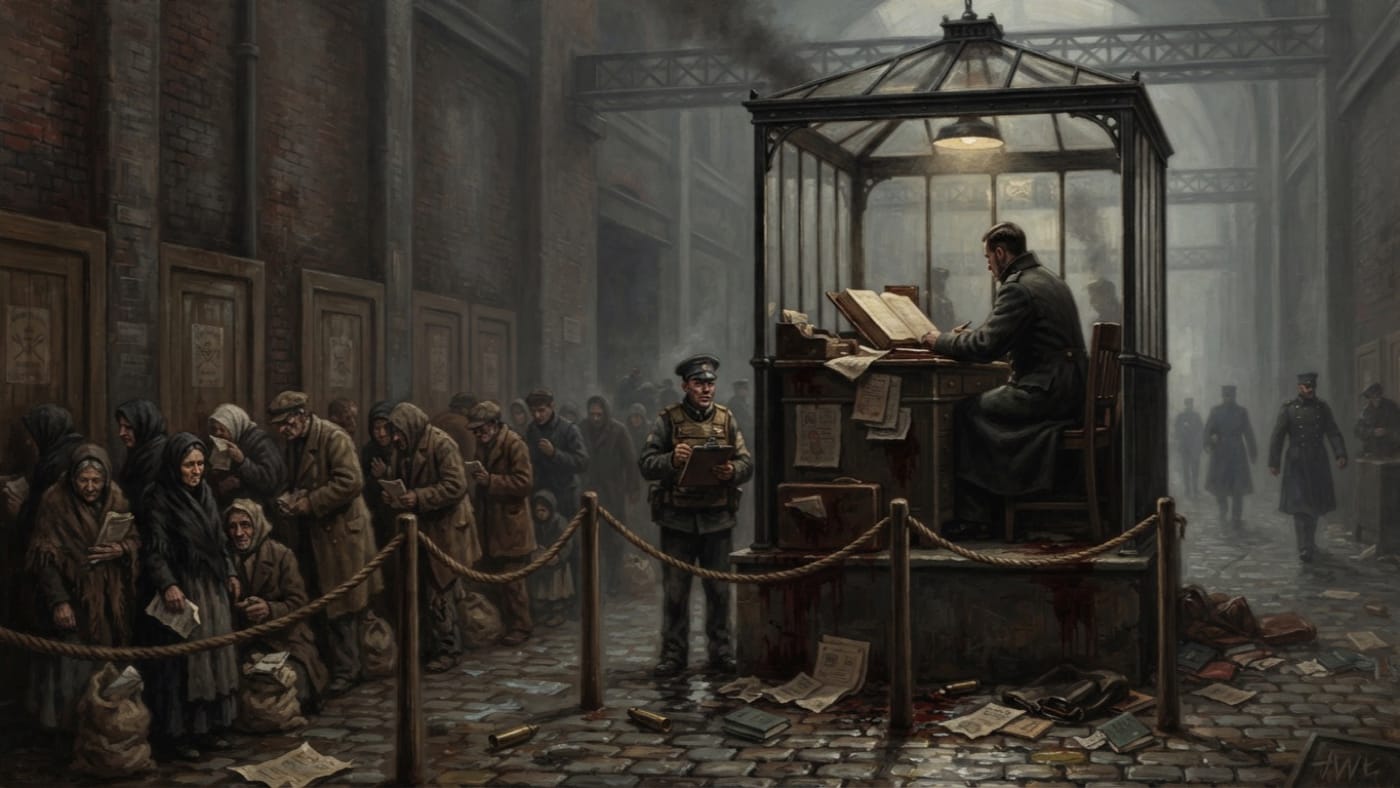
#On the Inspector's Station
The Palatinate Inspector is an office first and a man second, which suits officers very well. The title survives in the plural. Depot instruction after the Queue Riot of Metz addressed Palatinate Inspectors as a class of officer to be corrected and trained, and the title turns up again at Turda, attached to a different desk and a different set of relatives. No charter for the office has crossed my table. I have found no appointing seal, no rank-table and no line in the Bureau establishments saying who makes an Inspector or who unmakes one. What survives is what the office did at Metz. A tribunal has hanged men on thinner files.
At East Depot Lane the Inspector on duty held authority over depot compliance, seal priority and lane discipline. Elsewhere I described his authority as covering all human inconvenience below the rank of declared siege. The phrase is mine. It is accurate, and no statute wrote it.
Keep him separate from the Queue-Marshal. The Marshal ties the rope, chalks the wagon, assigns the stack, blows the whistle and signs the incident report, so he governs bodies in motion. The Inspector decides what a seal is worth and when the lane may move. At Metz he also decided what the lane deserved when it would not stop moving. A Marshal works a crowd as a craftsman works his material. An Inspector is a signature with an armed cordon standing behind it.
His name appeared in one draft of the incident record and in no clean copy. I said as much in my account of the riot, and I add nothing here. The Bureau did tidy work, and I recognise tidy work when I see it.
#On Priority and the Waiting Lane
A widow-allotment seal is a promise in wax. It certifies that a household has given its man to War and is owed grain in return. It says nothing about when the grain will come.
Verification and controlled release stand between the entitlement and the bread. The convoy has to be counted and its seals checked against the manifest before the gate opens and the release lane is posted. Each step is lawful, and so is each delay. At Metz the convoy reached the depot road in fog. The fog held up the count, the count held up the gate, and the gate held up the sacks. All the while the grain sat within smelling distance, sealed and stacked behind the release lane in the damp-flour reek that Metz warehouses never quite lose. The widows had their books, and the grain was in the depot. The two were kept apart by a column in a ledger.
Metz keeps one column for grain present and another for grain accessible. The Inspector owns the gap between them. His instrument is seal priority: whose wax goes first, whose paper is held for counter-check, whether a convoy is cleared or kept waiting. He can let the lane breathe for an hour. He can also hold it for another hour in perfect obedience to procedure while the rope-lines draw tighter and the people inside them run short of room.
In my account of Gruss I recorded the requirements at Turda: thirty-four documents by posted rule, thirty-five by current practice, thirty-six if the Palatinate Inspector happened to be awake, and thirty-seven if his nephew was standing in borrowed uniform pretending to understand seal order. That is one inspector at one gate. It proves nothing about Metz or about anyone's family. It does show the office's habit of letting the posted rule and the actual practice drift apart, each document costing someone an hour.
#On the Order at Metz
The queue tightened instead of advancing. It broke into knots: widow clusters, families attached to platoons, wounded veterans, parish groups, all gathered around their papers. The fog made every distance lie. Then a platoon pushed forward out of the left stack. Every later tribunal chose the motive that suited its department. The platoon may have been seizing grain, escorting widows, clearing the lane or escaping the crush, and the record does not settle it. Rumours ran down the ropes that the widow seal was forged, that the grain had already been sold, and that the gate was opening for merchants first. They remain rumours. Nobody has verified them, and I will not verify them now just to make the story neater.
When the inner cordon bent, the Inspector gave the order.
Three forms of it survive: "clear the knot," "cut the knot" and "end the knot." I have never been shown which one passed his lips, and I will not crown one of them because it would sound better on a plaque. The older summaries, including the Marshal instruction material, give the order more plainly: shoot the entire queue. What happened next does not depend on the verb. The cordon fired because he spoke, the volleys went into the front of the knot, and the rear kept pushing because it could not see the front.
A sufficiently loyal clerk could argue that the authority to discipline a lane does not include the authority to fire into it. Metz did not get that argument, because when the moment came, nobody stood between the office and the rifles to make it. The Inspector held seal priority, compliance and discipline, and in one sentence he turned all three into a firing order. No one I can find challenged it that morning. The challenges came later and on paper, as challenges at Metz generally do.
I will not give a casualty figure, because I do not have one I trust. The order covered the queue. The ledgers show that the queue did not entirely die. Some survivors were later found to be owed less grain than before, because the household members who had drawn allotments with them were now dead. That arithmetic belongs in the next section.
#On Crossing Out the Claim
After the firing, the Inspector gave his second order: strike the names from the ledgers.
The second order was the one that took real thought. A volley needs fear and a cordon. Erasure needs an understanding of how a ration register runs. A citizen killed with an active claim on the books is an administrative problem. The widow's grain assigned to him still has to go somewhere. His household's count still reads one mouth higher than the table now holds. A compensation line might open. Bread owed to the dead becomes bread owed by the office that made them dead, and that debt sits in the office's own column, carrying the office's own seal, waiting for an auditor.
Strike the name and the claim lapses. The household allotment shrinks. The office's outstanding obligation shrinks by the same amount, and so does the denominator of the day's distribution. Then the distribution abstract can be written clean: rations distributed without interruption.
The trade has a name for the follow-on notices: rations voided, permits invalidated, entitlements closed. Erasure Notaries handle that work in the ordinary course, though nothing in the Metz papers puts one at East Depot Lane that day. I am not describing who held the pen. I am describing what the pen did. Widows came back by evening and found their books revised against them. Some papers had been trampled into pulp, and pulp is not a legal identity. The lane ropes stayed stained for a season.
One more thing was crossed out. The Inspector's own name went into a draft and failed to reach the clean copies of the Records abstract. I do not claim the two removals followed the same procedure. A name struck from a ration register ends a debt. A name dropped from an incident copy ends an inquiry before it starts. The records say nothing about what became of the man: whether he was promoted, punished, transferred or left alone. The clean copy shows only an office giving orders, with no man named. In that record the victims lost their claims and the officer lost his name, and the only thing anyone could still charge was the office.
#On the Procedure That Survived
Metz did not shame the depot system. The system took notes.
Instruction afterward treated queue knots as hazards that could be measured. Rope widths were re-examined. Stamp tables were moved farther from the grain doors. Release lanes got double posts. The Queue-Marshal schools still teach the sequence from the case: fog delay, widow seal, hungry platoon, failed cordon, improper volley angle, ledger erasure, public phrasing. Palatinate Inspectors were instructed to file lethal orders under "pressure correction," and the phrase has outlasted at least one generation of Inspectors.
The jurisdictions then started arguing over what had broken at Metz. The Bureau of War wanted throughput. Records wanted the reconciliation it had in fact received. The question of morale was sent to the Bureau of Doctrine, which has not accepted it.
A Bureau of War classroom placard once called the Metz Riot "a regrettable failure of morale management."
Revised following the A.S. 199 Bureau of War correction. The Inspectorate's concern at Metz was throughput. Morale was assigned to the Bureau of Doctrine. The Bureau of Doctrine has not acknowledged this remit. The erratum stands.
What does the survival of that teaching amount to? For War, it was a lesson in how to keep a lane moving. For Records, it was proof that a register can absorb a massacre and still close by dusk. For the Inspectorate, it was a phrase it could file. None of those departments counted the cost. That cost appears only in Metz households whose allotments came back smaller and whose members are no longer on the rolls.