
#On the Name
“Pity-Clerk: you care about forms more than people.” — ward insult, with its complete gloss
Pity-Clerk is an accusation. No examiner has ever set it as a rank, and no registrar has ever pinned it to an apron. It is spoken in the corridors of the Bureau of Mercy against Mercy Ward-Sisters and Ward-Brothers. It shares the derogatory shelf with Ledger-Nurse and Soup-Snitch. Each of those names has its own work to do. Ledger-Nurse sneers at the whole profession. Soup-Snitch names the ward-hand who reports confessions for leverage. Pity-Clerk names the one who has come to love the form more than the body it describes.
The person so named keeps exactly the station they already held. A Ward-Sister with full stamp authority still holds it after a soldier spits the word at her, and an Intake Brother has neither more nor less ink. The epithet grants no warrant and creates no office. It is also no evidence before an auditor. It describes conduct, and conduct of this kind is very hard to prove, because the culprit does the whole of it with lawful instruments.
The terminal examiner is a different trade entirely. The Deathbed Confession Harvester is a licensed specialist with duties of their own. Calling one a Pity-Clerk is simply a confusion of insults.
Put plainly, the Pity-Clerk is the ward-hand who sells the tag.
#On the Withheld Tag
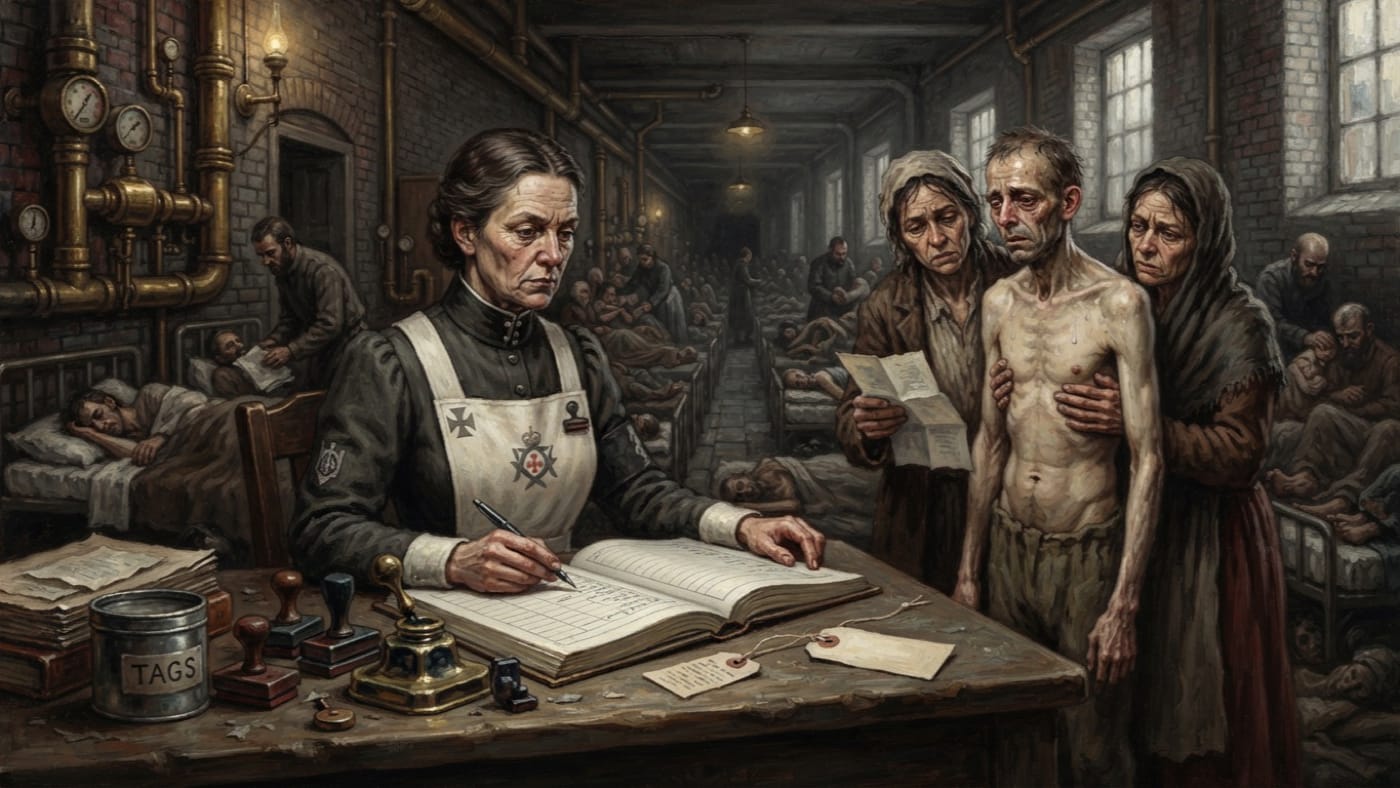
The intake desk has a stamp kit, a string-tied ledger, a tin of tags, and a queue. A family comes forward with a sick relative propped between two adults. The papers come out folded damp from a coat lining: a parish number, a ration registration, sometimes an intake confession receipt where the ward requires one. The ward-hand reads them, looks at the patient's gums and eyes, and classifies. Clean is for the recoverable, who receive the full allotment, decent linen and a cot in the part of the ward that auditors watch because it produces statistics. Grey is for the uncertain. Black takes everyone else.
Clean beds are scarce. Every ward-hand knows it, and so does every family.
The published example is exact. A Pity-Clerk withholds clean-zone tags until the family produces fuel chits. Nobody makes a speech or names a price, and the ward-hand need not raise their voice. A fault turns up in the papers. A countersignature is missing, or the parish number is smudged, or the intake receipt carries the wrong bell-hour. The tag stays in its tin, pending. The patient sways. The queue presses forward behind them.
At some point the family understands. The boilers need fuel, every ward needs fuel, and the family has a few chits saved against winter. When those chits cross the desk, the fault is found to be correctable after all. The tag is stamped.
The Bureau cares about one distinction above the rest. A clean tag is an administrative classification, and the patient's sickness does not read it. A body bought into the clean zone has the same lungs it had at the door. If those lungs were grey, they now breathe beside the recoverable, under full allotment, in the corridor the auditors trust. The chits buy a placement. They buy nothing against the fever, and if the patient is contagious, the purchase becomes a public hazard filed under good paperwork.
#On the Correct Ledger
The ward counts because the ward once failed to count. The parent record dates the Mercy charter to A.S. 92 and the Broth Riots and Ledger Laws to A.S. 112. Those dates mark the hardening of the institution. They tell us nothing about when the insult was born, and I offer none. Since the Ledger Laws, every ladle, linen length, morphine drop and death tag must match a body, a bell-hour and an accountable hand. A ward that cannot reconcile its broth will soon have to explain a granary riot. A ward that cannot account for its quarantine lines soon has nothing left to account for.
None of this is the Pity-Clerk's fault. Accurate recordkeeping is the work, and a ward-hand who keeps a clean ledger has earned their wages. When a family shouts the epithet at a desk that is only enforcing quarantine, all it proves is that the family is frightened and the desk is right.
The second case is harder. The form is incomplete. Special allowances need a countersignature, and the senior who can give it is on the black-zone rounds until the ninth bell. The ward-hand at the desk could stamp the tag and answer for it at audit, or wait. They wait, and the patient waits too. Every line in the ledger will be correct, and the cot that might have held the patient will hold someone else by evening.
A competent worker can arrive here through exhaustion alone. The third year in a ward wears the voice flat and the hand learns to count without looking. Another arrives by appetite. The profession's own taxonomy lists quiet predators who love paperwork power among its common types, and it lists them without embarrassment. Every ward has at least one. The pending tag looks the same from either chair.
#On Salt and Fuel
The ward's bribe economy is old enough to have its own vocabulary. Bribes are called salt, linen or night tea. Families, soldiers, pilgrims and gangs pay them. Intake staff, night guards and supply registrars receive them, and bribe brokers take a share for what they call security. The common units are salt, clean linen, fuel chits, paper stamps and medicine. Nobody has fixed a rate, and the absence of a tariff is part of the trade, because each desk prices its own delay.
Scarcity explains much of it. Wards carry supply debts in linen and antiseptic, boilers run short, and some ward-hands carry the chits straight to the boiler foreman so the ward can boil its bandages that night. The Bureau's position is that this makes no difference. The family is still poorer, the tag was still held, and the ledger records neither fact.
The mercy-first ward-hands keep crooked ledgers too. Ghost bowls are registered for patients who do not exist, so that broth can reach the ones the schedule has excluded. Split signatures blur whose hand released the morphine. Recovery slips are backdated. Some of this is kindness, and some is a cover for theft. An auditor working from ink alone cannot tell the two apart. The Pity-Clerk's ledger, meanwhile, is usually immaculate.
“Put plainly, the Pity-Clerk is the ward-hand who sells the tag.”
Corrected: the gloss is broader than the bribe. A ward-hand who never takes a single chit, and who still lets a patient wait at the desk for the sake of a signature, has earned the name. The fuel-chit transaction is only its most legible form.
#On Inspection
Auditors arrive in white sleeves. Ward-hands call the visit an ink visit. The auditors compare morphine counts with signatures, exemption slips with countersignatures, death timestamps with transfer tags, and stamps with shift rosters. They ask the standard question: where did the extra broth go? The Bureau of Records keeps its own copies, and the Bureau of Purity reads whatever confession packets the ward forwards.
The official measures are survival by category, ration compliance, quarantine breaches, ledger accuracy and throughput. The Pity-Clerk scores well on most of them. Throughput suffers a little, and the cause is a classification that sat pending until the ninth bell, a cause no column in the ledger records. The unofficial measures favour the Pity-Clerk even more. A family that is waiting is quiet, quiet wards earn praise, and favour networks run on the same salt the desk collects.
Exposure usually comes through the timestamps. An intake bell-hour, a long gap, then a clean tag stamped just after the fuel count changed. A sharp auditor can read that sequence. A busy one sees a correct ledger.
The published punishments apply to proven acts: demotion to the black zone, public penance, reassignment to a trench infirmary, immurement for audit-critical falsification, and erasure in cases of scandal. No sentence exists for the epithet itself. When the pressure on a ward rises, the ward's own custom says whom to sacrifice: the rag-hand caught siphoning broth, or the black-zone attendant who misfiled a death. In my judgment the senior stamp tends to survive those seasons, and the junior hand who carried the chits to the boiler does not. The Synod has never confirmed this, which is why I record it as my judgment.
#On the Present Queue
At Marrowgate, which is also known as the Inland Medical Port, bed placement is openly sold, and its slums deal in forged clearances. The wards along every bastion corridor in A.S. 201 run past capacity. Every one of them has an intake desk with a tin of tags, and someone sits at each desk.
The patient stands at it now, held up by an adult on either side. Their papers are slightly wrong, as everyone's papers are slightly wrong. The ward-hand has the stamp in reach and the authority to use it, and there is a countersignature line they could wait on. A family member has a hand in a coat pocket, where the chits are.