
#The Bone Harbor
"Everything heals or it gets a file." — Painted above the Wagon Quays intake gate in whitewash lettering two feet tall, refreshed every third day by a detail of three painters who are themselves recovering from wounds the Sagittal Line inflicted and Marrowgate has catalogued.
I have inspected Marrowgate on four occasions. Twice on behalf of the Bureau of Doctrine, once in an advisory capacity to the Bureau of Records, and once because my carriage threw a wheel on the Grayrail road and the nearest inn that served drinkable wine happened to be within its cordon. On each occasion I departed with the same conviction: that this city is a machine designed to convert human ruin into administrative order, and that its efficiency in this regard is both the Synod's proudest logistical accomplishment and its most damning confession.
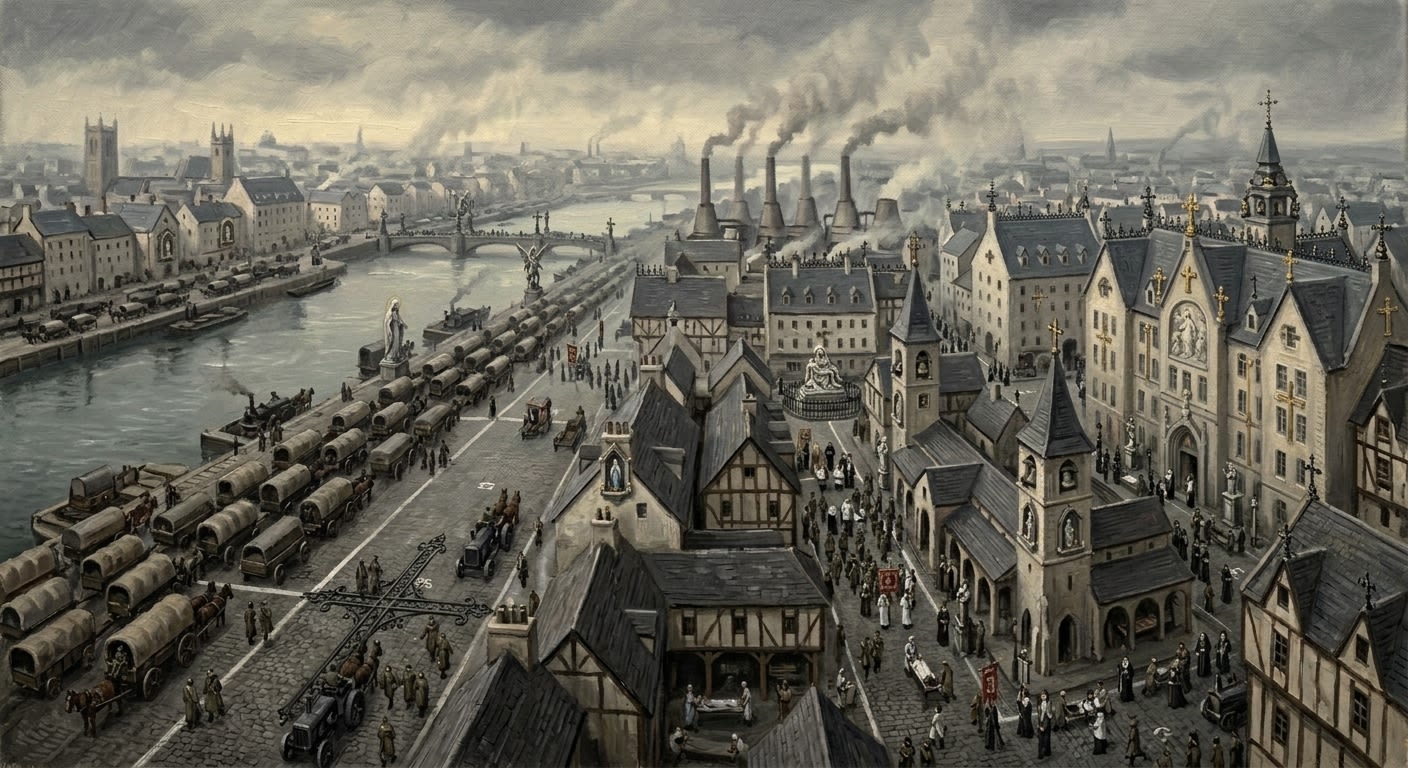
Marrowgate sits at the convergence of three wagon roads and a rail spur in the forward heartlands — Zone 3, near the Würzburg corridor (Unregistered), where the supply arteries feeding the Line thicken into their final tributaries before breaking into the war zone proper. It is an inland port that has never seen salt water. Its "quays" are wagon lanes; its "harbor chain" is a cordon of lime trenches and quarantine fences; its tide is the ceaseless arrival of the broken, the severed, and the dead, borne in from the casualty railheads on carts whose axles have never once been adequately greased. The population is officially ninety thousand. The unofficial population — the wounded in rotation, the refugees in transit, the debt-labourers in bondage, and the dead awaiting processing — swells that figure by a third on any given day and by half during a major offensive season.
The city was founded in the years following the establishment of the Sagittal Line — approximately A.S. 72, when river trade along the forward corridors collapsed under the combined weight of military requisition and the inconvenient tendency of barges to arrive carrying corpses instead of grain. A nameless logistics officer — the Bureau of War has filed his identity under a category that does not correspond to any living clerk's access — repurposed the old river-market town's port logic for overland triage. Wagons would dock. Wagons would unload. Wagons would depart. The wounded would be sorted. The dead would be processed. The paperwork would be completed. That the "cargo" screamed and bled was, from an administrative standpoint, immaterial.
#On the Cordons and the White Lines
The first thing a visitor observes about Marrowgate — and this observation precedes all others because the Sanitation Chapter has arranged it to precede all others — is the whitewash. Every street in the inner city is bisected by white lines painted on the cobblestones. These lines are not decorative. They are jurisdictional. They divide the city into "clean corridors" and everything else, and to cross one without the correct stamp on one's person is a crime punishable by quarantine confinement — "therapeutic confinement," in the Sanitation Chapter's preferred phrasing, which is a euphemism of such transparent cruelty that even the Bureau of Doctrine admires it.
The outer cordon is a ring of lime trenches and inspection gates through which all traffic must pass. The inner cordon — the white lines themselves — subdivides the city into zones of diminishing trust. Beyond the cordons, the Lime Yards and the cemetery terraces and the ossuary ridges spread outward like the rings of a tree whose growth medium is calcium and grief.
The Sanitation Chapter controls the cordons. The Sanitation Chapter, therefore, controls Marrowgate. This is a fact that the Civic Triage Tribunal disputes daily and loses daily, because the Tribunal controls beds and legal proceedings while the Sanitation Chapter controls whether you are permitted to reach a bed or a proceeding at all. Prefect Salvius — the Sanitation Prefect, whose smile has been described by three separate Bureau of Purity observers as "the expression of a man who has just locked a door and swallowed the key" — understands this dynamic with a precision that borders on the theological. When he declares a quarantine, the city seals. When the city seals, the Tribunal's authority extends to the walls of its own chamber and no further.
#On the Districts
Marrowgate arranges itself along a linear spine — the "quay-road" — with wards and yards branching off like ribs from a sternum. The metaphor is anatomical, and the city knows it. Everything here is a body. The city is a body. The wounded are bodies. The dead are bodies that have been reclassified as materials.
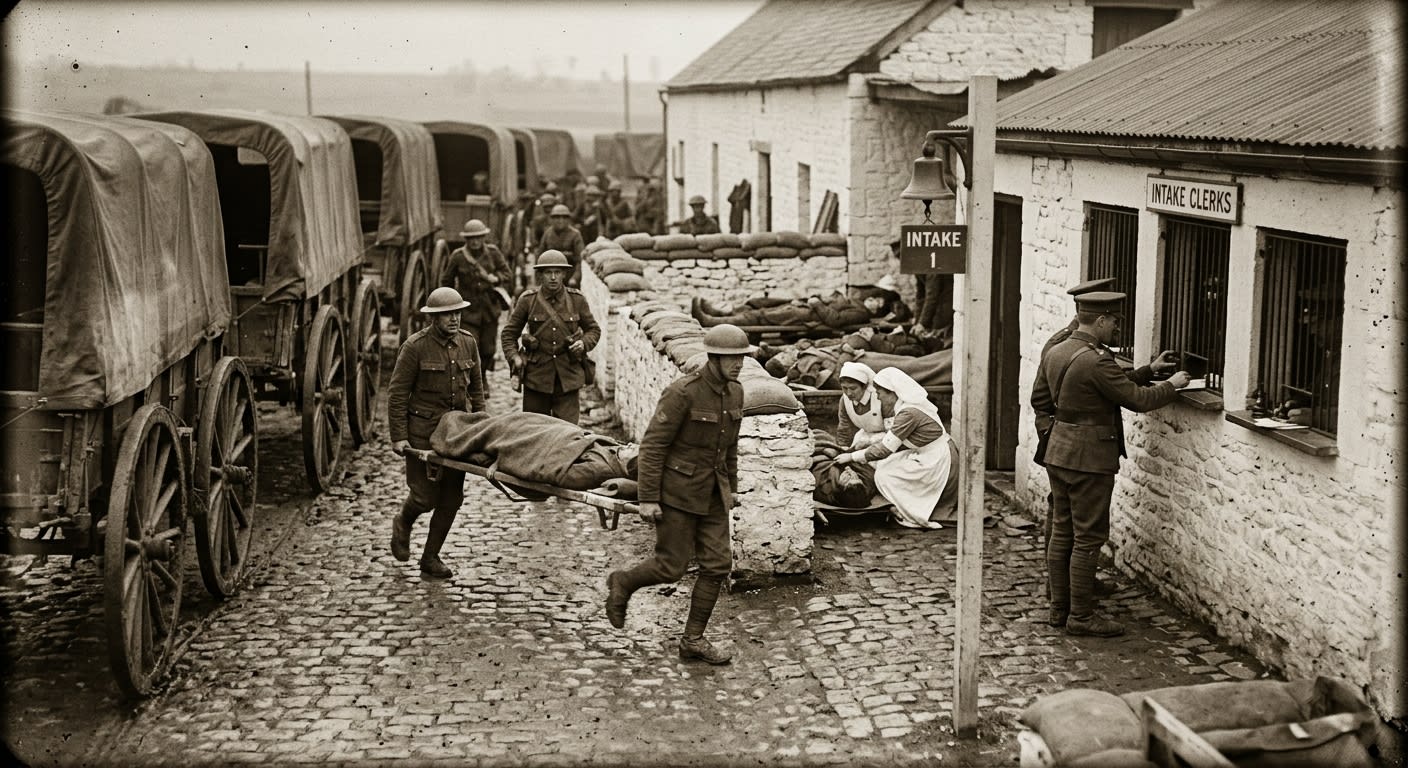
The Wagon Quays receive the intake. This is where the war arrives: ossuary wagons queuing in lanes that smell of wet canvas, horse sweat, and iron. The stretcher runners work in shifts timed to the intake bell, sprinting between wagons and the triage pens with a fluency of motion that suggests either extreme training or extreme terror. Bed tokens change hands here in transactions the Sanitation Chapter pretends not to see, because the alternative — acknowledging that triage priority is for sale — would require a theological position the Chapter has not yet formulated.
The White Ward is the primary infirmary block. It smells of vinegar smoke and boiled linen, and these are the good smells — the smells that mean the disinfectant protocols are functioning. When the White Ward smells of nothing, something has gone wrong, because at Marrowgate the absence of the chemical reek means the chemicals have run out, and when the chemicals run out the fever follows within seventy-two hours. The Ward operates on bell-time: bed allocations posted at midday, tribunal hearings concurrent with surgery, confession receipts required before treatment. A man may bleed to death while his intake confession is transcribed. This has happened. The Sanitation Chapter classifies such deaths as "procedural."
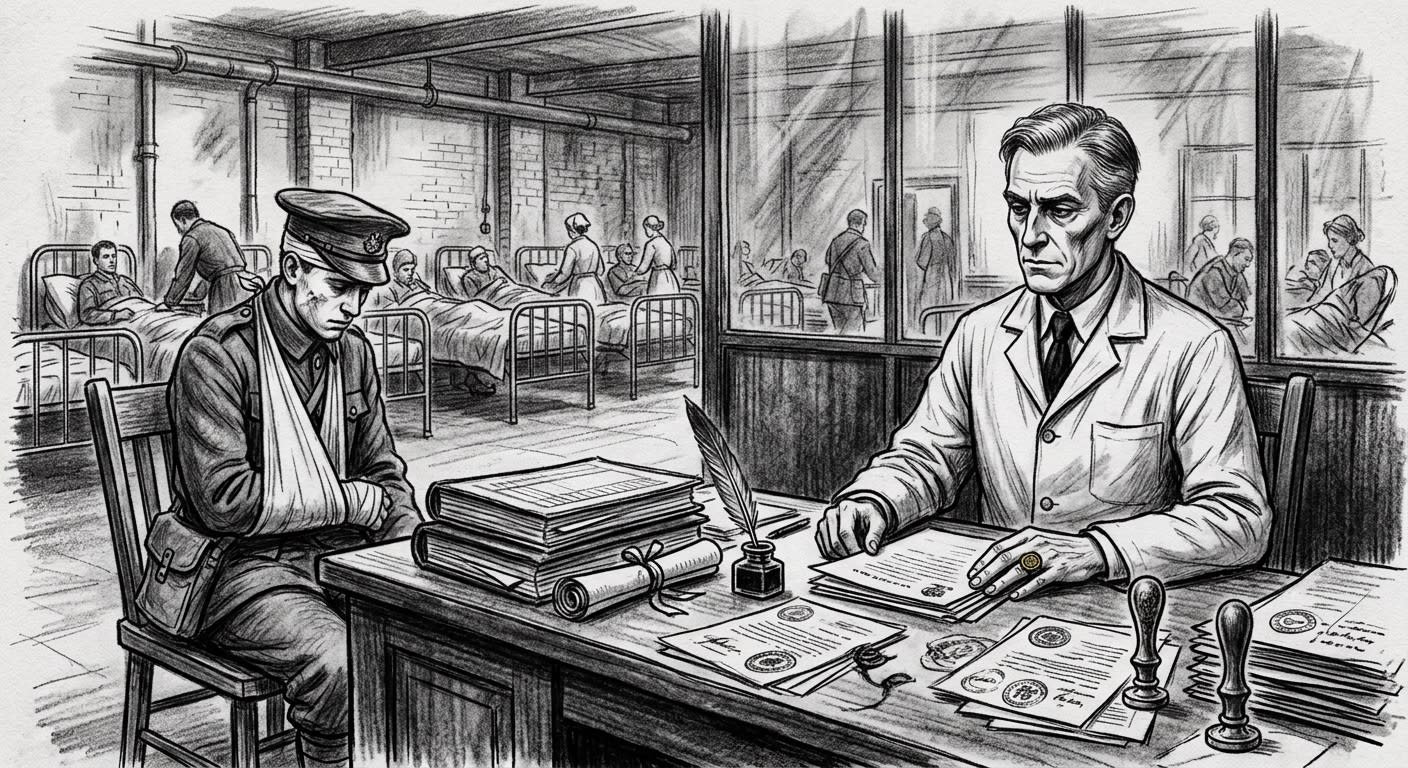
Notary Row houses the Civic Triage Tribunal, the surgeon-notary offices, and the seal registries. Here the wounded become legal. An amputation is performed by a surgeon; it is authorized by a notary. The stamp — the cut-stamp, in the soldiers' argot — is feared more than the saw, because the saw removes a limb while the stamp removes a man's identity. After a notarized amputation, a patient's file is amended. His old name — his "pre-excision designation" — may no longer be spoken in official proceedings. He is, in the eyes of the Ledger, a revised edition of himself.
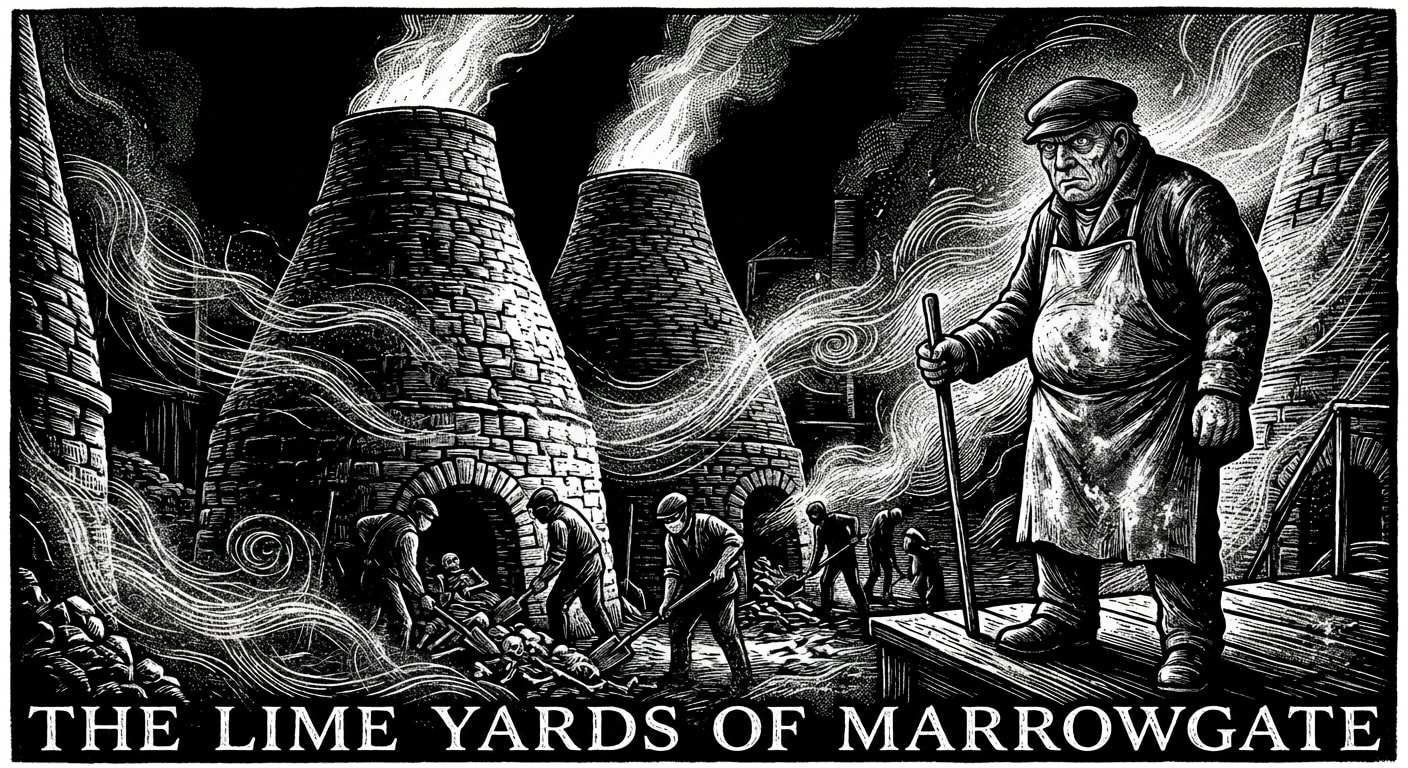
The Lime Yards process the dead. Bone-lime kilns burn day and night, converting human remains into building material — mortar, road surface, whitewash for the very lines that divide the city into zones of the living and zones of the processed. The economy is circular and the circle is a grinder. Kilnmaster Hark, whose lungs have absorbed enough calcium powder to constitute a geological deposit, oversees the operation with the detached competence of a man who stopped distinguishing between fuel and former persons approximately fifteen years ago.
The Prosthetics Arcade is the closest thing Marrowgate possesses to a commercial district, and its commerce is in the restoration of employability. Artificers, strap-makers, glass-eye cutters, and brace-fitters line a covered arcade whose air tastes of leather oil and metal filings. The Prosthetics Guild (Unregistered) — Guildmaster Joryn at its head, a man of considerable charm and absolutely no charity — operates on a simple principle: the fitting is affordable; the maintenance contract is not. A soldier receives a new arm. The arm requires adjustment every six months. The adjustment requires a guild-certified fitter. The guild-certified fitter requires payment. The payment, if defaulted, generates a debt. The debt generates a work prescription. The work prescription returns the soldier to the wards — as labour, this time, rather than patient.
Mercy Market occupies the steps and precincts of the Mercy Chapel of the Unburdened (Unregistered), where pain relief is dispensed as sacrament. The morphic draughts are real. The prayers are optional but recommended. The confessions extracted in exchange for a dose are filed, archived, cross-referenced, and occasionally deployed in tribunal hearings against the very patients who offered them. Sister-Matron Ilka (Unregistered) — kind, immovable, and possessed of a moral architecture that permits her to simultaneously comfort the dying and inventory their sins — presides over this exchange with the serene authority of a woman who controls the only supply of anaesthesia within fifty miles.
The Suture Slums house the debt-labourers — men and women bound to the wards by work prescriptions that function as indentures. They wash linens. They carry stretchers. They scrub the kilns. Their "rehabilitation" has no fixed endpoint, because the endpoint is determined by the Tribunal, and the Tribunal's arithmetic has a curious tendency to discover outstanding balances in files that were previously settled. The slums smell of damp wood and fever sweat, and their washhouses serve as the city's primary laundry district, its primary disease vector, and its primary recruitment ground for the Stitchmarket — the underworld cartel that runs Marrowgate's black economy in forged clearances, stolen anaesthetic, and organs transported in crates that rattle.
The Quiet Stacks are the ossuary shelves — coffin depots and bone repositories arranged in the silence zones beyond the inner cordon. Guards enforce quiet here with a zealotry that the Bureau of Purity would find instructive. The cedar-and-mould air carries an undersmell of prayers — old prayers, institutional prayers, prayers spoken by rote over bodies that have already been inventoried, catalogued, and assigned a destination. The corpse cart drivers who service the Stacks are, by long custom, permitted to speak to the dead. The dead, by recent and troubling report, have begun to answer.
#On the Sealhands and the Cut-Stamp
The surgeon-notaries of Marrowgate — the Sealhands (Unregistered), so called for the brass seal ring each licensed practitioner wears on the third finger of the operating hand — are the city's true aristocracy. They cut flesh and stamp paper with equal authority, and the second act is the one that matters. A wound that is stitched but not stamped does not, in the eyes of the Tribunal, exist. A limb that is removed but not notarized has not, in the eyes of the Ledger, been lost. Chief Sealhand Orin — hands like steel, disposition like a locked filing cabinet — oversees the guild with a monopolist's instinct and a bureaucrat's patience.
The cut-stamp is feared because it is irreversible. An amputation, in the crude physical sense, removes tissue. The cut-stamp removes status. A man who entered Marrowgate as Corporal Heinrich Aldus (Unregistered), born in the parish of Saint Ulrich (Unregistered), leaves — if he leaves — as a revised entry in a file whose prior contents have been sealed under notarial privilege. His old name is contraband. His old body is a retracted draft. He is whatever the stamp says he is, and the stamp says he is a man with one arm who owes the Prosthetics Guild fourteen months of adjusted service.
The Sealhands justify this system with a theological argument of disarming elegance: that the body is a text, that injury is a revision, and that revision without notarization is heresy — an unlicensed amendment to a document the Creator authored and the Synod administers. I find this argument persuasive. I also find it monstrous. The two assessments are, at Marrowgate, identical.
#On the Marrowwind
The anomaly.
Every city on the Line and in its hinterland has one — a local distortion, a wound in the fabric of administrative reality where the war's deeper logic bleeds through. At Marrowgate, it is the Marrowwind: a dry, chalky gust that rises from the Lime Yards without atmospheric cause and carries with it murmurs that the Sanitation Chapter classifies as "residual vocal particulate" and that everyone else classifies as the voices of the dead.
Prior Bureau of Alchemical Standards reports (A.S. 194) attributed the Marrowwind to "calcium precipitation interacting with sub-thermal air currents."
This explanation has been revised. The current classification is Category Two Localized Atmospheric-Scribal Anomaly, pending further review. The review has been pending since A.S. 194. It will continue to pend.
The Marrowwind presents in stages. First: chalk dust appears in sealed rooms. Patients across a ward dream the same surgery — identical incisions, identical hands, identical instruments, performed on identical bodies that are and are not their own. Second: sutures fail simultaneously. Names smear on paper. Patients forget their own scars, which is to say they forget the events the scars record, which is to say the Ledger's version of their bodies and their own version of their bodies have ceased to correspond. Third: a new set of ledgers appears on the duty desk, ink still wet, corrections applied in a hand that belongs to no living clerk. The corrections are always accurate. The Sanitation Chapter does not discuss what this implies.
The countermeasures are primitive. Ash circles. Salt-water washes. Burning old linens in the Lime Yard kilns. Keeping a "true-name slip" — a scrap of paper bearing one's birth name — under the tongue during Marrowwind hours. This last practice is dangerous because the paper dissolves, and a name that dissolves in one's mouth is, by the logic of Marrowgate, a name that has been consumed — ingested, metabolized, and excreted as something other than what it was.
The local superstition holds that the dead will forgive pain but never forgive miscounting. If your file lies, your wound will tell the truth. I have seen no evidence to contradict this. I have seen considerable evidence to support it, and I have filed that evidence under a classification that does not require me to act upon it.
#On the Economy of Ruin
Marrowgate's economy is a closed loop whose input is suffering and whose output is paperwork, bone-lime, and the quiet enrichment of every faction positioned to extract value from the transit of broken men.
The currency is plural: coin circulates but is secondary to ration chits, stamped medical scrip, and the informal economy of bed tokens — time-window allocations for treatment slots that are traded, hoarded, and counterfeited with the same ingenuity that other cities apply to coinage. A bed-window at peak intake is worth more than a month's wages. A bed-window during a quarantine lockdown is worth whatever the seller demands, because the alternative is the Suture Slums, and the Suture Slums are where debt begins its patient, inescapable work.
The Bone-Lime Consortium controls the dead with the same possessive efficiency that the Prosthetics Guild applies to the maimed. Kilns process remains into lime for mortar, road surface, and whitewash — the same whitewash that paints the clean lines, completing a circuit of meaning so compressed that it borders on sacrament. The dead build the walls that divide the living. The living cross the lines the dead have painted. Forewoman Rute collects the bone rent with the efficiency of a tithe-collector and the moral imagination of a kiln.
The Stitchmarket — the underworld cartel headquartered in the drainage tunnels beneath the Suture Slums — sells what the official economy will not acknowledge anyone needs: forged health clearances, stolen anaesthetic, counterfeit seal rings, organ crates routed through the River Spur Ash Docks (Unregistered), and the services of black surgeons who perform operations the Sealhands refuse. "Needle-King" Pavo runs the operation with a quietness that the Sanitation Chapter interprets as weakness and the Bureau of Purity interprets as evidence of competence. Both assessments are correct. The Stitchmarket thrives because the official system produces more desperation than it can process, and desperation, at Marrowgate, is the one commodity that never suffers a supply shortage.
#On the Present Condition
A.S. 201. The situation at Marrowgate is, by the standards of the institution, stable — which is to say that the mechanisms of suffering are functioning within their designed tolerances and the mechanisms of oversight are functioning within theirs, and the gap between the two has not yet widened to the point where external intervention becomes politically necessary.
The "clean paper plague" of A.S. 199 exposed the fundamental fraud: healthy men dying while officially classified as "cleared," their health certificates stamped and sealed and filed in good order while their bodies declined in wards whose infection tallies read zero. The audits that followed were thorough. The audits that followed were also, inevitably, conducted by auditors who arrived through the Wagon Quays, submitted to intake confession, and received their own bed tokens — a sequence of procedures that placed them, from the moment of arrival, within the very system they had been dispatched to evaluate.
The Marrowwind incidents have increased. Ledgers correct themselves overnight. New entries appear in files that were closed and sealed. The dead, it seems, have opinions about their own paperwork, and their opinions are — I say this with the full weight of my office — better sourced than the Sanitation Chapter's.
The official mortality statistics for Marrowgate, as submitted to the Bureau of Records in A.S. 200, reported a casualty-processing efficiency of 94.7% — meaning that only 5.3% of admitted patients died of causes unrelated to their presenting injuries.
This figure has been revised to "under review." The Bureau of Records does not specify the direction of the revision. The Bureau of Records does not need to specify. Everyone at Marrowgate already knows.
The Sanitation Chapter schemes to trigger a "necessary" lockdown that would consolidate its quarantine authority into permanent emergency governance. The Tribunal schemes to absorb the Chapter through a staged legal scandal. The Stitchmarket schemes to flood the city with forged clearances — a "paper liberation" that would, if successful, render the entire permit system meaningless and the Chapter's authority with it. The Prosthetics Guild schemes for nothing so ambitious; it merely adjusts its maintenance contracts upward by two percent per quarter and waits for the debt to accumulate.
Marrowgate saves the Line. Marrowgate eats the Line. Both slogans are painted on walls within sight of each other, and neither is wrong, and the Synod has not yet determined which to whitewash over because the Synod has not yet determined which is the greater heresy — the admission that the city feeds on the war, or the suggestion that the war could be fed by anything less.
The famous lie about Marrowgate is that it exists to heal. The famous truth nobody believes is that most deaths here are administrative. I have examined the ledgers. I have compared them to the bodies. The ledgers and the bodies do not agree, and at Marrowgate it is the ledgers that are considered the more reliable witness.
Nihil obstat. Filed and sealed.