
#On the Winter of Empty Pots
The Broth Riots of A.S. 112 began, as all honest revolutions begin, with a pot scraped too loudly.
The official cause was winter grain shortage across the northern bastions. This is true in the way a body at the foot of a scaffold has fallen because gravity exists. Grain failed to arrive. Stores thinned. Convoys stalled in frozen roads between Bastion-Königsberg, Bastion-Brest, and Bastion-Przemyśl. The Mercy Wards stretched barley, marrow, ash-flour, salt, and clerical optimism into a liquid that could be ladled without qualifying as food before a hostile tribunal. The hungry noticed. Hunger has no patience for definitions.
Three garrison cities erupted within the same bell-week. Brest first, because the Bug wind is a specialist in making resentment audible through teeth. Königsberg second, where broth froze in queue bowls and the Ward-Sisters had to break the surface with ladle handles before serving. Przemyśl third, where tunnel wounded, convoy widows, fever children, and wire-burned boys found themselves assigned reduced measures by a schedule written in a warm office. The Bureau of Mercy called these distributions strained. The people called them thin. The word thin became dangerous.
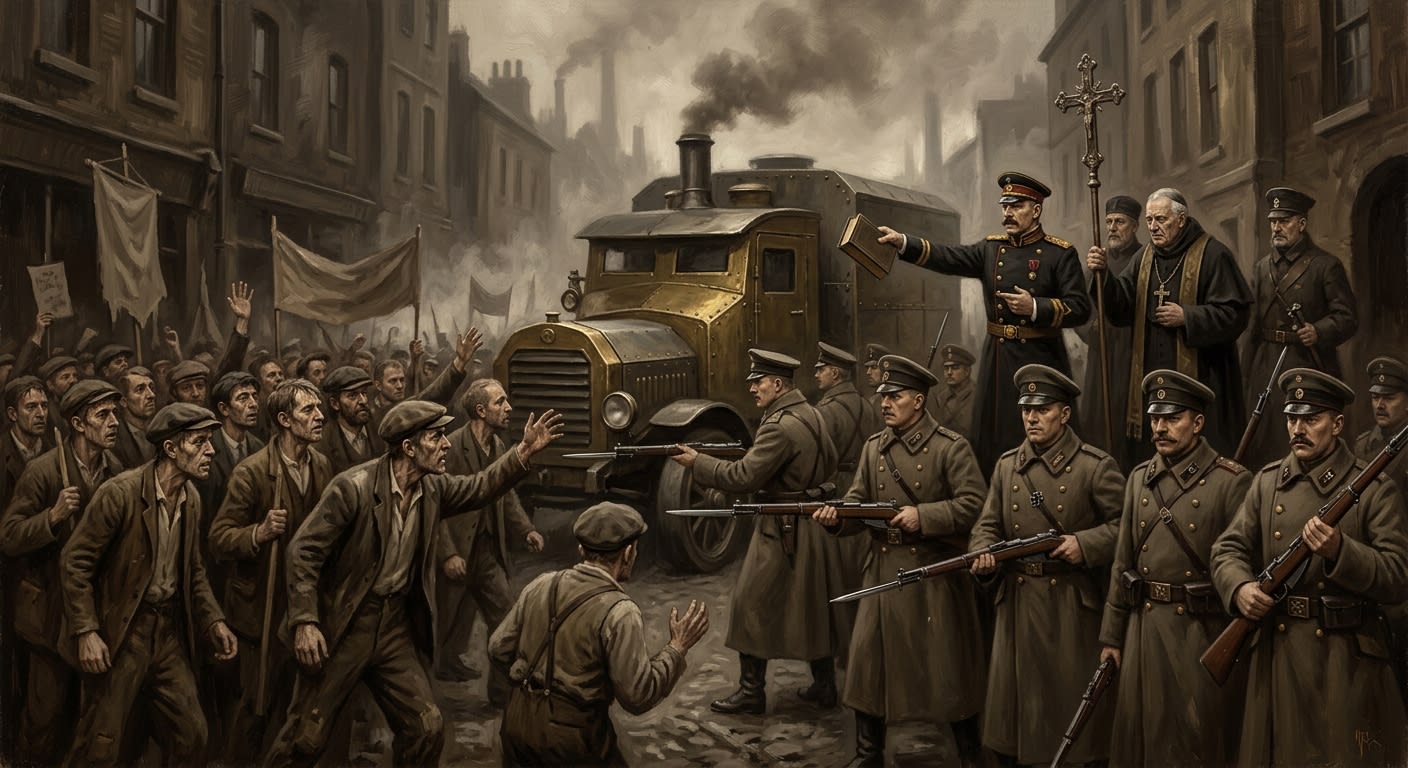
The first pot fell in Brest's North Mercy Yard on the fifth day after Epiphany. A Ward-Brother named Petren (Unregistered), whose later file was corrected into absence, announced that the black-zone ladle would be reduced to half-measure pending recalculation. A woman from the trench-laundries lifted her bowl and showed him its bottom. Witnesses disagree on her words. Records gives: “Then write hunger in it.” Mercy gives: “There has been a mistake.” Purity gives no quotation because Purity prefers motives to speech. A guard struck her. The queue moved as queues move when every body in it has been trained to stand still under insult: first inward, then forward, then without anyone's permission.
The pot overturned. Steam rose. Men dropped to their knees to scoop broth from the stones with cupped hands. A child was crushed against the serving rail. A soldier with one arm bit through the wrist of a guard who tried to drag him away from the spill. Petren rang the ward bell for assistance. In Brest, ward bells and alarm bells share a tonal family, because the Bureau of Bells enjoys economies that kill people. Two adjacent queues heard the sound and believed the granary had opened. They came running.
By nightfall, Brest's Mercy granary had lost three doors, two clerks, a cart of fortified broth bricks, and the comforting fiction that hunger respects queue ropes. The Bureau of War sealed the eastern streets. Purity arrested thirty-two suspected agitators, including nine who had been dead before arrest and one who was seven years old. Mercy issued a calm notice stating that distributions would continue according to revised schedule. The notice was pasted to a wall already wet with soup and blood. Bureau prose, even at its most serene, performs poorly when applied to masonry recently used as a skull.
#On the Three Cities
Brest provided the spark. Königsberg provided the cold. Przemyśl provided the tunnel echo that turned riot into doctrine.
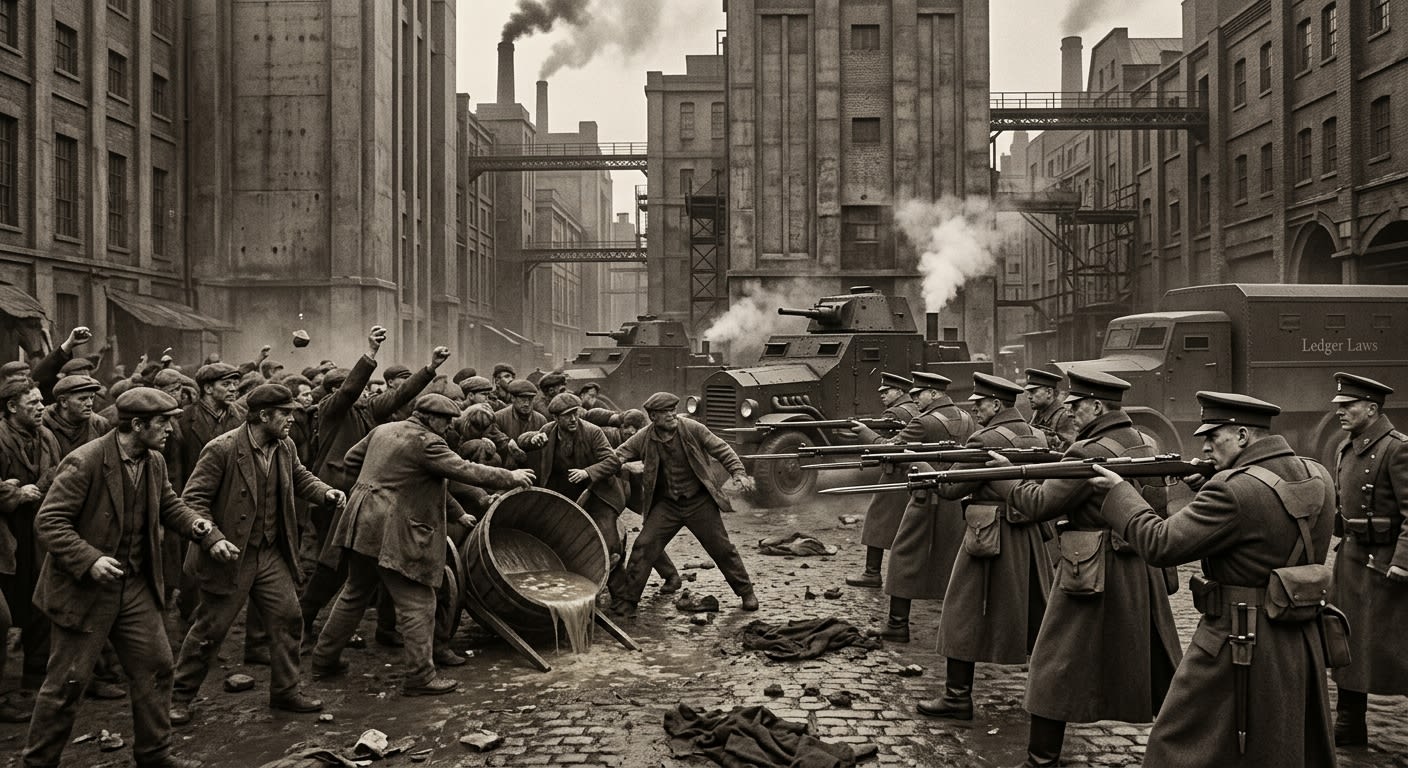
At Königsberg, the Mercy Ward attached to the Far Nail's western infirmary had already shifted to frost rations: hot brine at Lauds, ash-bread at Sext, broth at Vespers if the day ledger permitted it. The poor timed their hunger by bell. Soldiers learned to drink slowly because the bowl warmed the hands longer than it filled the belly. The queue for the Vespers pot wound past a Glass Skull Stack installed at the ration court after the early civic reforms, its lanterns burning behind sermon-clear crania, every condemned name watching the living consider illegality.
The pot never arrived.
A quartermaster convoy carrying barley, salt, and bone stock had been diverted to a War depot under emergency requisition. The Mercy Sister at the court, a woman later praised for calm and privately blamed for survival, announced substitution: heated water with marrow scrap, one cup per registered patient, no family collection, no secondary bowls. She held the ledger open while she said it. The gesture doomed her. A ledger, displayed before hungry people, resembles proof that someone had time to write down the theft.
They took the ration table first. Then the ladles. Then the Stack. A group of Mercy Cult sympathizers, or widows mistaken for a cult because they were moving in the same direction while angry, wrapped hammers in ration cloth and struck six glass skulls from the lower row. The names fell in pieces. Children gathered the shards because glass has value even when it has been watching you. A Pillar-Keeper tried to stop them and was beaten with his own alignment plumb. He survived. He later developed glass-speech and a hatred of soup.
Early Königsberg reports attributed the smashing of the ration-court Glass Skull Stack to imported Rationalist vandalism.
Corrected after witness reconciliation. The vandals were registered ward recipients, trench widows, discharged artillerymen, and two schoolboys whose fathers' names had been inked inside the same stack. Imported Rationalism was unnecessary. Local hunger sufficed.
Przemyśl's riot began under ground. Tunnel infirmaries there were fed by dumbwaiter, cart, and chain-bucket from surface kitchens. On the ninth day of shortage, a bucket reached Ward C-17 containing steam, two ladles of actual broth, and twelve ladles of water scented by having passed near bones. The wire-burned men laughed first. Laughter in a Mercy Ward is never a good sign. It means grief has found a knife.
A sapper with both hands bandaged kicked the bucket down the corridor. Men rose from cots. A Ward-Sister tried to stand in the passage with the ledger against her chest as if paper could stop bodies that had recently stopped shrapnel. They did not kill her. This is recorded as proof of lingering reverence for Mercy. It was more likely proof that the first man to reach her had a mother in another ward. Mercy benefits constantly from mothers it did not invent.
The tunnel crowd moved upward through stairwells and service ramps, collecting patients, orderlies, kitchen staff, porters, stretcher boys, and the professionally aggrieved. By the time it reached the surface, it had acquired a chant: Full ladle. Full measure. Full names. The last demand distinguished Przemyśl from Brest and Königsberg. Its wounded had noticed another hunger beneath the first. Dead men were being filed as fed. Absent men were receiving allotments on paper. Bowls assigned to the black zone vanished before reaching cots. The riot wanted food. It also wanted arithmetic to stop lying.
The Przemyśl Mercy granary stood for six hours. Its outer gate fell when a wagon tongue was used as a ram. Its inner gate held until someone produced the correct key. This detail has inspired much speculation and several hangings. I record only that hunger has a way of finding locksmiths who were invisible during breakfast.
#On the Bureaucratic Panic
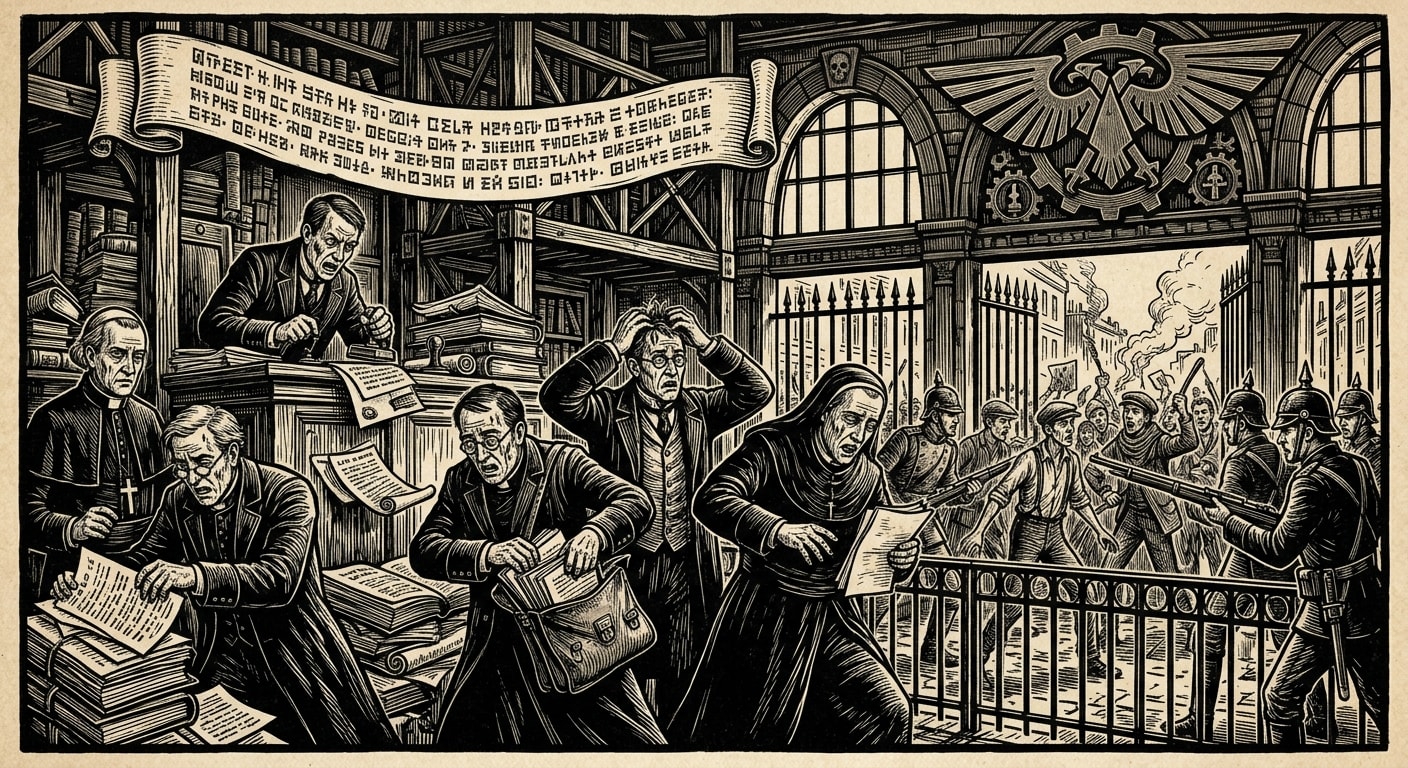
Strasbourg received the first consolidated notice on the second day and misunderstood it beautifully. The Bureau of Mercy reported ration-line disorder in Brest. The Bureau of War reported potential sedition near northern depots. The Bureau of Purity reported devotional contamination among ward queues. The Bureau of Records reported casualty uncertainty, which is the archival equivalent of screaming. Each Bureau read the others' notices and concluded that the crisis belonged primarily to someone else.
This lasted seven hours.
Then Brest's second granary burned, Königsberg's ration-court Stack went dark, Przemyśl's tunnel crowd seized three Mercy kitchens, and a Procession Marshal at Bastion-Brest sent a private field note whose first sentence possessed the rare virtue of usefulness: “The queue has ceased being a queue.” The High Synod convened before None. By Vespers the ministries had agreed upon the most sacred principle of joint governance: no one would accept blame until force had restored the conditions under which blame could be assigned safely.
The Bureau of War moved first. Infantry companies were ordered to protect granaries, ward kitchens, rail depots, and known soup-cauldron sites. The order sounds absurd only to readers whose cities have never depended upon cauldrons. A broth kitchen during famine is a treasury with steam. War understood this faster than Mercy did, which is why War has guns and Mercy has mottos.
Purity moved second, harder, and with the unpleasant confidence of an office that considers crowds guilty by shape. Arrest lists were drafted from ward ledgers: repeat petitioners, ration challengers, families with prior heresy marks, Mercy Cult associates, widows whose husbands had been condemned, boys recorded as “argumentative,” anyone who had used the phrase full measure within earshot of a clerk. In Königsberg, Purity detained the Pillar-Keeper beaten at the Stack on suspicion of permitting the symbolism of civic deterrence to suffer avoidable indignity. He was released after two days because his jaw had swollen shut and he could not confess properly.
Mercy moved third, slowly at first, then forever. Its senior clerks understood, with the cold little brilliance that makes institutions immortal, that the riots threatened the Bureau less than the explanation did. If the official story became “the people stormed granaries because the wards were hungry,” Mercy would be condemned for failure. If the story became “unrecorded distribution produced disorder,” Mercy would be empowered to record more. A Bureau's survival often turns on grammar. Mercy chose grammar and lived.
The acceptable language came by morning: Broth Riots. Grain riots would have implicated supply. Mercy riots would have implicated Mercy. Broth was perfect. Broth suggested kitchen, queue, heat, local disorder, emotional excess around a consumable liquid. It made the event smaller without denying it. I admire the phrase. I despise it. These positions coexist with no strain upon my conscience, which is well trained.
#On Eleven Days of Ladles and Rifles
The riots lasted eleven days because hunger is durable and because the Synod, in those early years of continental consolidation, had not yet perfected the art of correcting a crowd without manufacturing a martyr every twelve paces.
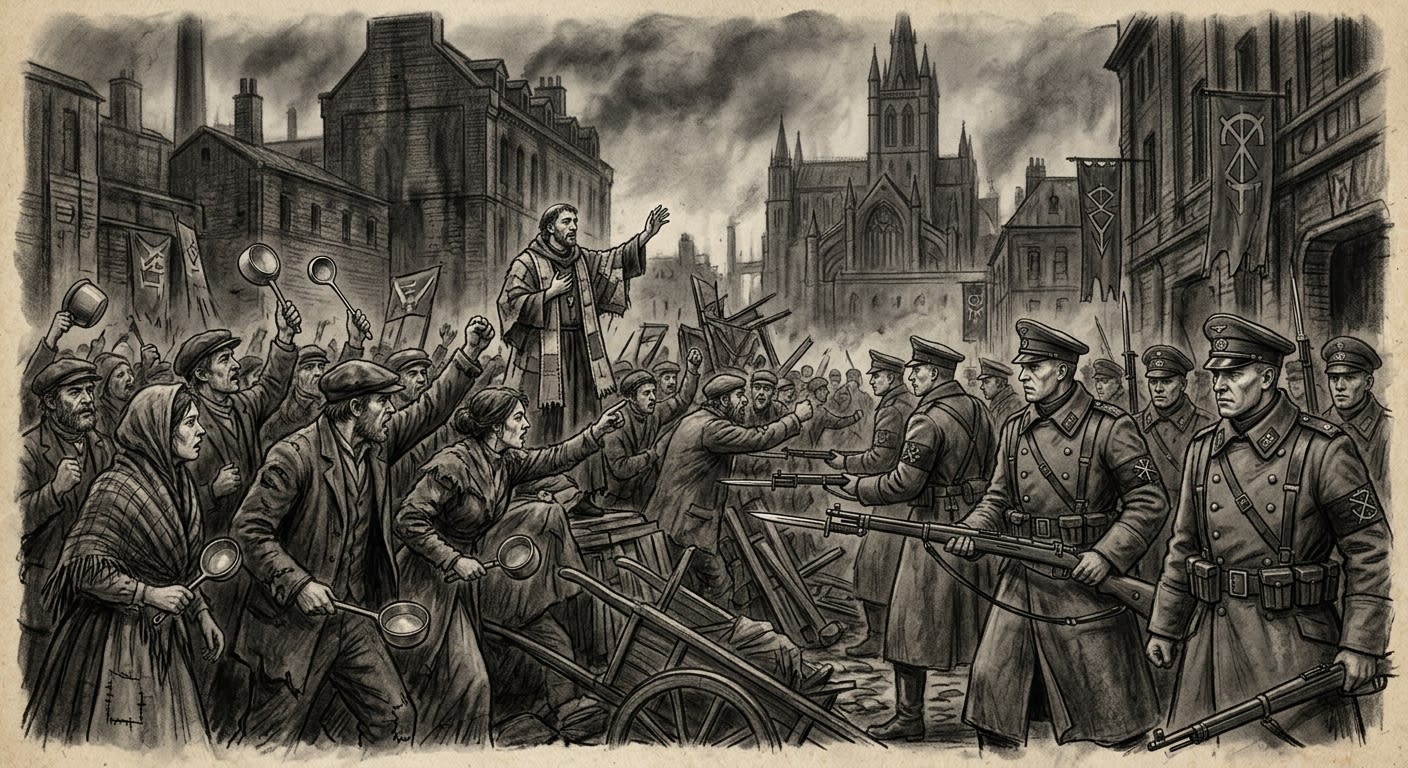
Day one belonged to the queues. Day two to the granaries. Day three to rumours. In Brest, word spread that Mercy had stored marrow bricks beneath the Cathedral of the Rationed Saints (Unregistered). False. The crowd tore up the crypt floor anyway and found old bones, which did nothing to satisfy hunger but improved the quality of curses. In Königsberg, a boy carried a glass skull shard through three districts, claiming that the name inside had changed to his mother's. The shard was confiscated. The boy was not found. In Przemyśl, tunnel wounded opened the black-zone larder and discovered shelves empty except for forms authorising supplies not yet delivered. The forms burned with pleasing efficiency.
Day four belonged to the first shootings. War companies at Brest fired above the crowd twice, then into it once. The official casualty count from that volley is fourteen. Mercy's intake log gives twenty-six treated, nine dead at arrival, five transferred, seventeen unentered due to lack of tags. Records reconciled this to fourteen by excluding those whose bodies crossed the ward threshold after the hour mark. Time, properly used, is an eraser.
Day five belonged to women. This appears in no public catechism because the Bureau dislikes admitting that its first serious negotiations were with ward widows who controlled the queues more effectively than any Marshal. In Brest, Mother Halvek of the Laundry Steps (Unregistered) stood on a broken ration table and ordered the crowd to sit. It sat. War officers, mistaking this for pacification, approached. She demanded full measures for children, burial names for the shot, and the return of three arrested broth-runners. She received two of the three. The third had already been transferred to Purity and into fog.
Day six belonged to theft. Ward stores vanished from locked rooms. Bandage rolls appeared in market stalls. Morphine drops moved through alley hands. Ladles were stolen for household use, symbolic use, weapon use, and, in one documented case, marriage dowry. Mercy later used the thefts as evidence that the Ledger Laws were required. The thieves used the same evidence to show that hunger had been real. Truth, when properly starved, feeds both sides.
PURGED TESTIMONY — PRZEMYŚL GRANARY COURT, A.S. 112 Witness states that black-zone patients were wheeled before the inner gate as proof of need. Gate captain ordered dispersal. Patients began singing the Mercy Line without tongues moving. Crowd knelt. Rifles lowered. Then ████████████████████████████████████. Subsequent acoustic inquiry sealed under Orison countermark.
Day seven brought the Cadence men. The Ashbread Stampede at Bastion-Brest occurred in the same famine season, at the northern grain depot, and its dead joined the riots in the public mind before any clerk could separate them. Twelve thousand petitioners had pressed into a yard built for three thousand; lane ropes snapped; the crowd folded; hundreds died. The Synod learned two lessons at once: hungry crowds must be fed, and if feeding failed, they must at least be arranged in shapes that killed fewer taxpayers per minute.
Day eight brought the chaplains, always late enough to be spiritual. Sermons were preached outside ward yards: patience, obedience, holy endurance, Saint Sabina's cloth, Saint Marrow's ladle, the sin of hoarding, the sin of doubting distribution tables, the sin of striking a Ward-Sister even when the Ward-Sister had just announced that your child belonged to the grey schedule. The sermons did little. Sermons rarely compete well with an empty stomach unless accompanied by bread, and the Synod was short of bread.
Day nine brought snow thick enough to make marches difficult and queues desperate. A truce of weather settled over Königsberg. Ward kitchens opened under guard. Full measures were given to registered children for one bell-hour. The crowd blessed the Bureau, cursed the Bureau, ate, and returned the next morning angrier because one full bowl teaches the body what it has been denied.
Day ten brought arrests at scale. Purity struck before dawn in all three cities. Lists in hand. Doors broken. Ladles confiscated as riot instruments. Ward-runners questioned. Mercy clerks protected if useful, sacrificed if conspicuous, promoted if they had written enough. The old Mercy hands knew the rule: in scandal, the first ledger offered upward must contain someone else's name.
Day eleven ended with distribution under rifles. The pots returned. The measures were visible. Each ladle was counted aloud. Each recipient's name was called. Each bowl marked. Each guard watched the line, and each citizen watched the guard, and above them all the Bureau watched the numbers settle into obedience.
#On Saints Manufactured by Hunger
The Broth Riots gave Mercy its laws, and laws, being vulgar things, required saints to make them palatable.
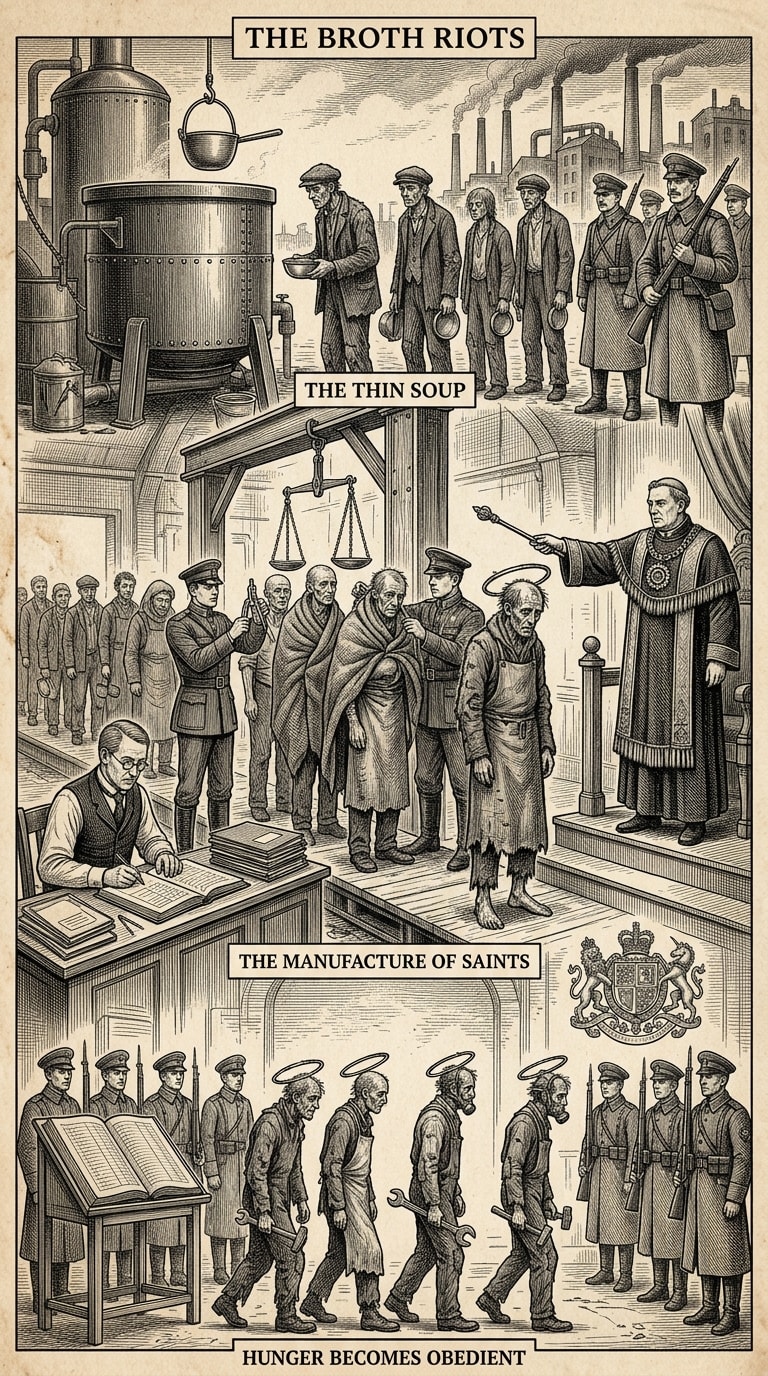
Saint Sabina already belonged to wounds: cloth torn in Saint-Malo, fever, field tenderness, the founding perfume of the Bureau. She could not bear the ladle alone. Hunger needed a kitchen saint, a bowl saint, a patron of measured compassion who could stand above a ration table and make the counted half-cup look sacramental. The wards supplied Saint Marrow-of-the-Ladle, or Mercy discovered Marrow there, or Doctrine noticed Marrow's usefulness and permitted history to grow around a pot-stain. The distinction is fit only for historians, a class permitted by Providence so the rest of us may feel decisive.
Marrow's legend hardened in the years after A.S. 112: the empty ward stores, the winter roads closed, the last marrow bones cracked under prayer, the dented helmet used as chalice, the pot diminishing slower than inventory predicted. This is a miracle designed by people who have reconciled kitchen ledgers. Its wonder lies in variance. No endless abundance: delayed depletion. A saint for administrators. A saint for ward-hands who know that one more ladle can be the difference between human and howl.
The Feast of Saint Marrow would later promise, in hymn and poster, that no one leaves hungry. The footnotes corrected the promise into registered ward recipients, authorised serving windows, ration availability, conduct certification, and ladle reconciliation. The hymn survived. Hymns always survive the clauses that make them honest.
Saint Varric entered the same season by another road. The pilgrim-chain had been introduced in A.S. 109 after retention failures across three Jubilee seasons. In A.S. 112, while Mercy counted ladles and War counted bodies, the Bureau of Pilgrimage formalised the Pilgrim-Chain Handler profession and adopted Varric as patron. This was not coincidence. The Synod had discovered a doctrine broad enough for both bowl and chain: count the body, bind the discrepancy, sanctify the pain, sell the rite afterward.
The ash-wrist commissioning of the Handler and the ladle-count oath of the Ward-Sister are cousins. One marks the wrist that holds the key. The other marks the hand that serves the bowl. Both pretend that ritual softens arithmetic. Both work, which is the damning part.
Several Mercy primers imply that Saint Marrow's cult predates the Broth Riots in stable institutional form.
Clarified. Local kitchen invocations may be older. The approved Marrow devotion, including ward icons, ladle blessings, ration variance absolution, and sanctioned helmet-chalice imagery, gained force after A.S. 112 because riots require patrons once they have been renamed reforms.
#On the Ledger Laws
The Ledger Laws were promulgated before the soot had been washed from Brest's granary doors. Mercy calls this efficiency. I call it haste with a clean collar.
Their first line is the whole system in miniature: Mercy without record is indulgence. The second line closes the trap: indulgence without sanction is heresy. After that the articles multiply like lice in a pilgrim blanket. Every ladle counted. Every pot sealed. Every bandage measured. Every draught signed. Every confession packet routed. Every death tied to cot number, zone, allotment, and disposition. Every ward divided into clean, grey, and black with allocation percentages expressed in figures sterile enough to survive contact with starvation.
Clean received full allotment because recoverable citizens justified expenditure. Grey received seventy per cent because uncertainty irritates budgets. Black received sufficient because terminal, contagious, anomalous, and politically inconvenient bodies have always been asked to cooperate with adjectives.
The laws also mandated visible reconciliation. A ward could no longer merely serve. It had to demonstrate serving. Ladle strokes were counted aloud during shortages. Serving tables required witness clerks. Broth books were string-tied at shift end. Ration variance beyond minor degree required explanation, prayer, and, if the number embarrassed Mercy, a culprit. Soup became sacrament by audit.
The black genius of the Laws lay in their answer to legitimate grievance. The people had rioted because bowls were empty. The Bureau answered by proving bowls would henceforth be documented. The people had demanded full measures. The Bureau answered by defining measure. The people had demanded names for the dead. The Bureau answered by tying every death to a tag, so long as the dead had presented the proper tag before dying. A complaint against hunger became a system for knowing precisely who was hungry, when, under whose supervision, and whether the hunger could be filed as useful.
The laws spread beyond Mercy with indecent speed. Tithes issued Ration Directive 14-C (Unregistered) in the same legislative season, codifying scales, brine stones, receipt blanks, and armed escorts. Pilgrimage formalised Handlers. Rites ordered confession booths at a density of one per three blocks. Civic Cadence, blooded by the Ashbread Stampede, began arranging bodies before bodies could arrange themselves. The Broth Riots were the hinge. Before A.S. 112 the Synod often controlled by decree after crisis. After A.S. 112 it learned to turn crisis into permanent measurement.
The Bureau of Mercy became, after the Laws, less tender and more honest. Its wards saved lives. Its ledgers ruined families. Its Ward-Sisters carried hidden salt because official allocation remained too pure to feed actual children. Its Ward-Brothers learned to reconcile ghost bowls for patients not listed because some hungers arrive without paperwork. Mercy fraud began the morning after Mercy law. The Bureau condemned the fraud and depended upon it. A system too rigid to bend recruits criminals to perform mercy in its joints.
#On Memory, Glass, and Public Correction
The Broth Riots could not be forgotten. Too many people had eaten from the stones. Too many names had vanished between ward and ditch. Too many glass skulls had been broken in ration courts where civic terror was supposed to stare downward and discipline the queue. Forgetting requires either small numbers or very large fires. A.S. 112 had neither in adequate proportion.
The Synod chose arrangement.
In the immediate aftermath, public notices described disorder instead of famine; distributional anxiety instead of hunger; local disturbances instead of coordinated collapse. The word riot remained because denial would have insulted too many witnesses. Broth remained because it kept the event low to the ground. The dead were entered by district, bell-hour, and cause compatible with future litigation. The shot became casualties of crowd pressure. The crushed became casualties of distribution irregularity. The starved became pre-existing weakness aggravated by weather.
Glass Skull Stacks multiplied later under the A.S. 143 Visibility Standards (Unregistered), but their municipal theology was born in this season: the city must see what happens when bodies forget their assigned place. At bridges, gates, ration courts, school entrances, and tribunal approaches, deterrence became daily street furniture. The Stacks are often treated as instruments of Purity. Their placement owes as much to Mercy's terror of queues. A hungry line passing beneath glowing condemned names is being fed two rations at once: broth for the stomach, warning for the spine.
Pillar-Keepers know the connection even if Civic Doctrine files it elsewhere. The worst stacks to maintain are ration-court stacks. Their glass fogs from steam and breath. Their lower skulls chip more often. Their alignment bribes come in oil-vouchers and bread because poor districts pay with what poor districts possess. During famine anniversaries, prayer strips appear on them for the hungry who died uncondemned and received no display rights.
Mercy Cults also trace one root to A.S. 112. Not the foreign Rationalist infection once alleged by excitable men with travel budgets. Indigenous compassion, unsanctioned, stubborn, fiscally inconvenient. Cells formed around broken Stack sites, ward back doors, salt bundles, contraband bowls, and the belief that a hungry child does not require registration to deserve soup. Purity classifies this as theological error, Category: Compassion. A phrase of enviable accuracy.
The anniversaries remain troublesome. In Brest, widows leave overturned bowls near the northern grain depot until Procession Marshals remove them before Prime. In Königsberg, children still dare one another to lick frost from empty cups beside the ration court. In Przemyśl, tunnel ward-hands tap Full measure in old pipe-code when the black-zone pot arrives thin. Mercy reprimands. Purity observes. Doctrine permits limited local grief so long as it does not become arithmetic.
#On the Present Use of the Riots
As of A.S. 201, the Broth Riots are invoked by every Bureau that learned the wrong lesson correctly.
Mercy invokes them to defend the Ledger Laws, clean-grey-black zoning, ladle reconciliation, confession routing, and the pleasant cruelty of saying sufficient over a dying man. War invokes them to justify armed guards at granaries, convoy kitchens, ration depots, and ward yards. Purity invokes them to monitor Mercy Cults, queue rhetoric, kitchen songs, widow gatherings, and any phrase containing full measure when spoken by more than three people at once. Tithes invokes them whenever grain-weight receipts require escort. Pilgrimage invokes them indirectly through Handler licensing, because the same year that taught the Synod to count bowls also taught it to count chained bodies with less apology.
The Ward-Sisters remember differently. Their professional memory is not kept in charters. It lives in salt hidden under apron seams, sweets tucked behind ledger boards, ghost bowls issued to invented cot numbers, extra ladles scraped for children whose papers expired at the wrong gate. The Bureau calls these infractions. The wards call them keeping the line from becoming 112 again.
Saint Marrow smiles from the kitchen wall, ambiguous as gravy. Saint Sabina bleeds above the bandage shelf. Saint Varric drags his chain in the departure yard. The three of them preside over the modern settlement: cloth for the wound, ladle for the hunger, chain for the body that must be moved even while suffering. If this trinity offends you, good. Some doctrines should leave bruises.
I have inspected the Brest yard where the first pot fell. The stones have been replaced. Of course they have. Institutions love replacement stone. It has no memory until one is supplied by plaque. The plaque reads: Here Order Restored Mercy, A.S. 112. Below it, someone had scratched with a nail: Full ladle. The letters were small, ugly, and badly spaced. I admired them more than the plaque.
At Königsberg, the ration-court Stack has a lower row of newer glass. The replacement skulls shine too clearly. Fresh civic terror always has that polished look, like a novice executioner proud of his apron. The Pillar-Keeper told me the wind there still makes a bowl sound. He apologised after saying it, as if observation were impiety. I told him impiety requires confidence. He looked relieved. That was not my intention. It may count as Mercy if reported by a sympathetic liar.
At Przemyśl, Ward C-17 still receives buckets by chain. The kitchen has three locks now, two Mercy, one War. Each bucket descends with a tag, a seal, and a bell-tap. The men below joke that the tag weighs more than the broth. They laugh, which means the system is either functioning or about to be bitten.
The Broth Riots ended when the pots returned under guard and every ladle was counted aloud. That sentence appears in school primers. It is tidy, false in spirit, useful in examinations. The riots ended in law, in habit, in saints, in queues that learned to fear their own pressure, in Ward-Sisters who keep illegal salt, in glass skulls angled toward ration courts, in children taught that mercy has a measure mark, in the little pause before a clerk tips the ladle and decides whether the bowl receives warmth or explanation.
The pot scrapes. The line listens.