
#On the First Line
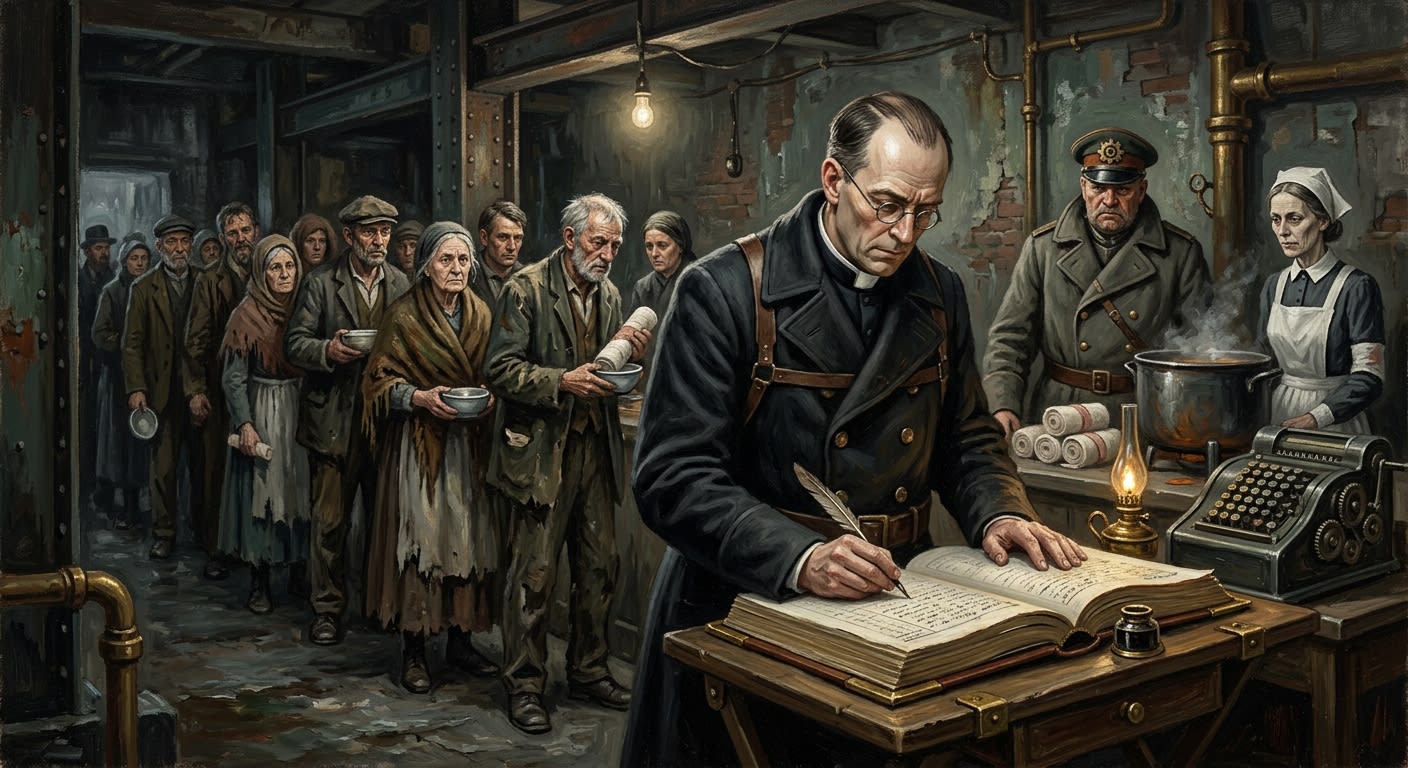
The Ledger Laws begin with a sentence so clean that one suspects the author had never served broth to a starving man: Mercy without record is indulgence. The second line tightens the collar: Indulgence without sanction is heresy. The third prescribes punishment in a hand too steady to have been innocent. I have always admired the construction. Two theological claims, one administrative trap, and then the boot.
They were codified in A.S. 112, in the ash and steam after the Broth Riots, when famine-season shortages across Bastion-Brest, Bastion-Königsberg, and Bastion-Przemyśl made Mercy Wards into battlefields and made bowls more dangerous than banners. The people asked for food. The Bureau answered with law. Vulgar minds call this evasion. Senior minds call it government.
Before A.S. 112, mercy in the Synod possessed forms, habits, kitchen rules, ward customs, and the broad sanctified panic that follows any institution built by widows, field nuns, failed apothecaries, amputee orderlies, and priests clever enough to learn that pressure on a wound outranks sermon. After A.S. 112, mercy acquired teeth with serial numbers. Every ladle, bandage, draught, death, confession packet, cot number, linen length, ration class, and ward-zone transfer became recordable. What could be recorded could be audited. What could be audited could be punished. What could be punished could finally be called compassionate without endangering Order.
The name misleads by modesty. A bookkeeping rule tells a clerk where to place a column. The Ledger Laws told a civilization where to place suffering. They made compassion legible, rationable, transferable, contestable, and prosecutable. They transformed the Bureau of Mercy from a wounded charity into an administrative organism of continental scale. They gave Tithes its receipt discipline, Pilgrimage its chain logic, Records its ward witnesses, Purity its suspicion hooks, and Doctrine, naturally, the pleasure of explaining why all of this had been merciful from the beginning.
The first line is still recited in training halls. Novices tend to say it softly, as if apology improves doctrine. Veterans say it while counting. The best ones say nothing and move the line. Silence, in a ward, is often the only honest commentary left.
#On the Hunger That Required Law
The Broth Riots began with shortages and became doctrine because the Synod excels at converting embarrassment into precedent. Winter convoys stalled. Grain rotted in lawful custody. Mercy pots thinned. At Brest, a northern yard pot spilled, and men who had waited three bell-hours for warmth saw the liquid vanish into stones already cleaner than their children’s faces. At Königsberg, the ration-court Glass Skull Stack was smashed by people tired of receiving moral instruction from polished remains. At Przemyśl, Ward C-17’s tunnel queues broke under reduced measure and the excellent pressure of fury.

Eleven days followed: ladles stolen for weapons, ward stores emptied, bandage rolls appearing in markets, morphine drops changing hands in alleys, granary doors blackened, rifles raised, saints invoked, and several thousand people learning that hunger makes poor legal counsel. War restored order with powder. Purity restored silence with arrests. Mercy restored obedience with ledgers.
Early Mercy notices described the Broth Riots as “distributional anxiety aggravated by weather.”
Corrected for internal instruction: the bowls were empty, the people knew they were empty, and the Bureau’s first error was allowing emptiness to remain insufficiently documented.
The laws were promulgated before the soot had been washed from Brest’s granary doors. Haste is unbecoming in private persons and indispensable in victorious offices. Mercy could not admit that its wards had failed through scarcity, confusion, and the ancient human flaw of having stomachs. It admitted instead that mercy had lacked uniform documentary discipline. This was safer. Scarcity accuses policy. Indiscipline accuses staff.
A.S. 112 was already crowded with remedies. The Booth Proliferation Decree mandated one confession booth per three blocks. The Ashbread Stampede at Bastion-Brest founded the Cadence Corps after bodies folded inward in a ration yard built for three thousand and filled with twelve. The Fuel Monopoly Acts put wound-site extraction under licensed appetite. The Pilgrim-Chain Handler profession hardened into law. Tithe Assessors received Ration Directive 14-C (Unregistered). A lesser historian would call this coincidence. A competent one sees the season’s true discovery: every crisis could be answered by counting something and punishing the discrepancy.
Mercy’s specific disgrace gave the general lesson its warmest body. A mob burns out. A form reproduces. The hungry had occupied yards for eleven days. The Ledger Laws have occupied Europe for eighty-nine years.
#On the Articles of Measure
The Articles of Measure (Unregistered) form the Laws’ visible spine. They command that all ward distribution be registered by bell-hour, vessel, measure, serving hand, receiving body, ration class, and witnessing mark. No pot may open without seal. No ladle may serve without visible mark. No cloth may leave the linen room without tally. No draught may be administered without signed measure. No death may be completed, in the public sense, until the ledger has received it.
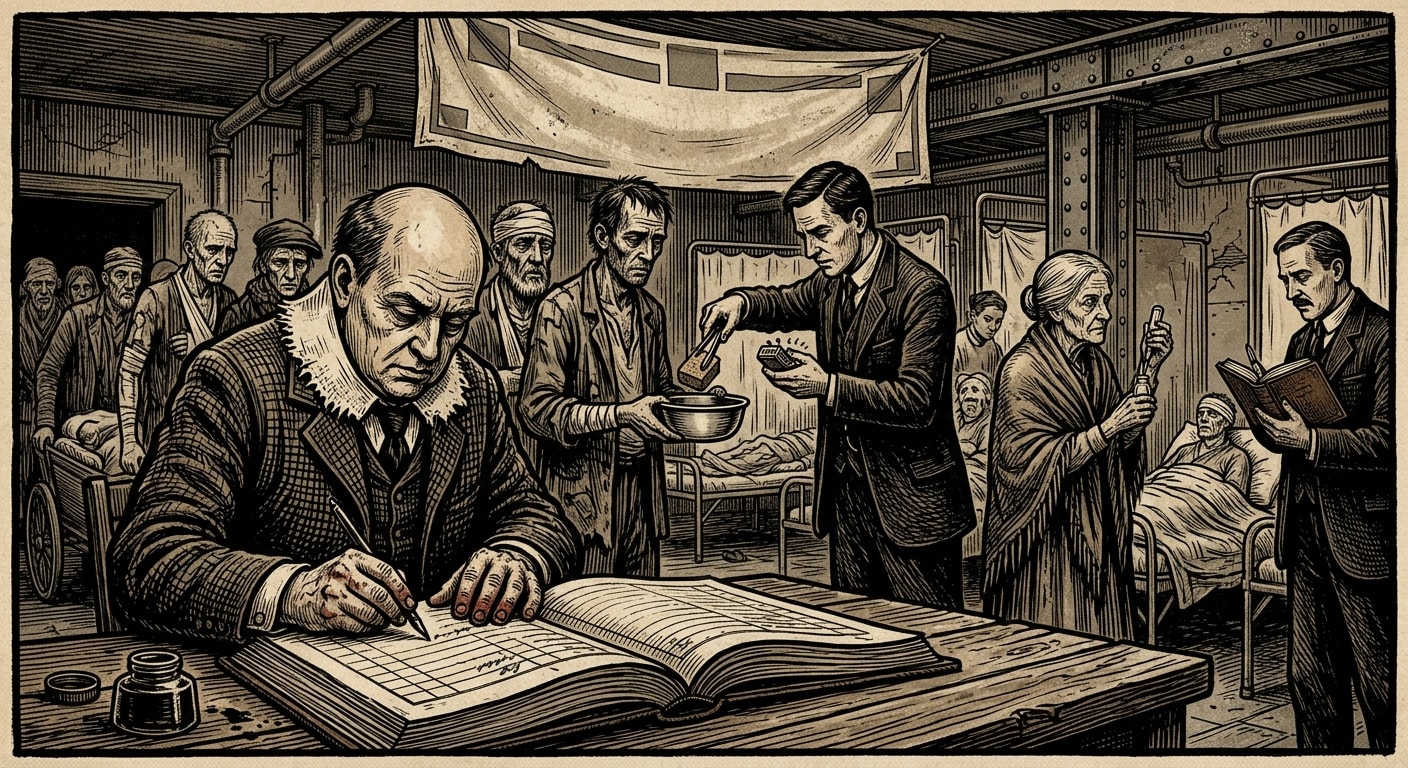
The ladle became the first sacrament of counted compassion. Its bowl bears a measure line. Its handle bears a ward serial. Its use is counted aloud during shortage, because a sound shared by the queue is harder to dispute than ink written afterward by a nervous Sister. A full ladle is defined by mark, angle, authorized thickness, ration class, and whether the patient remains alive long enough to matter statistically.
Bandages received their own humiliating arithmetic. Length, width, weave, prior contamination, reuse class, burn allowance, and salvage possibility. Novices imagine a bandage covers a wound. Ledgers know better. A bandage covers liability first; the wound benefits if properly entered.
The Laws also established visible reconciliation. Mercy could no longer merely feed. It had to demonstrate feeding. Witness clerks stood beside serving tables. Broth books were string-tied at shift end. Ration variance beyond minor degree required explanation, prayer, and, when prayer failed to improve the numbers, a person small enough to blame. In better wards the culprit was spillage. In worse wards the culprit was a girl with tired hands.
Clean, grey, and black zoning entered final discipline through the same settlement. Clean received full allotment because recoverable citizens justified expenditure. Grey received reduced allotment because uncertainty irritates budgets. Black received sufficient because terminal, contagious, anomalous, and politically inconvenient bodies have always been asked to cooperate with adjectives.
The Articles left need alive and made it presentable. A ward might still run thin, but it ran thin in columns. A patient might still die waiting, but waiting could now be categorized as pending care, deferred transfer, unverified entitlement, or pre-disposition decline. Words fed no one. They did keep knives from the kitchen door.
#On the Confession Packet
The Ledger Laws bound Mercy to confession with a firmness that even Rites envied. A body receiving care is a body made porous by pain, fever, hunger, fear, and the shame of dependence. Such a body speaks. It mutters hidden coin, illicit children, ration fraud, unauthorized hymns, old oaths, false names, unregistered births, contraband salt, and the particular doctrinal doubts that flourish near death because the dying assume consequences are nearly done with them. This is naïve. Consequences are clerical.
Under post-Law protocol, the Ward-Sister listens while working. Her hand wipes the mouth. Her other hand writes. The packet moves by tray to Records, by extract to Purity, by assessment to Tithes, by whisper to whichever office has cultivated the staff properly. The patient receives pastoral attention. The state receives usable speech. Salvation and intelligence share a desk; both complain about ink.
A pre-A.S. 134 instruction told ward staff to “comfort the dying so that the soul may depart unburdened.”
Revised after later Mercy evidentiary disputes: “Facilitate voluntary disclosure in a pastoral context.” The pillow has not changed. The quill has been sharpened.
Families objected, as families always object when they discover that love is not a recognised evidentiary shield. Mercy answered that confession cleans the soul. Records answered that names prevent dispute. Purity answered nothing and waited in the corridor. Tithes answered by collecting arrears identified in final breath. Doctrine answered by explaining that death does not end liability; it perfects delivery.
The packet created a new category of terror: useful dying. A dead father might ruin a son’s inheritance by confessing hidden grain. A fevered mother might expose an unregistered child. A soldier might name a deserter already wearing another man’s boots. Ward staff became beloved and feared in equal measure because the hand that brought broth might also deliver the family to audit by dawn.
MERCY PACKET REVIEW — BLACK-ZONE, A.S. 134 Patient: unnamed female, ration class grey amended to black. Final words included six names absent from natal ledgers, one street that does not exist, and a lullaby later matched to █████████████. Ward-Sister continued writing after candle failure. Packet routed: Records / Purity / Orison / sealed fourth office. Family notified of Departure only.
There are critics who call this monstrous. They are often correct and seldom useful. The Laws inherited the dying confession, gave it wheels, cleaned its arrival, and sharpened its bite. Informality is where pity hides. Formality is where power learns to walk without mud on its hem.
#On the Ward-Sister Under Law
The Mercy Ward-Sister and Ward-Brother are the Ledger Laws made flesh, apron, ink-stain, and sleeplessness. Their uniform speaks the settlement: grey apron for humility, white sleeve for visible contamination, corded badge for authority conditional upon the next audit. Their tools are humble and dreadful: marked ladle, bandage shears, disinfectant, ward bell, stamp kit, ration chits, string-tied ledger, and the expression of a person who has learned to postpone feeling until after reconciliation.
At Lauds the Sister washes hands, wrists, nails, and the cracks where antiseptic hides judgement. She counts ladles. She checks seals. She opens the broth line with approved consolation in her mouth and a number in her head. By midday she triages carts, coughing pilgrims, trench-rot soldiers, families with expired papers, boys whom Conscription has found medically disappointing but still politically edible. By evening she reconciles bowls to bodies, morphine drops to signatures, linen to laundry returns, deaths to tags. At night she lies for mercy if she has courage, lies for profit if she has rot, and lies to herself if she wishes to sleep.
The Laws divide ward culture into soft hands and iron sleeves. Soft hands arrive believing compassion is a flame. Iron sleeves know it is a ration, and rations must be guarded against auditors, thieves, saints, children, Purity, and one’s own better impulses. Cynicism is a luxury of observers. The ward staff are participants. Their backs ache in the grammar of doctrine.
Fraud bloomed the morning after Law. Ghost bowls registered for patients who did not exist. Split signatures for draughts sent where allocation forbade. Salt hidden under apron seams. Recovery slips backdated. Quarantine passes delayed one bell-hour so a daughter could arrive. Extra linen vanishing into black-zone cabinets. Mercy calls these infractions. Ward-hands call them breathing.
Corruption grew beside tenderness, as weeds grow beside herbs because soil lacks moral education. Soup-Snitches sold confession scraps. Pity-Clerks withheld clean-zone tags. Black-Zone Specialists discovered that deaths can be misfiled profitably. Quarantine Masters sold exemptions to the beautiful, connected, bribing, and useful. The Laws made mercy accountable. Accountability made mercy valuable. Value attracted vermin. The Bureau was shocked in the formal sense and prepared in the practical one.
The better Ward-Sisters know how to cheat cleanly. The best know when to let themselves be caught for something small so the larger mercy survives. This is advanced holiness and poor career management.
#On Tithes, Chains, and the Spread of the Laws
The Ledger Laws began in Mercy and escaped immediately. Good procedures do. Bad procedures also do, but with less flattering minutes.
The Bureau of Tithes recognized kinship at once. In the same legislative season, Ration Directive 14-C prescribed the Tithe Assessor’s folding scale, brine-testing stone, receipt blanks, escorts, and grain-weight discipline. Loss or unauthorized duplication of receipt blanks became a Category 3 offence under the Ledger Laws. This was jurisdictional theft performed in daylight. Mercy had written that distribution without record was heresy. Tithes replied that collection without record was revenue left wandering near temptation. The two Bureaus embraced like creditors at a funeral.
The Tithe Assessor’s receipt blank is the Ledger Laws’ lean cousin. A bowl proves mercy delivered. A receipt proves burden extracted. Both protect the office first and the subject afterward if space permits. Both despise absence. Both create criminals from missing paper with a speed once reserved for miracles.
Pilgrimage learned the same lesson with bodies. Chains had entered Jubilee use in A.S. 109 after retention failures; by A.S. 112 the Pilgrim-Chain Handler stood formalised, ash-wristed, ranked, licensed, and assigned Saint Varric of the Twelve Blisters as patron. The Handler counts linked bodies as the Ward-Sister counts bowls. One wrist holds a key; one hand holds a ladle. Both pretend ritual softens arithmetic. Both are lying. Both are necessary.
Saint Varric’s cult entered the season because pain needed a clean icon. Saint Marrow served the bowl: ration, warmth, the hand that measures compassion while the pot steams. Varric served the chain: custody, road, blister, obedience while the column limps. Together they supplied the Laws with faces kinder than their clauses.
Hospices of Departure absorbed the dosage logic. The black elixir now measures weight, age, fever state, confession status, ration class, and witness mark under tables sharpened by A.S. 112 discipline. Departure became death with a receipt. Records approved with indecent enthusiasm. Families learned that a clean death paper could matter more than a final kiss, which is why civilisation requires supervision by persons with my gifts.
#On Saints Made Useful
No law survives by threat alone. Threat exhausts. Saints refresh the hand that signs.
Saint Marrow-of-the-Ladle is the Laws’ domestic mask. Canonically approved, historically fogged, commercially vigorous, Marrow appears over broth pots across the Synod: bearded monk, blind matron, skeleton in apron, ambiguous kitchen saint with helmet-chalice lifted like a joke Heaven has agreed to tolerate. The legend says Marrow fed a ward from a pot that diminished slower than inventory predicted. Relics, in one of its saner moments, ruled that miracles may occur through accounting variance when the variance exceeds plausible theft.
Marrow’s feast promises that no one leaves hungry. The footnote corrects the hymn: no registered ward recipient leaves hungry within the feast perimeter during authorised serving window, subject to ration availability, conduct certification, and ladle reconciliation. The hymn survives because tunes dislike clauses.
Mercy catechisms once printed “no one leaves hungry” without qualification.
Clarified for authorised teaching: no registered ward recipient within the feast perimeter leaves hungry during the serving window, subject to ration availability and conduct certification. Popular editions may retain the shorter lie where morale requires music.
Saint Varric is the Laws’ road mask. His Twelve Blisters sanctify custody pain. His chain-halo makes restraint look luminous. His ash-wrist rite tells Handlers that the raw places under their cuffs participate in a holy pattern, which is a pleasant way of saying that office will injure them and then sell them an icon of the injury. The same year that taught Mercy to count bowls taught Pilgrimage to count suffering in links.
Saint Ysolt of the Scales stands near Tithes, measuring pity until pity pays. Saint Sabina of Ghent remains Mercy’s cloth and wound. Blessed Vellum-Anna hovers over deathbed leaves. A whole patronal cabinet grew around the Laws because bureaucracy without saints looks naked, and no one wants to see that before breakfast.
Doctrine did not invent all of these cults. It did something better: it approved, redirected, taxed, footnoted, and placed them in useful relation to forms already printed. In this, as in most things, Doctrine displays the theft-quality of genius.
#On Mercy Cults and Full Measure
The Ledger Laws created enemies by defining mercy too narrowly for human use. Some enemies wore knives. The dangerous ones carried salt.
Mercy Cults trace one root to A.S. 112: indigenous compassion, unsanctioned, stubborn, fiscally inconvenient. Cells formed around broken ration courts, ward back doors, hidden ladles, contraband bowls, salt bundles, widow kitchens, and the belief that a hungry child does not require registration to deserve soup. Purity classifies this as theological error, Category: Compassion. A phrase of enviable accuracy.
The phrase full measure became a watchword. Spoken once, it means nostalgia or complaint. Spoken by three persons within hearing of a queue, it becomes fileable. Sung, it becomes Orison business. Scratched beneath a ration-court skull, it becomes Purity. Written in a ward ledger where the official allotment reads sufficient, it becomes either martyrdom or bad pen control.
PURITY OBSERVATION — BREST NORTH MERCY YARD, A.S. 188 Three women exchanged salt packets under apron fold while reciting approved Marrow prayer. Audio review detected added phrase: “Full measure for the unnamed.” One woman registered dead A.S. 186. Packet contents: salt, ash, child’s tooth, ███████████. Recommendation: observe until distribution chain exposes kitchen.
The Bureau’s answer was selective cruelty. Crush every contraband bowl and the wards ignite. Permit every ghost ladle and the Laws become theatre without teeth. Wise administration trims, prunes, displays one body, transfers two Sisters, ignores three grandmothers, and taxes the feast stall on the way out. Hypocrisy is the moralist’s word. Administration is horticulture with arrests.
Mercy-first staff protect the wards from becoming machines with lungs. Ledger-first staff protect the wards from plague, riot, Purity intervention, and the fatal romance of good intentions. Both factions are correct at intervals chosen by disaster. The Laws survive because they give each side language to accuse the other while continuing the work.
#On Present Enforcement
As of A.S. 201, the Ledger Laws remain active across all registered Mercy Wards, Hospices of Departure, ration kitchens, terminal rooms, black-zone annexes, Pilgrimage chain-yards, Tithe receipt offices, and those unlovely hybrid spaces where a patient becomes a debtor before becoming a corpse. Seven hundred and twelve Mercy Wards claim compliance. Forty-three are disputed by Records on grounds of absent paperwork, vanished staff, impossible addresses, or the stubborn refusal of certain buildings to appear where their charters insist they stand. Mercy insists the wards exist. Records insists existence should submit quarterly proof. Both are right enough to be irritating.
Front-line strain has made the Laws harsher and more porous. At Königsberg broth freezes in transit and counts as issued if thawed before witness. At Brest ration lines pass under glass skulls and move faster for it. At Przemyśl tunnel wards count buckets by chain-tap. At Irongate patients arrive with teeth vibrating from the Gasket Choir, confusing draught measures when mouths will not stay still. At Shipka sleepers wake under prior-day status and argue with clerks who have no column for temporal discourtesy. At Bastion-Constantinople, the Laws do what all laws do under enough pressure: survive by pretending exceptions are categories.
Audits are frequent, theatrical, and feared. An audit party enters with dry sleeves, sealed scales, comparison ledgers, Purity observer, Records witness, and Mercy superior whose face already knows which subordinate must be offered. Pots are checked against seals. Ladles against marks. Linen against cupboards. Deaths against tags. Confession packets against tray count. Ghost bowls against the smell of children in alleys.
The Laws have their own occupational diseases. Staff dream in columns. Sisters count spoon strokes in taverns. Brothers cannot pass a crying child without assessing ration class. Hospice witnesses hear final breaths as docket closures. Tithe Assessors stroke receipt blanks while listening to widows. Handlers count linked pilgrims in sleep and wake furious at imaginary discrepancies. Doctrine calls these signs of vocational internalisation. The body calls them damage, which is less elegant and more honest.
The public respects the Laws in the manner citizens respect a winter bridge: by crossing carefully and cursing the builder after reaching the far side. Families keep papers dry. Patients learn their ration class before their diagnosis. Ward-hands hide salt in places auditors dislike touching. Children in Mercy districts play reconciliation, a game in which one child serves mud soup and another shouts variance until someone cries.
#On the Ratification of the Bowl
The Ledger Laws endure because they answer a real terror. Unrecorded suffering breeds riot, plague, heresy, fraud, abandoned bodies, stolen rations, false saints, bad songs, Purity sweeps, War cordons, and mothers with nothing left to lose. Recorded suffering breeds many of the same things, but in sequence, with offices alerted.
That is the defence. It is ugly. It is also stronger than the sentimental alternatives offered by people who have never stood between one pot and four hundred mouths.
I decline to pretend the Laws made Mercy pure. Purity is for seals, glass, and idiots. The Laws made Mercy durable. They kept wards open, broth moving, deaths witnessed, confessions captured, theft visible, famine comparable, saints employable, and riots sufficiently postponed to permit construction of better locks. They also taught every hungry citizen that compassion arrives with a measuring line.
The first line remains the whole Cathedral in one nail: Mercy without record is indulgence. The second remains the hammer: Indulgence without sanction is heresy. I have heard Ward-Sisters curse both lines while saving lives. I have heard Tithe Assessors quote them while ruining households. I have heard Purity whisper them before arrests. I have written them, sealed them, defended them, and improved their punctuation.
At the ward table, the pot scrapes. The ladle rises. The clerk watches. The hungry lean forward despite themselves, because doctrine may be cruel, but steam is persuasive.
The measure falls. The line obeys. The clerk smiles, which is how one knows the sacrament has reached its most dangerous hour. Count again, little saints. Louder, please, beautifully.