
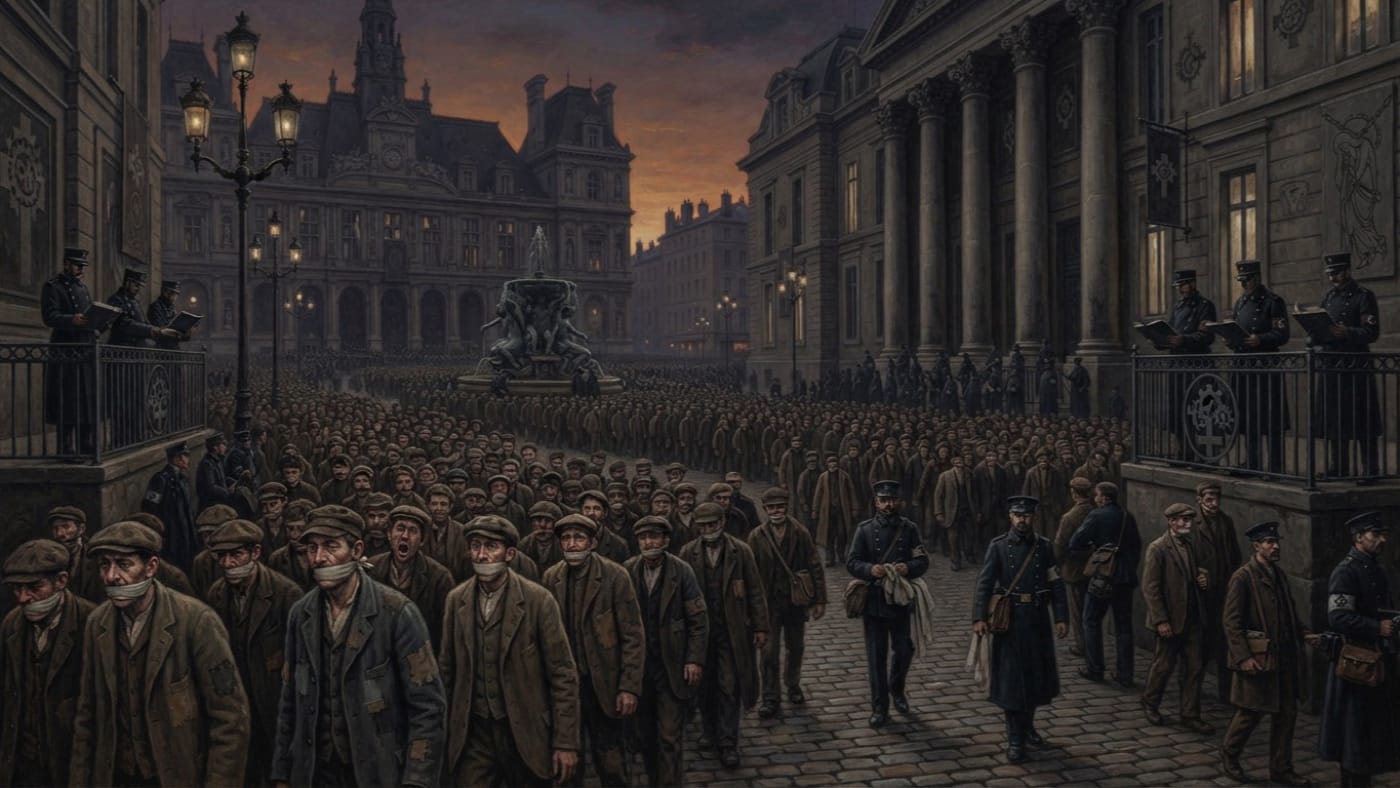
The Place des Terreaux is the last place named on a route the Bureau of Festivals has written for the throats of Lyon. Once a year the schedule of the Procession of Tongues brings the citizens of three river wards to it. After that the schedule says nothing more. It names Terreaux the way a sentence ends on a full stop. By the time the column reaches it, the Bureau has already said everything it meant to say: aloud, in unison, for at least four hours, through people whose voices were whole at the cathedral door and are whole no longer.
Most cities reserve their great squares for coronations, victories and the reading of edicts. Lyon reserves this one, on one Sunday a year, for the condition its citizens are in when they get there. Some are still chanting through cracked throats. Others walk with oiled linen tied across their mouths. Every one of them has arrived where they were told to arrive. That is the square's office in the Procession, and the Bureau has never asked it for another.
#On the Route to the Square
"Route: Cathedral of Saint-Jean to the Place des Terreaux via the Presqu'île." — Bureau of Festivals, Annual Schedule, Lyon Variant
The route has three fixed points, and the Bureau has never published a fourth. The Procession forms at the Cathedral of Saint-Jean, crosses the Presqu'île and ends at Terreaux, passing through the river wards of the city on the way. Citizens assemble by parish before the first article of the Creed is spoken. A parish marches as a parish. Each man walks beside the neighbours who will remember, for the rest of the year, exactly how he sounded in the fourth hour.
The obligation is precise, and I admire it as I admire any well-drafted levy. Every citizen aged fourteen to sixty within the Third, Fourth and Fifth Wards must walk. The schedule summons those wards and those ages and no others. The march lasts four hours at minimum. The Bureau sets the floor and leaves the ceiling to zeal.
What the route describes, read from end to end, is a movement outward. The Creed of the Church starts in the cathedral, where it is kept, and is carried on foot into the open city. At Terreaux it is delivered to the public, worn thin. The cathedral gives the words their authority. The Presqu'île gives them their distance. The square receives what is left of them.
#On the Voices That Arrive
The Creed is recited aloud and in unison. It is recited again, and then again. Any choirmaster could tell the Bureau what four hours of this does to a human voice, and the Bureau needs no telling, because the result is the point of the exercise. Voices crack. Throats bleed. Somewhere along the Presqu'île the Articles stop being sentences and become pure cadence, a sound a congregation makes with its lungs after its mind has stopped taking part.
The Bureau has an instrument for the moment a voice gives out. A Festivals clerk ties a strip of linen soaked in blessed oil across the faltering mouth and enters two words in his ledger: vox defecit, "the voice failed." The citizen keeps walking. Nobody steps out of the column to be gagged, and nobody steps out afterwards to recover. The gagged complete the rest of the route in silence, beside those still chanting, under the same obligation and with the same distance still to cover.
So this is what reaches Terreaux: a column that the march has never separated. Every hoarse mouth walks with a bound one beside it as instruction, and every bound mouth walks with a hoarse one beside it as reproach. The oil shines at the corners of the linen. The ink has long since dried in the ledgers somewhere behind them. The chanting that arrives in the square is thinner than the chanting that left Saint-Jean, because some of the voices that began it now travel as entries in a book.
#On Festival Authority and Mercy
There are two seals on this Sunday, and they do different work. The Bureau of Festivals holds the licence. It fixes the day, the route, the duration, the wards and the procedure for any mouth that gives out. The Bureau of Mercy holds the only way out. An exemption requires Mercy's counter-seal, and without it a citizen of the three wards walks.
The timing rule is the finest clause in the schedule. A medical exemption filed after the Procession is classified as retroactive cowardice and processed accordingly. The schedule does not explain what "accordingly" means, and it does not need to. The classification has done its work by the time anyone thinks to ask. A citizen whose throat began bleeding in the second hour had a remedy. The remedy was to have foreseen it in time to get a counter-seal.
Festivals' authority at Terreaux is ceremonial and annual. For one feast day the square is the endpoint of a licensed rite. The schedule claims nothing more: no title to the stones, and no say in what the square does on the other Sundays of the year. Festivals does not govern the square. It governs the arrival.
The feast belongs to Saint Sabina. Mercy claims her as its founder because she tended the wounded at Saint-Malo. On her day, Mercy's seal is the only exit from the route, and Festivals' linen is the only answer to a failed voice.
#On the Two Processions
The full rite belongs to Prague, to the Bureau of Purity and to the Order of Saint Ephrath. Its marchers are condemned heretics, their tongues nailed to doctrine tablets of oak. Lyon's marchers are citizens in good standing. Their instrument is repetition, and their only hardware is a strip of linen. Prague punishes the heretical tongue. Lyon disciplines the faithful one.
In my entry on the Procession I wrote that both routes end in silence. It is a fine sentence, and I stand by its theology. At Terreaux its arithmetic is looser. The square receives the bound and the hoarse together, and the hoarse are still chanting when they arrive, because nobody has given them leave to stop. My own reading, for which I alone answer, is that Lyon demonstrates obedience through exhaustion. Prague's condemned have their speech taken from them. Lyon's citizens are made to spend theirs, article by article, until what reaches the square is a voice that has given everything it was asked for and kept nothing back for argument.
The entry on the Procession of Tongues states that the Bureau of Purity adopted the rite in A.S. 94, "two years after the Bureaus were constituted." Corrected: the Church's offices grew in stages. There was an interim council from about A.S. 50, the Records transformation of A.S. 78 and Purity's development of A.S. 80, then the formal Synod under the Concordat of Strasbourg in A.S. 90 and the later settlements of A.S. 92–93. No single constitution brought every office into being two years before Prague's adoption. The A.S. 94 adoption in Prague stands. It dates nothing in Lyon.
#On the Present Condition
At the date of this survey, A.S. 201, the schedule is in force as printed. On the third Sunday of Septimus, at the Feast of Saint Sabina, the parishes of the Third, Fourth and Fifth Wards assemble at Saint-Jean and walk the Creed across the Presqu'île to the Place des Terreaux, for four hours or more, in unison for as long as unison lasts. The clerks carry linen, oil and ledgers. Mercy keeps its counter-seal for anyone who applied in time.
The square's name is the schedule's last word. It records the route, the duration, the wards, the exemptions and the procedure for failed voices. It has no line for what is done with a bound mouth once the mouth has arrived. Festivals has not thought that worth writing down. In my experience, a thing left unwritten is a thing nobody expects to be asked about.